
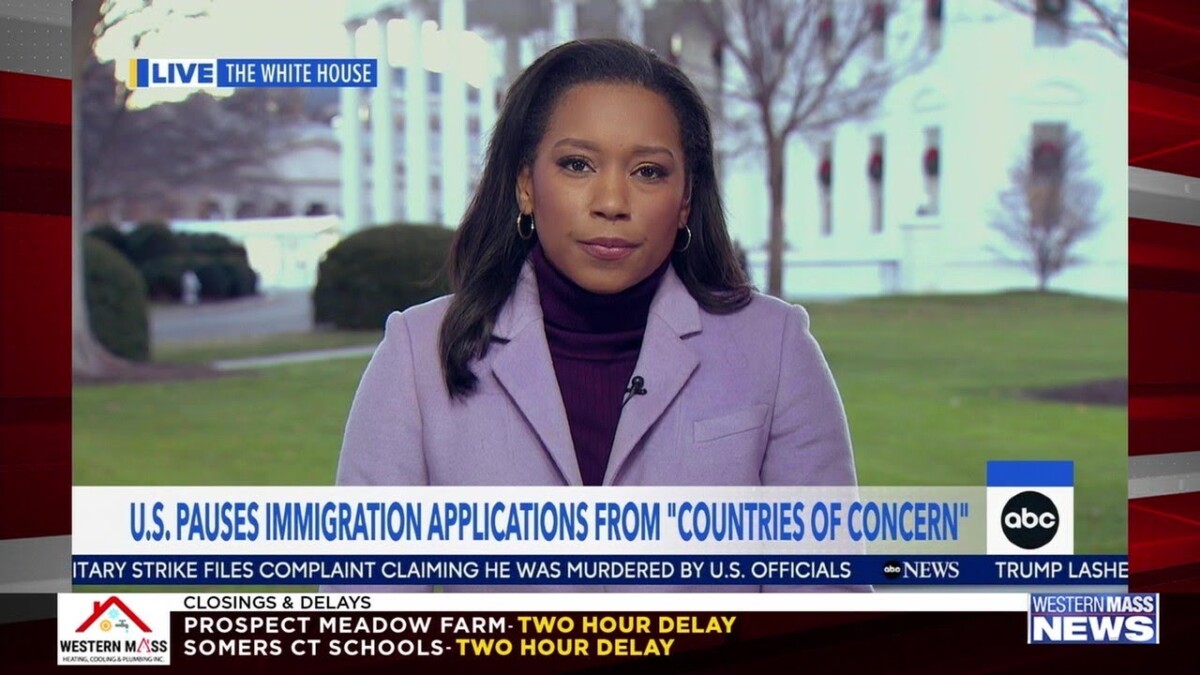
ABC Reporter Posts the President’s Own Words
Alumni Seek Funds for Magazines Defunded Over DEI
Community Grapevines Trumping Journalism?:
Sometimes People Don’t Want an Article, Just Clarity
. . . Local News Deserts at a Record, but There Is Optimism
. . . Teens Disparage Journos, but Are They Media Literate?
. . . $5 Million Targets Lack of Funding in Black, Brown Media
Burns Told Blacks’ 1776 Story in Unusual Detail
Michelle Obama Schools Whites About Black Hair
Reporters Reveal Immigration Crackdown Excesses
Shuffling Hosts at ‘Today’ and ‘CBS Saturday Mornng’
Trump to ABC’s Rachel Scott: “You are the most obnoxious reporter in the whole place. Let me just tell you — you are an obnoxious– a terrible reporter. And it’s always the same thing with you. I told you.” pic.twitter.com/3GcH2FaKB3
— Aaron Rupar (@atrupar) December 8, 2025
If no image appears, please consider changing browsers.
ABC Reporter Posts the President’s Own Words
“President Donald Trump called ABC News Senior Political Correspondent Rachel Scott ‘the most obnoxious reporter’ for asking a question about his previous assertion that he had ‘no problem’ releasing footage of the Sept. 2 strike off the coast of Venezuela — which killed the two survivors of an alleged drug trafficking boat — and the prominent reporter has parried with video evidence of POTUS’ course reversal,” Natalie Oganesyan reported Monday for Deadline.
Trump was continuing his pattern of berating female journalists, most notably Black female reporters. The roster includes Scott, who interviewed Trump at the 2024 convention of the National Association of Black Journalists, Yamiche Alcindor of NBC and April Ryan, now of BlackPressUSA.
“In the clip shared by Scott on her Instagram, the GOP leader denied saying he would be in favor of releasing footage of the second strike, which has launched significant bipartisan scrutiny and contentions that it constitutes a war crime,” Oganesyan continued. “ ‘I didn’t say that; you said that,’ Trump shot back, calling ABC ‘fake news.’ ”
“This is the latest in a long line of hostile encounters between Trump and a female journalist. Just days ago, the convicted felon called CNN Chief White House Correspondent Kaitlan Collins ‘stupid and nasty’ when she asked similar questions about the administration’s air strikes in the Caribbean.
View this post on Instagram
If no image appears, please consider changing browsers.
“Dissecting the exchange afterward, MS Now’s Nicole Wallace questioned if the president forgot or misspoke when addressing Scott’s inquiry.
“ ‘The second thing I wanted to hit pause on … is never normalize the verbal violence, the verbal assault on another female journalist,’ she said, before enumerating the laundry list of attacks Trump has lobbed at female reporters in recent weeks, including: calling CBS News’ Nancy Cordes a ‘stupid person,’ deeming the New York Times‘ Katie Rogers ‘“third rate’ and ‘ugly,’ berating ABC News’ Mary Bruce as ‘horrible’ and ‘insubordinate’ and, of course, telling Bloomberg News’ Catherine Lucey ‘quiet piggy,’ the last of which was defended by White House Press Secretary Karoline Leavitt as ”‘very frank and honest’ commentary, rather than playground-level taunting.
“ ‘This is sick shit. This is sick,’ Wallace lamented. ‘We’re either gonna normalize this, and then you’re gonna hear all sorts of prominent people calling women all sorts of name — I’m sure by the time I get off TV, I’ll have a few of those myself — but we’re either gonna normalize this, and usher in an era of unprecedented misogyny or that press corps is gonna act as one and say, ‘No more.’ ”
- Free Press: Chokehold: Donald Trump’s War on Free Speech & the Need for Systemic Resistance (report)
- Timothy Richardson and Viktorya Vilk, PEN America: ‘Quiet, Piggy’ ‘Terrible Reporter’: President Trump Escalates Assault on Journalists (Nov. 21)
WIAT-TV in Birmingham, Ala., known as CBS 42, reports on the defunding of the University of Alabama campus magazines. (Credit: YouTube)
Alumni Seek Funds for Magazines Defunded Over DEI
University of Alabama alumni have launched a fundraising campaign for two print magazines — Alice, a magazine aimed at women, and Nineteen Fifty-Six, a magazine focused on Black lifestyle and culture. The university shut them down to comply with the Trump administration’s anti-diversity posture, Williesha Morris reported Monday for AL.com.
Masthead, a nonprofit dedicated to “diverse, anti-racist and equitable student media at the University of Alabama,” opened a $25,000 fundraising campaign.
It said the university’s decision silences viewpoints “disfavored by the government because they dared to write about those topics at all,” Morris wrote.
The fundraiser will go toward printing costs, equipment and student salaries. Masthead president Victor Luckerson told AL.com it costs about $7,500 to print 1,000 copies.
In their Dec. 1 announcement to the staffs, university officials cited a memo from U.S. Attorney General Pam Bondi this summer claiming that DEI initiatives can be considered discriminatory and may be in violation of federal anti-discrimination laws,Heather Gann wrote for al.com.
But Mike Hiestand, the Student Press Law Center’s senior legal counsel, said the suspensions appear to be unlawful viewpoint discrimination.
“The DOJ memo the university cites was aimed at race-exclusive programs that deny access to benefits. These magazines do not exclude anyone; they amplify the voices of communities that have historically been marginalized. That is protected expression, not unlawful discrimination.
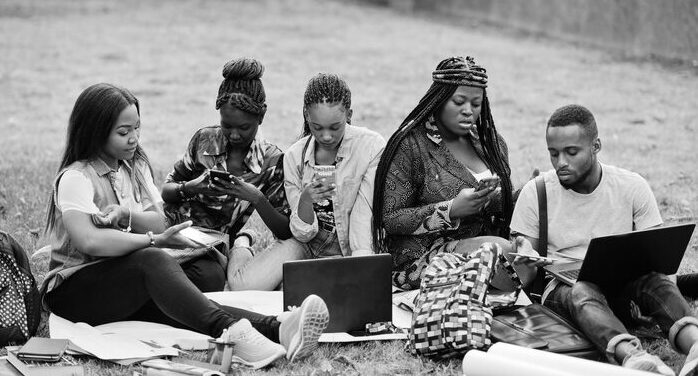
“Somewhere in 2026, an editor or funder will ask a question I now hear everywhere: ‘Why are the tiny, overworked immigrant outlets pulling off what we’ve been trying to do for a decade?’ wrote Garry Pierre-Pierre. “The answer isn’t mysterious. These outlets had no choice. They operate inside communities, not at the edge of them. And when life gets confusing — and life is very confusing right now — people don’t look for content. They look for a guide.” (Credit: AS Photo Family)
Community Grapevines Trumping Journalism?
Sometimes People Don’t Want an Article, Just Clarity
“In 2026, the people shaping the future of news won’t be in newsrooms. They won’t have titles, Slack channels, or even the faintest interest in CMS redesigns. Many won’t call what they do ‘journalism.’ But they’ll be doing the work anyway — often more effectively than the institutions built for it.”
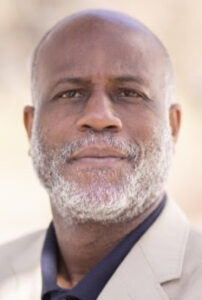 That’s what Garry Pierre-Pierre (pictured), founder of the Brooklyn, N.Y.-based Haitian Times, wrote for Nieman Lab when asked to contibute to its annual issue on predictions for the next year.
“I spend a lot of time in Haitian and immigrant communities across the United States. In Brooklyn, Miami, Chicago, and the Midwest. I keep seeing the same thing: the people keeping their communities informed aren’t reporters. They’re the pastor who delivers immigration updates before the sermon. The barber who streams local politics on Facebook Live. The neighbor who translates every school notice and distributes it through five different group chats. The teacher who explains American bureaucracy to families who arrived last week. The WhatsApp moderator running a rumor-control operation that outperforms the mayor’s office.
“None of these people will keynote a journalism conference. But if journalism is about helping people understand their world, they are quietly doing the job. And that’s my prediction for 2026: the news industry will finally realize that these informal community information networks are not peripheral to local news — they are the most functional version of it,” Pierre-Pierre continued.
“For years, local newsrooms have debated how to ‘engage audiences.’ Meanwhile, immigrant communities have treated information as a survival system. I’ve watched families gather after long shifts to collectively decipher government letters. I’ve seen multilingual WhatsApp threads get crucial facts out hours before official channels. I’ve watched regular people become translators, navigators, and explainers — not out of civic theory, but because someone needed help and they could offer it. In 2026, more news organizations will understand that people don’t always want an article. Sometimes they just want clarity. . . .
“So if you want a glimpse of the future of news, don’t look at dashboards or innovation labs. Look at the barbershop, the church hall, the group chat, the neighbor who becomes a newsroom by necessity. That’s where the future is already taking shape. In 2026, the rest of the industry will finally notice.”
. . . . Local News Deserts at a Record, but There Is Optimism
“The number of local news deserts in the U.S. jumped to record levels this year as newspaper closures continued unabated, and funding cuts to public radio could worsen the problem in coming months,” according to the Medill State of Local News Report 2025, from the Medill School of Journalism, Media, Integrated Marketing Communications.
“While the local news crisis deepened overall, Medill researchers found cause for optimism — more than 300 local news startups have launched over the past five years, 80% of which were digital-only outlets. . . .”
. . . Teens Disparage Journos, but Are They Media Literate?
“An overwhelming majority of teens (84%) express a negative sentiment when asked what word best describes news media these days,” the News Literacy Project reported in November.
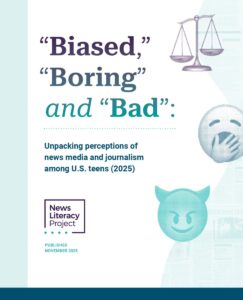 “Words or phrases teens use most frequently are those synonymous with being inaccurate and deceptive, such as ‘Fake,’ ‘False’ and ‘Lies,’ or invoking chaos and overwhelm, such as ‘Crazy,’ ‘Chaotic’ and ‘Wild.’ “
In addition, “More teens believe journalists are skilled at lying and deceiving than informing the public. When asked to think of one thing they think journalists are doing well, roughly 1 in 3 teens (37%) offer negative feedback, saying things such as lying and deceiving (81 responses) or that journalists don’t do anything well (66 responses).”
“When asked to think of one thing they think journalists could improve on, teens most frequently mention being honest and getting the facts right (283 responses) and minimizing bias and improving balance (138 responses).”
The report’s recommendations:
“Encourage young people to distinguish between standards-based journalism and other types of information. Teach students verification skills and how standards-based newsrooms operate. Foster accurate perceptions of journalism by helping teens question unrealistic portrayals or sweeping statements about ‘the media’ and by acknowledging examples of high-quality journalism.”
Alyson Klein added for Education Week:
“Part of the problem may be that teens — and the public in general — don’t really understand the difference between a standards-based news organization and an influencer or opinion writer. It doesn’t help that both types of content often come at teens, and the public in general, through social media, said Peter Adams, the News Literacy Project’s senior vice-president of research and design.
“ ‘If teens think that ‘everything they see online about current events and social issues and politics is quote ‘news’ from quote ‘media,’ then they’re going to blame standards-based news organizations for some of the shortcomings and deceptive tactics that users online engage in, that bad actors engage in, that hyperpartisan outlets engage in,’ Adams said.”
A solution from Hailey Hans, 18, a senior at Weir High School in Weirton, W.Va., where she takes a journalism class and works on her school newspaper: “We need media literacy, and we need news in classrooms,’ she said. ‘We need to be told how to look at a story and tell what’s biased, what’s fake.’
“In fact, teens who report higher trust in news media are more likely to report having had classes with some media literacy instruction, compared to their peers who did not have any media literacy lessons, according to previous research by the News Literacy Project. . . .
“Teachers should ‘highlight Pulitzer Prize winning investigative series, saying, ‘Look, these reporters went and discovered that this factory was polluting this community, and exposed it. Federal regulators were failing to catch this. The press caught it and impacted real people’s lives,’ ” Adams said.
“Another powerful way to help teens understand the news media: Have them report their own stories, using the same ethical standards as professionals, such as objectivity and fact-checking.
“That can be helpful even for students who aren’t interested in becoming professional journalists, such as Greyson Scott, 16, a sophomore at Weir High School.
“Greyson, who is considering a career in accounting, didn’t know much about how news gathering worked before he took a journalism class. He thought some media outlets were pushing an agenda.
“ ‘Before I started doing journalism this year, I did believe there was heavy bias’ in news outlets such as CNN, Fox News, and MSNBC, Greyson said. But now that he’s experienced a journalism class and taken a closer look at the news reporters versus the commentators on those networks, he thinks the bias among the actual news reporters is ‘slight,’ he said. . . . ”
- Congressional Black Caucus Foundation: Black on the Timeline: Social Media, Misinformation and the Mental Health of Black Emerging Adults
Sara Lomax-Reese and S. Mitra Kalita, founders of URL Media, discuss the organization’s founding in this 2021 interview in the wake of the murder of George Floyd and the Black pain subsequenty brought to the surface. (Credit: YouTube)
. . . $5 Million Targets Lack of Funding in Black, Brown Media
URL Media, a four-year-old nonprofit “created to address the chronic, systemic disinvestment in Black and Brown community media,” is receiving $5 million from the John S. and James L. Knight Foundation, the organizations announced last week.
URL Media says it “leverages multiple revenue streams to keep investment flowing to local outlets at a time when these organizations, and the information their communities depend upon, are at risk.”
Its aims:
- “A centralized ad-ops and data insights platform launching in 2026 that could become a key vehicle for public service announcements, government communications & civic engagement campaigns to communities often underrepresented in mainstream media.•
- “Low-interest loans ($30K–$100K) through an expanded Media Resilience Fund. “Operational support, including a managed internship pipeline, video resources, and editorial amplification.
- “Revenue access via advertiser introductions, partnership opportunities, and recruitment/talent development pathways.”
URL media was founded by Sara Lomax, president; owner/CEO of WURD Radio in Philadelphia, and S. Mitra Kalita ,CEO, who is also CEO and publisher of Epicenter NYC, former senior vice president at CNN Digital, and veteran of the Wall Street Journal, Washington Post and Los Angeles Times.
“Forty percent of white Virginians owned enslaved people, and farmers like George Washington lived in fear of a revolt. These fears come to reality when Virginia’s royal governor, Lord Dunmore, issues a proclamation offering freedom to any enslaved individual who joins his fight against their Patriot masters. Some 800 men would join Dunmore, including some of George Washington’s own slaves,” according to Ken Burns’ “The American Revolution” documentary. (Credit: YouTube)
Burns Told Blacks’ 1776 Story in Unusual Detail
When the British lost the Revolutionary War, Ken Burns’ “The American Revolution” told us in its final episode, “The Negroes had looked condemned, one militiaman remembered, for the British had promised them their freedom. Five enslaved people captured at Yorktown were returned to Thomas Jefferson. Two more, both women, were returned to George Washington’s Mount Vernon. . . .
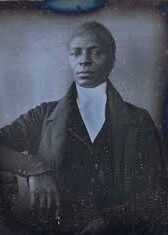 The docuseries told us that “after seven months . . . James Forten (pictured) was released. Emaciated, but lucky to be alive. He walked all the way home to Philadelphia from New York, most of the way barefoot.
“He astonished his mother on arrival. She had long since given him up for dead. After the war, Forten would make a great fortune making sails for the American merchant fleet, and used part of those earnings to fund the abolitionist movement.
“When, decades later, a friend urged him to apply for one of the pensions being granted to war veterans, Forten refused. ‘I was a volunteer, sir, he said. He didn’t want money. He wanted citizenship.’ ”
The six-part, 12-hour PBS series, in production for eight years, ended its initial run at the end of November, but continues in reruns and on streaming platforms. Part of its significance, as David Smith wrote for the Guardian, is that “The American Revolution analyses the central role of Native Americans and African Americans in a way that a documentary on this subject made in the 20th century probably would not have done.”
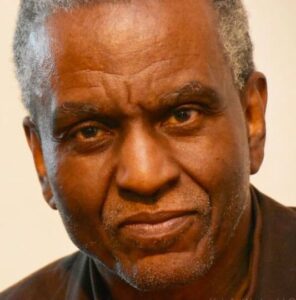 It is all the more extraordinary because when Black historian Gerald R. Horne (pictured) suggested in 2014 that the protection of slavery was central to the colonists’ fight for independence, he was ignored or dismissed.
Nevertheless, the late historian Bernard Bailyn explains in Burns’ film that the revolution’s rhetoric forced the issue of slavery into the open.
Progress, for sure, but that does not mean that Horne is satisfied with Burns’ project.
“The PBS series glancingly touches on slavery as motive force of 1776 but does not go far enough,” Horne messaged Journal-isms. “How was it that there were thousands of enslaved in the late 18th century and millions by 1860?
“The series fails as history too. A major reason to study the past is to provide present day insight. If 1776 were so grand, why are we disproportionately imprisoned and executed? To tie the present to the past, African Americans are the group most prone to oppose Trump (who the Mayor-elect of NYC deems a fascist) and Trumpism and our ancestors were more likely than most to oppose Enslaver #1: George Washington.”
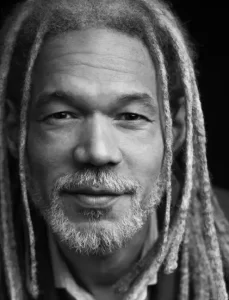 Vincent Brown (pictured), a Harvard professor of history and African and African-American Studies, was one of the Black academics appearing in Burns’ series. “I don’t yet have a good read on how Black people outside my immediate network are responding to the documentary,” Brown messaged on Nov. 26. “As far as I can tell so far, people appreciate the attention to Black people’s freedom struggles during the era and to the importance of slavery in the colonial and revolutionary era.”
- LZ Granderson, Los Angeles Times: Men like Trump represent what the founders were fighting against (Nov. 22)
- Jeremy Helligar, People: The Surprising Pro-Slavery Reason Why George Washington Rejected Black Soldiers During the Revolutionary War (Nov. 16)
- Andrew Lawler, the Atlantic: The Black Loyalists (Oct. 8)
- Kevin M. Levin, Substack: Ken Burns, Contingency, and the Question of Whether a New Consensus View of the American Revolution is Possible (Nov. 17)
- Candace Maracle CBC News: New Ken Burns series features Indigenous nations’ role in American Revolution (Nov. 21)·
- Dan McLaughlin, National Review: No, Ken Burns, the United States Is Not an Iroquois Nation (Nov. 22)
- Lex Pryor, The Ringer: The Stories We Tell Ourselves About the American Revolution (Nov. 20)
- ThinkAfrica.net: 10 nations that didn’t take part in the slave trade (March 6, 2021)
Michelle Obama Schools Whites About Black Hair
View this post on Instagram
On Nov. 25, Pennsylvania Gov. Josh Shapiro signed a law solidifying protections against hair discrimination in the state, making the Keystone State the 28th to pass a version of the CROWN Act. The CROWN Act stands for “Creating a Respectful and Open World for Natural Hair.”
If no image appears, please consider changing browsers.

A federal agent points his gun sideways during an immigration enforcement action in Chicago’s Little Village neighborhood last month. Longtime urban police leaders questioned that tactic and many others used by immigration agents during Operation Midway Blitz. (Credit: Armando L. Sanchez/Chicago Tribune)
Reporters Reveal Immigration Crackdown Excesses
“Operation Midway Blitz flooded Chicago with federal immigration agents, fueled frequent protests and — to policing experts — offered something else.
“The operation showed how not to police,” Joe Mahr and Gregory Royal Pratt reported Sunday for the Chicago Tribune.
Their report was one of the continuing efforts by news organizations to monitor the Trump administration’s immigration crackdown and its excesses.
“In incident after incident, experts said,” Marh and Pratt continued, “immigration and Border Patrol agents routinely took actions that not only infuriated civil libertarians and everyday residents but broke urban policing protocols meant to limit danger for suspects, protesters, passersby and even officers themselves.
“A Tribune review of the feds’ policing tactics follows a scathing, 233-page opinion by U.S. District Judge Sara Ellis that called out many of the federal agents’ tactics from a constitutional perspective. And the subsequent release of footage from agents’ body cameras late last month not only contradicted claims they made in use-of-force reports but chronicled some of the chaos on the streets. . . .”
Meanwhile, Jim Mustian and Jack Brook of the Associated Press reported Sunday that “State and federal authorities are closely tracking online criticism and protests against the immigration crackdown in New Orleans, monitoring message boards around the clock for threats to agents while compiling regular updates on public ‘sentiment’ surrounding the arrests, according to law enforcement records” reviewed by the AP.
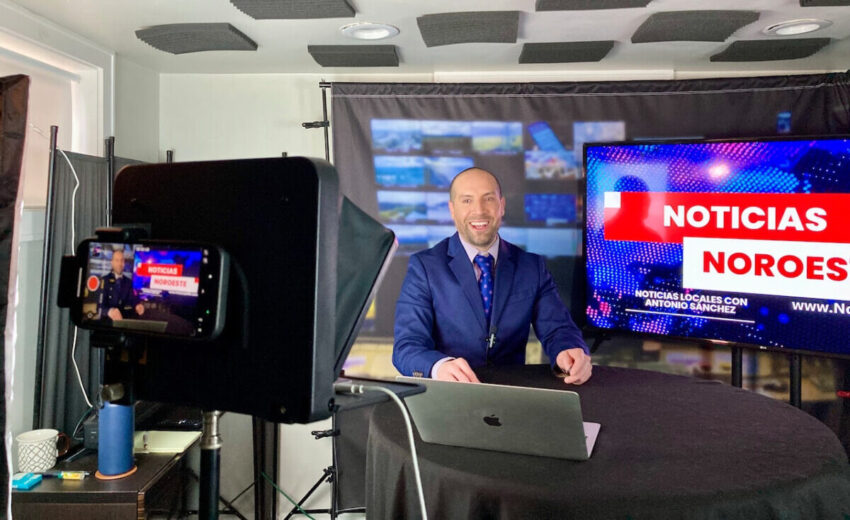
“It’s almost like I’m a journalist and a psychologist slash sociologist,” Antonio Sanchez said. “I’m their navigator because they see me as an authority figure and someone who can help them,” Sanchez said of his viewers. “It feels like they’re my family even though I have no connection to them.” (Credit: Gosia Wozniacka/The Oregonian)
Separately, Gosia Wozniacka reported for The Oregonian/OregonLive last week about former Univision news anchor Antonio Sanchez, who for the past nine months has operated as a one-man newsroom from his basement, researching, producing and editing a daily digital news program called Noticias Noroeste.
“He aims to fill a news hole left by the closure of Oregon’s last trusted Spanish-language media source. KUNP-TV (Univision Portland), ceased its Spanish programming and Univision affiliation in late 2024/early 2025 when Sinclair Broadcast Group switched it to English-language sports for the Portland Trail Blazers,” Wozniacka wrote.
“When the station closed, the city became a news desert for Spanish speakers – just as Trump was taking office, a reality Sanchez weighed seriously while planning his job search.
“ ‘Based on what I knew about Trump during his first term, I knew it was going to be chaotic, especially for my community,’ Sanchez said. ‘It was a moral situation. I realized the community was going to be misinformed. And I was like, I can’t just leave Portland, people depend on me.’ ”
To help journalists stay safe, the National Association of Hispanic Journalists and the Media Resource Center are sponsoring a one-hour webinar, “Deportations and Retaliations: What You Need to Know Now to Protect Your Rights” on Dec. 15, for NAHJ members.
- Jose Abonce, Alma Campos, Jim Daley, Andrew Fan, Francia García Hernández, Sebastían Hidalgo, Maheen Khan, Maira Khwaja, Efraín Soriano, Jonathan Torres, Wendy Wei, Race and Equity Project: Feds used chemical agents dozens of times in Chicago (Nov. 19)
- Fernanda Figueroa, Associated Press: New survey finds rising pessimism among US Hispanics (Nov. 24)
- Ruben Navarrette, Creators Syndicate: Why Trump Lost Latinos — It’s More Than Immigration (Nov. 20)
- Zane Sparling, The Oregonian/OregonLive: The whirlwind romance of Jenny and Billy Carter ended in tragedy. Then it became Trump’s propaganda
- Alice Speri, the Guardian: Detained in US for speech, a UK commentator speaks out: ‘They don’t want people like us to go to America’ (Nov. 14)
- Payton Armstrong, Media Matters for America: ICE keeps giving exclusive access to right-wing and right-leaning influencers (Nov. 17)
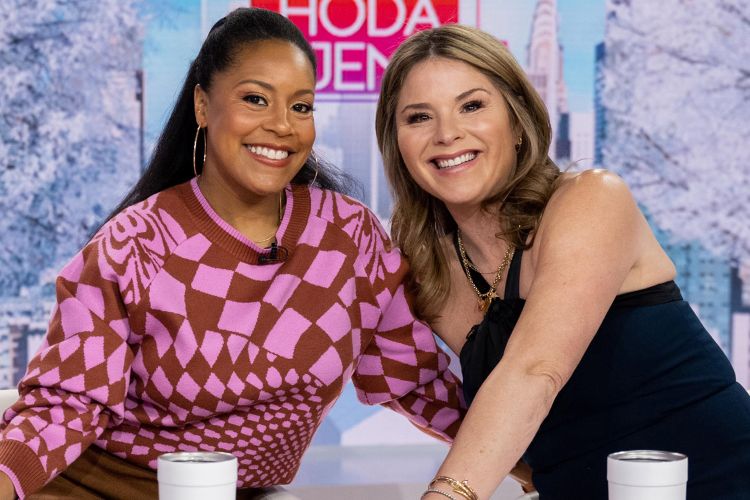
Sheinelle Jones, left, and Jenna Bush Hager.
Shuffling Hosts at ‘Today’ and ‘CBS Saturday Morning’
“Sheinelle Jones has a new gig at Today!” Colleen Kratofil and Rachel McRady reported Tuesday for People.
“Nearly a year after Hoda Kotb left the morning news program, it was announced on Tuesday, Dec. 9, that Jones will become Kotb’s replacement to join Jenna Bush Hager as the permanent co-host of the 10 o’clock hour. . . . “
(Credit: CBS News/YouTube)
CBS Saturday Morning co-hosts Dana Jacobson and Michelle Miller bid a tearful goodbye Nov. 22 on their final broadcast of the weekend news program, Natalie Oganesyan reported the next day for Deadline.
” ‘After seven long years of welcoming you to the weekend, our time here is coming to a close,’ Miller began, as she reached out to clasp Jacobson’s hand.’“CBS Saturday Morning will still be here with the latest news and all the stories you expect from CBS News. We wish our colleagues the best.’
“Jacobson added, ‘While it wasn’t our choice to leave, we did have one in how we get to say goodbye, including a chance to say thank you to the amazing producers, photographers, audio engineers, editors, makeup and hair stylists, assistants and floor crew and wardrobe — everybody who is a part of each and every story we told. Without them, there is no us.’ ”
Michelle Stein wrote the next week for TV Insder, “On November 29, Lindsey Reiser and Vladimir Duthiers took over as hosts for CBS Saturday Morning following Miller and Jacobson bidding emotional farewells to the program on November 22 amid a major network shake-up. Miller, Jacobson, and executive producer Brian Applegate were cut from the show as part of October layoffs at CBS.”
