
and an excerpt, courtesy Rev. Dr. D. Amina B. Butts, UCC media justice fellow.
From Facebook posting, Sept. 10, 2026:
 Sara Fitzgerald, Washington Post alum and member of the UCC Media Justice Board of Directors, introduces Richard Prince (Credit: UCC Media Justice)
Text of the acceptance speech:
‘You Gotta Believe!’
By Richard Prince
Thank you. I served two tours at the Washington Post. When I left the paper the first time, in 1977, editor Ben Bradlee said his subordinates told him I was “a goof-off and a pain in the ass.”
That’s one thing that makes this honor so sweet. After this award was announced, colleagues posted comments on social media like, “You are indefatigable,” and calling me “the hardest working person in the news media business.” Not exactly seconding Bradlee’s evaluation.
As for being “a pain in the ass,” another Post alum said, “Isn’t that what everyone in the newsroom is supposed to be?”
 Nevertheless, it was two years before I could land another newsroom job, and that was at Gannett, under top dog Al Neuharth (pictured at left, with fellow Gannett exec John Quinn).
Our friend David Honig described it this way: “Al, Doug McCorkindale and I put together Gannett’s 1979 ‘Partners in Progress’ program – the first modern voluntary affirmative action program in journalism. It was highly effective because Al, with his can-do spirit and low tolerance for excuses, commanded his publishers and TV station general managers to observe it and exceed its goals and targets. Their compensation and bonuses depended on it.”
Sadly, those days seem to be gone. But Gannett gave me the chance to learn various skills, by being an assistant metro editor, copy editor, editorial writer, op-ed editor and columnist. Today, that range of experience enables me to produce the “Journal-isms” column, which requires more than just writing and reporting.
It was all possible because of people who believed in me and people like me, and because I believed in myself. Some of my Post editors, such as Kevin Klose, Michael Hill, Barry Sussman and Bill Elsen, would become Journal-isms supporters. In fact, I returned to the Post in 1999 because Elsen let me know that I could apply to work on the foreign news desk as a part-time copy editor. And I did that successfully, for nine years.
Bill (pictured) also became the first copy editor for Journal-isms, before we had any money to pay him. I owe him.
With Bill and others in mind, the UCC’s announcement of this award prompted me to call for examples of the importance of believing in oneself and having others believe in you. That’s particularly important in this time of change in our industry and attempts to make racism respectable again.
 Some examples predated my request. Our pro bono lawyer in the Metro Seven case, in which seven Black Metro desk reporters took the Post before the Equal Employment Opportunity Commission in 1972, was Cliff Alexander (pictured). He had chaired the commission under Lyndon Johnson. When Cliff died at age 88 in 2022, we honored him at our Journal-isms Roundtable, our monthly gathering where we discuss issues of the day as they relate to diversity and journalism.
I wrote this afterward:
 “Longtime D.C. anchor Maureen Bunyan, who led the remembrance, said Alexander ‘worked to help change, especially [in] television . . . the attitude of the owners and the managers of TV, radio and newspaper operations. He went into their offices to talk to them; he didn’t write notes. He didn’t threaten, he just told them what the truth was . . . he said the truth was we belong in these places — and without us, and without Cliff’s work, a lot of us wouldn’t have jobs today, much less have any influence over the life and politics of the United States.’ Bunyan included herself among those Alexander helped.
“Alexander and high-powered lawyer Robert Barnett ‘walked into the offices of the management at Channel 9, and said in no uncertain terms, you will not treat this woman the way you have said. . . . and here is how you’re going to do it. And they did it.’ “
As I said, these Trumpian times are particularly challenging for journalists of color.
 Marc Morial (pictured), president of the National Urban League, has assembled a multiracial group of diversity advocates called the Demand Diversity Roundtable. At a session of this group in January, we learned that “The nation’s Black press has experienced an 80 percent decline in revenue since the backlash against diversity, equity and inclusion (DEI) ramped up a year ago, and the percentage that Black journalists occupy in the nation’s newsrooms is roughly the same as it was 50 years ago.”
This is having an effect on individual journalists of color. Some are leaving the business. Others are going independent, aided by such vehicles as Substack, YouTube and other social media. Not all of these journalists have the resources and skills to take these efforts where they need to go. Still, some are using them to take to task an industry they say devalues them and their perspectives.
Let us support and celebrate those who are still pushing, despite the obstacles:
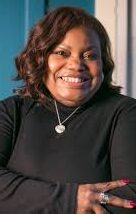 The Pivot Fund, created by Tracie Powell (pictured), has awarded millions to grassroots media organizations, furthering its mission to amplify the voices of people of color in local journalism.
The journalist of color associations supplement the efforts of the mainstream organizations in providing skills training and the comfort of knowing they are not alone.
Last month, the National Association of Black Journalists went further. It announced a partnership with the National Business League, founded in 1900 by Booker T. Washington, with the goal of building stronger Black institutions and teaching journalists to become entrepreneurs.
The Demand Diversity Roundtable says it would welcome UCC as a partner.
 The Multicultural Media, Telecom and Internet Council, known as MMTC, and founded by the aforementioned David Honig (pictured), continues to fight for equal access and representation in tech, media, and telecommunications.
In December, the National Association of Black-Owned Broadcasters said that ownership of broadcast stations among Blacks had actually declined since 1995 because of federal backtracking on diversity initiatives — some of them before Trump.
Journal-isms, too, has been affected by changing priorities. Foundations have shifted their focus to bolstering local news, an admirable goal, but one that seems to suggest not being able to walk and chew gum at the same time. Journal-isms needs help in evaluating new business models and to prepare for a successor so that I can safely leave the scene. With the demise of the national journalist organizations that track diversity numbers, reporting on that progress or the lack of it in real time assumes added importance.
 At the Post, I was privileged to have Bob Maynard (pictured) as a friend and colleague.
He might not have been called “a goof off and a pain in the ass,” but Maynard left the Post because he knew he could never become its editor.
He teamed with Neuharth, who believed in Maynard and his vision, enabling Bob to become editor and then publisher of the Oakland Tribune. Maynard also co-founded what is today the Maynard Institute for Journalism Education, now in its 49th year of training journalists of color to work and advance at places that said they “can’t find anybody qualified.”
 Jason Carson Wilson of United Church of Christ, left; Richard Prince; Post alum Jesse W. Lewis Jr. (Credit: Jason Carson Wilson)
- Sara Cederberg, United Church of Christ Media Justice Ministry: Unlearn, imagine, build anew: 44th Parker Lecture challenges tech’s dominant narrative Unlearn, imagine, build anew: 44th Parker Lecture challenges tech’s dominant narrative
—
June 26, 2026
Prince to Receive Parker Award for Media Coverage
Veteran journalist Richard Prince, author of the “Journal-isms” column and CEO of Journal-isms Inc., will be recognized with this year’s Everett C. Parker Award, the United Church of Christ’s Media Justice Ministry announced Friday.
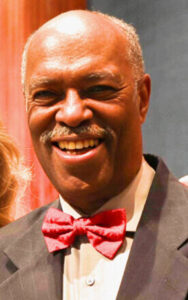 Prince (pictured) is to receive the Everett C. Parker Award,”given to an individual whose work embodies the principles and values of the public interest in telecommunications and the media. Prince is being recognized for decades of work holding the news industry accountable on questions of race and representation, from his early career as a member of The Washington Post’s Metro Seven to his founding of ‘Journal-isms,’ the column he created in 1991 that monitors and reports on diversity issues in the news media,” the ministry said.
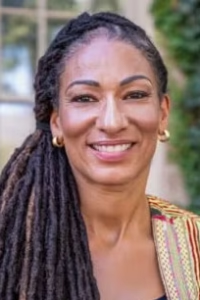 At the same event, Ruha Benjamin, Ph.D, (pictured) a leading scholar on race, technology, and justice, will deliver the 2026 Everett C. Parker Ethics in Telecommunications Lecture. Benjamin is the Alexander Stewart 1886 Professor of African American Studies at Princeton University and founding director of the Ida B. Wells JUST Data Lab. In 2024, she was named a MacArthur Fellow for illuminating how technology reflects and reproduces inequality and championing the role of imagination in social transformation.
The 44th Annual Everett C. Parker Ethics in Telecommunications Lecture and Awards Luncheon is to be held from 11 a.m. to 1 p.m. on Thursday, Sept. 10, at First Congregational United Church of Christ, 945 G Street NW, Washington, D.C. The event will also be livestreamed.
For his acceptance speech, Prince said he is seeking examples of the importance of believing in oneself and having others believe in you and your work. You may contact him at <Jroundtable5 (a) gmail.com>.
“The Metro Seven were a group of seven Black journalists who filed a landmark Equal Employment Opportunity Commission complaint against the Washington Post in 1972, challenging the newspaper’s discriminatory practices in assignments, salary, and promotions. It is believed to be the first complaint of its kind in the nation,” the ministry continued
“For more than three decades, his column has been a watchdog on the intersection of news media, race, and society. Beginning as a feature of the NABJ Journal, it grew into an independent publication read widely across the journalism industry.
“As the Multicultural Media, Telecom and Internet Council has recognized, if it is important to people of color in the media, it is in “Journal-isms.”
Prince was inducted into the National Association of Black Journalists Hall of Fame in 2019 and the Society of Professional Journalists’ Washington Pro Chapter Hall of Fame in 2025.
He has also received the NABJ President’s Award and the Ida B. Wells Award.
“Ticket information, sponsorship opportunities, livestream links, and additional details about the 44th Annual Parker Lecture can be found at https://uccmediajustice.org/Parker-lecture-2026.”
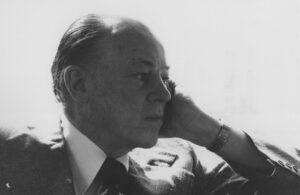 “The UCC Media Justice Ministry is the media justice arm of the United Church of Christ denomination, which includes about 4,600 congregations and more than 700,000 members. Rev. Dr. Parker (pictured) was inspired by the work of Dr. Martin Luther King Jr. to reform television coverage of the civil rights movement in the South.
“The advocacy of OC Inc., UCCMJM’s predecessor, resulted in the establishment of the right of all American citizens to participate before the FCC and the FCC being compelled to take away the broadcast license of the pro-segregationist television station WLBT-TV in Jackson, Miss., in 1969 for failing to serve the public interest.
“The Parker Lecture was created in 1982 to recognize the Rev. Dr. Parker’s pioneering work as an advocate for the public’s rights in broadcasting. The Parker Lecture is the only program of its kind in the United States that examines telecommunications in the digital age from an ethical perspective.”
- Journal-isms: ‘A Quiet Force Shaping Conversations on Race and Media’ (June 20) (scroll down)
June 10, 2025
Veteran journalist Bobbi Bowman introduces Richard Prince Tuesday at the Washington, D.C., Pro Chapter of the Society of Professional Journalists’ 2025 Dateline Awards Dinner & Hall of Fame Ceremony. She noted that as young Black reporters at the Washington Post in 1972, the two were part of the Metro Seven, who filed a groundbreaking employment discrimination complaint against the paper. Citing changes made at the Post, she said, “We won!” (Credit: Shevry Lassiter)
‘The Respect Issue Extends Not Just to Those Marginalized in Newsrooms’
Richard Prince acceptance speech (video) at SPJ – DC Hall of Fame honors, June 10, 2025.
Good evening,
There’s a song by Burt Bacharach and Carole Bayer Sager called “Overnight Success,” sung by Gladys Knight and the Pips. At one point, Gladys declares, “I worked hard for my respect!”
It always strikes a chord because that’s the way many marginalized people feel.
I’m not talking about the Rodney Dangerfield kind of respect, for those old enough to remember that Ed Sullivan-era comedian. (“I don’t get no respect!”)
I’m referring to the kind that is deeply rooted in the history of this country and others.
Supreme Court Chief Justice Roger B. Taney said in the Dred Scott decision of 1857 that Black people “had no rights which the white man was bound to respect.”
Today this attitude is manifested in the disrespect for other people’s history and viewpoints — witness the attacks on Black history, on DEI, even the removal of books from military libraries that deal with people who are not white men. Some women can tell you about how their views around the conference table are often ignored until a man says the same thing.
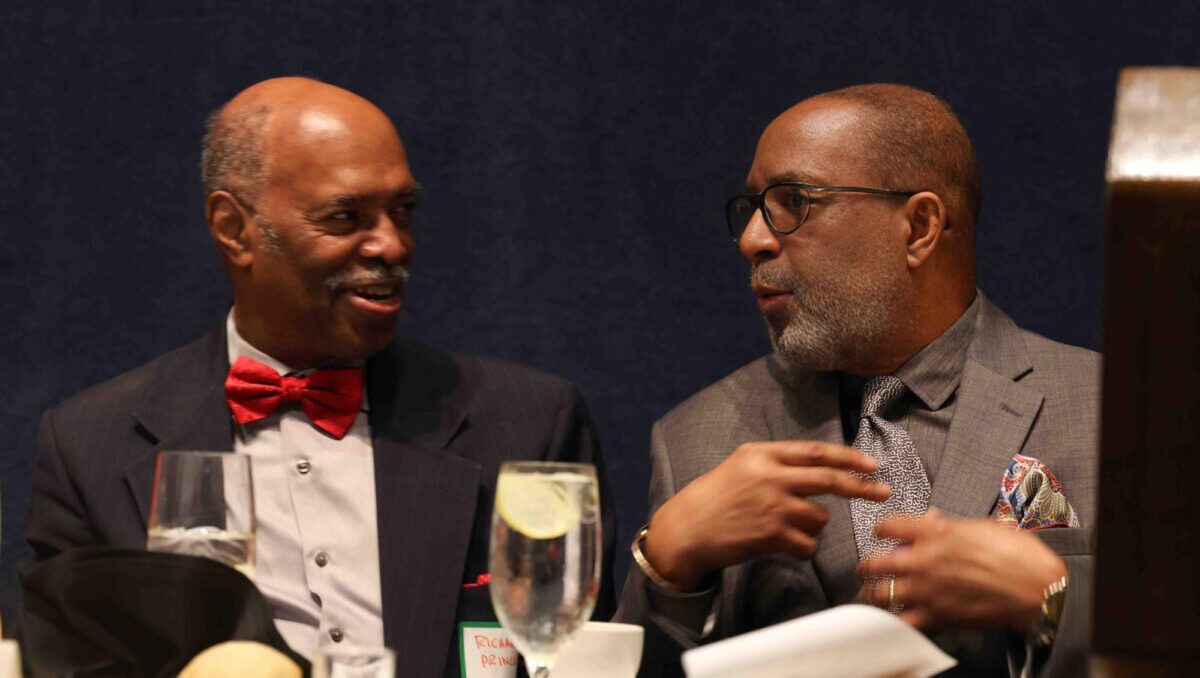 I feel this in my own work. Dori Maynard of the Maynard Institute for Journalism Education launched the online version of Journal-isms because the media columns of the day were not addressing issues of diversity nor reporting sufficiently on journalists of color. While that was in 2002, it’s still pretty much the case. I can break a story about people of color or diversity and it’s like shouting in the wilderness in many media-writing circles. (Photo: With Kojo Nnamdi, at right, master of ceremonies and host of WAMU Radio’s The Politics Hour, by Shevry Lassiter.)
I’ve spent more time than I care to, lobbying for obituaries of Black journalists to be included in the daily news report.
One distinguished reader, when I mentioned the subject of my remarks tonight, replied, “Maybe wrapped into the matter of respect is just having enough basic curiosity and human decency to actually want to know about communities other than one’s own and people different from one’s personal circle. Supposedly that is a key to being a good journalist.. . .”
This lack of respect is backed up by research. One study released in February, “Integrated Newsrooms: An Examination of Workplace Satisfaction for Black Journalists,” reported “that job satisfaction for Black journalists is linked to appreciation, competitive salaries, and newsroom innovation — not just diversity initiatives. The authors acknowledge that such factors for job satisfaction are likely to apply to journalists of all races and backgrounds, but that Black journalists may experience these things differently as well.”
And indeed, many respondents reported feeling isolated, facing exclusionary behaviors, and encountering structural limitations in career advancement. Overall, 50% of the journalists surveyed said they had experienced racism at work. As one respondent put it bluntly: “Newsrooms are still not diverse enough. … We are sitting at the table in greater numbers but are expected just to shut up and eat, so to speak.”
I don’t mean to be gloomy. While I’ve had one editor throw into the trash a souvenir I brought back from a conference in which I received an award, I had another, a female editor new to the job, bend down and tie my shoelaces. I didn’t know what to think. Another got on her knees to meet me at eye level to explain why she was rejecting the piece I’d written.
And of course the respect issue extends not just to those marginalized in newsrooms. The marginalized even do it to each other. Last year, the National Association of Hispanic Journalists and Asian American Journalists Association decided that working media writers could receive press passes for their four-or five-day conventions for only one day, then had to pay full-freight registration costs. “The reason for the policy is that virtually all convention attendees are working journalists engaging with the sessions in a professional capacity,” the P.R. person serving both organizations told me.
Don’t be surprised if I’m not there this year.
Yes, “Respect.” Aretha Franklin’s version of that song helped push the women’s movement forward. But the Staple Singers also had a hit song called “Respect Yourself.”
Applied to journalists, that means refusing to kowtow to orders that mean you compromise your journalistic principles, as happened this year with Wendy McMahon, now former president and CEO of CBS News, and Bill Owens, the now former executive producer of “60 Minutes.” It means that if you’re hosting the White House Correspondents’ Dinner, as Eugene Daniels did this year, that even when the president of the United States breaks with precedent and won’t join you, and you take flak for canceling the comedian you had scheduled, you make a ringing defense of the rights of journalists to operate free of White House retaliation over their editorial choices.
Such as the AP’s decision not to change its style to call the Gulf of Mexico “the Gulf of America.”
You are not respecting yourself as a journalist, though, when, as the journalism component of one historically Black college is doing, you travel to a country such as Cuba, where journalists and protesters are thrown in jail for expressing their views, and not say a word about it, instead joining the regime in denouncing the United States. Nor are others respecting themselves when they fail to report on this conduct.
I want to close with some words we should remember from Kathleen Carroll, former board chair of the Committee to Protect Journalists and formerly executive editor and senior vice president at the Associated Press.
When I told her I wanted to address the subject of press freedom in these remarks, she wrote back, “For the First Amendment to get the attention it deserves from average citizens, we need to do a better job of reminding people what it protects. Their rights.
“People have the impression we’re arguing for protecting our jobs/a profession. That’s not it at all, of course. It’s about their rights to say things, to gather, to pray, to ask questions, without the government using its power to punish them. It’s pretty clear cut.”
Thank you for the respect, not just for me, but for those I represent and write about.
- Journal-isms: Save the Date – June 21 for Journal-isms’ First Fund-Raiser/ Sweet Honey In The Rock (May 25)
- SPJ- Washington, D.C.: 2025 Hall of Fame and Dateline Awards dinner applauds journalism excellence in the D.C. region, celebrates distinguished honorees
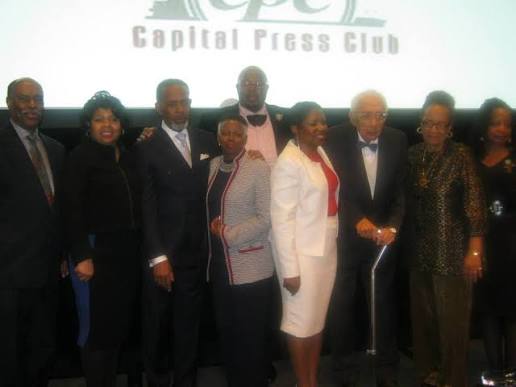
Washington’s Capital Press Club honored Richard Prince, left, in 2014 as “The Journalist’s Journalist” for “stellar leadership on coverage of diversity in the media.” From left: Prince, April Ryan, Joe Madison,Virgenia Brock (accepting for Paul Brock), Trystin Francis of the Trystin Kier Company (Capital Press Club treasurer and events planner), Hazel Trice Edney (Capital Press Club president), Simeon Booker, Barbara Reynolds, Denise Rolark Barnes. (Photo by Don Baker)
The HistoryMakers
 Story:
 Interview
- October 22, 2013
- http://www.thehistorymakers.com/biography/richard-prince
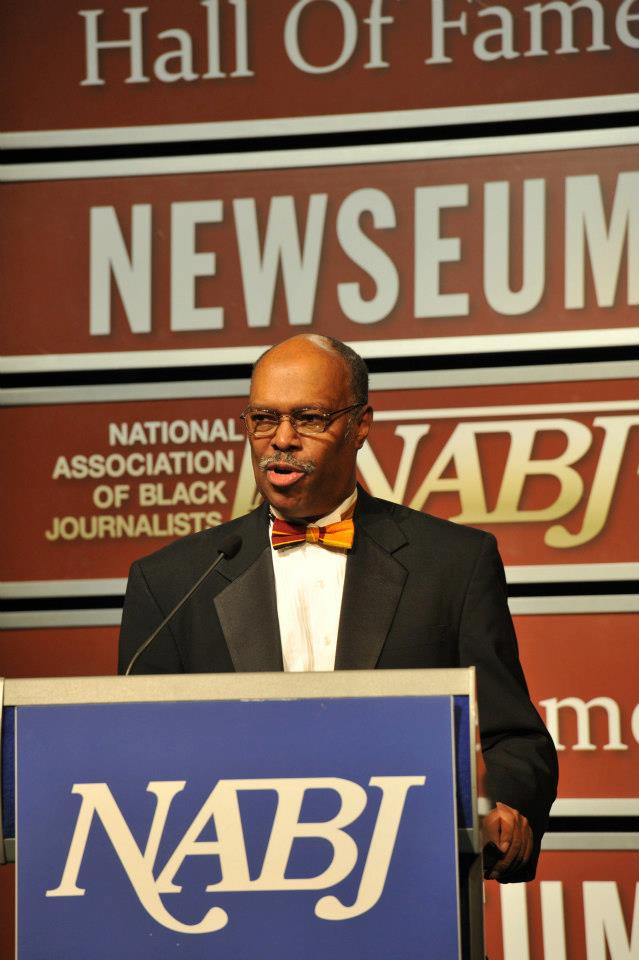 The National Association of Black Journalists held its Hall of Fame Induction Ceremony & Presidential Inauguration Gala on Thursday, January 17, 2013, at the Newseum in Washington, DC.
(Photo by Velvet S. McNeil of Velvet Multimedia, LLC)
Richard Prince Receives Ida B. Wells Award from NABJ, Medill
From “Journal-isms,” Jan. 19, 2013:
Prince Calls for New Ideas for Funding “Journal-isms”
This columnist called Thursday for members of the National Association of Black Journalists and their friends to come up with a new business model for financing “Journal-isms.”
The occasion was the NABJ’s Hall of Fame gala in Washington, where Richard Prince was presented with the Ida B. Wells Award, given to “an individual who has made outstanding efforts to make newsrooms and news coverage more accurately reflect the diversity of the communities they serve.”
“As Coretta King‘s husband said, ‘I have a dream.’ Mine is to be the first to break even doing this kind of work for a nonprofit and to pass it on,” Prince said. ” ‘Journal-isms’ should be a financially solvent institution with others waiting in the wings to carry on its work.
“And so I challenge us today to come together and figure out a way to create that.” The text of the acceptance speech is at the end of this column. The video of the introduction to the speech is here.
Unofficially, the gala attracted 342 attendees, said NABJ Secretary Lisa Cox, adding that NABJ is determining final figures. Tickets were $150, with early-bird tickets at $100.
Inducted into the Hall of Fame at the gala, held at the Newseum in Washington, were:
- Betty Winston Bayé, longtime columnist, Courier-Journal, Louisville, Ky. (Video)
- Simeon Booker, first black reporter at the Washington Post and longtime Washington bureau Chief, Jet magazine. (Video)
- The late Alice Dunnigan, first black woman credentialed to cover the White House, State Department and Congress. (Video)
- Sue Simmons, longtime anchorwoman at WNBC-TV, New York. (Video)
- The late Wendell Smith, legendary sportswriter who helped desegregate baseball. (Video)
- Cynthia Tucker, visiting professor at the University of Georgia’s Grady College of Journalism and Mass Communication, commentator and former Pulitzer Prize-winning columnist at the Atlanta Journal-Constitution. (Video)
Booker’s memoir, “Shocking the Conscience,” is being published by the University Press of Mississippi in April. A digital app in the program book provided downloadable copies. Booker is 94.
Actor Andre Holland told attendees he is playing Smith in the Warner Brothers movie “42,” about Jackie Robinson, which will open in April. LaVelle E. Neal III of the Star Tribune in Minneapolis, who is about to become president of the Baseball Writers Association, accepted the award for Smith. Neal told Journal-isms he is the only African American major league baseball beat writer at a mainstream newspaper.
Dunnigan’s 80-year-old son, Robert Dunnigan, and granddaughter Suzette Dunnigan Whyte accepted her award. Robert Dunnigan recalled his mother’s midnight runs to the post office in order to send Associated Negro Press dispatches.
Proceeds of the gala are to benefit NABJ scholarship and fellowship programs. The event was hosted by Byron Pitts, contributor to CBS-TV’s “60 Minutes” and chief national correspondent for the “CBS Evening News,” and Isha Sesay of CNN International and HLN.
Wayne Dawkins contributed to this report.
Photos from NABJ Hall of Fame gala (Facebook)
Richard Prince Wins 2010 McGruder Award for Media Diversity
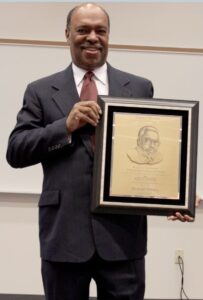 Richard Prince, columnist for the Maynard Institute of Journalism Education, is the recipient of the 2010 Robert G. McGruder Award. The award recognizes the accomplishments of media professionals who encourage diversity in the field of journalism.
The School of Journalism and Mass Communication will present the McGruder Award at a special ceremony and lecture at 1 p.m. Tuesday, April 6, in the FirstEnergy Auditorium in Franklin Hall. A reception will immediately follow the lecture.
Past recipients of the McGruder award are Greg Moore, editor of the Denver Post, in 2003; David Lawrence, Jr., retired Knight Ridder executive and The Miami Herald publisher, in 2004; Albert Fitzpatrick, retired Knight Ridder executive and Akron Beacon Journal editor, in 2005; and Leonard Pitts, Jr., Pulitzer Prize winner and columnist for The Miami Herald, in 2006.
See full article at:
http://einside.kent.edu/?type=art&id=92588
Richard Prince Receives Oakland PEN Censorship Award – 2010
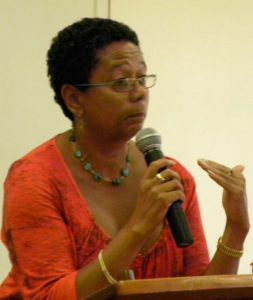 Dori J. Maynard, president of the Maynard Institute for Journalism Education, accepts the PEN Oakland Censorship Award on behalf of Richard Prince, Dec. 11, 2010 in Berkeley, Calif. Photo credit: Tennessee Reed
The PEN Censorship Award was presented to Oakland journalist and media watchdog Richard Prince, whose unique and indispensible thrice-weekly column on underreported media news (“Journal-isms”), appears on the website of the Maynard Institute (created to honor the legacy of Oakland Tribune Editor Robert C. Maynard).
See full article at: https://www.berkeleydailyplanet.com/issue/2010-12-15/article/36969?headline=Oakland-PEN-Writing-Awards-Honor-Paul-Krassner-Local-Writers
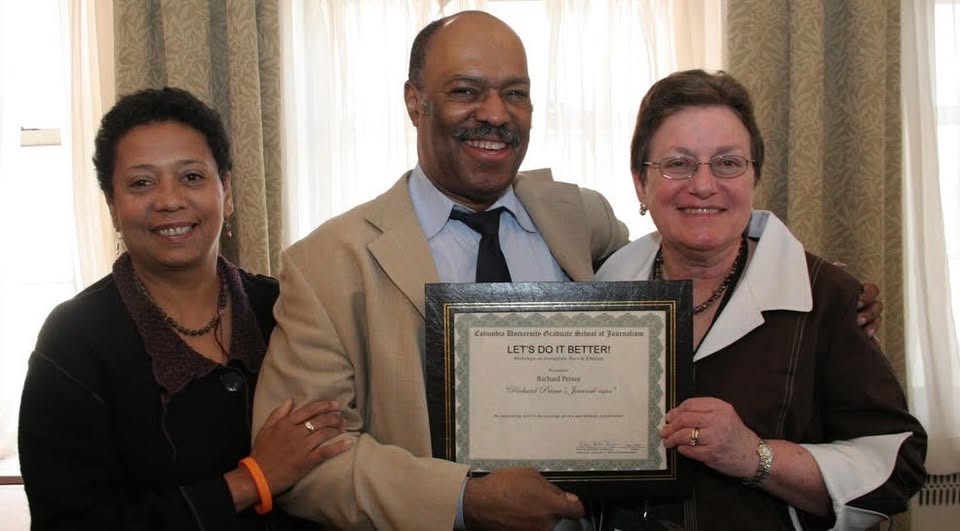 From left: Dori Maynard, Richard Prince and Arlene Noturo Morgan ((Photo by Rebecca Castillo)
Richard Prince Receives Columbia University “Let’s Do It Better Award” – 2007
The Let’s Do It Better! Workshop was established in 1999 through a Ford Foundation grant to foster coherent, complete and courageous coverage of race and ethnicity in America as “an urgent journalistic duty,” said Arlene Morgan, the school’s associate dean who directs the competition and workshop. “The award winning work must meet the standards of voice, complexity, context and authenticity, as well as serve as a teaching tool for the newsroom managers and journalism educators who attend the workshop,” added Morgan, explaining the criteria for winning.
See full article at:
http://web.jrn.columbia.edu/events/race/honorees/2007_press_release.asp