
Journos, Profs Say Clocks Won’t Be Turned Back
On Blacks as Pentagon Leaders: ‘Never Going to Fly’
Photo credit for homepage photo of Colin Powell: Paul Morigi /AP Images for National Portrait Gallery
Journal-isms Roundtable photos by Sharon Farmer/sfphotoworks
Forty-seven journalists, academics and others with an interest in racial dynamics in the armed services were at the April Journal-isms Roundtable on “Race and the Military” (Credit: You Tube)
Journos, Profs Say Clocks Won’t Be Turned Back
“In a move that disproportionately targets women and minority officers, Defense Secretary Pete Hegseth recently blocked the promotions of at nine Navy officers who had been selected by a board of senior Navy admirals,” Greg Jaffe and Kate Kelly reported Monday for The New York Times. It is an issue discussed in April by the Journal-isms Roundtable, in which participants concluded that the rich history of people of color in the military deserves to be amplified, not suppressed.
“The net result of Mr. Hegseth’s intervention is a slate of 22 nominees to be one-star admirals that bears little resemblance to the broader force these officers will help lead,” Jaffe and Kelly continued.
“Three of the officers removed by Mr. Hegseth from the promotion list are women and two are Black men. An additional four are white men.”
Separately, Michael Kunzzelman and Lindsay Whitehurst reported for the Associated Press, “A Pentagon policy illegally banned transgender troops from military service, a divided panel of federal appeal court judges ruled on Monday in another legal setback for President Donald Trump’s sweeping agenda.
“The majority opinion by a three-judge panel from the U.S. Court of Appeals for the District of Columbia circuit held that the Trump administration’s policy was designed to exclude people from the military based on their gender identity. . . .”
”The panel’s new ruling would keep the military from kicking out current service members named in the lawsuit, but wouldn’t allow new transgender recruits to join. The judges put their decision on hold, though, to let the administration seek further review. . . .”
April Ryan said on MS NOW’s “All In With Chris Hayes,” “Think about who has been in the military from almost the inception of this nation when we were fighting wars.” (Credit: YouTube)
The April Roundtable followed a March 27 report by Greg Jaffe, Eric Schmitt, Helene Cooper and Adam Entous for the Times that “Defense Secretary Pete Hegseth is blocking the promotion of four Army officers to be one-star generals, a highly unusual move that has prompted some senior military officials to question whether the officers are being singled out because of their race or gender.
“Two of the officers targeted by Mr. Hegseth are Black and two are women on a promotion list that consists of about three dozen officers, most of whom are white men, senior military officials said. . . .”
That evening on MS NOW’s “All In With Chris Hayes,” veteran journalist April Ryan said, “Think about who has been in the military from almost the inception of this nation when we were fighting wars.
“It`s enslaved Africans. You cannot erase that history. And [Harry S] Truman was the first president to officially integrate the wars. African Americans have been fighting in U.S. wars since before the Civil War. So, they need to get their history right and figure out what they`re going to do because you can`t change this history. The facts are the facts.”
Forty-seven people were on the Zoom call.
Using artificial intelligence, Rev.com listed these “key insights and takeaways” from the session:
- “People of color have been essential to U.S. military success since the Revolutionary War, yet their contributions are systematically minimized or erased.
- “Current administration’s diversity rollbacks represent historical regression, not innovation.
- “Military service represents complex intersection of patriotism, economic opportunity, and potential exploitation for minority communities.
- “The 250th anniversary [of the United States] provides strategic opportunity to counter historical revisionism through documentation and public education.
- “Stars and Stripes restrictions exemplify broader authoritarian threats to independent military journalism.
- “Veterans’ anti-war perspectives are often suppressed in favor of simplistic pro-military narratives.
- “Military integration has been one of America’s rare diversity success stories, making current rollbacks particularly damaging.
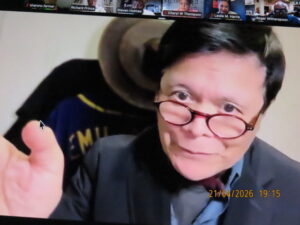 “Asian American military contributions, particularly Filipino veterans, represent largely unknown history of service and betrayal,” a point made by columnist Emil Guillermo (pictured).
- “The Supreme Court’s military academy exemption from affirmative action bans recognizes diversity as national security necessity.
- “Journalists and historians have responsibility to preserve and amplify suppressed military histories of people of color.”
The reference to Stars and Stripes includes the Defense Department’s firing of Jacqueline Smith, who served as the ombudsman for the publication “in a role that Congress established to safeguard the publication’s editorial independence. The decision comes after the Pentagon in January called the publication ‘woke,’ while announcing changes that interfered with the independence of a news organization founded during the Civil War, as PEN America noted.
More from the AI summary:
- “The conversation covered military service chronologically, beginning with the Revolutionary War. Leslie Harris discussed how Black people and Native Americans participated in colonial defense and the Revolutionary War, noting that ‘Black people have never been fully recognized and compensated for their contributions to this nation’ [15:13]. She emphasized that Black people have been involved in defending what became the United States since the colonial era [14:23].
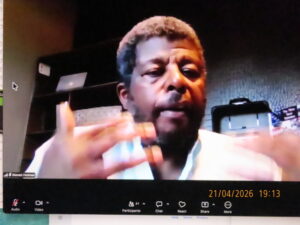 “World War II received significant attention, particularly the Tuskegee Airmen. Cheryl [W.] Thompson, whose father was a Tuskegee Airman, explained how ‘this country did not want these men in planes in World War II’ and that it wasn’t until 2007 [that] George W. Bush gave them the congressional medal for national recognition [17:19] [19:38]. Steven Holmes (pictured) noted other distinguished Black units like ‘the 761st Tank Battalion, the 333rd Field Artillery Battalion’ that haven’t received adequate recognition [20:40]. [Holmes has just published an historical novel on Black soldiers in World War II, “Black Messiahs.”]
- “Emil Guillermo discussed Asian American military contributions, focusing on Filipino Americans in World War II. He explained how 20,000 Filipinos enlisted after Pearl Harbor when ‘FDR allowed an exception for them to enlist as non-citizens’ [26:23]. However, the 1946 Rescission Act broke promises of citizenship to Filipino veterans, leading to a decades-long fight for equity pay that wasn’t partially resolved until [President Barack] Obama provided payments of ‘$9,000’ for veterans in the Philippines and ‘$15,000’ for those in America [29:34].
- “Vietnam War coverage included perspectives from Jesse Lewis, who reported [on Vietnam] for the Washington Post in 1966-67, and filmmaker Jason Harper, who created a documentary about Black soldiers in Long Range Reconnaissance Patrol units [55:52] [57:34].
- “Several participants were military veterans, including Ron Nixon (Marine Corps, 1988-1992), who emphasized that ‘the military is a microcosm of society as a whole’ and that racism exists within military institutions just as it does in civilian society [1:11:53].
- “The discussion addressed current challenges under the new administration’s policies. Eric Slavin from Stars and Stripes described restrictions placed on military journalism, including being ‘restricted from running wire service content’ and facing limitations on covering ‘controlled unclassified information’ [51:20].
- “Participants expressed concern about efforts to reduce military diversity. John Watson noted that the Supreme Court’s 2023 ruling against race-based college admissions made ‘a special exception for the military schools ‘based on national security needs [1:43:13]. However, there are concerns that current leadership opposes diversity programs.
- “The conversation concluded with discussions about the upcoming 250th anniversary of American independence and the need to continue documenting and sharing the contributions of people of color to American military history [2:05:44].”
There was more: Le’Trice Donaldson (pictured, below), assistant professor at Auburn University and founder of the Society of Black Military Studies, the first academic organization on the topic, said:
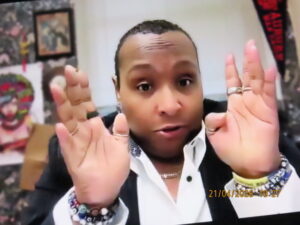 “If y’all want to talk about World War II, I can. We can shift gears here to talk about, I think, another figure that’s greatly underappreciated and under-researched . . . Mary McLeod Bethune and her work in terms of her advocacy, not only for Black women, but also Black men in their service. She was a special assistant to the secretary of war, Henry Stimson, and she actively . . . wore her uniform and actively participated and fought to get women you know, the Black Rosies, i.e. 600,000 Black women serving in the civilian defense industry, but also getting women to fight in and serve in the different military branches.
“So I think . . . a big part of this conversation around Black military service can go back to something David Walker said in ‘David Walker’s Appeal’ when he made the statement that this country is more ours than theirs. And if you operate from that kind of perspective in terms of who is . . . living out the true legacy of America’s . . . vision, you . . . make the argument that . . .when African Americans serve in the military that they’re holding that mirror up to the U.S. . . . What he meant was, this country is more ours than theirs because we built it.”
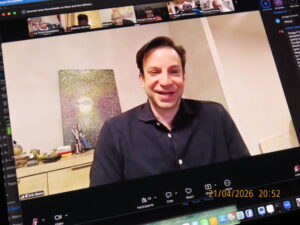 Slavin (pictured), of Stars and Stripes, discussed Pentagon demands that the publication rid itself of “D.C. gossip columns,” though “to my knowledge, I don’t think we’ve ever run a D.C. gossip column. I’m not sure what those ‘woke distractions’ were, because they never contacted us prior to putting that tweet out and did not contact us for several months afterward regarding that.”
Moreover, “there was a leak to the Daily Wire, which had some more information in there talking about potentially getting rid of our print edition, replacing our civilian reporters, number of other things that again, the Pentagon did not discuss with us. I don’t know how many of you are familiar with Stars and Stripes, but we do operate on First Amendment principles, which makes us fairly unique, given that we are within the Department of Defense. But it’s something we take very seriously and always have.
“So we are very careful about protecting that independence. And then on March 9, a new memo came out as we were working on Iran war coverage. We had a reporter, an African American reporter, I might add, in Bahrain,” Shannon Renfroe, “who had missiles going on around her apartment at the time, and continued to report.
“And in the middle of all this, a memo comes out with further information in it, saying that, yes, Stars and Stripes will remain independent, but you are hereby restricted from running wire service content from anything that you contract for, including the AP and the Washington Post. You are restricted from running comics in your print edition. Why comics? We do not know. And that it is something that comes from syndicated content. And you’re restricted from running what is called controlled, unclassified information.
“Now, we are probably as careful as any news organization about not putting service members at risk because they’re our readers. We don’t want to get them killed. . . . At this point, we are dealing with it as best as we can. We are continuing in our staff coverage to be as accurate and balanced and fair as we always have, and to call power to account when necessary.”
 Jesse W. Lewis Jr. (pictured), recounted his series on Black GIs in Vietnam. “I got to Vietnam for the [Washington] Post in December ’66 and came back in mid-late April ’67. And while I was there, I mean, I had two assignments. One was to back up Ward Just, who was the bureau chief.
“But I collected information for four and a half months on the role of the Black GI in Vietnam. Just as an aside, I was virtually ignored by the all-white press corps.
“They asked me, ‘What are you doing talking to Black people, or Black soldiers, all the time? I said, ‘I just feel more comfortable.’
“But the irony is that when my series was published, all of them came running to me and asked for my carbon paper, my copies, which in the old days were called blacks. There wasn’t anything to do with race, it’s just that was the color of the carbon paper.
“And they wanted to see what I had written.”
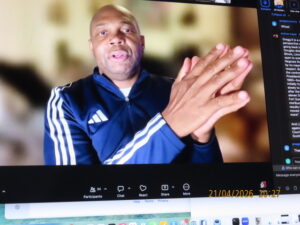 Nixon (pictured) noted that the Marines, his branch of the military, was the last of the major services “to actually fully integrate.” While he was at the Associated Press, where he rose to vice president for investigative, enterprise, grants and partnerships, “I edited a series . . . called ‘Racism in the Ranks.’ . . . And so some of the things that I experienced are some of the things that are still going on. . . .The military is a microcosm of society as a whole. . . . So, it’s not that . . . it is colorblind. You are forced to work with people, not because you necessarily like them, but your life depends on them.”
Rolando Roebuck, who described himself as a Vietnam-era Air Force veteran who is “extremely anti-war,” wanted to know about the complicated relations between African Americans and Indigenous people and about anti-war sentiment among the GIs. No one was available to answer about the Native Americans, but Clarence Page (pictured below), longtime Chicago Tribune columnist and Stars and Stripes alum, replied that, yes, “there was a tremendous protest movement quietly inside the service about ’68, ’69; there was a move to improve morale.”
There were even underground newspapers.
 “And a big report came out that said, you know, they needed to do something about promotions, and they didn’t say diversity in the ranks. They said that later on, but nevertheless, there was a . . . concern about the fact that there were no Black broadcasters in the Armed Forces radio and television.
“A concern about the lack of diversity in the upper ranks. . . .Things began to change rather quickly. And there are a bunch of reports which you can find without doing a whole lot of heavy research about what this service did in order to improve diversity in the ranks at that time. . . . And things got much better, and you began to see, well, Colin Powell himself was turned down when he was up for promotion to general. And at that time, they say, ‘this guy’s so well qualified and all.’ They went through the process again to see if they could get more diversity among their generals. He was promoted in that round.”
 While race was the major focus of discussion, gender was also mentioned. Tanya Gazdik (pictured), president of the Journalism & Women Symposium, known as JAWS, sent this statement:
“The Journalism & Women Symposium aims to empower women and promote diversity while advocating for inclusive and accurate news coverage. We are concerned when women in any profession face challenges that appear to be gender or race motivated. I’d like to give a shout out to the National Association of Black Military Women (NABMW), which works to document ‘HerStory,’ ensure representation, and provide mentorship to current service members.”
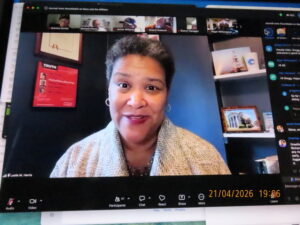 Leslie Harris (pictured), professor of history and African American studies at Northwestern University, spoke about Black and Indigenous contributions to the Revolutionary War.
She was upbeat.
“I want to reinforce, and this gathering is an example of that, that we’re not going back. They’re dragging us back. The people who do not want to go back vastly outnumber these people at the top, you know, the hardcore, which may remain a permanent hardcore, anti-diversity, is really, pro-MAGA, whatever you want to call it. . . .
“MAGA itself is estimated at 35 percent in polling.
“As an historian who’s done a lot of public history over the years, particularly around the issue of slavery, what I’ve seen from teachers, from museums, from people, just general walks of life, is that…
“More people than we imagine have gone through a transformation in their thinking of what this country is. It’s imperfect.
“But more people have an experience of diversity, desire an experience of diversity.
“And, um, I think we’re going to see some of that in terms of how this 250th anniversary is celebrated.
“That you’re going to have local organizations that are not taking their notes from the Trump administration.
“I’m thinking, too, about the military, which did argue before the Supreme Court in favor of a diverse military, and that was very striking to me.
“I’ll say, historians date the integration of the military [to] after World War II, and see that as one of the rare success stories in which even with all its problems . . . that is an institution that has really pushed diversity just as strongly as higher education in other places.
“And I think it’s harder than they imagine to uproot all of that.”
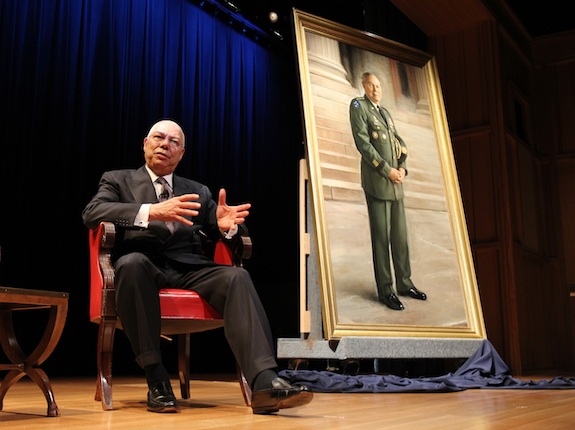
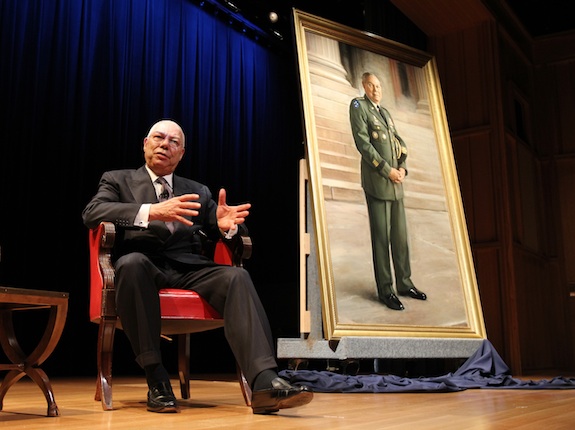
Gen. Colin Powell discusses his life and career at the unveiling of his portrait at the Smithsonian’s National Portrait Gallery on Dec. 2, 2012, in Washington. (Credit: Paul Morigi /AP Images for National Portrait Gallery)
On Blacks as Pentagon Leaders: ‘Never Going to Fly’
Just before Memorial Day, Pentagon correspondent Helene Cooper (pictured, below) of the New York Times, while not with us at the Roundtable, expanded on Defense Secretary Pete Hegseth and race on the May 22 edition of PBS’ Washington Week.” (video)
“I just would like to put some of this into a little bit of perspective,” Cooper began.
“The . . . American military had prided itself about its integration.
 “They were, you know, one of the first to integrate, and . . . the military had, I think 42 percent representatives of minorities like in the late — around 2018, 2019, 2020.
“But if you looked at the people who were in the leadership roles of the military, all of them were white men.
“There weren’t women and there weren’t Black people.
“There were not Hispanics.
“That was it.
“It was white men.
“You walk down this hallway in the E-ring of the Pentagon.
“And all you see are the portraits . . . . of white guy after white guy after white guy.
“I remember one afternoon — these are the chairmen of the Joint Chiefs of Staff — standing at the end because the press hallway, the old press hallway was near there, and watching as . . . one Black officer after the other walked down that hallway and I kept watching each one pause when he got to Colin Powell.
“And there was like this moment where you stop and you’re like, ‘Oh yeah?’
“And then you keep going, because at that time there had only been one Black chairman of the Joint Chiefs of Staff and it had been Colin Powell.
“And then Lloyd Austin came in; you have a Black defense secretary.
“And not soon after that, President Biden appointed Charles CQ Brown as the chairman of the Joint Chiefs of Staff.
“You had two Black men leading the military.
“I remember a Black Marine saying to me, ‘This is never going to fly.’
“And there was this belief that there is no way this military was ready to be led by — and it would have been the same way if you had been two women leading the military.
“It just wasn’t ready for that.
“And I think what you’re seeing in many ways with Pete Hegseth is sort of the embodiment of what, you know, what that Marine was afraid of.”
- Maya Boddie, Blavity: The Iran War Disproportionately Impacts Black Americans, And Here’s How (March 22)
- Jimmie Briggs, New York Amsterdam News: War in Iran – How Black veterans’ perspectives make it clear (April 9)
- Editorial, San Antonio Express-News: Pete Hegseth targets Black, female officers more qualified than him (March 30)
- BrieAnna J. Frank, USA Today: Pete Hegseth’s ouster of Army’s top chaplain leaves ‘enormous gap’ (April 25)
- Bryon L. Garner, Routledge publisher: Black Veteranality: Military Service and the Illusion of Inclusive Patriotism
- Thomas Guglielmo, C-SPAN: Racism in the U.S. Military During WWII (March 2, 2023) (video)
- Thomas A. Guglielmo, Oxford University Press: Divisions: A New History of Racism and Resistance in America’s World War II Military (2023)
- Steven A. Holmes, CNN: The Black battalion that rescued Tony Blinken’s stepfather (Nov. 30, 2020)
- Indiana War Memorials Foundation: Celebrating One of Indiana’s Own: Tuskegee Airman Arthur Lloyd Carter (Feb. 17, 2021)
- Greg Jaffe, New York Times: Pentagon Bars Reporters From Its Press Office
- Theodore R. Johnson, Washington Post: America’s real source of patriotism has been clear for 250 years (Dec. 31, 2025)
- Rhian Lubin, the Independent: Hegseth forced out US Navy admiral who had legal concerns over Trump’s drug boat strikes: report (Dec. 4, 2025)
- Wendy Murphy, Boston Herald: Unequal draft, unequal rights (April 26)
- Clarence Page, Chicago Tribune: Pentagon’s press panic threatens august Stars and Stripes (March 23)
- PEN America: Pentagon Doubles Down on Secrecy in New Restrictions on Journalists (June 2)
- Vincent Schilling, Indian Country Today Media Network: Memorial Day Tribute: American Indian Warriors Who Made the Ultimate Sacrifice in War (May 24, 2014)
- Brandon Tensley, Capital B: Black Service Members Warn Military Is Moving Backward (April 10)
- Mark Wingfield, Baptist News Global: For first time ever, Army chief of chaplains fired — by Hegseth (April 2)
