
How the Two Have Always Been Joined at the Hip
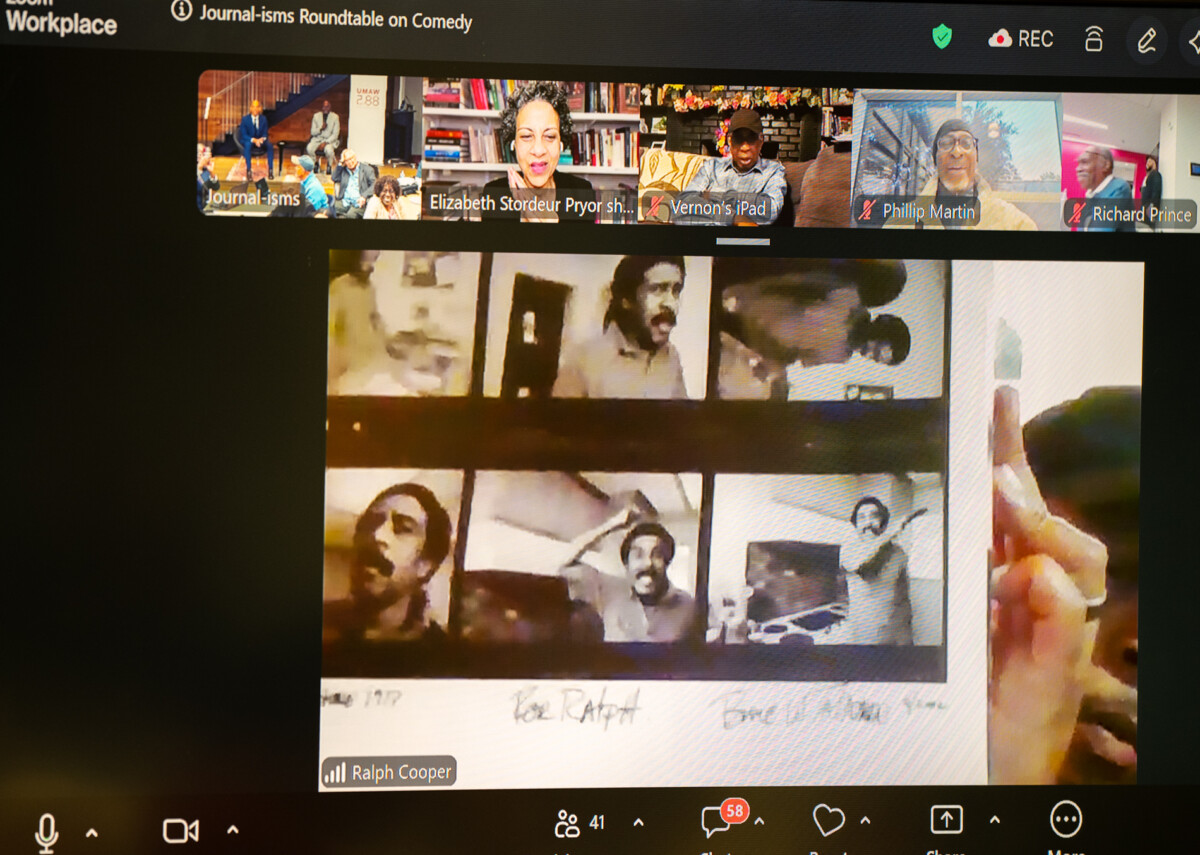
(Journal-isms Roundtable photos by Jeanine L. Cummins. [Updated caption:] Homepage photo: Ralph Cooper displays contact sheets from photos of Richard Pryor in January 1978, taken by photojournalist Bruce Talamon.
(“I shot those photographs in Richard’s kitchen sometime in January of 1978, just after he had shot up his wife’s car during the New Year’s Eve Party,” Talamon told Journal-isms. “We had just finished the cover photo session and I wanted to shoot some casual shots around the house. So we walk into his kitchen and he asks me, ‘What do you want me to do?’ I think my reply was something like, ‘…whatever you want to!’ And before that sentence was fully out of my mouth he grabbed that very large knife, spun around and said, ‘… Well how ‘bout I stab you Muthafucker?!’ I got off two shots.”)
“The Richard Pryor Show” started as “The Richard Pryor Special?,” a one-shot sketch and variety broadcast that aired on May 5, 1977. (Credit: YouTube)
How the Two Have Always Been Joined at the Hip
Richard Pryor, considered by some to be the greatest comedian of the 20th century, of any race, hosted his own special on NBC on May 5, 1977, as his career continued to gain steam.
Elizabeth Stordeur Pryor, a Smith College history professor who has taught a course about her dad and has a book about him to be released within days, told this story about that broadcast:
“My father plays like this straight man basically going backstage and trying to figure out how to get onto the stage. And while he is doing it, all these people are trying to tell him and redirect him to tell him what the show should actually be about.
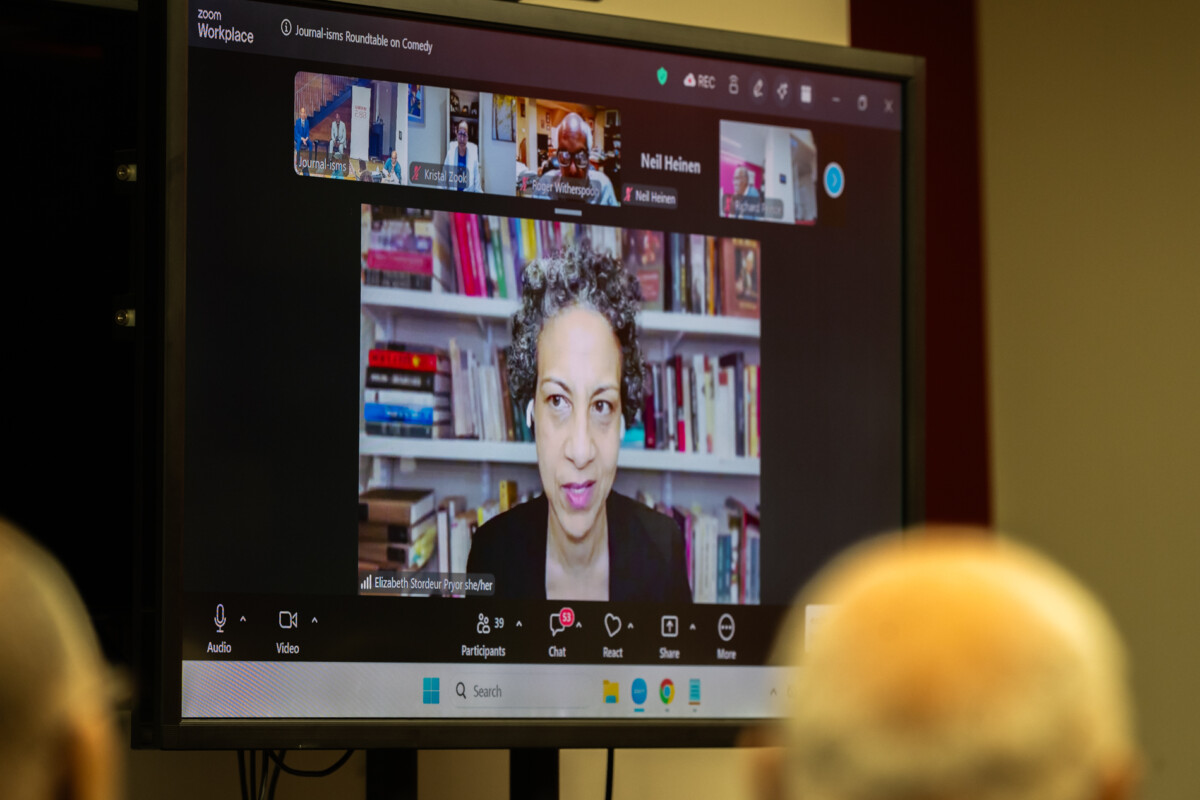
Elizabeth Stordeur Pryor, Smith College history professor who has taught a course about her dad, Richard Pryor, urged Journal-isms Roundtable participants and others to send her stories of having an older person sneak them a Richard Pryor album or about the first time they heard a Pryor album when they weren’t supposed to be listening to him. (Credit: Jeanine L. Cummins)
“And when he finally gets on stage, he kind of gets out there and starts singing, ‘There’s No Business Like Show Business.’ ”
“I thought it really spoke to the kind of anxiety that he was facing. My father kind of had both experiences: Where he was the arbiter of his own voice, like on stage doing his own comedy, and then would end up . . . kind of trapped in these Hollywood films like ‘Silver Streak,’ where he’s doing a blackface scene with Gene Wilder, and stuff like that.
“And kind of how painful that was for him when he was trying to really authentically bring his own voice to the screen.
“You asked about a favorite joke, and mine is of my father’s, of course. I’m not an expert in comedy, but I have been studying my father because I just wrote a book about him and me and the N-word, called ‘Something We Said: Richard Pryor, a Notorious Word and Me.’ It comes out in a week and a half. And one of my favorite jokes — I’m a historian at Smith College — is my father says in a very solemn voice, ‘You all know where Black humor started? It started on the slave ships. Cat was on his way over here rowing. And dude said, “What are you laughing at?” And he said, “Yesterday I was a king.” ‘ . . .
“All of that humor rooted in Black pain is kind of quintessential Black comedy,” she continued. “One of the things that was sort of magical about my father is his ability to speak to the heart of racism without holding back to mixed-race audiences. . . .”
The Journal-isms Roundtable “Everyone Needs a Laugh — the History of African American Comedy” took place at the studios of WAMU, the NPR affiliate in Washington, and drew 73 people — 36 in person and another 37 via Zoom. (Credit: YouTube)
That ability — and acceptance of that ability — was a running thread during a two-hour Journal-isms Roundtable on May 21, “‘Everyone Needs a Laugh — the History of African American Comedy.”
It took place the same night Stephen Colbert hosted “The Late Show’s final broadcast after CBS canceled it, ostensibly for financial reasons, but widely believed to be an appeasement of President Donald Trump, the target of some of Colbert’s jokes.
 We have moved past Pryor’s heyday in the 1970s, ’80s and ’90s. Now, we “literally live in a place where you can be a comedian and you can get canceled, not have a career for saying a joke,” said Ralph Cooper (pictured), an NPR journalist-turned-stand-up comedian. “And I’m not talking about these white dudes saying ‘nigga’, and trying to act like it’s funny and [claiming] free speech. I’m talking about a real written joke. You can get canceled now, point blank, taken out for a joke.” Cooper said he’s seen it happen at the regional level.
Cooper’s comment touched on what is now called the “N-word,” which Pryor renounced in 1979.
“I think he saw that in some ways when the word got out of his hands, he couldn’t pull it back because [in] that same bit, which is in ‘Live on the Sunset Strip,’ he said, ‘I don’t want those hip white people coming up to me and asking me, telling me no N-word jokes,’ ” Elizabeth Pryor told the group.
Cooper and Professor Pryor were among the speakers at a Journal-isms Roundtable held in person at WAMU, the NPR affiliate in Washington, that drew 73 people — 36 at the station and another 37 via Zoom.
The topic was prompted by the release of “Black Out Loud: The Revolutionary History of Black Comedy from Vaudeville to ’90s Sitcoms” by Geoff Bennett, co-anchor of the “PBS News Hour.”
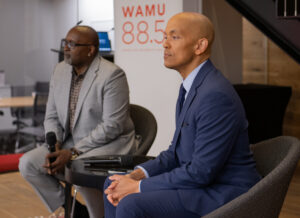 Bennett (pictured, at right) was present, along with Cooper; Elizabeth Pryor; Eric Deggans (pictured, at left), NPR critic at large, college professor and author of “Race-Baiter: How the Media Wields Dangerous Words to Divide a Nation” (2012). They joined Kristal Brent Zook, cultural reporter, professor of journalism and author of “Color by Fox” (1999); and Mel Watkins, who wrote a 1994 history of African American comedy, “On the Real Side: Laughing, Lying and signifying — the Underground Tradition of African American Humor That Transformed American Culture from Slavery to Richard Pryor.”
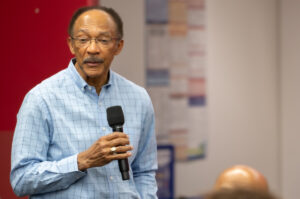
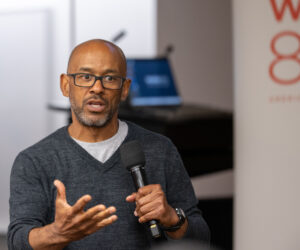 The Roundtable attendees toasted Jahi Chikwendiu (pictured), who just won the Pulitzer Prize for feature photography while at the Washington Post; Jackie Greene (pictured, below), chosen for induction into the National Association of Black Journalists Hall of Fame; and Wayne Dawkins of Hampton University, Ron Thomas of Morehouse College and Linn Washington of Temple University, journalists who are retiring from their professorships.
 The nuanced discussion included such tidbits as Bill Cosby’s insistence that Black stuntmen perform as his stand-ins on the mid-’60s undercover-spy television drama “I Spy,” rather than use white counterparts in blackface; why Black women in comedy were treated as less threatening than Black men; that the hit show “Friends” was actually an adaption of “Living Single,” with the race of the characters changed.
Attendees also learned how business motivations in media often masked or enabled racial exploitation, with Black audiences and creators used as stepping stones rather than valued constituencies.
“What strikes me is that when you look at the earliest examples of Black folks in comedy on television, you see Black, talented Black performers struggling with images of Black people that were created by white people rooted in prejudice,” Deggans said.
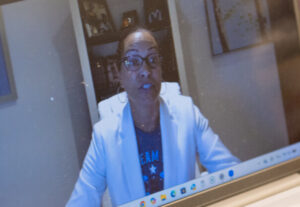 Zook (pictured) said, “you talked about going back to African traditions. I think included in that was cutting up, the signifying monkey, all the different ways that Black creators would try to speak the language that the lion wouldn’t understand. And that was happening all the time in TV. And it was always contested,” she added, citing arguments among the creators of “A Different World.”
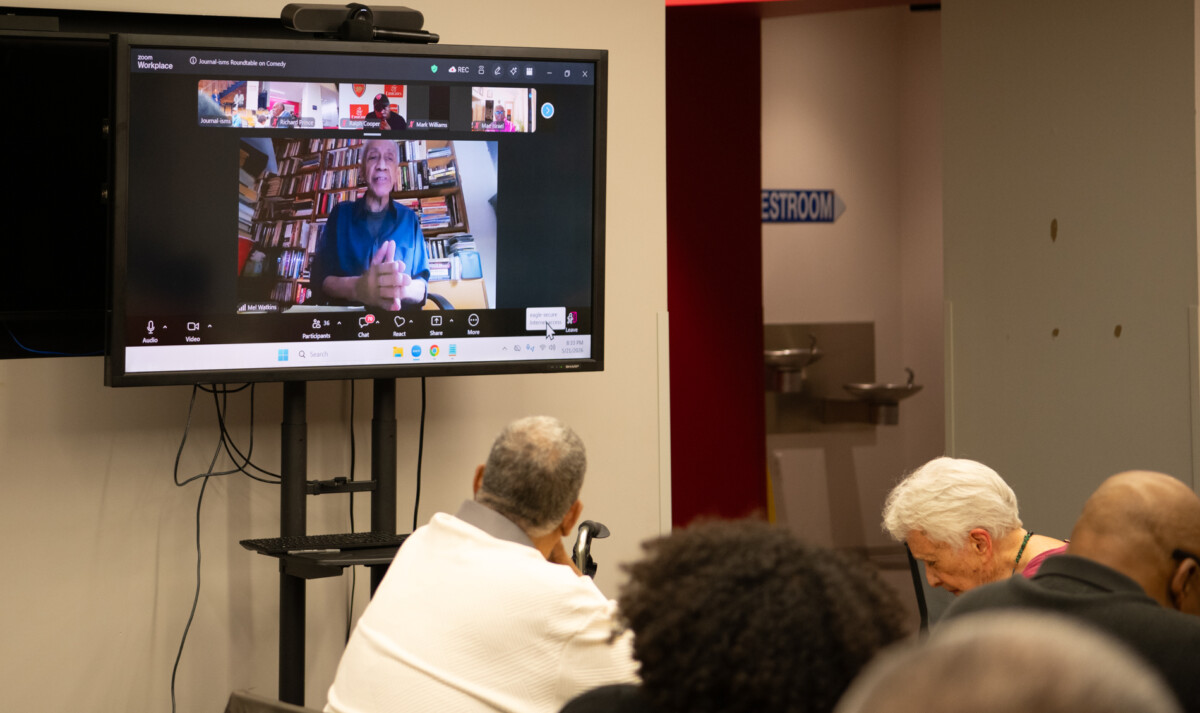
“I had worked at the New York Times as a book reviewer,” Mel Watkins said. “With most Black authors, excluding Toni [Morrison] and James Baldwin, perhaps humor, certainly with Richard Pryor, was saying or telling us more about the Black community being more truthful about the Black community than many of the novelists of the time.”
Conversations about how much Black humor should be shared with the wider public has always been an issue, said Watkins. “The kind of humor that [Lenny] Bruce and Pryor and Redd Foxx was doing at that time had been active in the Black community all along. It was simply repressed. It was not allowed into the mainstream. And instead what you had in the mainstream was a distorted view of African American humor, which had nothing to do essentially with what was real.”
Black humor was “used as a weapon to break through the hypocrisy that was flagrant in the country,” Watkins continued.
During slavery, humor “had to be indirect. It had to be in a sense nuanced. And even though . . . people tried to portray slaves, portray Blacks at that time as being barbaric, as being unsophisticated, the humor was not that. It was very nuanced. It was intentionally indirect, but just as pointed . . . in its goal of pointing out hypocrisy in the society, pointing, deriding and ridiculing the pompousness of the whites who assumed authority in that society and minstrelsy, during the time of minstrelsy, what we know of minstrelsy, at least white minstrelsy, that is whites portraying Blacks.
“The jokes were mostly negative jokes, and Blacks were the butt of the joke. . . . What they did was to gradually change those jokes. Instead of directing the humor towards themselves, as white minstrels had done, they started to subtly change that humor to subtly move it or direct it towards the hypocrisy in the society,” a difficult accomplishment because Black performances had always been circumscribed by whites.
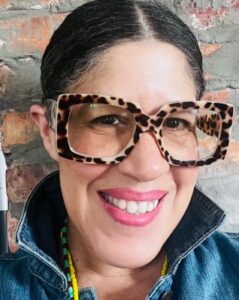 Rain Pryor (pictured), another Pryor daughter who is an actor, director, screenwriter and educator, sent this message:
“The state of African American comedy is being held up by the likes of truth sayers, like, Marsha Warfield, [Ali Siddiq], even Dave Chappelle. And now more than ever, our experiences must be shared to free us, as only our humor can do. We must not give in to the pressures of Hollyweird, but to keep affirming our culture and cultural experiences.
“Our humor is unique as we turn our suffering into punchlines that free our pain.
“That’s who our father was. He was a truth sayer that made us laugh at our pain, and gathered ALL people into a shared experience.”
Deggans questioned whether Chappelle belongs in that category, however, given Chappelle’s attacks on such marginalized groups as transgender people. Still, Deggans said Chappelle shared this much with Pryor: “Chappelle’s also articulated that he got uncomfortable with the way his comedy, rooted in Black culture, how it changed when white culture got ahold of it and he got the sense that people were not laughing with Black people, but they were laughing at them.”
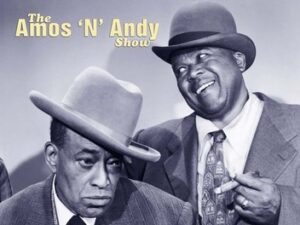 Many of these conversational threads converged in a discussion of “Amos ‘n’ Andy,” the radio show that ran from 1928 to 1960, created, written, and voiced by two white actors, and ran on television from 1951 to 1953, with Black actors playing the roles. The NAACP mounted a formal protest almost as soon as the television version began, describing the show as “a gross libel of the Negro and distortion of the truth.” The protests eventually forced the show off the air.
“Sometimes I think if the show was funny and it was funny to Black folks, that’s enough,” Bennett said.
“It was hilarious because it did show an only-Black world,” said Watkins. “It was the only time you could see that . . . Blacks didn’t even appear in mob scenes on television. They didn’t appear in movies. You could have a shot of New York City and people walking down the street. There were no Black people.”
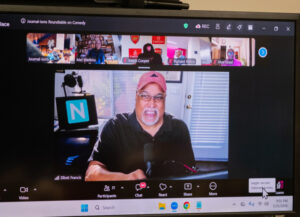 Broadcast journalist Elliott Francis (pictured), who produced an audio show about “Amos ‘n’ Andy,” said, “It gave a lot of people work. It became a source of pride in the neighborhood. But yes, sitcoms by their very nature have to do with buffoons.” And that show was no different, he said.
For most of the attendees, the overall discussion was personal. “Oh, how I adored listening to my Uncle’s. . . collection of music and comedy albums when I was growing up!” said one. “During last Thursday’s roundtable, I could relate to every single speaker and learned a few things, too!”
“I can see this having another part,” said another, “with comedians such as Pigmeat Markham, Godfrey Cambridge, LaWanda Page, etc.; [the conversation] had us touching just the edge.”
Another concluded that “Black humor is like the blues, a way to transform pain into something you can dance to or laugh at, an essential tool for coping with oppression.”
Elizabeth Pryor told the group, “I do hope that people will engage further in the work that I’m just doing. ‘Something We Said’ [is] going to come out soon and continue the conversation. I have an Instagram, which is @pryorhistories.
“For next week . . . I’m going to ask people to create an archive with me because I have heard from so many people this story — it kind of brings tears to my eyes — of having an older person sneak them a Richard Pryor album. Or . . . the first time they heard it where they weren’t supposed to be listening, and they were sitting at the top of the stairs while their parents were downstairs having a glass of wine and listening to Richard Pryor.
“And I would love to aggregate and collect these. So anyway, if you want to participate in that and that’s part of your memory, come to @pryorhistories.”
- Brandon Caldwell, theGrio: Roy Wood Jr. gets candid about taking leaps of faith and why he’s hesitant to go into ‘serious’ journalism (May 30)
- Chris Hacker, Elahe Izadi and Emily Yahr, Washington Post: Trump tried to silence late-night hosts. They’re mocking him even more.
- Neal Justin, Minneapolis Star Tribune: George Floyd joke at brutal Kevin Hart roast sparks controversy (May 14)
- Reelblack One: Amos ‘N Andy – The Christmas Story (1952) (video)
- Asheea Smith, The Root: These Black Comedians Aren’t Hitting Like They Used To (May 15)
- Curtis M. Wong, HuffPost: Marlon Wayans Says He Can Be Friends With Dave Chappelle While Supporting His Transgender Son (May 26)
