
Photography Pulitzer for a Former ‘Young Hooligan’
Black Enterprise Lays Off Its Freelancers
Trump’s EEOC Backs White Male Targeting N.Y. Times
22 Chosen for Diverse Nieman Class of 2027
Worldwide, Press Freedom Means Lives Saved
Short Takes: ICE use of physical force and chemical agents; Ronald Smothers; Pittsburgh Post-Gazette; “American Muslims: A History Revealed”; Shreveport, La., domestic abuse pattern; inaugural Michael Days scholarship winners; generational differences in news-source choices; serving low-income immigrant communities;
NAHJ and critical mental health and wellness; Mary Hudetz; winner at Black Public Media’s PitchBLACK Awards; Prashant Rao; Javier E. David; Urban One; digitizing recordings at HBCU radio stations; workplace harassment in Venezuelan newsrooms; Russian disinformation among Latin American journalists.
Updated May 5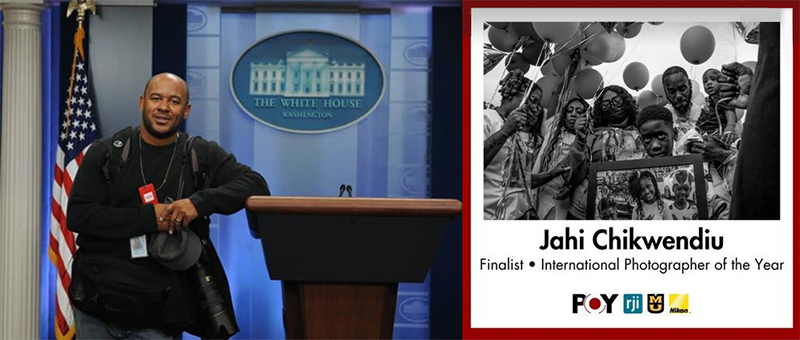
Photography Pulitzer for a Former ‘Young Hooligan’
How many Pulitzer Prizes have been awarded to a photographer who produced a photo essay called “Chokehold: The dangers of internalizing racism”? One who would write, “I keep hope, but I have lost all faith that this country will ever appreciably cleanse itself of deeply entrenched racism. Its barrage is constant and unavoidable warfare”?
Jahi Chikwendiu, one of the many who took a buyout last year from The Washington Post, which in February laid off all of its staff photographers. Chikwendiu had worked there since 2001.
He did not win a Pulitzer Monday for the 2019 racism photo essay.
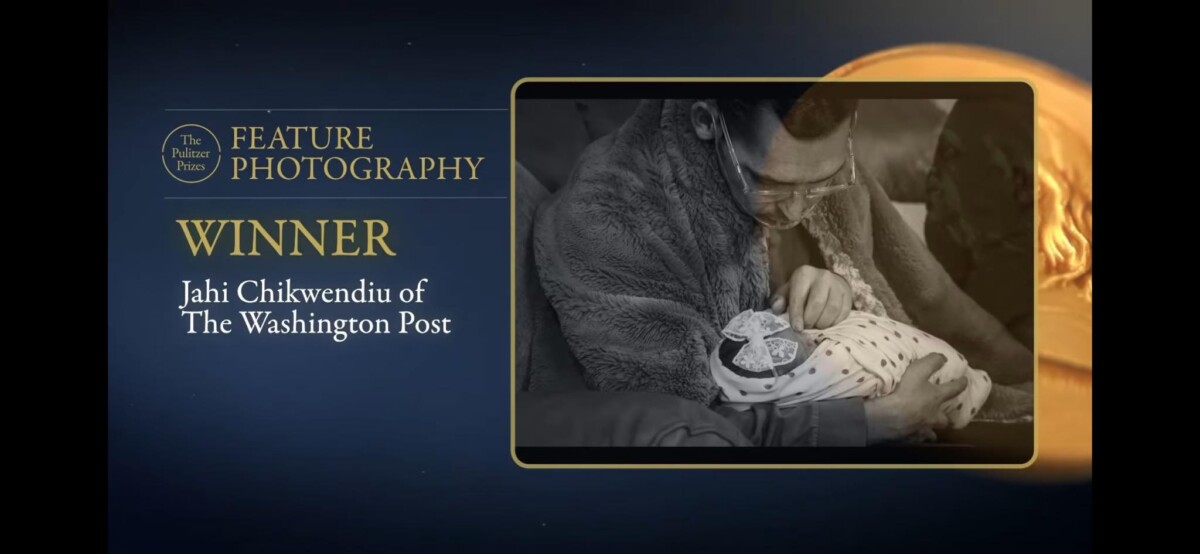
Chikwendiu “won for photographs taken for two stories about a young couple, Tanner and Shay Martin, who struggled with Tanner’s terminal colon cancer while Shay carried their daughter, AmyLou,” Scott Nover reported for the Post. “The couple let Chikwendiu, along with reporter Ariana Eunjung Cha and video journalist Drea Cornejo, spend months documenting their lives in Utah. Data journalist Dan Keating analyzed trends in rising cancer rates among young Americans.
“In a follow-up story, Chikwendiu photographed Tanner’s funeral less than six weeks after the couple’s baby was born.”
“This award is very, very hard to win and his fellow finalists this year were nearly as amazing as Jahi,” former Post publisher Donald Graham wrote on social media.
[In a telephone conversation Wednesday, Chikwendiu became emotional in describing how he received the news that he had won. It followed other awards in which he’d been named a finalist, and differences of opinion about which photos from the photo essay would be entered in the Pulitzers: He wanted the focus to be on the family welcoming their child; not the father’s dying of cancer.
[Chikwendiu was in his backyard in his Kentucky hometown. “I got teary, like I get right now,” he said. He looked at the sky and thought of his late mother, who bought him his first camera, his estranged father, a photography buff who “might have won a Pulitzer if he wasn’t a maintenance man in the United States, strapped down by racial dynamics of his day that might’ve limited his possibilities.” And of the Washington Post security guard who would routinely greet him with “You got that Pulitzer yet?” and told him, “you’re going to get it when you least expect it.”]
His award provides one of the most interesting backstories of this year’s winners.
In 2009, when a photo exhibit of Chikwendiu’s work debuted in his hometown of Lexington, Ky., Rich Copley of the Lexington Herald-Leader quoted the photographer, then 41:
” ‘The people back home, a lot of them know me as James Clay Fishback, this young hooligan who used to run around halfway terrorizing Lexington. So now, when I go back and reintroduce myself to Lexington through my work, it kind of brings people up to speed. It allows me to give back to people who didn’t necessarily think I would amount to much.”
“Last year, he told Herald-Leader columnist Merlene Davis that he changed his name at age 25 to ‘start a new legacy.’ Jahi means ‘dignity’ in Swahili, and Chikwendiu means ‘life depends on God’ in Ibu,” a Nigerian language. However, texted Journal-isms, “I first found jahi to be ‘dignity’ in Swahili, “until I went to kenya and found the word njahi . . . but I learned it’s a kikuyu word and is a black bean they eat in celebratory times.”
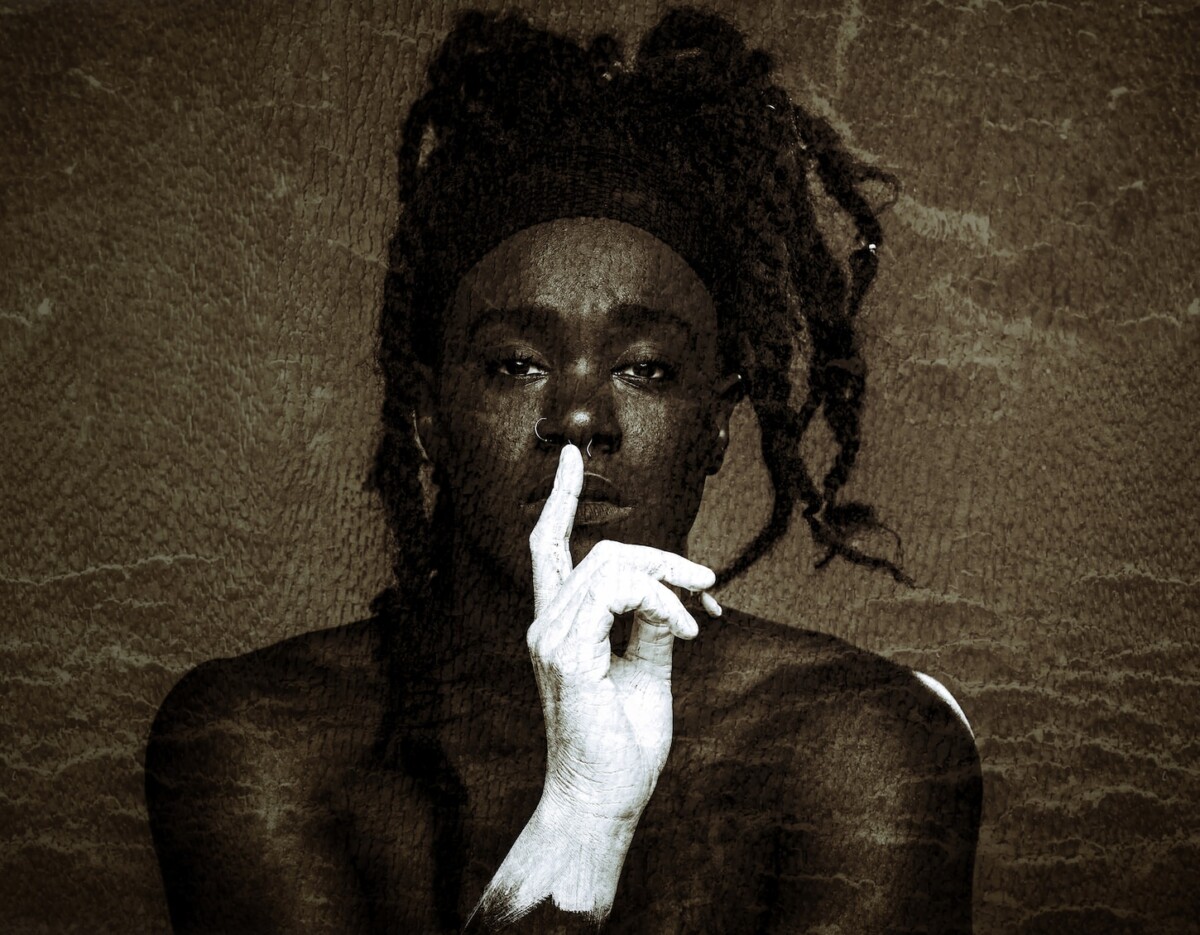 Chikwendiu took this photo accompanying his 2019 Washington Post essay on “Visualizing Racism.”
“The Siena International Photo Awards produced this bio:
“Born of a mother who was an amateur mathematician and a father who was an amateur photographer in Lexington, Kentucky, USA, Jahi Chikwendiu was destined to pass through both fields of study. In the end, his passion for visual storytelling dominated.
“A burning desire to tell photographic stories started while earning a mathematics degree from the University of Kentucky. After also completing a master’s degree in math education and after teaching high school math for one year, he started as a staff photographer for his hometown newspaper in autumn of 1998.
“Three months later, Chikwendiu was named the 1998 Photographer of the Year by the Kentucky News Photographers Association. For two years, he documented the rich cultural landscape of Kentucky, usa, before joining the staff of The Washington Post. There, he covered a wide range of visual stories from his Washington, DC-area home base and more than 40 countries on five continents from the first days of 2001 until July 2025.
“D.C.’s broken school system, the 2003 U.S.-led invasion of Iraq, genocide in Darfur, south Lebanese victims of Israeli cluster bombs, the aftermath of the 2007 assassination of Pakistani politician Benazir Bhutto, religious violence in the southern Philippines, police brutality in the United States, the 2011 formation of the world’s newest country, South Sudan. Chikwendiu spent the first three months of 2009 in Africa covering the Barack Obama inauguration from the Kenyan home village of the U.S. president’s father along with other stories in the Democratic Republic of Congo, Rwanda, Kenya, and South Sudan.
“In 2023, Chikwendiu covered issues that include climate change and sea level rise, declining life expectancy in the U.S., the Black maternity health crisis in the U.S., and how climate change is increasing the range and season of malaria-carrying mosquitoes in Mozambique.
“In 2024, he documented a transgender athlete’s fight for human rights, an indigenous American tribe’s recovery of remains of children stolen in genocide by the United States government in the late 1800’s, and the United States presidential elections from the view of Black women as candidate Kamala Harris ran an historic campaign to be the country’s first woman president. In 2025, Chikwendiu documented the rise of cancer among young people in the United States, thought to be driven by poor diet and lifestyle choices in combination with environmental pollutants.”
In the overall contest, “The Washington Post on Monday won the Pulitzer Prize for public service for its coverage of President Donald Trump’s far-reaching efforts in his second term to shrink the federal workforce and overhaul government through the Elon Musk-led U.S. DOGE Service,” Nover reported for the Post.
“The stories that won the public service prize, widely considered the top honor in American journalism, prominently featured staff writer Hannah Natanson’s reporting that chronicled how federal workers’ lives were upended last year. In an essay, she recalled being the newspaper’s ‘federal government whisperer,’ a role she described as all-consuming, involving interactions with more than 1,000 sensitive government sources.”
The story led to an alarming FBI raid on Natanson’s home — which involved taking possession of her phone, two laptops and a Garmin watch — that is being contested.
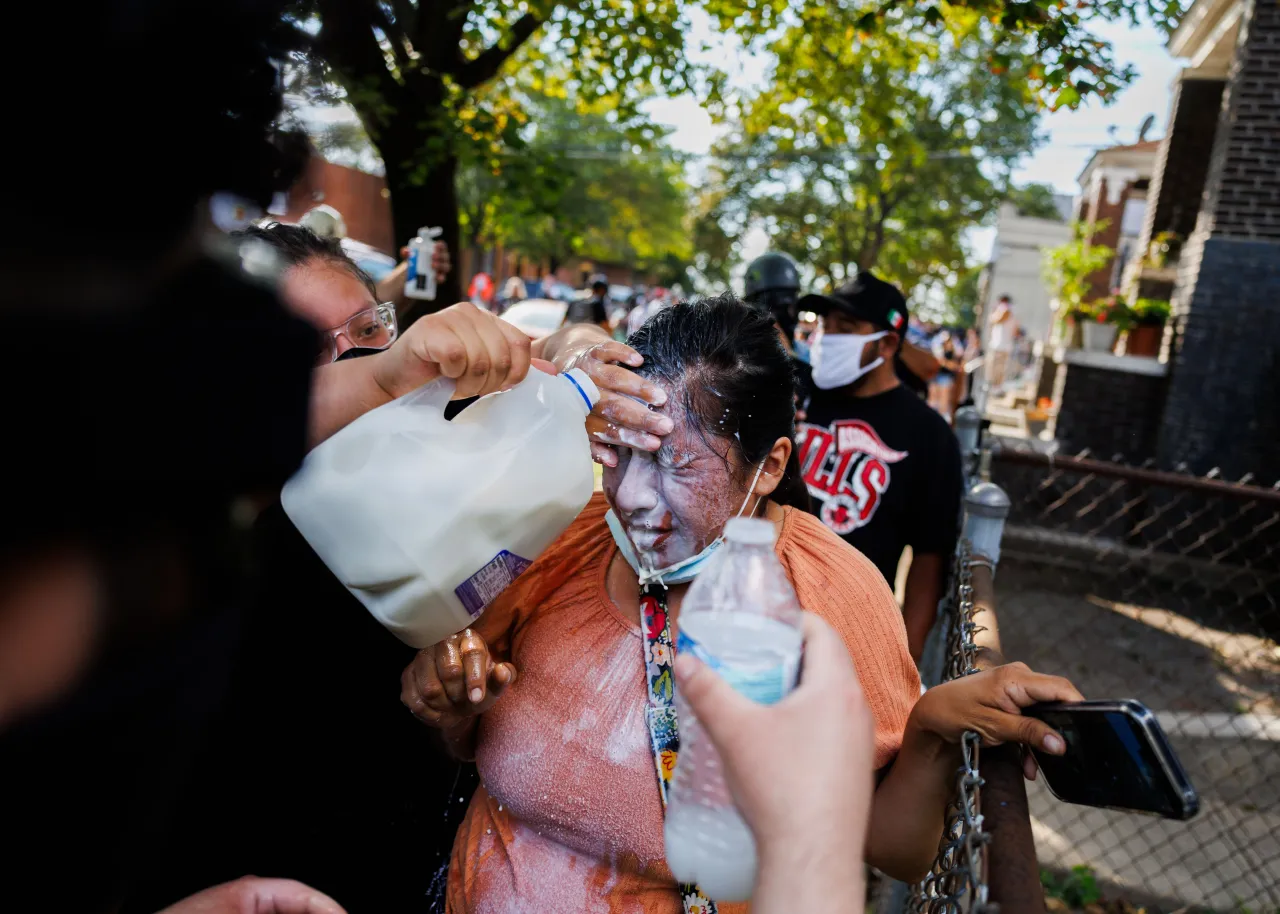
A woman has milk poured on her face after federal officers threw canisters of chemical agents at protesters from their vehicles while leaving Chicago’s Brighton Park neighborhood on Oct. 4, a photo that was part of the Chicago Tribune’s coverage of the federal immigration sweep. The Tribune shared the Pulitzer for local reporting. (Credit: Armando L. Sanchez/Chicago Tribune)
The judges called the project a “pioneering and entertaining form of live podcast journalism.” It’s produced by Meadowlark Media and licensed by the New York Times Co.-owned sports site The Athletic, Jennifer Peltz reported for the Associated Press.
The Chicago Tribune shared a local reporting prize “For its powerful coverage of the Trump administration’s militarized immigration sweep of the city that described in vivid, muscular prose how the siege-like incursion of ICE agents unified Chicagoans in resistance. (Moved by the Board from the Public Service category, where it was originally entered and nominated.)”
“More than 75 Tribune reporters, photographers, senior editors, copy editors, audience engagement editors, page designers and editorial board members contributed to coverage of the unprecedented incursion, reporting that frequently challenged or disproved the Trump administration’s version of events,” Robert Channick reported for the Tribune.
- Investigative Reporters & Editors: Announcing the 2025 IRE Awards (May 5)
- Poynter Institute staff: The Pulitzer winners offer a snapshot of journalism’s priorities and its changing power structure
- Kimberly J. Soenen, the Fine Print Magazine, Substack: Photographing Illness and Death: A Conversation with Photojournalist Jahi Chikwendiu about Grace, Trust, Intimacy and Respect
Black Enterprise Lays Off Its Freelancers
Black Enterprise magazine, which for years was the most authoritative popular source of information on Black business and money management, laid off all of its 15 freelancers Friday, leaving only editors to put out the now all-digital publication.
The publication, launched in 1970 — same year as Essence magazine — was founded by Earl G. Graves Sr., who died at 85 in 2020. It maintained a presence online — it was among the most popular Black-oriented sites in a 2023 Journal-isms survey, but lost much of its cachet as its staff shrank and many of its stories were first reported elsewhere.
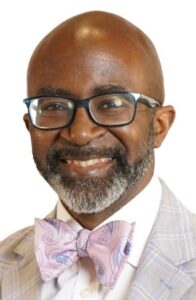 Alfred Edmond (pictured), SVP/executive editor-at-Large, and Derek Dingle, EVP/chief content officer at Black Enterprise Magazine, did not respond to requests for comment.
However, Edmond outlined the publication’s transition to digital in a 2022 message.
“Black Enterprise’s shift from magazine publisher to digital media company was completed by 2016, with only limited-distribution special issues printed 2016-18,” he wrote.
“Today, Black Enterprise is the No. 1 Black digital media brand, with monthly unique visitors exceeding 10 million (per Comscore).
“As we no longer publish magazines, we don’t measure magazine circulation, nor are we eligible to join the Alliance for Audited Media. We no longer have a traditional ‘editorial staff’; however, the company is currently hiring to fill a number of cross-platform content-related positions.
“Our primary source of revenue is digital media, including content (including video and podcasts) on our website and live-streamed on our social platforms. We also produce and livestream virtual events, in addition to our national, in-person conferences such as the Entrepreneurs Summit, the Women of Power Summit (held in Las Vegas in March 2022) and the Black Men XCEL Summit (October 2022).”
 During last month’s National Action Network conference, the Rev. Al Sharpton, its founder, said without elaboration, “Part of our mandate, we met our board this morning, is we need to escalate pressure on the corporate world about advertising in Black media. We’ve recently had to deal with one company about Essence. They almost lost the festival and we’ve got to put the pressure on as only we know how to do.”
The nation’s Black press has experienced an 80 percent decline in revenue since the backlash against diversity, equity and inclusion (DEI) ramped up a year ago, Benjamin F. Chavis Jr., DMin., president of the National Newspaper Publishers Association, said in January.
Trump’s EEOC Backs White Male Targeting N.Y. Times
“The Equal Employment Opportunity Commission is poised to file a civil rights lawsuit against The New York Times, centered on the allegations of a white male employee who did not get a sought-after promotion and argued it was because of his race and gender, two people familiar with the matter said,” Rebecca Davis O’Brien reported Sunday for The New York Times.
“The lawsuit, which could be filed as early as this week, would mark a rapid escalation of an investigation that had been underway for months, said one of the people, who had been briefed on the investigation but was not able to discuss it publicly.” [Update: It was filed.]
“The E.E.O.C. is bound by strict laws against disclosing details of civil rights complaints and investigations. Danielle Rhoades Ha, a spokeswoman for The Times, called the allegations ‘politically motivated.’ . . . .”
“Under Chair Andrea Lucas, the EEOC has become a tool in the administration’s assault on civil rights protections for women, transgender workers and other protected groups,” Tanya Goldman wrote in January for the National Partnership for Women & Families.
“The agency has made sweeping enforcement changes attempting to strip transgender workers of their Title VII protections, announced it will no longer process complaints alleging disparate impact violations – a cornerstone of civil rights enforcement for over 50 years – and is dismantling critical infrastructure for monitoring workplace discrimination. The Senate’s confirmation of Brittany Panuccio as a commissioner in late 2025 reestablished a quorum, giving the agency additional authority for the Chair and Commissioner Panuccio to advance this anti-worker, anti-civil rights agenda.”
- James Causey, Center for Health Journalism: The Health Divide: Racist language gets under the skin and erodes health (April 20)
- Gene Demby, Jess Kung, Leah Donnella, NPR “Code Switch”: In college admission, trauma is shorthand for Blackness
- Richard Fausset, New York Times: Behind Voting Rights Case, a Clash Over the Reality of Racism
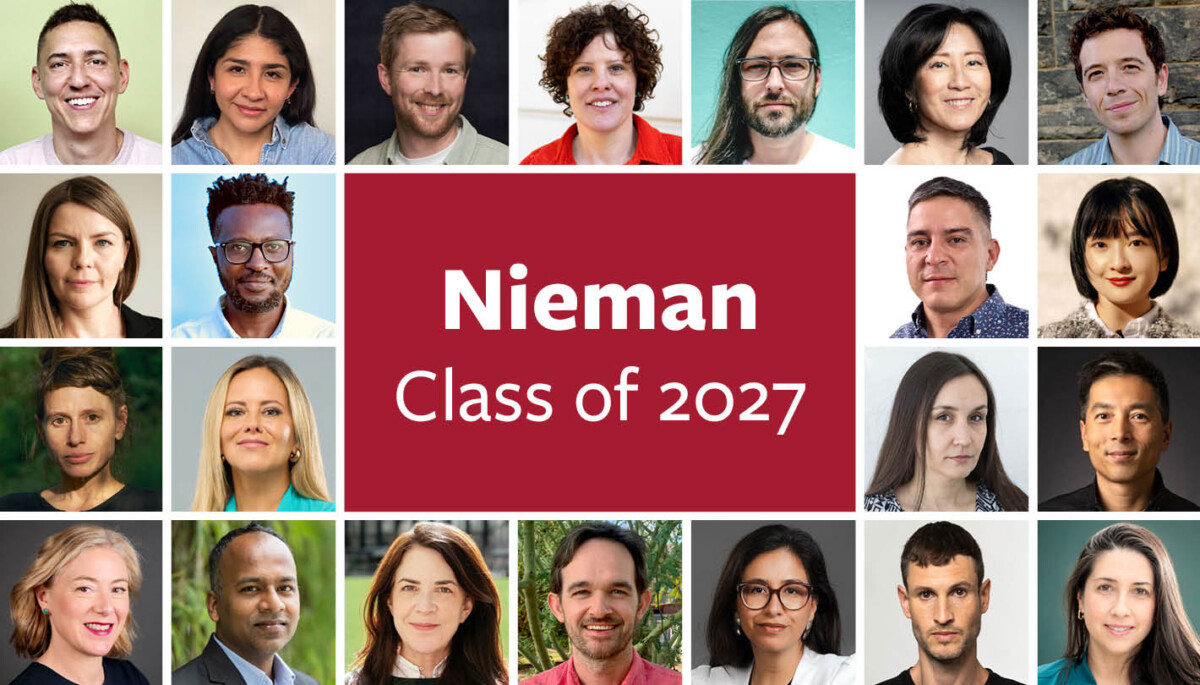
Top row, from left: Benji Jones, Cecilia Reyes, George Butler, Vivian Pasquet, Graham Lee Brewer, Ellen Nakashima, and Jake Offenhartz. Second row: Amber Bracken, Maurice Oniang’o, Juan Pablo Barrientos, and Isabelle Niu. Third row: Stacy Kranitz, Claudia Uceda, Oksana Parafeniuk, and Justin Jin. Fourth row: Harriet Torry, Sagar, Cara Buckley, Rowan Moore Gerety, Romina Mella, Hilo Glazer, and Erin Smith.
22 Chosen for Diverse Nieman Class of 2027
The Nieman Foundation for Journalism has selected 22 journalists from around the world as members of the Class of 2027, the foundation announced Tuesday.
“During two semesters of study at Harvard University beginning this fall, the fellows will research topics that will help them better understand how press restrictions and new technologies such as generative AI are changing the nature of reporting; how to better cover underserved communities; how to rebuild trust in journalism; and how to bring fresh perspectives on the impact of climate change.”
Among those selected:
- Juan Pablo Barrientos, “editor of the investigative unit at the Colombian digital news outlet CasaMacondo, will study access-to-information laws in the Americas, focusing on countries where such laws do not exist or have been rolled back.”
- Graham Lee Brewer, “most recently a national writer for The Associated Press based in Oklahoma, will study relations between tribal governments and the U.S., as well as the impact of imperialism on Indigenous storytelling and recordkeeping.”
- Justin Jin, “a photographer, writer, and National Geographic Explorer based in Brussels and Shanghai, will study philosophy and geopolitics to bring greater interpretive depth to his visual reporting across differing worldviews.”
- Romina Mella, “managing editor of the Peruvian investigative outlet IDL-Reporteros, will study the impact of disinformation strategies and violent discourse used by special-interest groups to delegitimize investigative journalism and undermine democracy.”
- Ellen Nakashima, “a national security reporter for The Washington Post, will study the impact of emerging technologies on U.S. defense and intelligence agencies and their ability to meet the challenges posed by multiple adversaries in an evolving global order.”
- Isabelle Niu, “a video journalist for The New York Times, will study how displacement and migration shape communities across borders and how journalists’ own personal backgrounds bear on their reporting.”
- Maurice Oniang’o, “a Kenyan investigative reporter who covers systemic abuses and institutional failures across East Africa, will look at how to design sustainable, collaborative models for investigative journalism in the region.”
- Cecilia Reyes, “an investigative reporter based in the Midwestern U.S., will study how individuals are affected by repeated interviews after a traumatic event, and the best practices for journalists collecting firsthand accounts.”
- Sagar, “a senior staff writer for The Caravan in India, will examine the impact of the Indian media’s systemic exclusion of perspectives of people from marginalized castes and the measures that can improve coverage of those communities.”
- “Claudia Uceda, “a national television correspondent for TelevisaUnivision who covers the U.S. government, will examine how Spanish-language journalists can survive newsroom cutbacks by leveraging AI and emerging technologies to better serve Latino audiences.”
For World Press Freedom Day, António Guterres, secretary-general of the United Nations, said that “far too frequently, the first casualties are the journalists who risk everything to report that truth – not only in war, but wherever those in power fear scrutiny. Across the globe, media workers risk censorship, surveillance, legal harassment – and even death.” (Credit: YouTube)
Worldwide, Press Freedom Means Lives Saved
“Marking World Press Freedom Day, the Sudanese Journalists Syndicate, the Sudan Media Forum, and the Sudanese Female Journalists Network highlighted a surge in targeted attacks that have left dozens of media professionals dead and pushed Sudan further down global press freedom rankings,” the Sudan Tribune reported Monday in one of the many commentaries on World Press Freedom Day, May 3.
Sudan’s civil war has created the world’s greatest humanitarian crisis. The media organizations said that “escalating violence and censorship are undermining prospects for national reconciliation.”
The Sudan Tribune continued, “The Sudanese Journalists Syndicate, which recently won the 2026 UNESCO World Press Freedom Prize, stated that attempts to control the media through intimidation or propaganda prolong the ongoing conflict.
“The Syndicate argued that freedom of expression is a fundamental requirement for a democratic society rather than a ‘postponed luxury,’ and demanded the immediate release of all detained journalists. . . . ”
Elsewhere:
- “Palestinians in Gaza gathered Sunday to mark World Press Freedom Day 2026 as Israel’s assault on journalists, especially those reporting on its actions, continues,” Drop Site News reported. The organization spoke with Tahseen al-Astal, deputy head of the Journalists Syndicate in Gaza, “who shared the following updated figures: 262 journalists killed in Gaza; 15 journalists killed in Lebanon; 150 media institutions destroyed in Gaza; 700 journalists’ homes demolished; 900 journalists displaced, many now living in tents.”
- Pope Leo “urged the faithful to remember journalists and reporters who have lost their lives pursuing the truth, particularly in areas afflicted by conflicts,” Reuters reported. ” ‘Today we celebrate World Press Freedom Day … unfortunately, this right is often violated, sometimes in blatant ways, sometimes in more hidden forms,’ he said.”
- On Cuba, Yaima Pardo wrote for Marti Noticias, “This May 3rd, Cuban journalists commemorate the date amidst a complex reality, where reporting remains, for many, a daily act of resistance and commitment to the truth.” Pardo quoted Cuban journalists, both inside and outside the island, who “warned about the deteriorating conditions for practicing independent journalism and defended press freedom as a citizen’s right.”
- The LatAm Journalism Review, a trilingual digital magazine published by the Knight Center for Journalism in the Americas at the University of Texas at Austin’s Moody College of Communication, wrote, “What is the relationship between press freedom and peace? Journalists from the Americas weigh in.”
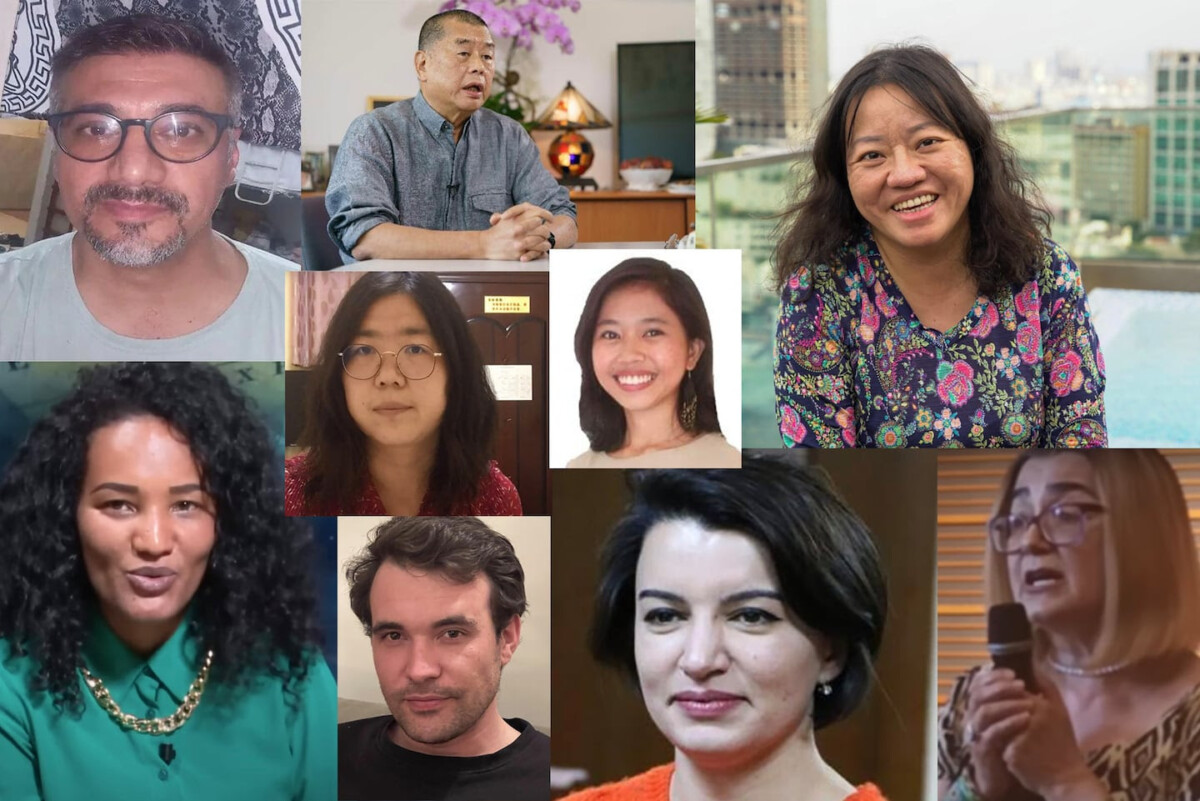
“Ten most urgent cases of journalists imprisoned in different countries for seeking the truth”: Top row, left to right: Ulfatkhonim Mamadshoeva (Tajikistan), Frenchie Mae Cumpio (Philippines), Reza Valizadeh (Iran), Pham Doan Trang (Vietnam), and Sevinj Vagifgizi (Azerbaijani). Bottom row, from left: Tsi Conrad (Cameroon), Genet Asmamaw (Ethiopia), Zhang Zhan (China), Jimmy Lai (Hong Kong), and Christophe Gleizes (France).
- “The One Free Press Coalition, which includes international media such as The Financial Times, The Wall Street Journal, The Washington Post, The Economist, The Atlantic and El Pais, publishes its annual list of the ten most urgent cases of journalists imprisoned in different countries for seeking the truth,” Quino Petit reported for Spain’s El Pais. “The 10 journalists highlighted this year have been held on terrorism or anti-state charges. According to data from the Committee to Protect Journalists, 330 journalists are behind bars worldwide for their work,” the coalition said.
- “Venezuela’s Press and Society Institute (IPYS) and the National College of Journalists (CNP) denounced on Sunday that the persecution of journalists and censorship in the country have not ceased, following the capture of Nicolás Maduro on January 3,” Efecto Cocuyo reported Sunday. “Journalism is still practiced in the country, although in conditions of resistance, marked by limitations, restrictions and harassment by the Venezuelan State against those who try to inform the public,” is the conclusion reached by Espacio Público, a Venezuelan NGO dedicated to registering cases of censorship and attacks on journalists. Its own director was detained in illegal conditions by the government of Nicolás Maduro.”
- In the United States, Mediaite republished this statement from Dan Perry’s Ask Questions Later Substack page: “Media freedom is under pressure as governments discover the effectiveness of not only killing and jailing journalists but deploying regulation and legal pressure – such as the FCC pressuring ABC to fire Jimmy Kimmel. But as we mark World Press Freedom Day on May 3, there is a deeper shift at play: the creator economy has collapsed the distinction between journalism and content, leaving the public unsure what the press is, and why it’s worth defending. This is the actual emergency.”
Jodi Rave Spotted Bear, founder and director of the Indigenous Media Freedom Alliance and Buffalo’s Fire, suggested that readers “Thank a local journalist in your community. . . .Take a moment to connect with the local reporters in your community, or drop them a thank you card,” and to “stay informed about press freedom.” “Our series, Shine, is a months-long exploration into the people who are working towards more transparency in tribal government. Support our journalism identifying the solutions for a more informed tribal citizenry.”
The National Association of Black Journalists said, “A free and independent press is essential to democracy, accountability, and the public’s right to information. Black journalists have long stood on the frontlines, documenting history, speaking truth to power, and telling stories that shape our communities and our future.
“Supporting press freedom means supporting the journalists who do this work every day.”
Alison Bethel, State Affairs’ editor-in-chief, chief content officer and veteran of international press groups, wrote, “Independent journalism does not, on its own, create peace. It doesn’t solve inequality. It doesn’t fix broken systems
“What it does — at its best — is shine a light.
“And that matters more than we often acknowledge.”
- In Liberia, the Center for Media Studies and Peacebuilding (CEMESP-Liberia) called for urgent action to safeguard press freedom in Liberia, warning of growing threats to journalists despite notable gains made in recent years. It “said Liberia’s progress toward a free and independent media environment remains fragile and at risk of reversal,” according to the Liberian Investigator.
Short Takes
- Based on a trove of ICE records obtained from a government employee, the Washington Post found at least 780 incidents in which staff members at U.S. Immigration and Customs Enforcement facilities used physical force or chemical agents to control immigrant detainees during the first year of the Trump administration, Douglas MacMillan, Andrew Ba Tran, Drea Cornejo and Luis Melgar reported Monday. “Detention guards have used punches, kicks, takedown maneuvers, restraint holds and restraint chairs, as well as less-lethal weapons such as Tasers and pepper spray, according to the reports.”
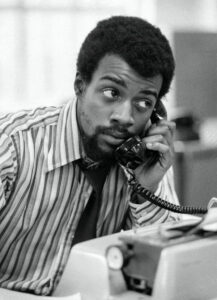
- Ronald Smothers (pictured in 1972, by Eddie Hausner/New York Times), a Black journalist who spent 35 years at The New York Times, was “among a small wave of African American reporters hired by nearly all-white newsrooms in the late 1960s with the expectation they could gain access to Black sources and bring insights during a turbulent period of the civil rights movement,” Trip Gabriel reported Sunday for the Times. “He considered it his role to ensure that Black social and political trends were reflected in news coverage.” Smothers, whose passing at 79 was reported here (scroll down), also “joined a class-action suit against The Times that claimed the company discriminated against minority groups in hiring, pay and promotions. The suit was settled in 1980 with the company agreeing to commit more resources to minority recruitment and training, but with no provision for back pay or promotions.”
- “At least 40% of Post-Gazette newsroom workers are expected to lose their jobs Monday as new nonprofit owners take over, the Newspaper Guild of Pittsburgh said Friday,” Chrissy Suttles reported for Axios. “The big picture: Staff reductions will shrink coverage of local news, high school and college sports, and the arts at Pittsburgh’s oldest newspaper, along with cuts to editing and production staff, per the Guild. . . .” The reductions did indeed take place, a Guild spokesperson told Journal-isms. “Based on the union’s estimates, 80 percent of those on the Post-Gazette staff who had been on strike received the bad news,” Riddhi Setty wrote Tuesday for Columbia Journalism Review.
- “American Muslims: A History Revealed,” a six-part documentary series “that reveals and explores the early history of Muslims in the United States,” began airing last weekend on some public television stations. “The films are hosted by journalists Malika Bilal, Aymann Ismail, and Asma Khalid, who travel the country to piece together stories spanning over 200 years.”
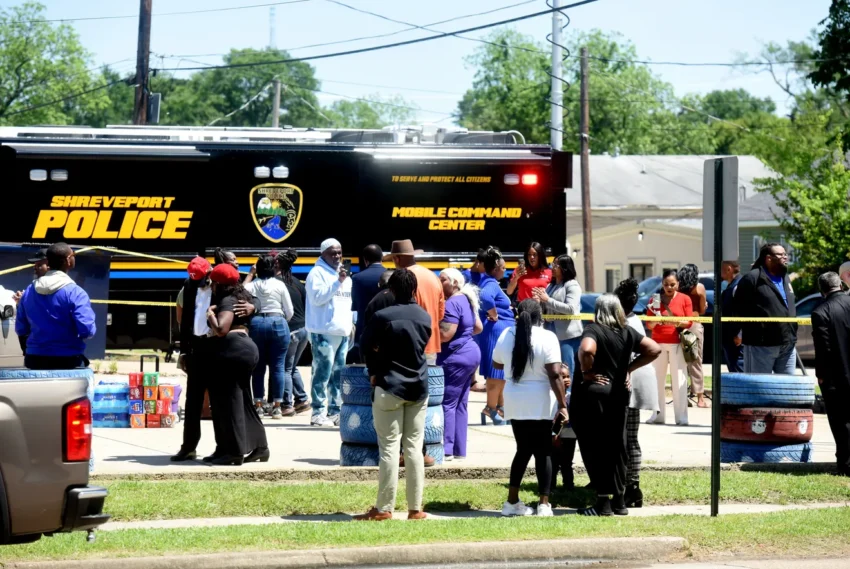
Community members come out to show support for the deadly shooting of eight juveniles in the Cedar Grove neighborhood of Shreveport, La., on April 19. (Credit: Henrietta Wildsmith/Shreveport Times)
- Adam Mahoney of Capital B followed up on the April 19 assaults in Shreveport, La., in which eight children were killed, seven of them shot by their own father in what appeared to be a domestic violence massacre. Mahoney reported Thursday for Capital B, “Interviews with domestic violence survivors in Shreveport reveal a culture where abuse is dismissed as ‘normal relationship problems,’ where police won’t remove abusers from shared homes until violence becomes ‘super physical,’ and where economic vulnerability traps Black women in dangerous relationships. In Shreveport, a majority-Black city, more than 30% of homicides are domestic-related, which is three times the national average.”
 “It was my honor to present the inaugural Michael Days scholarship on behalf of NABJ Philadelphia to two outstanding students pursuing a career in journalism,” Melanie Burney reported on social media. “Ciara Gustin (at left), a sophomore at the University of Delaware and Jackson Juzhang, a senior at Haverford College, each received $2,000. We were blessed to have Mike’s wife Angela Dodson (center) help present the checks. NABJ Philly started the scholarship in October in loving memory of Mike, our founding president and a legendary journalist and media executive. What better way to carry on his legacy! . . .” (Photo credit: Facebook)
- “American teens today are getting their news from… everywhere,” Graph Massara reported Sunday for Semafor. “A new AP-NORC survey of Americans ages 13 and up, out last week, shows that the youngest media consumers are omnivores; 13-to-17-year-olds said social media (57%) was their top source of daily news, and TV, their parents’ favorite source, was their No. 2. But sizable portions also said they get news each day from search engines (37%), email (24%), radio (24%), and chatbots (22%), a more even spread than older cohorts. And 57% of teens said they ‘sometimes’ or ‘often’ get information on national news from influencers or independent creators (compared to 44% average across age groups). Another finding from the survey suggests the reason why: Teens distrust all news sources roughly equally, except for AI, which they trust even less.”
- . . . “The study also reveals significant stress and fatigue in Americans’ relationship with news,” the American Press Institute reported. “While most feel capable of finding relevant content and identifying trustworthy information, the emotional toll they feel in doing so is considerable. Very few Americans say news gives them a hopeful view of the world; and a substantial portion report feeling overwhelmed or finding news too stressful.”

- “Here is what I’ve learned,” Madeleine Bair, founder of the Bay Area publication El Timpano, wrote Monday for the Poynter Institute: “The fact that El Tímpano serves low-income immigrant communities is not our weakness. It’s the foundation of our sustainability. That realization came from a $5,000 grant from the Alameda County Census office in 2020. The county wasn’t paying us to reach a mass audience. They were paying us because we could reach people they couldn’t — people who wouldn’t answer the door when a census worker knocked, who didn’t speak English, who didn’t trust government sources, but who trusted El Tímpano.” The publication Monday released the Civic Partnerships Playbook, “a free, practical guide for local newsrooms seeking new revenue strategies, particularly those serving immigrant and low-income communities.”
- “The National Association of Hispanic Journalists (NAHJ) is expanding its NAHJ Cares initiative through a strategic collaboration with the Media Resilience Network, bringing critical mental health and wellness resources to Latino journalists navigating one of the most challenging moments in the industry,” the groups announced Friday. “As part of this effort, NAHJ and the Media Resilience Network will host a free webinar, “Building Your Mental Health Toolkit: Practical Stress Management for Journalists” at 6 p.m. ET/ 3 p.m PT on May 28 led by Luisa Ortiz Pérez and Joe Ruiz. Register here. NAHJ membership is not required.
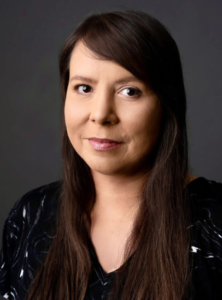
- Mary Hudetz, Apsaalooke (Crow Tribe) (pictured), formerly a reporter and editor for the Associated Press and an investigative reporter for the Seattle Times and ProPublica, is now the Indigenous Journalists Association’s director of education and training, the association announced Friday. “In this contract role, Hudetz will help guide the next phase of IJA’s student and professional development efforts as we continue to support Indigenous storytellers — and strengthen pathways for them to thrive,” the organization said. Hudetz was president of the group,, formerly the Native American Journalists Association, from 2013 to 2015.
- “Award-winning director Luchina Fisher’s Hiding in Plain Sight, a dynamic examination of the innovative Black, queer musicians — like Sister Rosetta Tharpe and Little Richard — who have driven forward mainstream culture despite their full selves being acknowledged, is the big winner at Black Public Media’s PitchBLACK Awards,” Black Public Media announced. “The documentary was awarded $150,000 in production funding. Sponsored by Netflix and Andscape, PitchBLACK is the nation’s largest pitching session for Black stories (film and immersive media).”
 “Semafor has promoted Prashant Rao (pictured) to global managing editor, elevating a senior newsroom leader with international reporting and editing experience to a key role overseeing its global editorial operations,” Citybiz reported Monday. “Rao, who has been based in London as a senior editor, has led Semafor’s flagship daily newsletter, Flagship, while managing a range of editorial initiatives across the organization. In his expanded role, he is expected to help guide the company’s global news strategy and day-to-day editorial execution as it continues to build out its international coverage.”
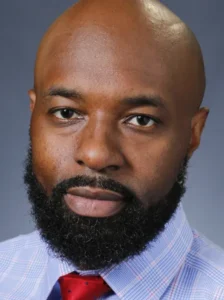 Javier E. David (pictured), who has been business editor at the Dallas Morning News, has left the news organization, Chris Roush reported Friday for Talking Biz News. “He had been with the Morning News since December 2024.” David told Journal-isms, “For now, I’m still planning to stay in the D-FW area and am pursuing independent projects of my own choosing. . . . I still contribute to CBS News as a markets and economy commentator.”
- “Urban One is simultaneously growing and streamlining its Dallas presence, acquiring two stations while handing off a third to a Spanish-language Christian broadcast ministry seeking a new flagship among the market’s massive Hispanic audience,” Cameron Coats reported Friday for Radio Ink. “The company has agreed to acquire Service Broadcasting Group, LLC, which includes stations KKDA and KRNB. As part of the deal, Urban One will sell 94.5 KZMJ to Fuzion Dallas, LLC, the entity behind Encouragement Media Group’s Fuzión format. . . .”
- “Historic recordings from Fisk University’s campus radio station will be digitized to preserve decades of voices, culture, and community,” Nashville’s NewsChannel 5 reported. “The HBCU Radio Preservation Project selected WFSK 88.1 to digitize nearly 400 hours of historic audio. The recordings will be available to researchers, students, and creators to ensure the voices continue to be heard. Nearly one-third of the nation’s 101 HBCUs have radio stations, with many featuring decades of history still on the air today.”
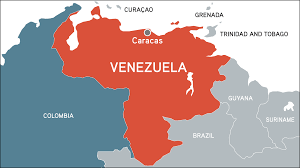 A study of 129 women who are journalists and students of Social Communication in Venzeuela shows that 44.2% of participants reported having been victims of workplace sexual harassment, and an additional 13.2% stated they were unsure, bringing the total to 57.4% of women who have experienced or suspect they have experienced these situations, medianalisi, which explores the relationship between journalism and social actors in the country, reported April 27. The majority of the harassment is verbal or non-verbal (40.3% have experienced it more than once), followed by online harassment (33.3%), physical harassment (26%), and sexual coercion in exchange for job benefits or information (12.4%).”
- “Russia has trained more than 1,000 content creators, journalists, or influencers to spread disinformation in eight Latin American countries: Argentina, Bolivia, Chile, Colombia, Cuba, Mexico, Nicaragua, and Venezuela, according to a report from the Digital News Association (DNA) presented in the United States March 31, the EFE news agency reported. “These communicators, trained by the state media outlet RT in Spanish, join nearly 200 Spanish-speaking content creators that Moscow has in Russia to distribute information towards Latin America, said investigative journalist Jeffrey Scott Shapiro, coordinator of the Russian Propaganda Alert at DNA.”
