

Sometimes We Don’t Know What We Don’t Know
Homepage photo: Ivan Meyers, senior lecturer and director of operations at Medill Washington, welcomes the Journal-isms Roundtable to his campus. (All photos by Jeanine L. Cummins)
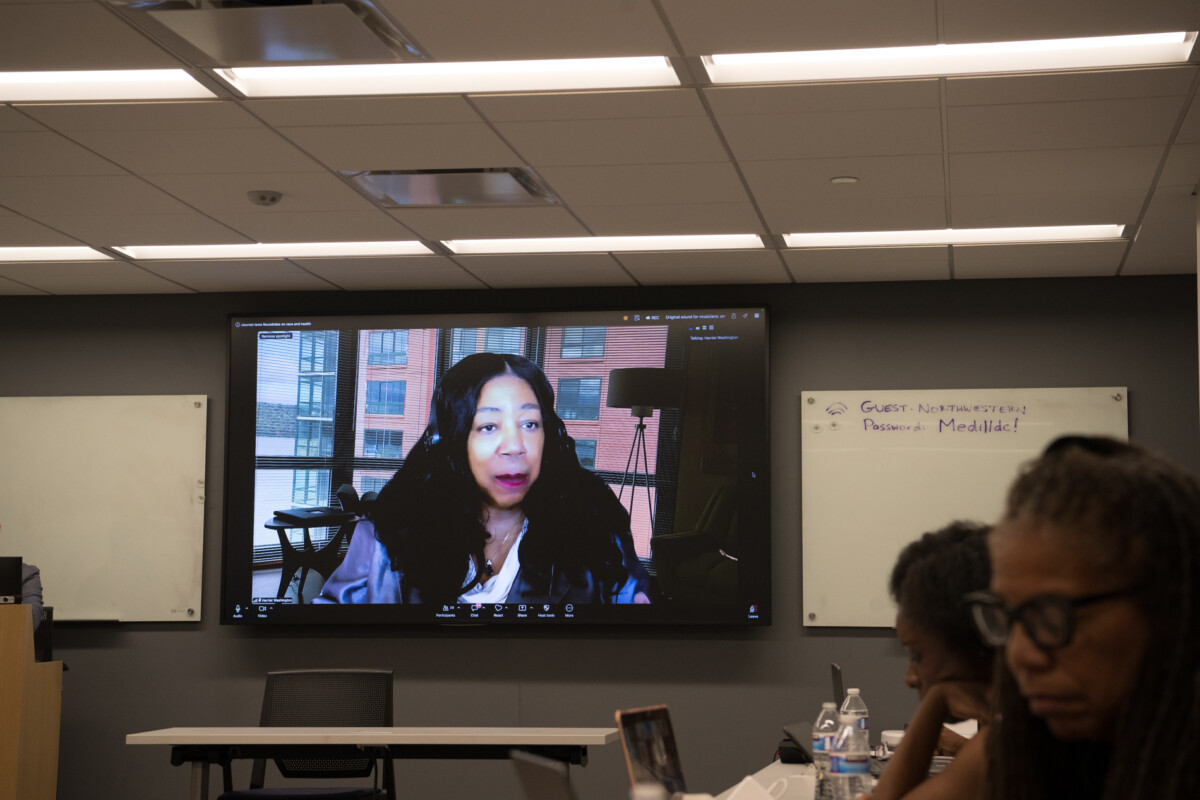
“These algorithms, these measurements and metrics that differ by race, they’re part of systemic racism,” explains Harriet Washington, a lecturer in bioethics at Columbia University and author of several books on medicine and race.
Sometimes We Don’t Know What We Don’t Know
When it comes to racial disparities in health care, even journalists don’t know what they don’t know.
That was one takeaway from a Journal-isms Roundtable on “Race and Health” that underscored calls for journalists to educate themselves, and then their readers and viewers, on how preconceived notions, issues of access and lack of funding have placed Black people at a disadvantage in situations ranging from everyday health care to enrollment in medical schools to the use of harmful hair products.
 Journalist Nicole Carr (pictured), author of the new “The Price of Exclusion: The Pursuit of Healthcare in a Segregated Nation,” told attendees about “the stress of being Black that is embedded in your body because of the risk that you calculate every day just to survive.”
Yet amid the cautionary tales and the revelations about how insidious some medical practices can be was a very bright spot:
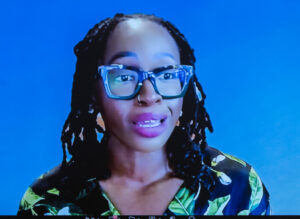
 By Zoom, Daniel Cressy (pictured), a 23-year-old Black would-be aviator, told those assembled, “I made history as the first person in Louisiana to become cured or functionally cured of sickle cell disease. And now I’m on the next steps of applying for my medical certificate this week and eventually get my medical, start flying and become a commercial pilot.”
Cressy is one of fewer than 100 people worldwide to receive a new type of gene-editing therapy that led to his new status.
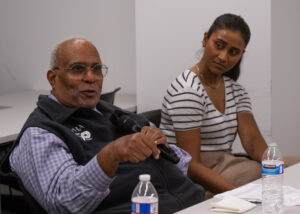 “Most people with sickle cell live their lives in and out of the hospital constantly,” Cressy said. The trait has dogged Black people for generations, even the much-lauded Tuskegee Airmen of World War II, explained Dr. Georges Benjamin (pictured, with Shubhanjana Das), executive director of the American Public Health Association.
“Daniel’s living this long is the benefit of enormous medical research and intervention over the years and things we learned from that work. And this gene therapy that he has is the future of medicine,” Benjamin said.
“And so the question here is, is that going to be available to anybody for any disease? Because we’re going to be talking about going into people’s genomes and addressing them early for cardiovascular disease, for cancer, for hyperlipidemia, for diabetes. I mean, we’re at a place . . . There are a lot of ethical issues here. Costs, expense, access to care, training, having enough people trained to do this. . . .
“Ethical issues about going in and screwing around with your genome.
“Deciding what baby’s going to be born tomorrow. . . . We now do genetic screening and we’re going to pick this baby over that baby. This embryo over that embryo. This baby who’s going to look like me over this baby who doesn’t look like me. . . .
“In the military, even having sickle cell trait . . . at one point, Black flyers could not fly if you had sickle cell trait, meaning you didn’t have the disease, but one of your genes was a sickle gene and the other gene was a normal hemoglobin gene. . . .”
It was another way “of keeping Blacks from flying. Another way to keep them out of the place, out of airplanes in the military. . . . It was a big fight in the military, which ultimately was won by Black flyers to allow them with ‘trait’ to fly. . . . There wasn’t really a scientific study done, but there were many Tuskegee Airmen who weren’t screened who would often complain about having left-flank pain, probably splenic infarctions, who had trait, who flew marvelously, as we know.
“And so the point is that even having trait, if used inappropriately from a policy perspective, can undermine our ability for us to succeed and to go into different disciplines and jobs. . . .
“It’s a fascinating story. And I encourage some of you folks to write about that because I think that’s a wonderful story about health equity. And then if you line that along all the stuff we did or didn’t do with HIV/AIDS, those two stories line [up].”
Added Cressy, “There’s a lot of funding that needs to be put toward sickle cell research. It’s a lot and I can’t even really deep dive into it, but there’s a lot of things that we still have to do as a community to ensure that everybody and every family has access to this treatment.”
Twenty people gathered in person for the “Race and Health” Journal-isms Roundtable on Sunday, July 12, at the downtown Washington, D.C., campus of Northwestern University’s Medill School of Journalism, Media, Integrated Marketing Communications. Another 33 joined via Zoom. (Credit: YouTube)
In addition to considering issues related to living conditions, access and myriad other obstacles, those addressing racial disparities in health care have a lot of history to factor in.
They must account for algorithms used in medical practice that are based on false assumptions about racial differences.
“These algorithms, these measurements and metrics that differ by race, they’re part of systemic racism, but it’s important to uncontextualize them in history of medicine, because in the mid-19th century, physicians promulgated the idea that Black people had diseases that only they suffered and they had immunities [to] disease that would not harm them,” explained Harriet Washington, a lecturer in bioethics at Columbia University and author of several books on medicine and race, including “Medical Apartheid: The Dark History of Medical Experimentation on Black Americans from Colonial Times to the Present.”
“The end result is to separate them from the care they need.”
A 2016 study by researchers at the University of Virginia found that 40 percent of white first- and second-year medical students and 25 percent of medical residents believed the false claim that “Black people’s skin is thicker than white people’s skin.” Another finding without factual basis was that Black people’s blood coagulates faster or that their nerve endings are less sensitive than those of white people.
Trainees who believed these myths rated Black patients’ pain as lower and were significantly more likely to give inaccurate, inadequate pain treatment recommendations, the researchers found.
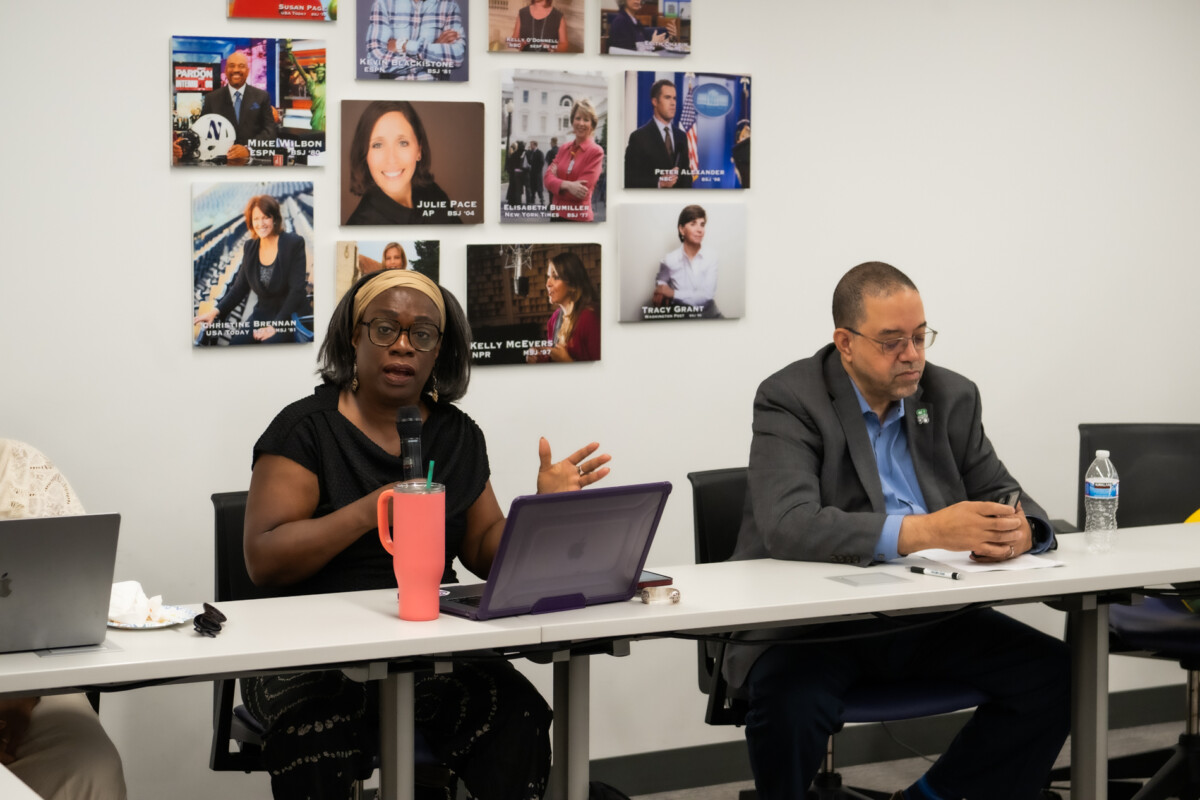
Rachel Jones describes her experience at George Washington University Hospital in Washington. She is seated next to Dr. James E. Rogers of Consumer Reports, who discussed its study of hair braiding products. On the wall are photos of Medill alums.
The Roundtable attendees had their own examples. “I just had to sort of jump in . . . probably one of the most defining experiences I’ve ever had as a journalist was in 2018 when I was reporting on maternal mortality with Black women, women of color for National Geographic,” said Rachel Jones, director journalism initiatives at the National Press Foundation.
“And I was at GW [George Washington University] Hospital in the maternity ward and there were two women in the room — labor and delivery room — that I was in; one was Black, one was white. And the team came in and they stood at the white woman’s bedside cooing and wiping her brow and comforting whatever and turned to look at the Black woman in labor saying — physical responses. One of them tugged the cover up and then they all walked out.
“And I was standing there, and they knew who I was. And so for me, it so profoundly drove home the point that if you are not perceived as human or as much human or as someone who experiences pain or someone who needs that kind of interaction, it’s going to affect the type or the quality of care you get throughout your life cycle.”
Benjamin added, “There’s no intellectual reason why you should actually think that one race of people’s skin — I recognize that’s a social construct — is any different than any other. Or that we do the study of neurology and pain. We all studied the same material, but unless somebody specifically tells you these stupid things are stupid, they’re obviously wrong, but people do integrate them in their thinking.”
Indeed, there are some efforts to combat these myths, but the disproportionately low numbers of doctors of color isn’t helping. “The exclusion of Black physicians in these systems matter to the way that we’ve understood our bodies, the health of our nation, how socioeconomic conditions play into that,” said Carr.
Add to that “these exclusionary policies in place today, whether they’re economic policies, the DOJ going after these medical schools for folks who have already been admitted, challenging the place,” Carr continued, referencing the Department of Justice targeting medical schools over diversity, equity and inclusion.
That’s in addition to fears that pursuing Medicaid fraud is just another way of getting rid of Black doctors.
Veteran journalist Barbara Reynolds, a former USA Today columnist, cited her own reporting and a forthcoming book by Angela Greene and herself, “Legalized Extortion: How the Government Hunted Black Doctors for Treating Poor and Elderly Medicaid Patients.”
“The reporting . . . showed how because of high costs, this is what was said, that there was fraud in the Medicaid programs. But instead of dealing with the top firms, they went after doctors. I saw doctors who had lost their whole practice. I visited doctors in prison. I visited widows because their doctor husbands had committed suicide. It was a terrible thing. And I reported on it all through the ’80s and ’90s and thank God Angela Greene has taken [it] up.
“But I want to know,” Reynolds continued, “a recent call came out that Trump was going to get rid of Medicaid fraud. I said, ‘Oh my God, here we go.’ And what can we do to raise this issue to show how the way that they are getting rid of Medicaid fraud is to get rid of the doctors? So how can we get more attention to this?”
 Attention is also what’s needed to the health concerns of Consumer Report’s Dr. James E. Rogers, director of product and food safety testing, who led the publication’s testing of braiding hair products.
“I’ve seen some numbers that Black women use about 18 personal care products where white women use about 11. Plus those products tend to have more contaminants in them than mainstream products,” Rogers said.
“So we have to be really, really aware of what we’re putting on our bodies and what goes on our bodies gets in our bodies at times. And so those are the reasons why I took this project on. . . .
“What we found is that the majority of those products had something that had potential to harm the wearers of this product. We did a risk assessment where we tried to gauge what the actual exposure might be and what those levels might be. Got criticism though, because they said our risk assessment was not very realistic.
“And so for the second testing, Black women asked us, ‘Well, what can we use?’ And so we tested those products labeled safe. We tested human hair. Human hair had orders of magnitude of lead in it much more than any other product that we tested. And human hair is seen as an alternative to the synthetic products. The other concern is, well, how’s this lead getting in there? And we believe that the women that sell their hair for the human hair market are exposed to lead in their environment, in their diet.
“And so that’s something else to explore. We were also concerned about the braiders. The braiders actually are exposed to these products for days and hours and over years without any type of protection, not wearing masks, not wearing gloves, et cetera.
“We did a lot of outreach and education to consumers about these products, but also what can they do to change things? We submitted a number of petitions. We submitted a number of acts toward the actual manufacturers. We actually showed up at their door and wanted to deliver the petitions to get these manufacturers to commit.
“Now, I do have to say there’s some smaller manufacturers that are working with us to try to set limits, to try to be transparent in testing, to try to actually find good labs to help them test. Testing is expensive, but they’re willing to do this and they’re usually Black-woman-owned manufacturers that are willing to commit to actually produce a much safer product. Also want to say that this resonated with the mainstream because we were nominated for an ASME and the Deadline Club awards, the former referring to the American Society of Magazine Editors; the latter to the New York chapter of the Society of Professional Journalists.
“We just recently published about hair dyes and hair dyes that resonate in the Black community and Afro-Latina community,” Rogers continued. “And we’ve actually stood up a brand new personal care product testing group where we can test more of these products. “The Black women asked us, ‘Please test wig glues, please test wigs, please test eyelash glues.’ There’s a report that there may be formaldehyde in these glues. And so we want to do more testing, but it’s all about resources and timing. So I’m hoping that we get more publications and more information out there, but also more advocacy.”
There is no question that the conditions under which Black people live contribute to the racial disparity.
 In 2023, Bernardine Watson’s book “Transplant: A Memoir,” won the first annual Washington Writers’ Publishing House Creative Nonfiction Award.
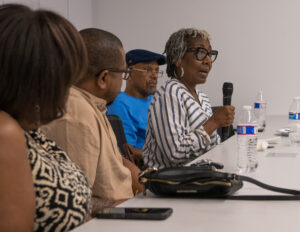
“I’ll just talk about my own experience in my dialysis center,” Watson (pictured, with microphone) told the other Roundtable attendees. “I was on dialysis for five years. I went to a dialysis center in Dupont Circle and the whole dialysis center was Black and I was always talking about coming up on the ground floor, coming up out into the light where you would see all the white people in Dupont Circle and all the Black people were in dialysis with me.
“And also people that have multiple conditions. I knew people that not only had kidney disease, but they had drug addiction disease, they had diabetes and other things and those people, the doctors, weren’t so interested in helping them to get a kidney.
“The percentage of nephrologists that might pay attention to Black people is another issue.
“Just people being able to be healthy enough to advocate for themselves, and lots of Black people live in food deserts where if you want to start there with nutrition. And then we end up with high blood pressure, with diabetes. These are the things that lead to kidney disease.
“So yes, there is a racial dimension because Black people are susceptible to these diseases because of often the way we are living in this society.”
 Sometimes cultural interventions are needed. ShirDonna Lawrence, Ph.D. (pictured), of the Jed Foundation, is leading a program targeting Greek-letter organizations and the mental health of their members. Black and Hispanic suicide rates are increasing while those for whites are declining, according to the Centers for Disease Control, “and we’re seeing an even higher percentage in suicide in Black men ages 20 to 24,” Lawrence said.
“We’ve seen a lot of concerns around sports betting, relationship violence, or just how to navigate a breakup. . . . Students don’t want to come to the grown folks anymore for help. They go to each other more than they go to maybe even professionals.”
For journalists, the challenge is to educate themselves, and in some cases, to get the story right.
Shubhanjana Das, who covers immigration for the Sahan Journal in Minneapolis, pointed to a nationally publicized kickback scandal involving Feeding Our Future, a nonprofit federal food aid program. The scandal was used to demonize the Somali community, Das said, but that program gave them money to feed children.
“The mastermind of this fraud case was a white woman,” Aimee Bock, Das said. “And the Somali community was dragged into this as to make some sort of an example. And what followed is that Black and brown families lost jobs who worked in the childcare community in the daycares.
“I have interviewed Somali Black immigrants, who by the way have a high percentage of autism in that community. They don’t have care anymore. Parents have had to quit their jobs to care for their kids because they can’t go to daycare centers because they were all shut down out of fear. And that’s what brought the immigration agents to Minneapolis. And the ripple effects just followed with Latina women not feeling comfortable going to the hospital to give birth or people just sitting at home with major chronic illnesses because ICE was in the hospital targeting Black and brown people.
“So I think people often miss that strand . . . This started as-a health disparity story, which then spiraled into this immigration story.”
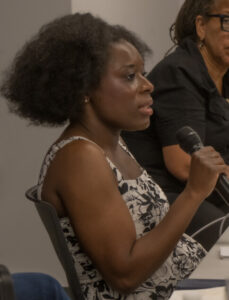 Delese Smith-Barrow (pictured), who helps lead a health-coverage team at Politico, said, “the hard part for journalists can be figuring out how do we tell those stories in a way that’s nuanced and really gets people engaged. Sometimes with health, once you get into the Medicare versus Medicaid, their eyes glaze over, they don’t know the difference, and it just does not feel relatable. It does not feel attainable.
“And so I hope that in my work as a journalist, I make healthcare health language less intimidating and people are starting to get even an inkling of, OK, this is what I need to know to advocate for myself or my family members.”
The Roundtable also heard from veteran journalists Susan Chira and Miranda Spivack, who gave a brief presentation about the free support their Main Street Media Cooperative is offering to newsrooms around the country. “This comes in the form of providing reporters to work collaboratively on stories about the many ways the actions in Washington are affecting people and readers close to their homes: health, environment, immigration, criminal justice, the economy and on and on.” The founders, who include Amanda Bennett, formerly CEO of the U.S. Agency for Global Media, director of the Voice of America and editor of the Philadelphia Inquirer, “also are looking for expert journalists to assist/provide expertise for a small honorarium.“
Roundtable Topics ‘as Urgent as They are Complex’
 “In an era when the media industry is under constant scrutiny for how it represents race, equity and truth, few spaces have proven as enduring — or as discreetly influential — as the Journal-isms Roundtable,” Roundtable regular Gregg Morris (pictured), journalist and journalism professor, writes on his The Word Review site.
“The Roundtable has, for more than two decades, served as [a] unique forum where journalists gather not simply to network, but to wrestle with the most pressing and uncomfortable issues and challenges facing their profession. . . .
“Participants — ranging from reporters to editors, academics, media executives, and students — come prepared to discuss topics that are as urgent as they are complex: Racial bias in reporting, the lack of diversity in newsroom leadership, inequities in coverage, and the ethical dilemmas that arise when telling stories about marginalized communities. . . .”
- American Medical Association: Willie Underwood III, MD, inaugurated as 181st AMA president (June 9)
- Aaliyah Amos, Word in Black: Where Black Students Find Racial Healing on Campus
- Ashley Andreou, Scientific American: Doctors Do Racist Things to Patients. Here Are Seven Ways They Can Stop (Oct. 26, 2023)
- American Psychological Association: President Wendi S. Williams, PhD
- Robert B. Baker, Harriet A. Washington, Ololade Olakanmi, Todd L. Savitt, Elizabeth A. Jacobs, Eddie Hoover, Matthew K Wynia: African American physicians and organized medicine, 1846-1968: origins of a racial divide (July 10, 2008)
- Geoff Bennett and Zeba Warsi, “PBS NewsHour”: Former USAID head says ‘people are dying’ a year after agency’s dismantling (July 1)
- Jessica Blake, Inside Higher Ed: DOJ Finds That UC Davis Medical School Considers Race in Admissions (June 11)
- Nicole Carr with Geoff Bennett, “PBS News Hour”: ‘The Price of Exclusion’ explores lasting impact of racial inequality in medicine (June 17)
- Commonwealth Fund: The Commonwealth Fund 2026 State Health Disparities Report (April 29)
- Zoe Cummings, Washington Post: At 23, he was functionally cured of sickle cell. Now he’s ready to fly.
- Boubacar Diallo, Associated Press: Autism remains widely misunderstood in parts of Africa. A mother in Guinea fights for her child (July 4)
- Cecil Egbele, USC Center for Health Journalism’s Ethnic Media Collaborative: The Imported Doctors: Kern County built its healthcare system on foreign medical talent. What happens if the international pipeline breaks? (June 8)
- Adrian Elimian and Nicholas Wu, Semafor: Trump administration to end PEPFAR funding for South Africa (June 18)
- Judy George, MedPage Today: Why Danny Glover Is Speaking Publicly About His Alzheimer’s Disease (July 2)
- Cindy Krischer Goodman, South Florida SunSentinel: TikTok is reinventing healthcare; should you trust it? (June 20)
- Cindy Krischer Goodman, South Florida SunSentinel: ‘Bad policy costs lives.’ Medical professionals urged to improve Black patient outcomes — by voting (June 18)
- Jennifer Porter Gore, Word in Black: Black Men: “Manning Up” Isn’t a Mental Health Flex (June 5)
- Jennifer Porter Gore, Word In Black: COMMENTARY: Mental Health Crisis Among Black Men — A Growing Concern (June 15)
- Suzette Hackney, USA Today: As a mental health crisis hits young adults, this group offers hope (Feb. 27, updated March 2)
- Michelle D. Holmes, MD, MPH; David Hodges, MD; John Rich, MD, Journal of the American Medical Association: Racial Inequalities in the Use of Procedures for Ischemic Heart Disease (June 9, 1989)
- Kelly Hooper, Politico: The miracle cure for sickle cell is now 2 years old. Most are still waiting. (Dec. 28)
- Dana James, Black Iowa News: ‘The Black Superwoman & Mental Health: Power & Pain’ anthology tackles sensitive subject (podcast) (June 23)
- Johns Hopkins Medicine: AI-Assisted Diagnostic Tool Shown to Reduce Eye Care Disparities for African American Adults With Diabetes (June 9)
- Roy S. Johnson, al.com: Hey, it’s my 1-year prostate cancerversary. My faith is even stronger (June 2)
- Adam Mahoney, Capital B: Black Americans Face Heightened Risk in Record-Breaking Heat (July 1)
- Shaunicy Muhammad, Oklahoma Eagle: Tulsa, Cherokee Nation partner to increase healthcare access, lung cancer screening
- National Nurses United: A PREVENTABLE CRISIS: The Unnecessary Cuts to Medicare, Medicaid, and ACA Threatening 602 Hospitals and the Communities They Serve [PDF]
- Deon Osborne, Oklahoma Eagle: As Oklahoma cuts mental health funds, Black counselors seek to expand services in Tulsa (Dec. 3, 2025)
- Roni Caryn Rabin, New York Times: Racial Inequities Persist in Health Care Despite Expanded Insurance (Aug. 17, 2021, updated Aug. 29)
- Kate Raphael, Harvard Global Health Institute: Racial bias in medicine (Feb. 5, 2020)
- Caroline Raymond-King, MD, PhD, Molly M. Jeffery, PhD; Sirry Alang, Ph.D. et al, Journal of the American Medical Association: Deaths Caused by Law Enforcement in the US (” Non-Hispanic Black males had the highest mortality rates each year, indicating persistent racial disparities, even in adolescence.”) (July 8)
- Ana Rodriguez-Knutsen, YWCAWorks: Why BIPOC women receive unequal health care (Feb. 8, 2023)
- Sal, Medium: They’re Calling Black Doctors “DEI” After America Spent Generations Making Them Rare (May 25)
- Sree Sreenivasan, Substack: How I Use AI to Manage My Pre-diabetes (June 12)
- Tisha Thompson, ESPN: Ex-Bucknell strength coach charged with hazing in 2024 death of player who collapsed during workout (player collapsed from sickle cell-related rhabdomyolysis) (July 7)
- Kaitlin Washburn, Chicago Sun-Times: Illinois prison healthcare still poor as state goes 1 year without long-term medical provider (July 7)
