

$18 Billion Settlement Crafted to Lessen Time Online
Black News Sites Join in Outpouring for Dolly Parton
Cubans, in Poll, Seek Transition to Capitalism
Keith Ellison, Minnesota’s attorney general, said in a statement, “I expect this settlement to set a template that will fundamentally transform how the whole social-media industry designs products for kids and teens and safeguards their experience. Keeping our kids safe online is my goal.” (Credit: C-SPAN)
$18 Billion Settlement Crafted to Lessen Time Online
If persistent reports that people of color are disproportionately affected by harmful social media consumption are correct, an $18 billion settlement with Meta to resolve claims brought by 29 U.S. states over children’s safety should be sweet news.
“Meta on Wednesday agreed to sweeping changes designed to restrict minors’ access to Instagram and Facebook. The changes include a daily time limit, a restrictive ‘Night Mode,’ autoplay controls, and more,” Amanda Silberling reported for TechCrunch.
“The lawsuit alleged that the social media giant knowingly designed platforms like Instagram and Facebook to addict children, despite knowing about the harms the platforms could pose to young users. The states also claimed that Meta knowingly collected data from children without parental knowledge, which violated the Children’s Online Privacy Protection Act (COPPA).
“By settling, Meta is not admitting that it’s guilty of these claims, but it shows the company’s reluctance to move forward with a jury trial. . . .”
There has been clear evidence that social media abuse disproportionately hurts people of color.
“People who are young adults, Black, and female are among the largest consumers of social media in the United States,” Sara Matsuzaka, Lanice R. Avery and Alexis G. Stanton wrote in 2023 for Social Media + Society, citing previous research.
“Approximately 84% of young adults in the United States use at least one social media platform. Relative to White Americans, Black Americans report greater use of social media platforms, such as Facebook (74% vs 67%) and Instagram (49% vs 35%; PRC, 2021), with women reporting greater use than men. . . .
“Women are shown to use social media for social interaction, information access, and entertainment . . . Scholars suggest that Black American women may have other uses for social media, such as access to social resources to navigate structural oppression.”
Another team studying problematic screen use (social media, video games, mobile phones) reported for Pediatric Research in 2022 that” Native American, black, and Latinx adolescents reported higher scores across all problematic screen measures compared to non-Latinx white adolescents.”
Among a sample of U.S. adolescents, Black eighth graders reported higher daily use of video games compared to their white counterparts, even after controlling for socioeconomic status, J.M. Nagata, G. Singh, O.M. Sajjad, et al. reported in 2022 for Pediatric Research. (Credit: YouTube)
During the COVID pandemic, Xiangyu Tao and Celia B Fisher cited hate speech in a report for the Journal of Adolescent Health. “The recent increase of racial/ethnic discrimination messaging on social media during the COVID-19 pandemic and racial justice movements places Black, Indigenous and people of color (BIPOC) youth at higher risks of mental health problems,” they said. “Pre-pandemic research has shown that between 10% to 42% of BIPOC adolescents have experienced and 70% witnessed online racial discrimination.”
Added Alyan Layu , Samiksha Krishnamurthy, Rachel McKenzie and Bo Feng, writing in 2022 for JMIR Formative Research, “With increases in anti-Asian hate, Asian and Asian American social media users may experience the negative effects of online racial discrimination in addition to the reduced psychological well-being resulting from exposure to online COVID-19 content.”
Silberling continued for TechCrunch, “Meta is framing its settlement as a call to action for YouTube and TikTok to adopt a set of protections for teens and controls for parents, which it developed in collaboration with 52 state attorneys general. Pending judicial approval, these protections will include the following terms, which will remain for 10 years:
- “A default two-hour daily time limit, cumulative across both Facebook and Instagram; at 60 and 90 minutes, teens will be alerted about their daily usage, and they will also see prompts at 15-minute intervals to ‘encourage intentional use,’ per Meta’s description
- “A default block from Meta’s apps between midnight and 6 AM (known as ‘Night Mode’), plus muted notifications from 8 AM to 3 PM, when teens should be in school (‘School Mode’)
- “A default block for teens on seeing the number of likes and reactions on both their own posts and others’ posts
- “A block for teens on using what Meta describes as ‘extreme makeup filters,’ building on its existing block of cosmetic surgery filters
- “Further investment in age assurance technology to proactively identify accounts that might belong to users under 13 years old, or accounts that might belong to teens but were registered with an adult birthday
“While Meta already defaults teens into private Facebook and Instagram accounts, the company says it will strengthen its work to prevent adults from finding, following, and interacting with teens. Meta has also vowed to strengthen its existing parental controls and improve its response times to harmful content reports from teens.”
While the state attorneys of color did not explicitly single out the benefits for their Black, Latino, Asian American or Indigenous constituents, nearly all issued statements, with New Mexico Attorney General Raúl Torrez, whose office won the first jury verdict against Meta over child safety anywhere in the country, telling Fortune that the settlement doesn’t go as far as what his state already secured on its own:
Also:
- Cayla Bamberger, Daily News, New York: How New York will spend its nearly $1B Meta settlement
- District of Columbia: Attorney General Schwalb Announces That Meta Will Pay Up to $17.1 Billion for Exploiting Kids with Intentionally Addictive Social Media Platforms
- Editorial, Washington Post: The Meta settlement won’t make the kids all right
“Now I don’t hip, and I don’t hop,” rapped Dolly Parton. “I’ll black both eyes with this big top. I know the queen got them too, but she don’t work them like I do.” (Credit: YouTube)
Black News Sites Join in Outpouring for Dolly Parton
“The late Dolly Parton, hailed as the ‘Queen of Country,’ also had some rap skills,” Taylor Ardrey reported Wednesday for USA Today.
“BET shared a rare moment of the singer dropping bars on the network’s former music countdown show ‘106 & Park’ during the press tour for the 2012 film ‘Joyful Noise’ alongside her co-star Queen Latifah.
“While on stage with hosts Terrence J and Rocsi Diaz, Latifah, who is regarded as a respected emcee in hip-hop with hits like ‘U.N.I.T.Y.’ and ‘Ladies First,’ beatboxed while Parton kicked off her freestyle.
” ‘Queen Latifah, she the queen of hip-hop and up on the movie screen. She the queen of her own hood, but I’m the queen of Dollywood,’ Parton spit. ‘Now I don’t hip, and I don’t hop, I’ll black both eyes with this big top. I know the queen got them too, but she don’t work them like I do.’
“Parton continued with a section she deemed as her favorite: ‘I know your gang is mean, but let me warn you, queen, don’t mess with me because I’ll be right on top of you. I know your gang is rough, but you never seen tough until you mess with the redneck mafia.”
“The footage was posted in light of the music icon’s death after a brief battle with cancer, which was announced on Tuesday, Aug. 25. She was 80 years old.”
It was by no means a certainty that Black-oriented news websites would jump aboard the celebration of Parton’s life, but BlackAmericaWeb.com, Capital B, theRoot and others went there.
“Parton’s reach extended far beyond Tennessee — and far beyond country music,” Brandon Tinsley wrote for Capital B. “Her impact spanned genres and generations, making an undeniable mark on Black life and culture.”
Whitney Houston, “beloved as The Voice, famously covered Parton’s song, ‘ I Will Always Love You,’ for The Bodyguard in 1992. Her rendition topped the Billboard Hot 100 for 14 weeks. Parton later revealed in 2021 that she used some of the royalties from Houston’s version to invest in a historically Black Nashville neighborhood. . . . ”
Glyniss Wiggins zeroed in on “how “Parton Invested ‘I Will Always Love You’ Royalties Into Black Community” for foxynyc.com, picked up by BlackAmericaWeb.com
TheRoot.com not only contibuted “Black Celebrities React to Dolly Parton’s Death” but listed “11 Reasons Why Black Folks Will Always Love Dolly Parton.”
They were:
- “Dolly Parton Wanted Whitney Houston to Cover ‘I Will Always Love You’ – and Was Grateful She Did
- “Dolly Parton’s Surprising Investment of ‘I Will Always Love You’ Royalties
- “She Changed Her Restaurant Name to Reflect the Right Side of History
- “Dolly Parton Believed Black Lives Matter
- “Dolly Parton Supported Beyoncé’s “Jolene” Cover and Foray Into Country Music
- “Dolly Parton’s Fashion Game Was Always on Point, Just Like Us
- “She Was a Philanthropic Queen
- “Black Folks’ Love for Dolly is so Strong, It’s Sometimes Unexplainable
- “Dolly Parton Always Knew How to Read the Room
- “Dolly Was Street Smart and Business Savvy
- “Dolly Parton Was One of the Few People We Would Adopt as Part of the ‘Black Delegation Trade-Off’ ”
- Rev. Dorothy S. Boulware, Word In Black: Dolly Parton Didn’t Just Say Black Lives Mattered. She Showed It. (Aug. 27)
- LaTosha Brown, Contraband Camp (Substack): Why Black People Love Dolly
- Tressie McMillan Cottom, Substack: The Dolly Moment (Feb. 24, 2021)
- Taylor Crumpton, URL Media: Why Black America claimed Dolly Parton as family (Aug. 26)
- Ellie Quinlan Houghtaling, New Republic: The Republicans Mourning Dolly Parton Gutted Funds to Her Charity (Aug. 26)
Video is in Spanish. A coalition of independent media, content creators, and Cuban activists surveyed political opinion — both inside and outside of Cuba — in April 2026 regarding regime change preferences, alternatives to the regime, and perceptions of leadership, among other political issues. This panel, organized by the Cuban Research Institute at Florida International University (FIU), features Sebastián Arcos (interim director of the CRI), José Jasán Nieves, director of El Toque; Italia Sánchez, pollster; Armando Chaguaceda, political scientist; and Elaine Acosta, sociologist. (Credit: YouTube)
Cubans, in Poll, Seek Transition to Capitalism
Some “80.1% of Cubans support the island’s transition towards a capitalist model of liberal democracy and market economy, according to the final results of a public opinion poll that concluded on May 1st with 41,658 responses, the largest collective effort to measure Cuban public opinion to date,” the independent news outlet Ciber Cuba reported.
“The survey was launched on April 24 by a coalition of over 20 independent Cuban digital media outlets, including El Toque, CiberCuba, El Estornudo and Rialta, through the site encuestascuba.net.”
A second poll, published Aug. 14 by the Madrid-based Diario De Cuba, “with a different design, registers around 57.9% dissatisfaction with the system and 60.4% who consider political change in Cuba urgent — more moderate figures, but they point in the same direction: there is a clear majority that rejects the current model and wants to transform it.”
The Ciber Cuba report was published May 7 and the survey has since been updated.
 “The most substantive critique of the survey’s methodology was published here,” El Toque’s editor-in-chief José J. Nieves (pictured), who is also executive director of the Mas Voces Foundation INC., messaged Journal-isms on Tuesday.
Nieves, an exiled media leader from Cuba, is being honored in November by the International Center for Journalists with its Knight International Journalism award. ICFJ President Sharon Moshavi said in a news release, “José has built a newsroom in exile that helps Cubans navigate their daily lives by giving them access to information the government won’t provide.”
Nieves’ message continued, “Beyond that, it is important to say that the Cuban government attacked the survey from the moment it was launched and blocked access to the site on the island, which we think says something about how seriously it was taken.
“We also held a public presentation of the results with outside experts who reviewed the data and methodology, which might be useful context (It is in Spanish).”
The survey results can be viewed here.
Of the 42,263 responses analyzed, 58 percent were inside Cuba and 42 percent outside.
Respondents were asked to list the “main problems in Cuba today,” and could choose up to three options. They named:
1. “The lack of civil and political liberties. 82.2%
2. “The inefficiency and inaction of the Government. 74.8%
3. “The economic crisis and the shortage of basic goods. 52.6%
4. “Institutional corruption. 47.8%
5. “Mass emigration and the loss of human capital. 7.3%
6. “The US embargo and external pressures on the country. 4.7%
7. “Other, 1.3%.”
- Cuban Observatory for Freedom of Expression: Repression in Cuba reaches a historic high in July 2026
- Silvia Higuera, LatAm Journalism Review: Blocking of media outlet El Toque further reduces information access in Cuba (Feb. 16)
- Karla Pérez, ADN Cuba: Cubalex documents 17 deaths in Cuba in 2026 linked to lack of medical care in prisons
- Movement for Social Justice, Facebook: “A first hand report on the situation in Cuba from Sariyah Mohammed and Oren Gordon, who attended conferences and other activities recently.”
- Frances Robles and David C. Adams, New York Times: After Whiskey With His Captors, Cuban Dissident Lands in a Miami Maelstrom (Aug. 27)
- Nora Gámez Torres, Miami Herald: Combative Díaz-Canel says Cuba won’t make concessions to Trump, talks are ‘very stalled’
Karen Attiah Wins Arbitration Case in WaPo Firing
Aug. 24, 2026
Journo Groups Backed Her; She’s ‘Willing to Go Back’
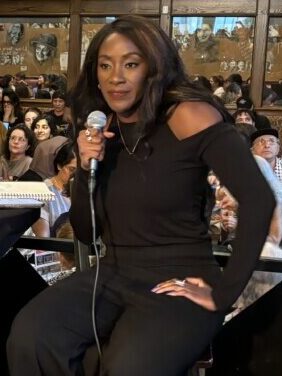
In the flood of attention last September after her firing, Karen Attiah interviewed Algerian-Palestinian activist Mahmoud Khalil at D.C.’s Busboys and Poets restaurant. The event was sold out, with lines oustide, and was recorded and preserved on YouTube. Of the arbitrator’s verdict, Attiah wrote on Facebook Monday, “It’s been a year-long fight, but this is a victory for journalists everywhere.” (Credit: Richard Prince)
Journo Groups Backed Her; She’s ‘Willing to Go Back’
“A private arbitrator has ordered The Washington Post to rehire the opinion columnist Karen Attiah, who was fired in September over her social media posts about the assassination of the conservative activist Charlie Kirk. It also ordered the company to compensate her with back pay,” Benjamin Mullin reported Monday for The New York Times.
“Sarah Miller Espinosa, the arbitrator, said in a written decision Thursday that The Post ‘did not have good and sufficient cause’ to terminate Ms. Attiah and ‘violated’ its labor agreement, according to a copy of the decision shared with The New York Times by Ms. Attiah’s lawyers.
“ ‘The Washington Post failed to establish the grievant engaged in gross misconduct,’ Ms. Espinosa wrote.
“In a statement, Ms. Attiah said that she hoped the decision ‘sends a message to journalists and media institutions everywhere that freedom of expression is always worth fighting for.’ She said that she was ‘willing to go back’ to her work at The Post, which she called ‘one of the world’s most storied newspapers.’
“ ‘This decision confirms what we’ve said from the start: I was doing my job as an opinion writer, and this was wrongful termination,’ she said, adding that she was ‘relieved to finally have that record set straight’.
“A spokeswoman for The Post said that the company respects the arbitration process and declined to comment further.”
Attiah added in a message to friends and supporters, “I will have more to say and will be coming out with a Substack post shortly.
Journalism groups supported Attiah. Just nine days ago, the National Association of Black Journalists awarded one of five “Thumbs Down” awards to the Post, saying it “implemented layoffs and newsroom restructuring that disproportionately affected Black and other journalists of color, including reporters covering race, identity, extremism, protest movements, and other essential public interest beats. The reductions also weakened reporting capacity across opinion, international, local, and sports coverage.
“These decisions diminish newsroom diversity and subject matter expertise at a moment when robust, inclusive journalism is critical to public accountability and democratic understanding.”
Attiah was NABJ’s “Journalist of the Year” in 2019. “In 2018, Attiah was celebrated for raising her voice and using the power of her pen to bring attention to and offer ongoing coverage of the murder of fellow Washington Post columnist Jamal Khashoggi,” NABJ said then. “Khashoggi was murdered inside the Saudi consulate in Istanbul. Attiah’s reporting of Khashoggi’s death helped bring international coverage to the political persecution he faced as a journalist, which caused him to flee Saudi Arabia in 2017. Her work also inspired ongoing global dialogue about protecting the role of the free press.”
In June, the D.C. chapter of the Society of Professional Journalists inducted Attiah into its Hall of Fame, where she addressed her firing. “I’m going to keep fighting, because that’s all I know how to do,” she said.
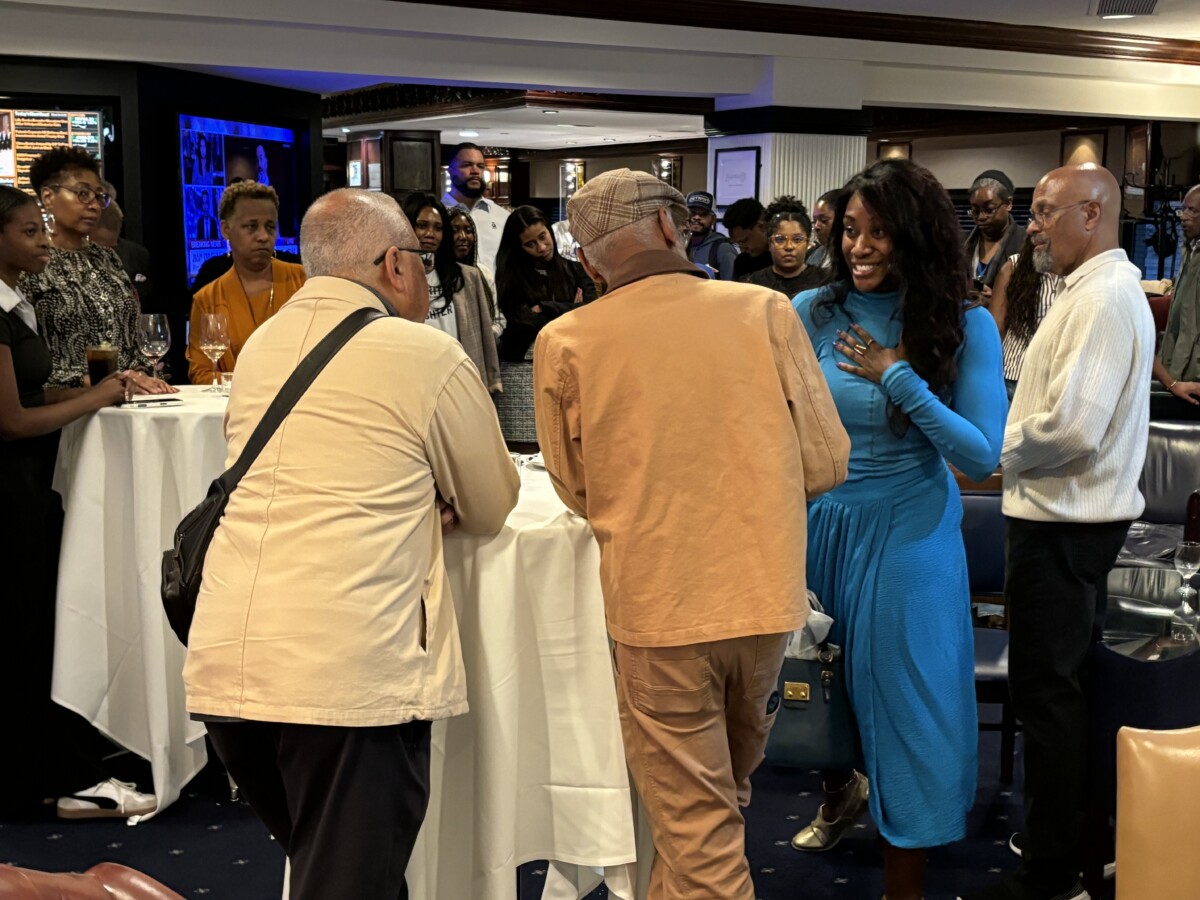
Karen Attiah joins supportive members of the Washington Association of Black Journalists on Sept. 17, 2025, days after her firing. (Credit: Richard Prince)
And last fall, the Washington Association of Black Journalists and the D.C. chapter of the Asian American Journalists Association issued a joint statement of support. “As an opinion columnist, Attiah has the right to free speech and a duty to speak her mind, make people think and provide analysis on current events. By firing her, the Washington Post has sent a chilling message to the public — one of the most powerful newspapers in the world is willing to silence voices with which it disagrees. If the space for open expression narrows and diverse voices are lost, the stories our communities most need risk being diminished,” they said.
WABJ President Phil Lewis told Journal-isms Monday, “The Washington Association of Black Journalists was proud to support Karen Attiah throughout this process. We hope this landmark decision sends a message to newsrooms everywhere: Black journalists deserve to work in environments where we are free from attempts to silence our voices.”
Attiah said in a Substack post in June, “Beginning July 20th, I’ll be bringing back Race, Media, and International Affairs 101 and 102 to the public for a seven-week online course.”
Mullin’s piece continued, “The decision is the result of a yearlong fight between The Post and Ms. Attiah, who last year accused the company of violating its labor agreement and social media policy when it fired her for posts she said were within her purview as an opinion columnist. A clause in the agreement allows employees to submit disputes for arbitration.
“Arbitration is generally considered binding in most disputes, though courts have occasionally overturned decisions after courtroom findings of fraud or other improprieties. The Post’s labor agreement says that arbitration is binding, though both the company and the employee retain their legal rights.
“The Washington Post said in its termination letter that Ms. Attiah’s posts about Mr. Kirk had harmed “the integrity” of the organization and violated standards requiring employees to use social media with civility and respect. . . .”
- Karen Attia with Nermeen Shaikh, “Democracy Now! “They Threw Me to the Wolves”: Karen Attiah on Censorship Under Trump, Winning Her WaPo Job Back (Aug. 26)
- Karen Attia, Substack: The Washington Post Fired Me. I Fought—and Won My Job Back.
- Karen Attiah, Substack: My Case Against the Washington Post Goes to Arbitration This Week (June 1)
- Karen Attiah with Rachel Maddow, MS NOW/Apple Podcast: Trump learns the hard way, ‘incompetence has consequences’ (podcast)
- Andrew Beaujon, Washingtonian: Karen Attiah Is Still Waiting for the Washington Post to Call (Aug. 25)
- Charles C. W. Cooke, National Review: The New York Times Helps to Launder Karen Attiah’s Lie
- Democracy Defenders Fund: Karen Attiah Secures Landmark First Amendment Victory in Wrongful Termination Case Against The Washington Post
- National Association of Black Journalists: NABJ Stands With Karen Attiah and Renews Call for Accountability at The Washington Post
- Riddhi Setty, Columbia Journalism Review: Karen Attiah Is Ready to Go Back to the Washington Post (Aug. 26)
