
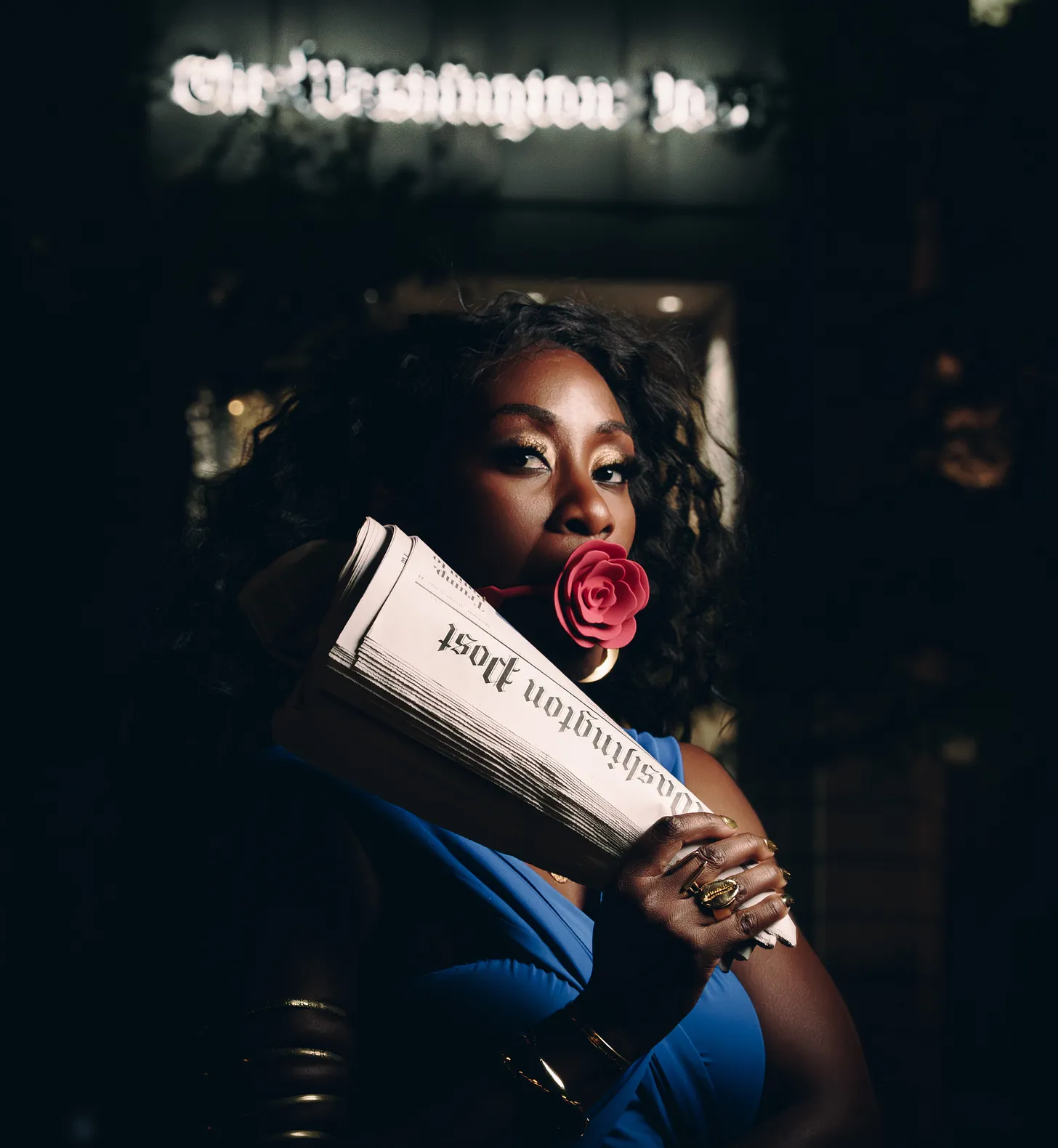
Journo Groups Backed Her; She’s ‘Willing to Go Back’
Homepage photo by Ethan Wong/ Karen Attiah Substack
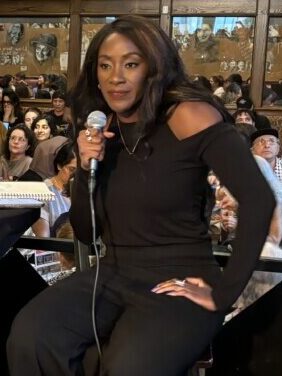
In the flood of attention last September after her firing, Karen Attiah interviewed Algerian-Palestinian activist Mahmoud Khalil at D.C.’s Busboys and Poets restaurant. The event was sold out, with lines oustide, and was recorded and preserved on YouTube. Of the arbitrator’s verdict, Attiah wrote on Facebook Monday, “It’s been a year-long fight, but this is a victory for journalists everywhere.” (Credit: Richard Prince)
Journo Groups Backed Her; She’s ‘Willing to Go Back’
“A private arbitrator has ordered The Washington Post to rehire the opinion columnist Karen Attiah, who was fired in September over her social media posts about the assassination of the conservative activist Charlie Kirk. It also ordered the company to compensate her with back pay,” Benjamin Mullin reported Monday for The New York Times.
“Sarah Miller Espinosa, the arbitrator, said in a written decision Thursday that The Post ‘did not have good and sufficient cause’ to terminate Ms. Attiah and ‘violated’ its labor agreement, according to a copy of the decision shared with The New York Times by Ms. Attiah’s lawyers.
“ ‘The Washington Post failed to establish the grievant engaged in gross misconduct,’ Ms. Espinosa wrote.
“In a statement, Ms. Attiah said that she hoped the decision ‘sends a message to journalists and media institutions everywhere that freedom of expression is always worth fighting for.’ She said that she was ‘willing to go back’ to her work at The Post, which she called ‘one of the world’s most storied newspapers.’
“ ‘This decision confirms what we’ve said from the start: I was doing my job as an opinion writer, and this was wrongful termination,’ she said, adding that she was ‘relieved to finally have that record set straight’.
“A spokeswoman for The Post said that the company respects the arbitration process and declined to comment further.”
Attiah added in a message to friends and supporters, “I will have more to say and will be coming out with a Substack post shortly.
Journalism groups supported Attiah. Just nine days ago, the National Association of Black Journalists awarded one of five “Thumbs Down” awards to the Post, saying it “implemented layoffs and newsroom restructuring that disproportionately affected Black and other journalists of color, including reporters covering race, identity, extremism, protest movements, and other essential public interest beats. The reductions also weakened reporting capacity across opinion, international, local, and sports coverage.
“These decisions diminish newsroom diversity and subject matter expertise at a moment when robust, inclusive journalism is critical to public accountability and democratic understanding.”
Attiah was NABJ’s “Journalist of the Year” in 2019. “In 2018, Attiah was celebrated for raising her voice and using the power of her pen to bring attention to and offer ongoing coverage of the murder of fellow Washington Post columnist Jamal Khashoggi,” NABJ said then. “Khashoggi was murdered inside the Saudi consulate in Istanbul. Attiah’s reporting of Khashoggi’s death helped bring international coverage to the political persecution he faced as a journalist, which caused him to flee Saudi Arabia in 2017. Her work also inspired ongoing global dialogue about protecting the role of the free press.”
In June, the D.C. chapter of the Society of Professional Journalists inducted Attiah into its Hall of Fame, where she addressed her firing. “I’m going to keep fighting, because that’s all I know how to do,” she said.
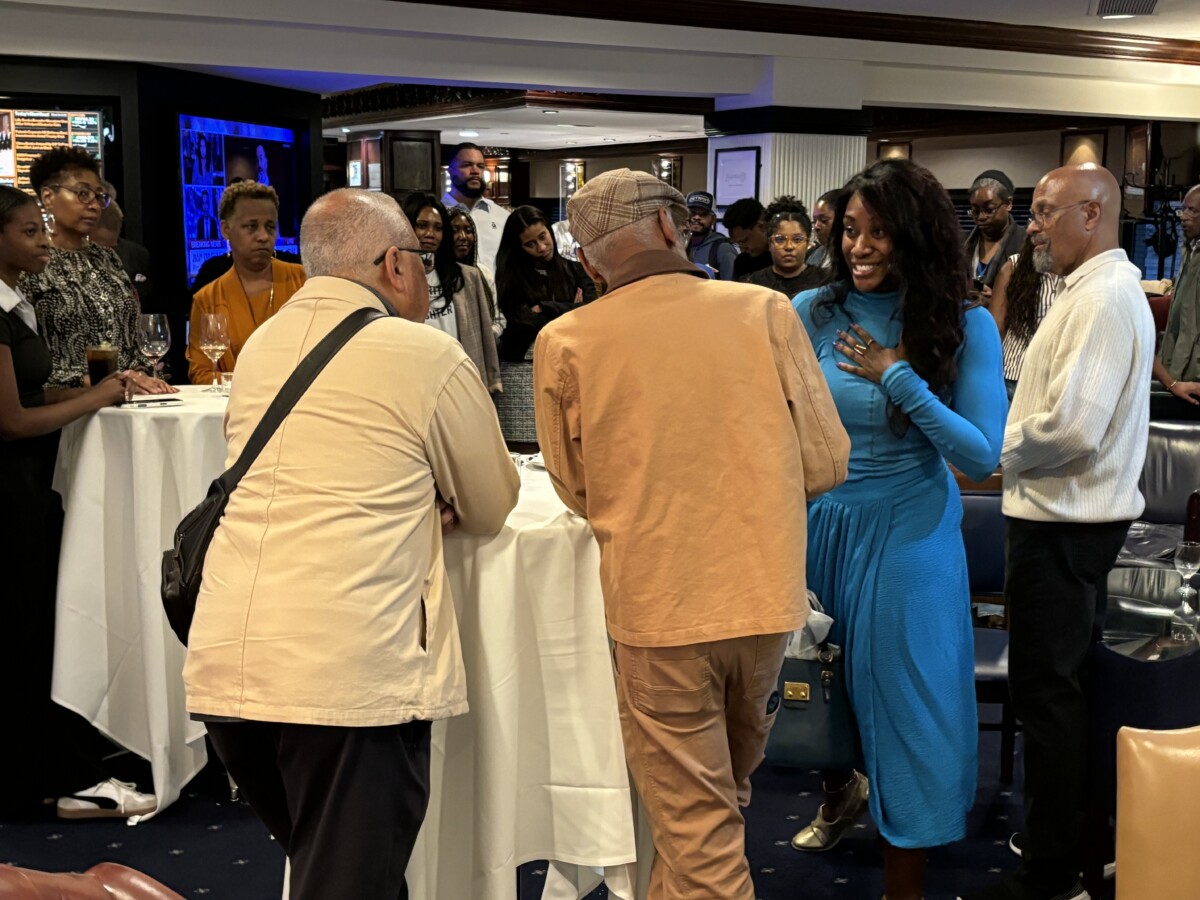
Karen Attiah joins supportive members of the Washington Association of Black Journalists on Sept. 17, 2025, days after her firing. (Credit: Richard Prince)
And last fall, the Washington Association of Black Journalists and the D.C. chapter of the Asian American Journalists Association issued a joint statement of support. “As an opinion columnist, Attiah has the right to free speech and a duty to speak her mind, make people think and provide analysis on current events. By firing her, the Washington Post has sent a chilling message to the public — one of the most powerful newspapers in the world is willing to silence voices with which it disagrees. If the space for open expression narrows and diverse voices are lost, the stories our communities most need risk being diminished,” they said.
WABJ President Phil Lewis told Journal-isms Monday, “The Washington Association of Black Journalists was proud to support Karen Attiah throughout this process. We hope this landmark decision sends a message to newsrooms everywhere: Black journalists deserve to work in environments where we are free from attempts to silence our voices.”
Attiah said in a Substack post in June, “Beginning July 20th, I’ll be bringing back Race, Media, and International Affairs 101 and 102 to the public for a seven-week online course.”
Mullin’s piece continued, “The decision is the result of a yearlong fight between The Post and Ms. Attiah, who last year accused the company of violating its labor agreement and social media policy when it fired her for posts she said were within her purview as an opinion columnist. A clause in the agreement allows employees to submit disputes for arbitration.
“Arbitration is generally considered binding in most disputes, though courts have occasionally overturned decisions after courtroom findings of fraud or other improprieties. The Post’s labor agreement says that arbitration is binding, though both the company and the employee retain their legal rights.
“The Washington Post said in its termination letter that Ms. Attiah’s posts about Mr. Kirk had harmed “the integrity” of the organization and violated standards requiring employees to use social media with civility and respect. . . .”
- Karen Attia with Nermeen Shaikh, “Democracy Now! “They Threw Me to the Wolves”: Karen Attiah on Censorship Under Trump, Winning Her WaPo Job Back (Aug. 26)
- Karen Attia, Substack: The Washington Post Fired Me. I Fought—and Won My Job Back.
- Karen Attiah, Substack: My Case Against the Washington Post Goes to Arbitration This Week (June 1)
- Karen Attiah with Rachel Maddow, MS NOW/Apple Podcast: Trump learns the hard way, ‘incompetence has consequences’ (podcast)
- Andrew Beaujon, Washingtonian: Karen Attiah Is Still Waiting for the Washington Post to Call (Aug. 25)
- Charles C. W. Cooke, National Review: The New York Times Helps to Launder Karen Attiah’s Lie
- Democracy Defenders Fund: Karen Attiah Secures Landmark First Amendment Victory in Wrongful Termination Case Against The Washington Post
- National Association of Black Journalists: NABJ Stands With Karen Attiah and Renews Call for Accountability at The Washington Post
- Riddhi Setty, Columbia Journalism Review: Karen Attiah Is Ready to Go Back to the Washington Post (Aug. 26)
Pentagon Fires Editor of Stars and Stripes
Aug. 21, 2026; updated Aug. 22
Journalist Stood Against Defense Dept. Censorship
Homepage photo: From left, Stars and Stripes Publisher Max D. Lederer Jr., Editor-in-Chief Erik Slavin and reporter Lara Korte. (Credit: Stars and Stripes)
Updated Aug. 22
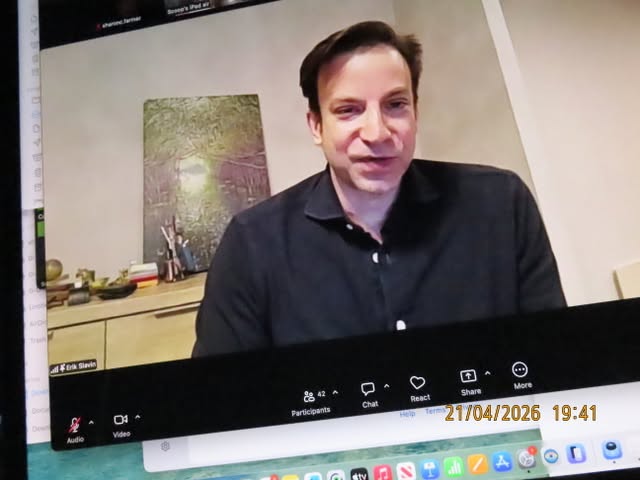
Erik Slavin told the Journal-isms Roundtable in April, “We do operate on First Amendment principles, which makes us fairly unique, given that we are within the Department of Defense. But it’s something we take very seriously and always have.” (Credit: Sharon Farmer/sfphotoworks)
Journalist Stood Against Defense Dept. Censorship
The Pentagon on Friday moved to fire the editor-in-chief of Stars and Stripes, Svetlana Shkolnikova and Rose L. Thayer reported Friday for the publication. The editor, Erik Slavin, declared at the Journal-isms Roundtable in April that the publication operates on First Amendment principles, even though it is part of the Department of Defense.
The publication has “reported extensively on difficulties faced by military communities as the war in Iran has dragged on. The terminations came about 10 days after Stars and Stripes journalists reported on hardships that Navy sailors were facing on the U.S.S. Abraham Lincoln, the aircraft carrier whose deployment was extended to nine months amid the war,” Minho Kim reported for the New York Times.
Slavin said in a statement:
“I received the notice of proposed separation today and I’m reviewing it. I’ll respond through the required process.
“According to the notice, I am being fired for stating in a CBS interview that hypothetical censorship of news for service members would constitute a personal red line. The Pentagon’s public affairs office has charged me with insubordination.
“I stand by the principle that Stars and Stripes must remain editorially independent, as required by law and by the department’s own policies.”
In the interview with CBS’s “Sunday Morning,” now-fired reporter Lara Korte discussed the increasingly tense relationship between the publication and the DoD. “I am working for Stars and Stripes. Not for the Pentagon,” she said. “Not for any administration. Not for any policymaker. I am here to cover the military community,” Scott Nover and Liam Scott reported for the Washington Post.
“Stripes has a decades-long history of independent journalism. DoD formally codified many of Congress’s recommendations to protect the paper in 1994, including the appointment of a civilian editor in chief and the insulation of editorial decision-making from DoD officials,” Sen. Elizabeth Warren, D-Mass., said in May.
Jon Passantino added Saturday for Status: “During World War II, Eisenhower famously defended the paper’s independence. ‘Stars and Stripes is the soldiers’ newspaper. We will not interfere,’ Eisenhower said. That tradition eventually became formal policy: Congress and the Defense Department established protections requiring the newspaper to operate as an independent publication with First Amendment protections, free from outside news management and censorship.
“Nevertheless, Hegseth’s Pentagon has spent much of this year working to dismantle that protection. It scrubbed the policy guaranteeing ‘ free flow of news and information’without management or censorship, and accused the paper of publishing ‘woke distractions’ and ‘repurposed DC gossip columns.’ ”
Slavin appeared at the Journal-isms Roundtable convened after a report that, “In a move that disproportionately targets women and minority officers, Defense Secretary Pete Hegseth recently blocked the promotions of at nine Navy officers who had been selected by a board of senior Navy admirals.”
Errin Haines, president of the National Association of Black Journalists, has on several occasions linked press freedom and justice for Black journalists.
“There’s strength in numbers and when we show up together you know we remind the country that press freedom and civil rights are not separate fights. They’re the same fight,” she has said.
Caroline Hendrie, executive director of the Society of Professional Journalists has agreed. “Press freedom, diversity, equity and inclusion, they are all one and the same in so many ways.”
Roundtable participants concluded that the rich history of people of color in the military deserves to be amplified, not suppressed. Chicago Tribune columnist Clarence Page and Associated Press and New York Times veteran Ron Nixon were among those recounting their experiences with race and the military, with Page discussing his time at Stars and Stripes. Page is in this video at [53:36], saying he served from 1969 to 1971, at a time when Black soldiers were dying at a higher rate than white soldiers, and that “there was a concern about the fact that there were no Black broadcasters in the Armed Forces Radio and television.”
Also at the session, Slavin discussed Pentagon demands that the publication rid itself of “D.C. gossip columns,” though “to my knowledge, I don’t think we’ve ever run a D.C. gossip column,” he told the Roundtable. “I’m not sure what those ‘woke distractions’ were, because they never contacted us prior to putting that tweet out and did not contact us for several months afterward regarding that.”
Moreover, “there was a leak to the Daily Wire, which had some more information in there talking about potentially getting rid of our print edition, replacing our civilian reporters, number of other things that again, the Pentagon did not discuss with us. I don’t know how many of you are familiar with Stars and Stripes, but we do operate on First Amendment principles, which makes us fairly unique, given that we are within the Department of Defense. But it’s something we take very seriously and always have.
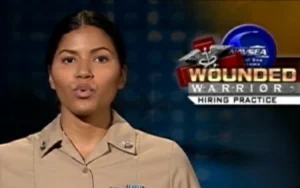 “So we are very careful about protecting that independence. And then on March 9, a new memo came out as we were working on Iran war coverage. We had a reporter, an African American reporter, I might add, in Bahrain,” Shannon Renfroe (pictured), “who had missiles going on around her apartment at the time, and continued to report.
“And in the middle of all this, a memo comes out with further information in it, saying that, yes, Stars and Stripes will remain independent, but you are hereby restricted from running wire service content from anything that you contract for, including the AP and the Washington Post. You are restricted from running comics in your print edition. Why comics? We do not know. And that it is something that comes from syndicated content. And you’re restricted from running what is called controlled, unclassified information.
“Now, we are probably as careful as any news organization about not putting service members at risk because they’re our readers. We don’t want to get them killed. . . . At this point, we are dealing with it as best as we can. We are continuing in our staff coverage to be as accurate and balanced and fair as we always have, and to call power to account when necessary.”
The firings “come at a time when the Trump administration, in its second term, has been progressively combative toward the media — including sharply curtailing Pentagon access for the press corps that covers the Defense Department,” Jocelyn Noveck reported for the Associated Press. “Trump or other parts of the executive branch have also, in policy and in the courts, grappled with The Wall Street Journal, The Associated Press and The New York Times — in addition to using the FCC to target broadcast networks.
Passantino also wrote:
“In a letter published Friday on the Stars and Stripes website, the active-duty Navy Capt. Bill Urban, who previously served in public affairs roles and was appointed “military deputy to the publisher” earlier this month, pledged to maintain the paper’s high standards.
“I understand that I am now part of a team, committed to editorially independent journalism that best serves our most important customer, which is our service members, their families, and our greater military community,” he wrote.
“But how can editorial independence survive when the people who exercise it are punished for doing so? Democratic Sens. Richard Blumenthal, Elizabeth Warren and Jeanne Shaheen are demanding answers from Hegseth, giving him an August 28 deadline to explain the recent shakeup and Urban’s role. The firings have also set off alarm bells for press freedom advocates, who slammed the move as an act designed to muzzle a free press.
“Stars and Stripes exists to produce independent journalism. When their team expressed concern over government censorship, the Pentagon went to war … with the truth,” the Freedom of the Press Foundation said in a statement.
“National Press Club President Mark Schoeff Jr. also denounced the firings as ‘brazen’ and ‘disturbing’ and called for the decision to be immediately reversed.
The Journal-isms Roundtable convenes again this coming Monday to discuss ‘What’s It Like to Be a Music Journalist?”
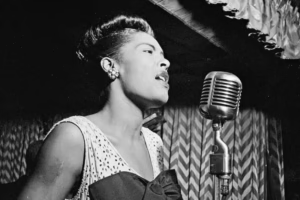 Panelists include Miles Marshall Lewis, cultural historian of the Hip Hop Museum, pop culture critic, essayist, literary editor, fiction writer, and music journalist; Regina Jones, co-founder and publisher of Soul newspaper, the world’s first soul music-focused publication; Bruce Talamon, acclaimed photographer who started out with Soul; Felix Contreras, co-creator and co-host of “Alt.Latino,” NPR’s pioneering radio show and podcast celebrating Latin music and culture; and Willard Jenkins, artistic director of the DC Jazz Fest, author of “Ain’t But a Few of Us: Black Music Writers Tell Their Story.”
Also, Leonard Pitts Jr., Pulitzer Prize-winning former syndicated Miami Herald columnist who got his start in the business writing for Soul newspaper; Natalie Hopkinson, Ph.D., foremost expert on D.C.’s go-go music, H. Zahra Caldwell, author of “The Fiercest Kind: Five Black Women in Art, Performance and Resistance, 1937-1965,” and Lisa E. Davis, entertainment lawyer; author of “Our Minds Were Always Free: A History of How Black Brilliance Was Exploited — and the Fight to Retake Control.” (Photo of Billie Holiday from Library of Congress, 1947)
- Mike Blinder, Editor & Publisher: Stars and Stripes must never become the Pentagon’s mouthpiece (Aug. 24)
