
’80s Campaigns Changed Journalism, Not Just Politics
Charles Robinson Dies at 69, Covered Md. Politics
Journal-isms Roundtable photos by Jeanine L Cummins
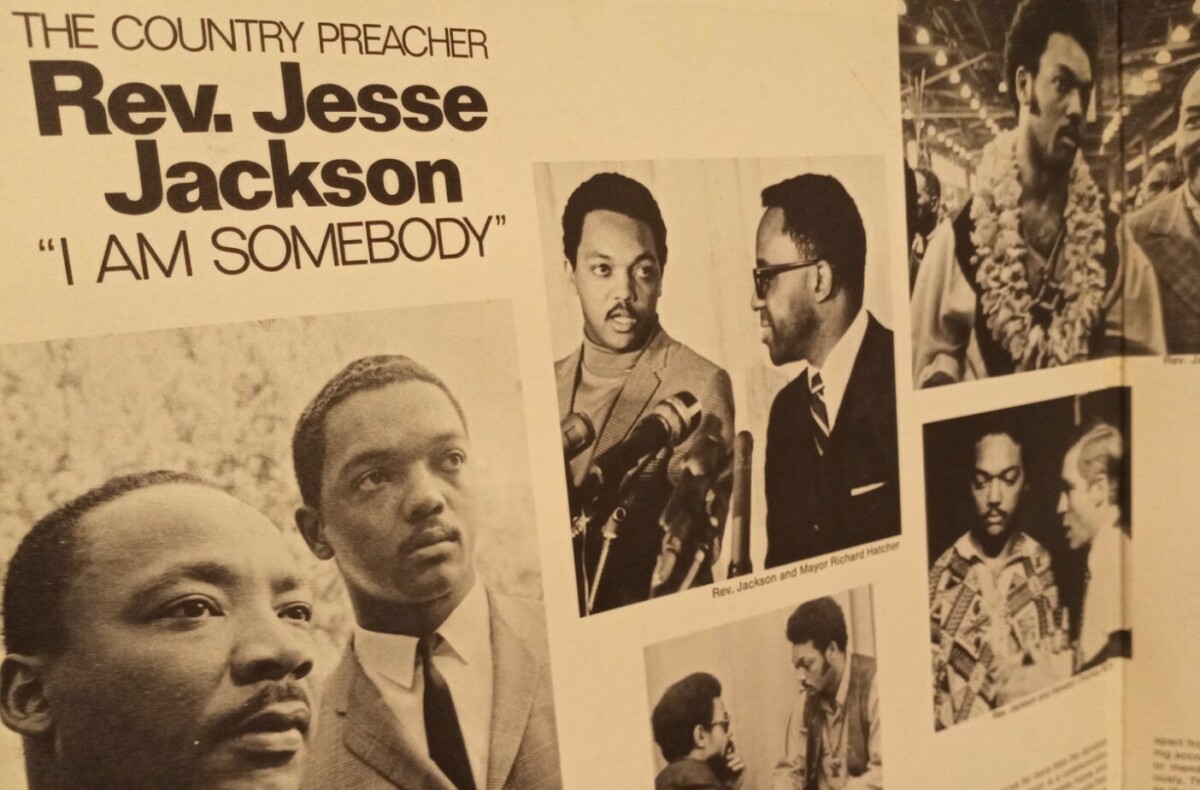
In 1971, Respect Records released “Country Preacher,” with Jesse Jackson’s exhortation, “I Am Somebody.”
’80s Campaigns Changed Journalism, Not Just Politics
If no image shows, please consider changing browsers.
An ‘in-depth interview analysis’ by Rev.com’s artificial intelligence
INTERVIEW CONTEXT:
- Participants: Multiple journalists, historians, and media professionals who covered Jesse Jackson’s presidential campaigns and civil rights work, including Jack White (Time Magazine), Sylvester Monroe (Newsweek), [George] Derek Musgrove (historian), Barbara Reynolds, Clarence Page (Chicago Tribune), Bruce Talamon (photographer), Adam Clayton Powell III (TV producer), and others
- Primary focus: How Jesse Jackson should be remembered and his impact on American politics, journalism, and civil rights
- Setting/circumstance: Virtual roundtable discussion hosted by the Joint Center for Political and Economic Studies, with participants joining via Zoom and some in person in Washington DC
THEMATIC ANALYSIS:
- Jesse Jackson as Political Trailblazer
• Prevalence: Central theme throughout 60% of the discussion
• Key points:- Made Obama’s presidency possible by breaking barriers
- Changed Democratic Party rules and culture
- Registered 6-7 million voters throughout his career
- Transitioned civil rights movement into electoral politics
• Representative quotes: - “If not Jesse, no Obama. But the one I like is, if not Jesse, if not now, when and if not Jesse, who?” – Jack White
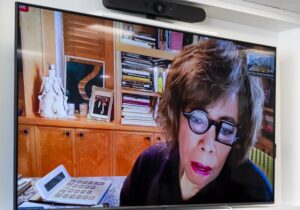
- “Jesse has registered more people to vote than any single American ever in the history of this country” – Hermene Hartman (pictured. She is a Jackson mentee who is publisher at Hartman Publishing in Chicago and publisher of N’Digo. She said she spotted errors in the new book on Jackson by Abby Phillip of CNN.)
• Subtext/implications: Jackson’s campaigns were less about winning and more about transforming American political culture and creating opportunities for future Black politicians
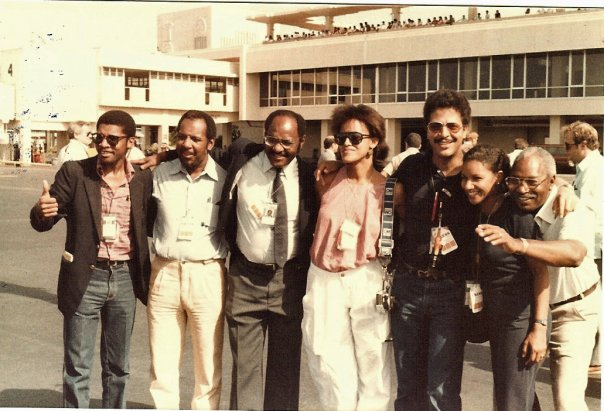
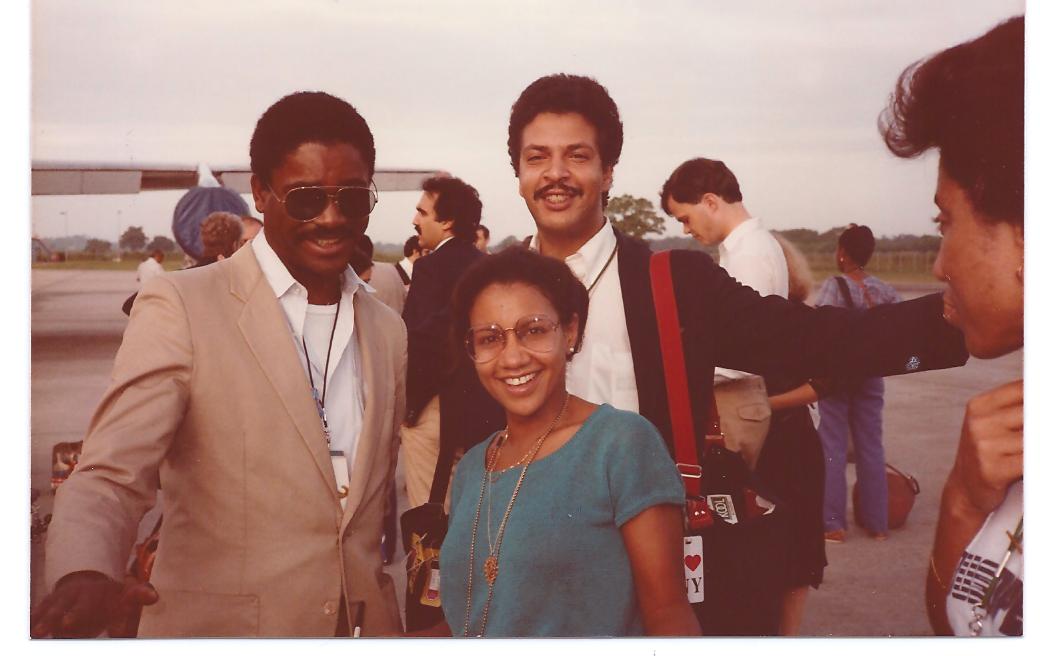
From left, Reporters Sylvester Monroe of Newsweek; Bob Jordan, Boston Globe; Gerald Boyd, New York Times; Marilyn Milloy, Newsday; Jack White, Time and A’Lelia Bundles of NBC News; and Eugene Wheeler of the 1984 Jackson campaign. At the airport in El Salvador during Jackson’s campaign tour of Central America. (Credit: A’Lelia Bundles)
- Opened doors for Black journalists in mainstream political coverage
- Created the “alligators” – Black reporters covering his campaign
- Led to career advancement for many participants
- Changed newsroom dynamics and coverage patterns
• Representative quotes: - “This was also for Black journalists an enormous opportunity, because a lot of our careers blossomed” – Jack White
- “Jesse Jackson called us the Alligators” – A’Lelia Bundles. [Bundles covered Jackson’s 1984 campaign as a producer for NBC News. White, who reported for Time magazine, explained, “‘It’s a line from ‘Amos n’ Andy’. I resent the allegations. I denies the allegations and the alligators.”]
• Subtext/implications: White editors initially assigned Black reporters cynically, but this created unprecedented opportunities that transformed the media landscape:
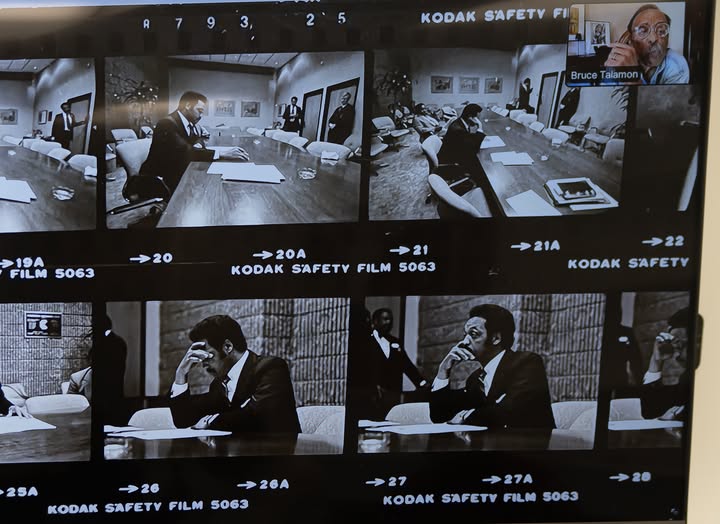
Bruce Talamon, at top right, who photographed the 1984 campaign for Time magazine, displays his contact sheets. “You’ve got the job nobody wanted, Jesse,” his editor told him. “. . . if you were working at that time, and actually even today, if you were working for AP, Time magazine, Newsweek, and your candidate went all the way, you were generally offered the job of White House photographer. And so folks looked up and down at Jesse and said, ”oh, he’ll be gone by Super Tuesday.’ . . . They did not understand that this was not a traditional campaign. This was a crusade.” Photo taken Nov. 3, 1984, when Jackson announced his intention to run for the Democratic nomination, at the Washington, D.C, Convention Center.
- Impact on Black Journalism
• Prevalence: Major theme occupying about 25% of discussion
• Key points:
- The “Hymietown” Controversy
• Prevalence: Significant discussion for about 15% of the conversation
• Key points:
- The “Hymietown” Controversy
- Milton Coleman’s reporting methods questioned
- Confusion over “off the record” vs. “let’s talk black talk”
- Damaged Jackson’s 1984 campaign momentum
- Raised ethical questions about journalism and sourcing
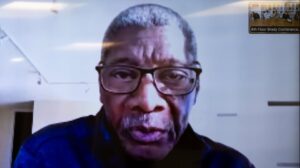
- Representative quotes:
- “Milton never heard this. And we took him to task…because he was unprofessional” — Sylvester Monroe (pictured) [Coleman, of the Washington Post, wrote his perspective on the story in an essay for the Post in 1984.]
- “Jesse didn’t use those terms…He would say, let’s talk Black Talk” — Jack White
- • Subtext/implications: Reveals tensions between journalistic ethics, racial solidarity, and political consequences
From left, Kenneth Walker, A’Lelia Bundles and Jack White. Walker, who died in April, covered the campaign for ABC News.
- Jackson’s Charisma and “I Am Somebody” Message
• Prevalence: Recurring theme throughout discussion
• Key points:- Inspirational leadership during Reagan-era despair
- Economic empowerment through boycotts and business pressure
- Global recognition and respect
- Ministerial calling beyond politics
• Representative quotes: - “Maybe I can be somebody…we need more inspiration. We need more charisma” – Barbara Reynolds
- “He’s a minister, most of all. He’s truly, truly a minister” – Hermine Hartman
• Subtext/implications: Jackson’s power came from spiritual and emotional connection, not just political strategy
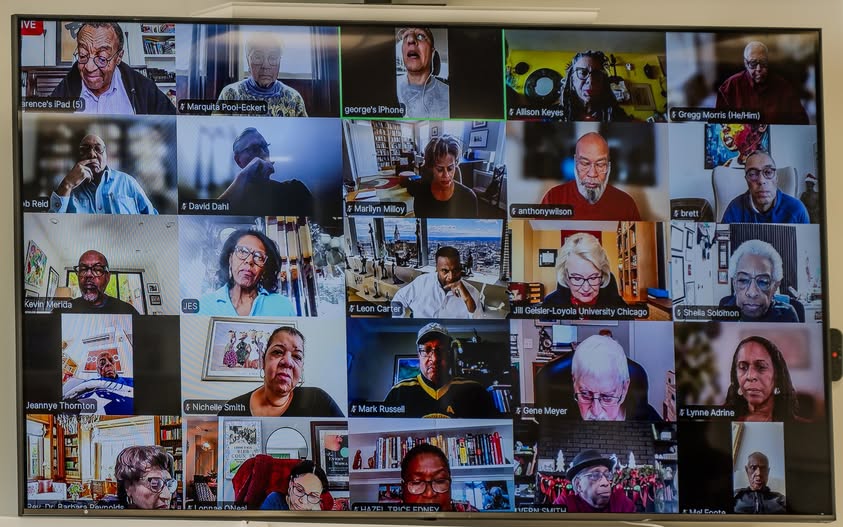
Attendees remarked on the iconic and authoritative status of some of the speakers. “I hope that we can share the YouTube video and Facebook video far and wide,” wrote Nichelle Smith, independent investigative journalist, formerly of USA Today. “Our mainstream outlets will be inclined to talk about the reverend from the perspective of the presidential campaign as a failure and write about some of the negative headlines. The more I began to write about him as a Gen Xer, and meet him, the more respect I have for his legacy.”
CONVERSATIONAL DYNAMICS:
- Power dynamics: Richard Prince as moderator maintained control but allowed organic flow; participants showed deep respect for each other’s experiences
- Areas of alignment: Universal agreement on Jackson’s historical importance and impact on Black political advancement
- Points of tension: Disagreement over Milton Coleman’s journalistic ethics; some defensiveness about campaign coverage decisions
- Avoidance patterns: Reluctance to discuss specific negative aspects of Jackson’s personality or campaign management issues
- Question/response patterns: Participants built on each other’s comments rather than directly answering moderator questions; tendency toward storytelling over analysis
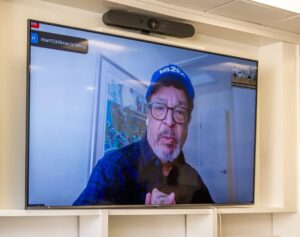
PIVOTAL MOMENTS:
- 22:08: Jack White’s (pictured) reframing of the campaign as “Black America’s campaign” rather than just Jesse’s.
- Before: Discussion focused on individual experiences
- After: Conversation elevated to historical significance
- Significance: Established the broader political and social context
- 22:08: Jack White’s (pictured) reframing of the campaign as “Black America’s campaign” rather than just Jesse’s.
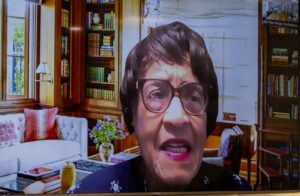
1:11:12: Barbara Reynolds’ (pictured) question about the Hymietown controversy
- Before: Nostalgic reminiscences about campaign experiences
- After: Serious discussion of journalistic ethics and racial dynamics
- Significance: Addressed the elephant in the room that still affects Jackson’s legacy
- 1:43:39: Jerry’s call for a larger tribute effort [Jerry Thomas is a former director of media relations and former adviser to Jackson, and a family friend,]
- Before: Individual recollections and analysis
- After: Recognition of the need for comprehensive historical documentation
- Significance: Transformed from reminiscence to call for action
EMOTIONAL MAPPING:
- Participants: Generally warm nostalgia mixed with professional pride; defensive when discussing controversial topics; passionate about Jackson’s legacy and their role in documenting it
- Moderator: Respectful but time-conscious; working to balance multiple voices and perspectives
CREDIBILITY ASSESSMENT:
- Consistent narratives: Jackson’s impact on Black political advancement, his charismatic leadership, the transformative nature of his campaigns
- Contradictions: Some disagreement on details of the Hymietown controversy and Milton Coleman’s role
- External verification points: Specific dates, locations, and events mentioned could be fact-checked; claims about voter registration numbers and campaign details
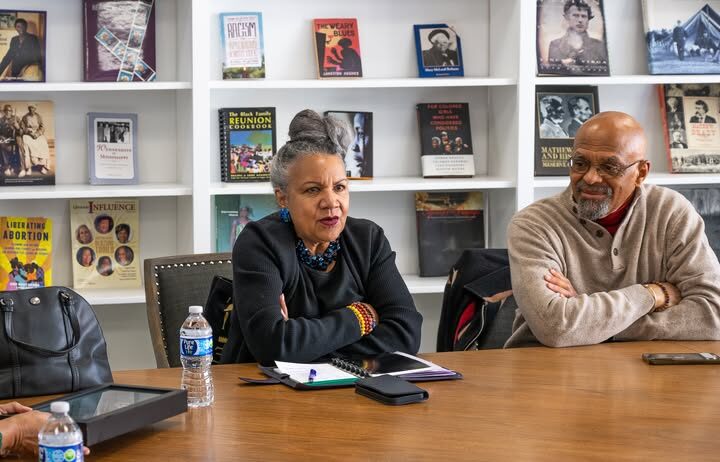
“It was an incredible inspirational campaign,” said A’Lelia Bundles, then a producer with NBC News, seated next to veteran journalist Joe Davidson. “Many people will say that there would be no Obama without Jesse Jackson, but it also had its quirks and it was disorganized and chaotic at the same time. But it was, for me, clearly a highlight . . . ,of my professional career. And I see these friends who are on the screen who I made during that campaign here.”
KEY INSIGHTS AND TAKEAWAYS:
- Jesse Jackson’s presidential campaigns were transformative moments that changed American politics beyond electoral outcomes
- The campaigns created unprecedented opportunities for Black journalists and fundamentally altered media coverage of politics
- Jackson’s legacy is complex, encompassing both inspirational leadership and controversial moments that still generate debate
- The participants represent a unique cohort of journalists whose careers were shaped by covering Jackson, creating both professional advancement and personal bonds
- There’s a strong desire among participants to create a comprehensive historical record of Jackson’s impact while he’s still alive
- The discussion reveals ongoing tensions between journalistic objectivity and racial solidarity in covering Black political figures
- Jackson’s influence extended far beyond politics into business, media, and international affairs
- The “Rainbow Coalition” concept and voter registration efforts had lasting impact on Democratic Party politics and American electoral participation
See also: Jesse Jackson’s speech at the 1984 convention of the National Association of Black Journalists: ‘You Work in Pain’
And: A Sunday ‘Hotter than July’ Stories From a Photojournalist Who ‘Made it Sing’ (on Bruce Talamon, Sept. 11, 2022)
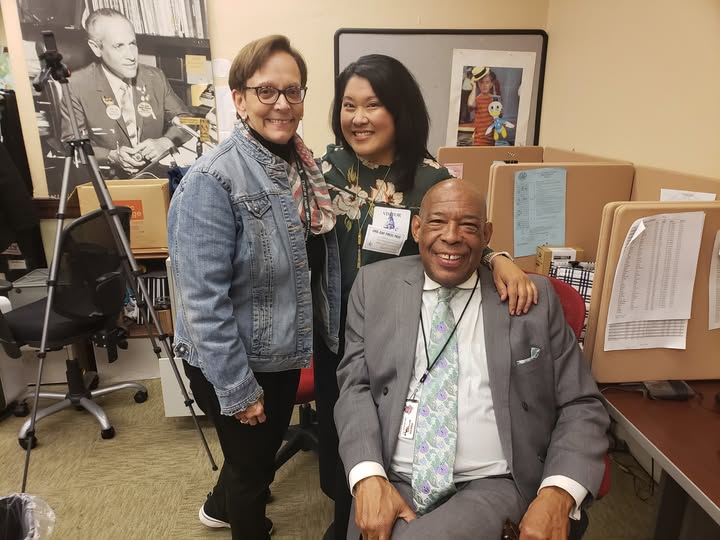
Maryland Public Television’s “State Circle” team in 2019. Standing are reporters Sue Kopen Katcef, left, and Nancy Yamada/ Sitting: Charles Robinson. (Credit: WMPT)
Charles Robinson Dies at 69, Covered Md. Politics
“Charles Robinson III, an award-winning journalist who covered stories across TV, radio and print for decades, died Monday afternoon at age 69, according to an executive at Maryland Public Television, his most recent workplace,” Sara Ruberg reported Tuesday for the Baltimore Banner.
“It wasn’t immediately clear what caused Robinson’s death,” Ruberg wrote. An MPT spokesman told Journal-isms, “I’m sorry, but at this point, MPT doesn’t have information about Charles’s cause of death, nor where it took place.”
Robinson was active in the National Association of Black Journalists, where he served as a board member for nearly eight years and was an NABJ presidential candidate in 2011, losing to Gregory H. Lee Jr. In 2021, he was honored with NABJ’s Lifetime Achievement Award.
Robinson was born in Richmond, Va., but grew up in Baltimore. He was four-year president of Baltimore’s Association of Black Media Workers and twice was elected to lead journalists from NABJ’s mid-Atlantic region.
He also maintained a blog in which he annually listed his top Black news stories of the year.
In 2022, after the Baltimore Sun issued a mea culpa over its history in covering the Black community, Robinson wrote, “The Baltimore Sun admitted this morning the many wrongs it did to Black folks in Baltimore going back to before the Civil War. For those of us who live here it is nothing new. In 1968 when the riots [happened] 2 blocks from my home, I wondered and asked, ‘Why weren’t there people who looked like me talking to my neighbors?’
“I became a journalist to ‘bear witness.’ I began this journey by delivering the Afro-American Newspaper. I have gone on to have a career that has seen me write for the Afro, be a radio journalist, a TV journalist and create online publications. I have encouraged my young colleagues to dig and join our ranks. I will never stop believing.”
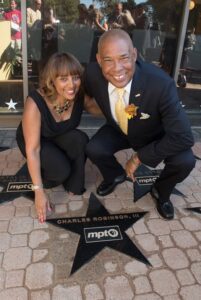 In 2016, Robinson was honored with a star on MPT’s Walk of Fame for his on-air contributions to the network. (Pictured, with wife Robbie Robinson. Credit: WMPT)
The Baltimore Afro American noted that “Robinson, a member of Alpha Phi Alpha Fraternity, Inc., taught budding journalists at Morgan State University and was a strong supporter of the institution’s School of Global Journalism and Communication. He was also a popular voice on WEAA FM 88.9.”
Robinson was also a self-described science geek and aficionado of Black music, particularly but not exclusively old-school rhythm and blues. In 2022, he gave us a clue as to what you might find him listening to.
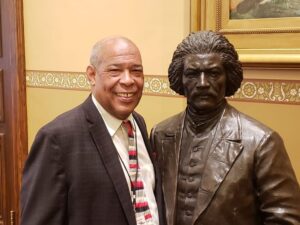 You might even have heard him on a podcast discussing Little Richard’s influences. And he honored Black heroes with Maryland connections, such as Frederick Douglass (Robinson shown with statue) and Harriet Tubman, both subjects of MPT documentaries.
According to the station’s bio, Robinson worked in television “as a reporter (WWBT-TV, Richmond, VA; WPEC-TV; West Palm Beach, FL; WCPO-TV, Cincinnati, OH) and national correspondent (BET); radio as news director (WEAA-FM, Baltimore, MD), political analyst (WEAA-FM, Baltimore, MD), and executive producer (TPT Radio Network, Washington, DC); and print as editor-in-chief (Sphinx Magazine).”
Robinson covered the impact of the Rodney King verdict; the story behind the monument to the Amistad revolt; the history of the Buffalo Soldiers and the Million Man March. His coverage of Nelson Mandela’s first trip to the United States won him an award from NABJ in 1991.
He is survived by his wife, Robbie, and two children.
