
Amid Assaults, ‘We’re Not Talking to Each Other’
Betty DeRamus Dies; Her Writing ‘Touched All Senses’
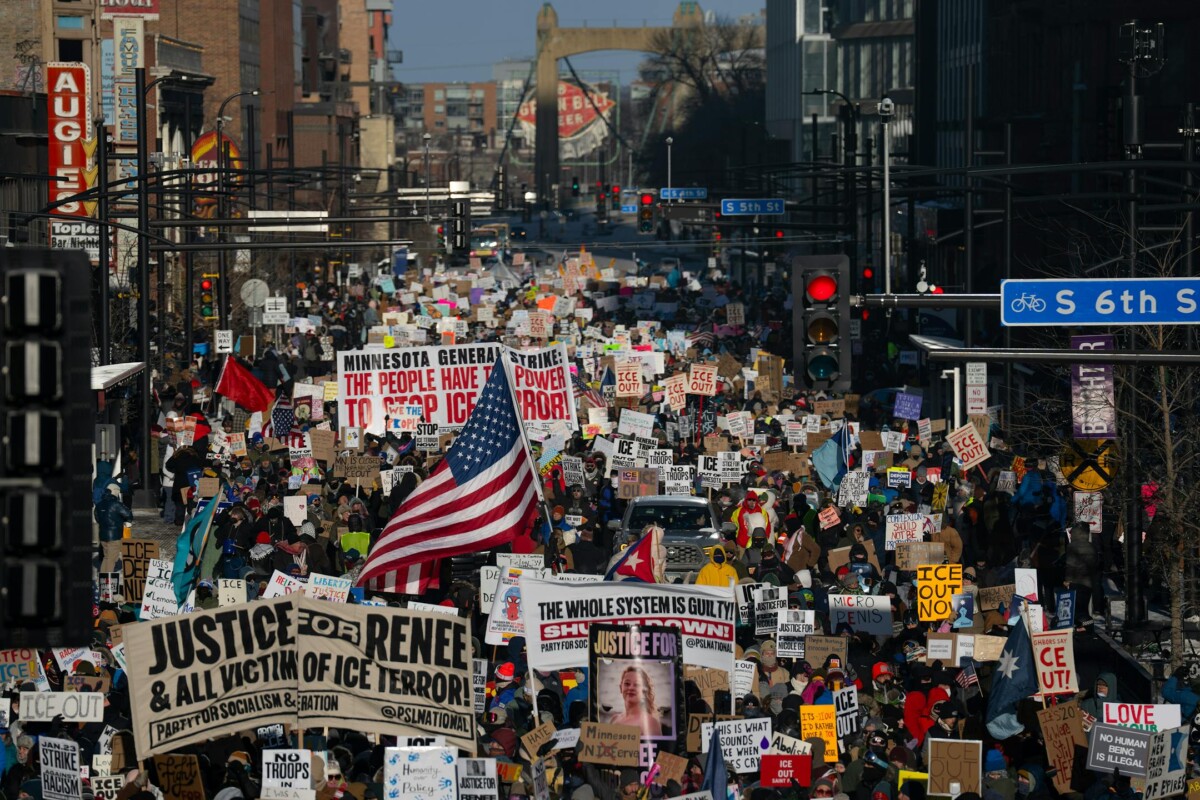
Homepage photo: Thousands march down Hennepin Avenue in downtown Minneapolis on Jan. 23, protesting Operation Metro Surge in minus-10-degree weather. (Credit: Alex Kormann/Minnesota Star Tribune)
Journal-isms Roundtable photos by Jeanine L. Cummins
Sunday’s Journal-isms Roundtable drew 60 attendees on Super Bowl Sunday. (Credit: YouTube)
Amid Assaults, ‘We’re Not Talking to Each Other’
The outrage-inducing victimization of the various people-of-color groups in Minnesota should lead to a revival of the Unity journalists coalition, as well as recognition in the media of the racial underpinnings of the assaults by federal agents, according to participants in Sunday’s Journal-isms Roundtable.
The Trump administration’s immigration crackdown in the state, dubbed Operation Metro Surge, is in its third month.
The operation has left two U.S. citizens dead, resulted in more than 4,000 arrests, put about 2,000 agents from the Bureau of Immigration and Customs Enforcement (ICE) and Customs and Border Protection (CBP) on the streets, clogged the courts, prompted national and international protests, and terrified and victimized many of the state’s citizens.
Not to mention the harassment directed at journalists exercising their First Amendment obligations.
[Feb. 12 update: “The Trump administration said on Thursday that it was ending its deployment of immigration agents to Minnesota, unwinding an aggressive operation that has stretched for more than two months despite loud opposition from residents and local officials,” the New York Times reported.]
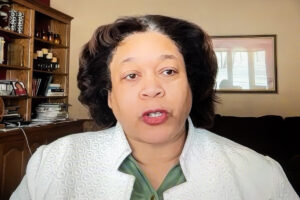 “Our journalists are being pepper sprayed. Someone was shot in the foot,” said Sheree Curry (pictured), co-president of the National Association of Black Journalists – Minnesota.
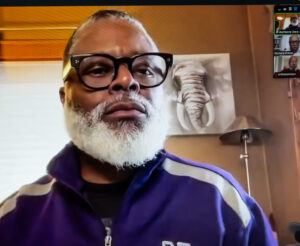 “It’s just been a really difficult run emotionally,” said Duchesne Drew (pictured), president of Minnesota Public Radio. “There’s just been no time to breathe, and, it’s one thing to parachute into a community, spend a few days or a couple weeks, and then go back home to peace and quiet. It’s another thing to be surrounded by it for weeks, if not months on end.”
While proud of the coverage his network has provided, Drew said that MPR, which operates on multiple platforms, is looking at $350,000 in unexpected costs at a time when federal funding for public broadcasting has been cut.
 Still, most media are not telling the whole story, said Courtnay Peifer Kim (pictured), a longtime journalist who detailed what she and others called the racial animus behind the immigration crackdowns.
“It’s just one thread of what the administration is doing in order to create a very white Americanism,” Kim, a former assistant managing editor for business at the Star Tribune, told the 60 people on the Zoom call.
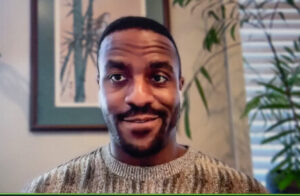 Her comments were part of a Roundtable that toasted the 10th anniversary of Journal-isms as an independent entity, and which heard from Michael Brice-Saddler (pictured), a local reporter at the Washington Post, who is active in the Post Guild and in the Washington Association of Black Journalists. He was among an estimated 300 journalists laid off at the Post last week.
The turmoil in Minnesota, however, was the Roundtable’s Topic A.
 Jose Antonio Vargas (pictured) is the onetime Washington Post journalist whose previously undisclosed undocumented status helped lead him to found the organization Define American, which tackles the immigration issue. Vargas told the group, “This may be the only roundtable I’ve been a part of that’s journalism-oriented that is calling it exactly what it is. Because it is about race.”
Kim elaborated. “The reason why they’re asking people who are not white in Minnesota to carry their papers and prove their citizenship is because they want everyone who is not white to really know that they are not respected as citizens, and so we have to prove this,” she said. “And so I carry my papers, and I’m an American citizen.”
Kim wrote about her experience under “occupation” for the Boston Globe. The piece, which ran Jan. 26, was headlined, “ICE brought fear to Minneapolis. Now we are standing up for ourselves.”
She and others urged more attention to so-called “Kavanaugh Stops” and said the Supreme Court must be held accountable for giving a pass to racial profiling.
In September, Justice Brett Kavanaugh “wrote that Hispanic residents’ ‘apparent ethnicity’ could be a ‘relevant factor’ in federal agents’ decision to stop them and demand proof of citizenship. Immigration and Customs Enforcement and Customs and Border Protection promptly seized upon his opinion as a license to stop any Hispanic person on the basis of race — often with excessive, even sadistic force — and detain them until they proved their lawful presence,” Dahlia Lithwick and Mark Joseph Stern wrote Dec. 30 for Slate.
“Most of you should be highlighting this in every story you write,” veteran broadcaster and media watcher Eric V. Tait Jr. said.
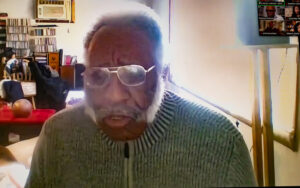 Charles Hallman (pictured), contributing reporter and sports columnist at the Minnesota Spokesman-Recorder, part of the Black press, described the fear he sees. “I coach high school basketball locally, in fact,” he said.“Not too far from where Renee [Good] was killed . . .
“And our kids don’t want to go outside anymore. They gotta escort them from the school to the Y, which is around the corner, to practice.
“I lost one player. Parents took them out of state because of fear of what’s going on. We had a game canceled because the suburban school didn’t want to have their kids coming through our neighborhood.
“So, it’s been… it’s been crazy, and I think those stories continue to need to be told.”
Vargas was among those who mentioned misleading media language. “I’m so glad that Courtney named…how Asian people often get left out of this conversation,” Vargas said. “Nationally, at least 70 percent of all Asian adults in this country are immigrants.
“Asian people are more immigrants to this country than the Latino community is more immigrants to this country.
“And yet, that’s not really the context you hear about. Even in the language we use, when people say ‘Black and brown communities are being impacted,’ I wonder, when we say ‘Black and brown communities,’ do we include Asian people in that conversation? Are Asian people included in that framing?”
That brings us to Unity.
The Unity coalition’s beginnings date to the 1980s, when Juan González, a future president of the National Association of Hispanic Journalists, and Will Sutton Jr., a future president of the National Association of Black Journalists, started comparing notes about their experiences as journalists of color.
The two, both in Philadelphia, met in 1986. Separately, in 1988, DeWayne Wickham, then NABJ president, convened the first joint meeting of the boards of NABJ, NAHJ, the Asian American Journalists Association and the Native American Journalists Association, now the Indigenous Journalists Association. Two years later, In 1990, Unity was established as a nonprofit organization.
In 1998, the name became Unity: Journalists of Color, Inc., which evolved in 2012 to Unity: Journalists for Diversity.
That evolution wasn’t exactly smooth. NABJ pulled out in 2011 and NAHJ followed in 2013. The remaining members voted to add the National Lesbian and Gay Journalists Association, which now calls itself NLGJA: The Association of LGBTQ Journalists.
Unity: Journalists for Diversity folded in 2018.
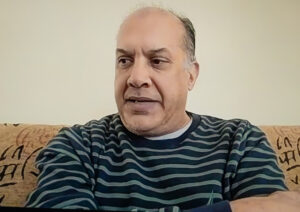 Neal Justin (pictured), media writer for the Minnesota Star Tribune and Unity’s last president, told the Roundtable that the coalition was undermined by financial issues — how the money should be split among the organizations.
Yet Justin, who then represented the Asian American Journalists Association, said Sunday, “I think we need to take a look at something like Unity again. You know, we’re not talking to each other. . . . Racism is racism. We need to put aside money and politics and all that stuff that has divided us before and find ways to work together.”
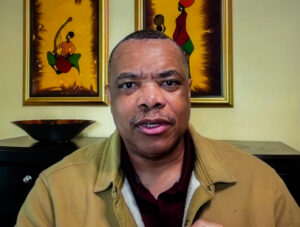 John Yearwood (pictured), who represented NABJ on the Unity board for about seven years, serving as treasurer, told the gathering, “I attend three to four of the major affinity conferences every year. And if there’s a through line in all of the comments from different people, it’s that people are asking, ‘You know, where is Unity? ‘ “ Yearwood is editorial director for diversity and culture at Politico.
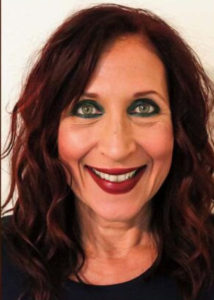 Mc Nelly Torres (pictured), an investigative journalist and a former vice president of NAHJ, described newsrooms where, she said, too many white editors are afraid to discuss race or do not understand its dynamics. “I think that we need to join forces. To make some changes, because this is affecting all the journalists of color and the future generations, and also the state of the media,” Torres said.
“Everybody’s running scared. That’s what I just see. People . . . don’t want to speak up, they don’t want to become a target.. . . . But my God, you know, there has to be a way, there has to be a way for us to join forces.“ Torres pointed approvingly to how now-independent journalists such as Don Lemon, Joy Reid and Jim Acosta worked together to cover a “No Kings Day” protest and support one another.
Journal-isms queried the journalists of color associations and NLGJA Monday about their openness to reviving the Unity idea, but no answers were forthcoming.
Today’s fractured and troubled media environment was not lost on any of the participants.
Without notice from the news industry, the year 2025 came and went with the industry failing to meet the goal it set for itself in 1998: Matching in its newsrooms the percentage of people of color with the figures for the general population by 2025. That was an extension of the American Society of News Editors’ original target year of 2000.
Too many news organizations are accommodating the Trump administration’s war on diversity, equity and inclusion initiatives.
The fracture is deepening in the nation’s capital. Considering the layoffs of 30 percent or more of the Washington Post workforce, Brice-Saddler told the group, “It’s a little bit scary, I think, to see the erosion, particularly locally in D.C., of news coverage.
“Local news in D.C. is extremely relevant to what’s happening federally and across the country. We’ve seen intervention, we’ve seen D.C. use this as a testing ground for federal policy, so just taking away the Metro section, as they’ve done, you know, 40-some reporters, which was already a fraction, down to 12 or 10 . . .
“I feel sorry for my colleagues who are left, and I think, you know, it’s important for us to be thinking about how we can continue to support the people who are remaining, because they’re going to be steadfast in trying to put a paper out every day to report the news as best they can and fill in the gaps.“
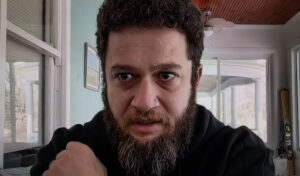 Seth Stern (pictured), director of advocacy at the Freedom of the Press Foundation and a First Amendment lawyer, told the Roundtable that not only is the Trump administration going out of its way to harass journalists with frivolous narratives that are tossed out of court, and attempting to criminalize journalism itself, but it is trying to co-opt the medium for its own purposes. “You saw Lemon said in his interview on Jimmy Kimmel’s show, he offered to turn himself in.
“That wasn’t good enough. These people are trying to make television. They wanted to… do it in a dramatic fashion.”
.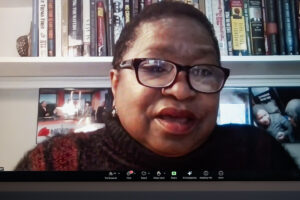 Challenges, yes. But the Roundtable participants were not short of ideas; increased collaboration being a common theme. Hazel Trice Edney (pictured), who runs her own Trice Edney Wire, a news service targeting the Black press, said, “There’s so many stories that must be told, and I’m hoping that Michael [Brice-Saddler] and some of his colleagues will get together and create a website . . . . We can be… we can own our own. I’ve been doing it for 15 years.”
 Tanya Gazdik (pictured), new president of the Journalism & Women Symposium, known as JAWS, noted that her organization spoke loudly about the arrests of Lemon and Georgia Fort.
“We issued our own statement after I saw the video of Georgia. Georgia posted on Facebook Live of the agents outside of her house and her children crying. And I was just so moved by that and I immediately started typing up a response from JAWS and I got my executive committee to sign off on it, and we had it posted within a couple of hours because we can’t be quiet. It’s too important right now. I’m hoping that JAWS can continue to stay active. And we haven’t been big on statements in the past, but I think going forward we will be.”
 Emily Emery (pictured), vice president, government affairs at the News/Media Alliance, representing publishers, messaged the next day, “If we at N/MA can be supportive, particularly through API, on connecting journalists with professional opportunities, I’d love to ensure we have connections in place to support that.” The API reference was to the American Press Institute, an affiliate of the alliance.
One positive in the Twin Cities, Justin pointed out, was its robust local media presence. “It does pay off when these big stories” happen, he said. But he also urged recruiters to broaden their sights.
“If we’re going to look at diversity and people coming from different backgrounds . . . Let’s start making some room for kids that are going to community colleges.
“For kids that are not going to college at all.
“For places that don’t have traditional journalism schools. They have a lot to teach us.
“And they can bring a lot to the profession.“
- American Immigration Council: Immigration in Minnesota
- David Bauder, Associated Press: In Minneapolis, all-encompassing immigration story tests a newsroom in midst of digital transition (Feb. 1)
- Graham Lee Brewer, Savannah Peters and Steward Huntington, Associated Press: Fearing ICE, Native Americans rush to prove their right to belong in the US (Jan. 30)
- Committee to Protect Journalists: New emergency fund supports US journalists at risk
- John Cusack, Chicago Sun-Times: Paywall-free news coverage of ICE raids, deportation campaign aids those who need it most (Jan. 28)
- Noah Dowe and Alyssa Tirrell, Media Matters for America: A federal judge’s ruling debunks right-wing media smears about Haitian immigrants
- Georgia Fort, New York Times: I Was Arrested for Doing My Job as a Reporter. Who’s Next?
- Matt Gertz Media Matters for America: MAGA media demand Trump put down the Minnesota “revolution” (Jan. 30)
- Roy S. Johnson, al.com: Journalism is not a crime, not in America
- Journal-isms: No Asylum From Racial Abuse (Nov. 30, 2022)
- Journal-isms: NAHJ President Wants to Reboot Unity (Aug. 30, 2018)
- Marisa Kabas, the Handbasket: The hell of being a ‘Kavanaugh stop’ victim (Jan. 7)
- Cait Kelley, APM Reports: ICE agents are trained in CPR. They didn’t use it on Renee Macklin Good (Jan. 17)
- Dahlia Lithwick and Mark Joseph Stern, Slate: Brett Kavanaugh Is Trying to Walk Back “Kavanaugh Stops.” Too Late.
- Ernesto Londoño, New York Times: Prosecutors Began Investigating Renee Good’s Killing. Washington Told Them to Stop.
- Ernesto Londoño and Hamed Aleaziz, New York Times: Top ICE Lawyer in Minnesota Departs as Immigration Lawsuits Overwhelm Courts
- Julianne Malveaux, syndicated: Black journalists get punished for doing their jobs
- Native America Calling: Native Americans are compelled to respond to indiscriminate ICE pressure (Feb. 2)
- Rümeysa Öztürk, Vanity Fair: “Even God Cannot Hear Us Here”: What I Witnessed Inside an ICE Women’s Prison (July 17)
- Clarence Page, Chicago Tribune: Chaos is the point of Trump’s war on immigrants in Minnesota (Feb. 3)
- Clarence Page: A cruel irony: Native Americans profiled as ‘aliens’ by ICE (Jan. 19)
- Matthew Purdy, New York Times: For Minneapolis’s Native Americans, a New Fight Echoes a Bitter History (Jan. 28, updated Jan. 30)
- Marc Ramirez, USA Today: Native ICE patrols recall Indigenous activism’s Minneapolis origins (Jan. 28)
- Lizz Winstead, MSNOW: Pam Bondi is using the FACE Act against Don Lemon for a reason — and it’s not public safety (Feb. 3)
Betty DeRamus Dies; Her Writing ‘Touched All Senses’
“Betty DeRamus may not have been a native Detroiter, but as her friend, former Free Press columnist Susan Watson once wrote of her: ‘She wasn’t born in Detroit, but her soul was,’ ” Susan Whitall reported Friday for the Detroit News.
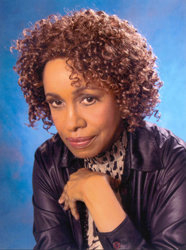 “DeRamus (pictured), a prize-winning columnist for The Detroit News from 1987-2006, and author of two books about the Underground Railroad, died early Friday after a long illness at a care facility in Novi, said longtime friend Denise Crittendon. She was 84.
“She had been suffering the effects of dementia in recent years. But up to the end, when friends would call her at the group home where she was living, there were still signs of her vibrant personality and curious, questioning mind.
“She was also a reporter and editorial writer at the Detroit Free Press, from 1972-87, and before that, a reporter for the Associated Press and the Michigan Chronicle.
“ ‘Betty DeRamus has always seemed like someone who should have been born in the future,’ said Kim Trent, a former Detroit News colleague. ‘She was an Afrofuturist before it was cool. Her brain is like no one else’s. She is without a doubt one of the smartest, most creative people I’ve ever known. She wrote beautifully because she thought deeply.’
“Her writing touched all the senses — sight, smell, sound and taste, especially in her columns about vanishing parts of the city’s culture. She wrote with the precision of a poet of her beloved city, where ‘the sad and the sassy, the beautiful and frightful often bump shoulders.’ At the same time, she was as dogged as any investigative reporter about chasing down leads and interviewing reluctant subjects. . . .”
Crittendon, a science fiction writer and former journalist, wrote on social media, “Per her request, burial will be private. A memorial service will be held early this Spring.”
