
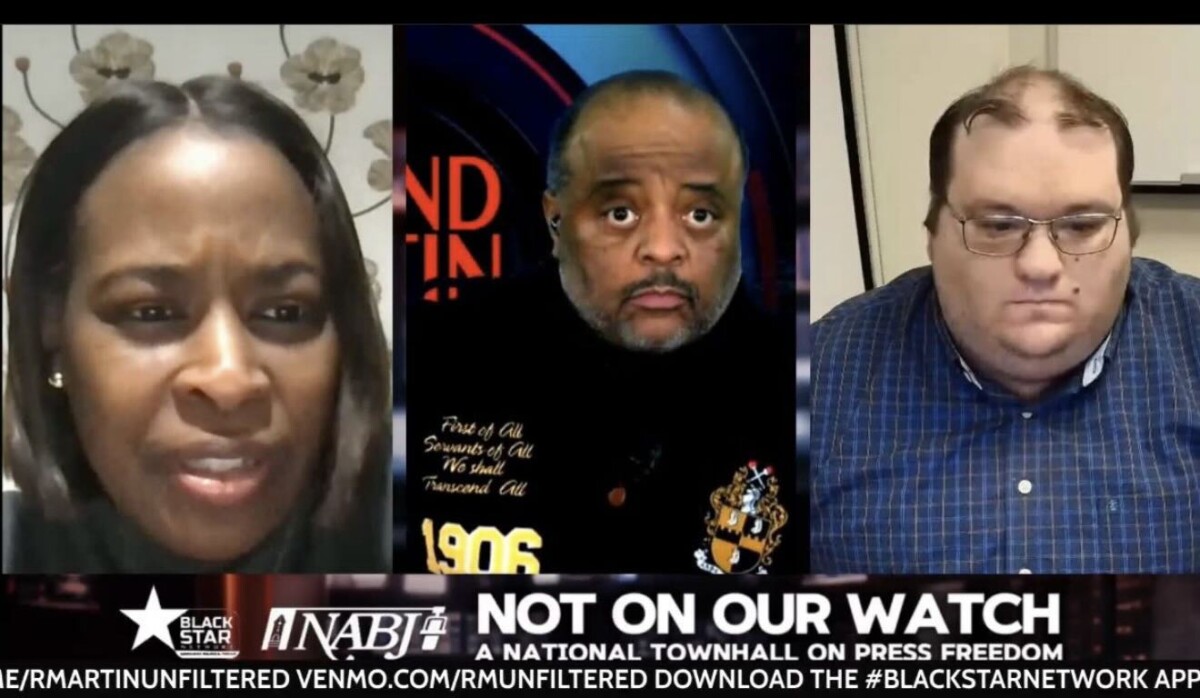
NABJ President Errin Haines told viewers, “NABJ was created for moments like this 51 years ago to advocate, to intervene and to ensure that Black journalists are not facing these threats alone.” The association celebrated its 50th anniversary on Dec. 12. (Credit: YouTube)
Hundreds Watch as NABJ Takes On Press Freedom
Los Angeles Mayor Karen Bass urged the National Association of Black Journalists to think about creating a legal defense fund Monday as the organization conducted an unprecedented two-hour “town hall” that attracted hundreds of online viewers in light of the prosecution of Black journalists Don Lemon and Georgia Fort in connection with the Minneapolis protests.
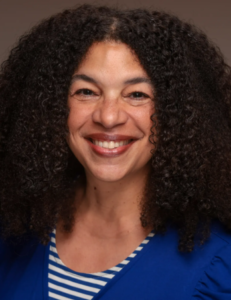 The times are exacerbating journalists’ problems as well as their responsibilities, speakers agreed. “Reporters are walking the streets now. . . . On one arm there’s a Sharpie with an immigration attorney and a name and a phone number, and on the other one is the First Amendment lawyer’s name,” said Karen Rundlet (pictured), executive director and CEO of the Institute for Nonprofit News, one of about 15 top-level press freedom figures assembled for “Not On Our Watch” on short notice.
Participants also said that economic pressure through legal costs might be more effective than direct censorship in silencing independent media, and that safety training and protective equipment are now essential for covering domestic protests. The concentration of media among large corporations rather than with family owners whose priority is journalism, not profits, makes the situation more difficult, they said.
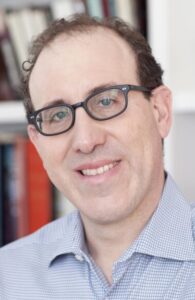 Moreover, said veteran press freedom advocate Joel Simon (pictured), “The laws that protect the rights of journalists covering protests and mobilizations, going back to the civil rights era, are incredibly weak.”
For 16 years, Simon was executive director of the Committee to Protect Journalists. He is now founding director of the Journalism Protection Initiative at the Craig Newmark Graduate School of Journalism at the City University of New York.
“We don’t have real protections,” he said. “And every time there are mass protests and demonstrations, there’s a crackdown on the press freedom and the rights of journalists.”
In addition, Simon continued, “One of the things that [I see] when I look around the world in my CPJ role, this is again something that many people have observed: The first line of attack is against journalists and the media. So if you see journalists coming under attack, you know that there’s a broader crackdown that’s coming. This was true in Russia, it was true in Venezuela. It was true in Hungary. It was true in Poland. It doesn’t matter the nature of the society, the first line of attack is usually against the press, and there’s a reason for that.”
 Trevor Timm, co-founder and executive director of Freedom of the Press Foundation, told viewers, “I’m looking at the U.S. Press Freedom Tracker right now.
“Just a few days ago, a video journalist was shoved and threatened with arrest by federal agents. Another reporter was grabbed and thrown down to the ground by a federal officer. Another was pepper sprayed, another was clipped with tear gas canisters. Others were hit with rubber bullets, another crowd control projectiles and . . . on and on. There’s been 19 incidents that have happened in the past six months in Minnesota. Many of them have happened just in the past six weeks.”
NABJ President Errin Haines replied, “We know for Black journalists, we disproportionately are covering things like civil unrest, protests, immigration, right, police violence. We are the ones that are disproportionately covering those. So to hear that means that we are disproportionately at risk for some of that danger. “
The “Not on Our Watch” session was conducted at the studios of the Black Star Network, a project of entrepreneurial journalist Roland Martin, who is vice president/digital for NABJ. As many as 582 people were watching at one point via NABJ’s YouTube channel, and more tuned in on Facebook.
Participating were leaders of such groups as the Committee to Protect Journalists, the News Guild-CWA, the Society of Professional Journalists, the International Women’s Media Foundation, the Committee for the First Amendment, the National Press Photographers Association, NABJ’s Minnesota chapter, the National Press Club Institute, the Institute for Nonprofit News and the American Society of Journalists and Authors and Free Press.
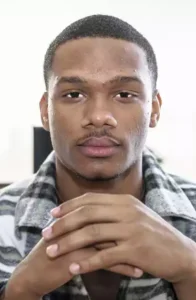 Viewers also saw a clip from Jerome Richardson (pictured), 21, a Black senior at Temple University who is a native of St. Paul, Minn., who turned himself in Monday to federal authorities in Philadelphia after assisting Lemon in Minneapolis. He asked for financial and emotional support.
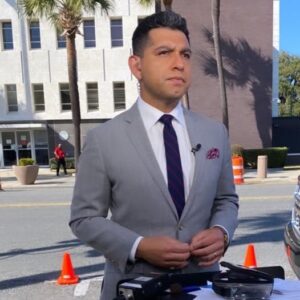 Also speaking was Nick Valencia (pictured), a CNN veteran who has been on the ground at protests and has his own media company, NVN.
“They want us to feel scared and talking about this and sort of panicked.” Valencia said. “I mean, that’s how I used to think words like fascism were too dramatic, right? I mean, I used to sort of cringe myself at people that brought that up, but when you sort of look at the elements of what’s happening, it’s already happening.
“Just the idea that we have this paranoia as independent journalists and feel uncomfortable or feel that potentially there’s going to be a knock on the door. I know I wasn’t alone on the day that my friend got arrested, Don and Georgia Fort and two others, and I wasn’t the only one that was making plans if that happened to me. And that’s when the fear wins. But there is a lot of hope to hold onto. There’s things that are called Bivens lawsuits.
“It’s a 1982, 1983 Supreme Court case that allows everyday citizens to sue federal agents for violating their constitutional rights and seek monetary damages.”
Given the large number of speakers, consider this: “There were some people wanting to join us, but because of the schedule couldn’t get on,” Martin said as he and Haines ended the session, which went overtime at 2½ hours.
 Nicole Carr (pictured), a journalist, author, and professor at Morehouse College, agreed with Haines that Black journalists were especially targeted. She has noted the historical pattern in a newly recirculated piece on the federal government’s harassment of the Black press during World Wars I and II.
“What we’re seeing in this assault today seems like it’s coming out of nowhere. But if you’re a journalist like I am, who was on the ground as the Big Lie was forming here in Georgia, a lot of us in local news were under private security,” Carr said. “I was, for four months, my children had an evacuation plan from this house. We were reporting locally and saying, there are no ballots and suitcases under seats in Fulton County, Rudy Giuliani.
“For every Ruby Freeman, you had 10 election workers and so many local journalists who were also facing threats. And we were encouraged not to talk about this. So silence doesn’t do anyone any good.”
Despite that Black focus, “Not on Our Watch” illustrated the multicultural nature of the issue, voiced by, among others, Latino journalists Valencia and Vanessa Maria Graber, who teaches at Temple University, as well as by Bass.
“Look, when the National Guard was here, we have Latino members of the National Guard that when they were off duty and out of uniform, got pulled over by other National Guard,” Bass said from her car. “I mean, this stuff is just so out of control and it’s just so racially targeted. We have a police department here in Los Angeles that’s almost 50 percent Latino. So now the police officers have to worry. Don’t go home from work without your uniform on.”
Added Temple University’s Graber, “for many of our communities, there are no news outlets. There are no Spanish-language news. So we’re forced to use alternative forms of communication in order to get the message out. And when that happens, you lack the institutional support, these legal trainings and knowledge of resources.”
Bass’ point about a legal defense fund for Black journalists was welcomed as something NABJ is looking into – “That’s one of the things that we’re talking about partnering with others as well,” said Martin, while others pointed out what is already available.
“One of the things that we do for members is we have a really big, we provide legal services basically for photographers,” said Alex Garcia, new president of the National Press Photographers Association. “We are not licensed to practice law in every state, but when we’re not, we can basically refer people to a network of lawyers around the country for referrals. We draft or join in the letters addressing First Amendment and journalist issues. So we’re pretty heavily into legal issues around this.”
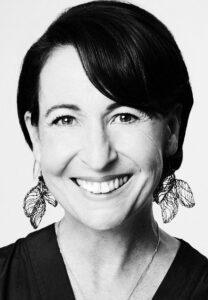 Gabrielle Gayagoy Gonzalez of the American Society of Journalists and Authors, and Elisa Lees Munoz (pictured), president of the International Women’s Media Foundation, each mentioned her group’s Emergency Assistance Fund.
“The threats, the harassment, the attacks online and in public are very gendered, and they are meant to send an additional message in addition to the media being perpetuated as a source of mis- and disinformation, women are belittled and shamed and set out as part of the problem,” said Munoz.
Caroline Hendrie, executive director of the Society of Professional Journalists, added, “SPJ has a very modest legal defense fund that sometimes can provide some assistance, and I think the idea of getting pro bono attorneys is really important. There is an organization called Lawyers for Reporters, I believe, and that’s one that folks should look at.
“Of course, Reporters Committee for Freedom of the Press also has legal hotlines that I imagine that your journalists are aware of. If they’re not, definitely look into that. They do provide pro bono assistance under certain circumstances.”
Katherine Jacobsen, U.S., Canada, and Caribbean program coordinator for the Committee to Protect Journalists, provided the email address emergencies (at) cpj.org, as “the general safety inbox that we have, and we triage from there. So we work with a series of partners, ” also mentioning the Reporters Committee for Freedom of the Press. “We also work with Penn America, Freedom of the Press Foundation . . .as well as the IWMF [International Women’s Media Foundation] to kind of help direct the needs the best.”
That said, Martin said there was no need to reinvent the wheel.
“You have to move as a collective.” he said. ”So if there’s somebody who’s already doing something, it doesn’t make sense for NABJ to say, well, let’s create our own. No, if you already got it, how can we tap into it? . . . .This is where the sharing of information is just so important — to know what is out there to help folks who need help.
 As he wrapped up, Martin said, “We’ve shown you GoFundMe pages, we’ve shown you organizations, nonprofits that raise money for legal defense funds, for training, for security, all of those different things, they are all needed. . . . Remember our soldiers, when we have wars, they didn’t fight for the Second Amendment alone or the Third or the Fourth. There’s a reason the First was the first.”
Haines said, “NABJ was created for moments like this 51 years ago to advocate, to intervene, and to ensure that Black journalists are not facing these threats alone. So if you’re able to support NABJ’s work, support Black-led newsrooms like this one and support organizations providing the legal, safety and professional resources.
“And third, speak up where you have an influence. We heard people calling for that tonight. So if you lead a newsroom, if you lead a classroom, a foundation, a community organization, ask what policies, protections, partnerships are in place when journalists are targeted, and what gaps still exist to be addressed. And, finally, refuse silence. That is what this message is sending. The chilling effect. When you can silence Black journalists, who else can be silenced? . . .
“ A free press is not a privilege. It is a public good, and protecting it is a shared responsibility because this is about the public’s right to know.”
A Journal-isms Roundtable complementing this town hall takes place this coming Sunday at 1 p.m. Eastern. See details.
- Stacey Patton, BlackAmericaWeb: Can NABJ Protect Black Journalists — Or Just Mourn Us After? (Feb. 5)
- Fisher Jack, EURWeb: Mayor Karen Bass Joins NABJ Call for Legal Defense Fund to Protect Black Journalists | WATCH (Feb. 9, from Journal-isms)
- Carly Thomas, Hollywood Reporter: Don Lemon Aware His Charges Are “Very Serious,” But That He’s “Not Going to Let Them Steal My Joy”
Alarmed L.A. Mayor Moves to Aid Black Journos
Feb. 1, 2026
Bass Meets with Officials, Media Reps After Arrests
Blackistone, Cut From WaPo, Cites ‘Journalistic Malpractice’
2 Blacks on CBS’ New Contributors List
Why Did Ye Choose Wall St. Journal for His Apology?
Praise for Book Version of Stories on Race Scam
Cold War Tale of Robeson, Robinson Has Parallels Today
Kids of Color Help Bid to Make Newsday ‘Cool Again’
Anti-DEI Forces Win by Turning Laws on Their Heads
As Conditions Sour, Cuba Targets Independent Journos
Los Angeles Mayor Karen Bass told Don Lemon and the assembled crowd Friday that politicians would stand behind him and ensure that he could continue to cover important stories around the country. (Credit: TMZ/YouTube)
Bass Meets with Officials, Media Reps After Arrests
Los Angeles Mayor Karen Bass convened an emergency meeting of Black officials Friday in light of the arrests of Black journalists Don Lemon and Georgia Fort, and invited “a large contingent of Black media” to participate, according to Black journalists who were present.
“Mayor Bass — joined by Congressional Representative Sydney Kamlager-Dove, LA County Supervisor Holly Mitchell, and California leaders — framed the arrests not just as legal overreach, but as a symbolic assault on democratic oversight and Black civic voice, particularly at a time when federal power has been deployed with little transparency or accountability,” Sharon Kyle, one of the journalists present, wrote Saturday for LA Progressive.
“Bass made clear that the spectacle of federal agents arresting journalists for doing their job was ‘shocking’ and ‘alarming,’ and struck many present as a warning to Black media professionals who have long been on the front lines documenting injustice.
“What followed was candid conversation about fear, resilience, and responsibility — and a shared commitment among Black press leaders and legislators to defend the First Amendment and protect community voices from state intimidation.”
In a move that outraged press freedom advocates, journalism and civil rights groups, as well as Black political leadership, federal agents last week arrested two Black independent journalists — Lemon and Fort — in connection with their coverage of an anti-ICE protest inside a church in St. Paul, Minn.
Two Minnesota Black activists who have run for office — Trahern Crews, a former candidate for St. Paul mayor and the state House of Representatives, as well as a co-founder of Black Lives Matter Minnesota, and Jamael Lundy, a lobbyist for the Hennepin County Attorney’s Office and current DFL candidate for Minnesota Senate District 65 – were arrested along with Lemon and Forte. Attorney General Pam Bondi took credit for the arrests.
Longtime White House reporter April Ryan, who writes “The Contrarian” on Substack, told Journal-isms Sunday that Bass was alarmed by the arrests and spoke with Ryan Friday morning.
Referring to Lemon, Bass “said she was going to make sure he’s safe and she was going to the court hearing,” which she did.
Later in the day, Ryan said, Kamlager-Dove told her that Bass was convening a meeting of Black officials. Ryan said the mayor wanted her to contact Black journalists who could attend.
Bass saw a connection between Trump administration attacks on the media, particularly Black journalists, with recent moves against Black activists and on public officials of color such as Rep. Maxwell Frost, D-Fla., Rep. LaMonica McIver, D-N.J., and Rep. Ilhan Omar, D-Minn.
View this post on Instagram
If no image is visible, please consider using another browser.
On short notice, Ryan then contacted Darlene Superville, White House correspondent for the Associated Press, and Philip Lewis, deputy editor of HuffPost and president of the Washington Association of Black Journalists. Other media figures present, Sharon Kyle reported, included Dominique DiPrima, who frequently hosts Bass on her KBLA-AM show, “First Things First with Dominique DiPrima.” In all, Ryan said, there was “a large contingent of Black media” on the hour-long Zoom call.
[Other journalists included Lila Brown of the Los Angeles Sentinel , Regina Brown WIlson, executive director of California Black Media, and a representative of the L.A. Standard, mayoral spokesperson Sam Jean said Monday.]
Superville said she didn’t say anything, messaging Journal-isms, “I was on deadline at the time so listened w only one ear.”
Among the office holders present was L.A. County Supervisor Holly Mitchell, who wrote on Instagram after the Lemon and Fort arrests, “When the Attorney General uses state power to silence people, it sends a chilling message rooted in white supremacy and a long history of suppressing Black voices.”
Kamlager-Dove is a First Amendment advocate who in July, with Rep. Hank Johnson, D-Ga., re-introduced the Restoring Artistic Protection Act (RAP Act) “to protect Americans from the wrongful use of their creative or artistic expression against them in criminal and civil proceedings.”
Those on the call discussed what legislation might be needed on the local and federal levels to further address attacks on the First Amendment. Bass is a former chair of the Congressional Black Caucus.
The participants were especially concerned about the Black Press, Ryan said, because unlike with corporate media giants, “they feel they can pick you off.”
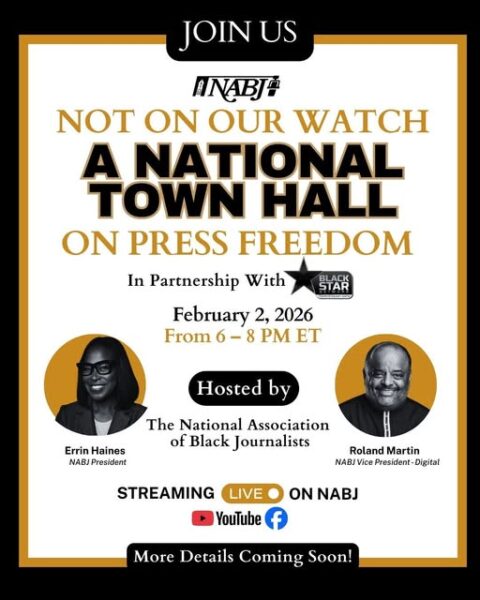
Separately, the National Association of Black Journalists announced Sunday that NABJ President Errin Haines and Vice President of Digital Roland Martin will host “Not On Our Watch: A National Town Hall On Press Freedom” in partnership with Martin’s Black Star Network to discuss next steps as Black journalists are targeted. This town hall is to stream live on Monday from 6 p.m. to 8 p.m. Eastern on NABJ’s official YouTube and Facebook pages.
- Associated Press: Read the full indictment against Don Lemon, Georgia Fort and others charged in Minnesota
- Jem Bartholomew, Columbia Journalism Review: ‘Terrorist! Terrorist! Terrorist!’: From Minneapolis to Gaza, how does the press responsibly report killings when officials act in obvious bad faith? By looking out the window.
- BlackPressUSA: NNPA Stands With Georgia Fort, Don Lemon, And All Arrested, And Demands All Charges Be Dropped
- Joe W. Bowers Jr., Sacramento Observer: After Don Lemon’s Arrest, Black Officials Raise Concerns About Independent Black Media (Feb. 3)
- John Casey, the Advocate: The racist, homophobic, and frightening arrest of Don Lemon
- Neel Dhanesha, NiemanLab: What a safety expert thinks journalists should know about “less than lethal” rounds and chemical irritants used by ICE
- Carolina Abbott Galvão and Riddhi Setty, Columbia Journalism Review: The Astonishing Arrests of Don Lemon and Georgia Fort
- Gerren Keith Gaynor, theGrio: Legal experts explain why charges against Don Lemon and Georgia Fort are so chilling
- Katie Herchenroeder, Mother Jones: Don Lemon’s Arrest Escalates DOJ Crackdown on Black Journalists and Activists
- Ja’han Jones, MSNOW: Before her arrest, journalist Georgia Fort gave me dire warnings about the press
- Los Angeles Sentinel: The Minneapolis ICE Crisis: Los Angeles Leaders Speak Out in Support
- Ronald Mitchell, Bay State Banner, Boston : Black journalists will not be intimidated (Feb. 4)
- Clarence Page, Chicago Tribune: A cruel irony: Native Americans profiled as ‘aliens’ by ICE (Jan. 19)
- Lydia Polgreen, New York Times: In Minneapolis, I Glimpsed a Civil War (Jan. 19)
- April Ryan with Mayor Karen Bass, Instagram
- Seth Stern, the Guardian: The arrest of Don Lemon is blatant censorship. And he is not the only one
- Tim Sullivan, Associated Press: A shadow network in Minneapolis defies ICE and protects immigrants
- Brandon Tensley and Dalila-Johari Paul, Captial B: Trump Administration Targets Black Church Protesters Over ICE Demonstration
- Susan Wessling, New York Times: How We Think About Words Like ‘Murder’ in Our Minneapolis Coverage
In a December 2024 appearance at Cornell University, Kevin Blackistone discusses how young Black men in college sports are pawns in a system that, ironically, he said, they can control if only they exercised their collective power. (Credit: YouTube)
Blackistone, Cut From WaPo, Cites ‘Journalistic Malpractice’
Washington Post watchers inside and outside of the newsroom are abuzz with the demoralizing news that the Post plans drastic cuts to stem years of financial losses, but one hard-hitting sports columnist of color – Kevin B. Blackistone – has already been given his walking papers.
Blackistone, whose columns include “Trump’s immigration policies make the U.S. an unfit World Cup host,” “Trans athlete bans are still about scoring political points, not fairness,” and “Trump would pull the Commanders back toward an ugly history,” says he was told in December that as a contract worker, he is being let go.
Sports Editor Jason Murray confirmed the development. Murray can’t be too happy, either. According to the New York Times, “The sports, local and international sections are preparing to take a disproportionate share of the pain.”
Blackistone, 66, is also an ESPN panelist and professor of the practice at the Philip Merrill College of Journalism at the University of Maryland.
Journal-isms asked Blackistone how he felt about what has taken place and what is happening now.
“Man, I was a Post delivery boy. I remember throwing the Watergate edition, the day after Nixon resigned. That was part of my inspiration to pursue journalism,“ he messaged.
“And the Post then was not what it became, a powerhouse in all levels of reporting and writing, from local to sports to national to foreign.
“I only had a contract to write a column in sports the last 10 years. It was a great ride. I wrote almost exclusively at the connection between sports and society’s points of contention. And a few times not about sports at all. And in that short time the paper invested in human capital that boosted its reporting and stature. Its reach and resonance increased. That’s how you do journalism. With more reporters doing more reporting.
“So what is said to be happening now is journalistic malpractice. I mean, The Washington Post first and foremost should cover Washington. That can’t be done with butchered metro and sports staffs. Not only that, but local journalism, especially nonprofit, is thriving right now. Look at Minneapolis. Lean into that, not away. That’s antithetical.
“And the paper’s standing, its reputation, can’t be maintained with a kneecapped foreign desk.
“It’s already cost itself talent with a poorly conceived reduction in force plan. Now it appears to want to continue that foolhardiness by surrendering reporting to AI. That’s how sports was left to cover the Georgetown game when the coach hurled a water bottle into the stands that struck a kid. AI of course didn’t account for it and the Post was left scrambling.
“I hope the smarter heads are listened to DC and the rest of the country need the robust journalism the Post was producing and there are still talented people there who are doing it nonetheless. They deserve help, not
https://awfulannouncing.com/newspapers/washington-post-lack-coverage-ed-cooley-water-bottle-georgetown.html hindrance.”
- Sean Keele, Awful Announcing: Washington Post’s lack of timely coverage over Georgetown coach Ed Cooley incident doesn’t bode well: Washington Post readers were entirely in the dark over Ed Cooley’s water bottle incident for half a day. (Dec. 21)
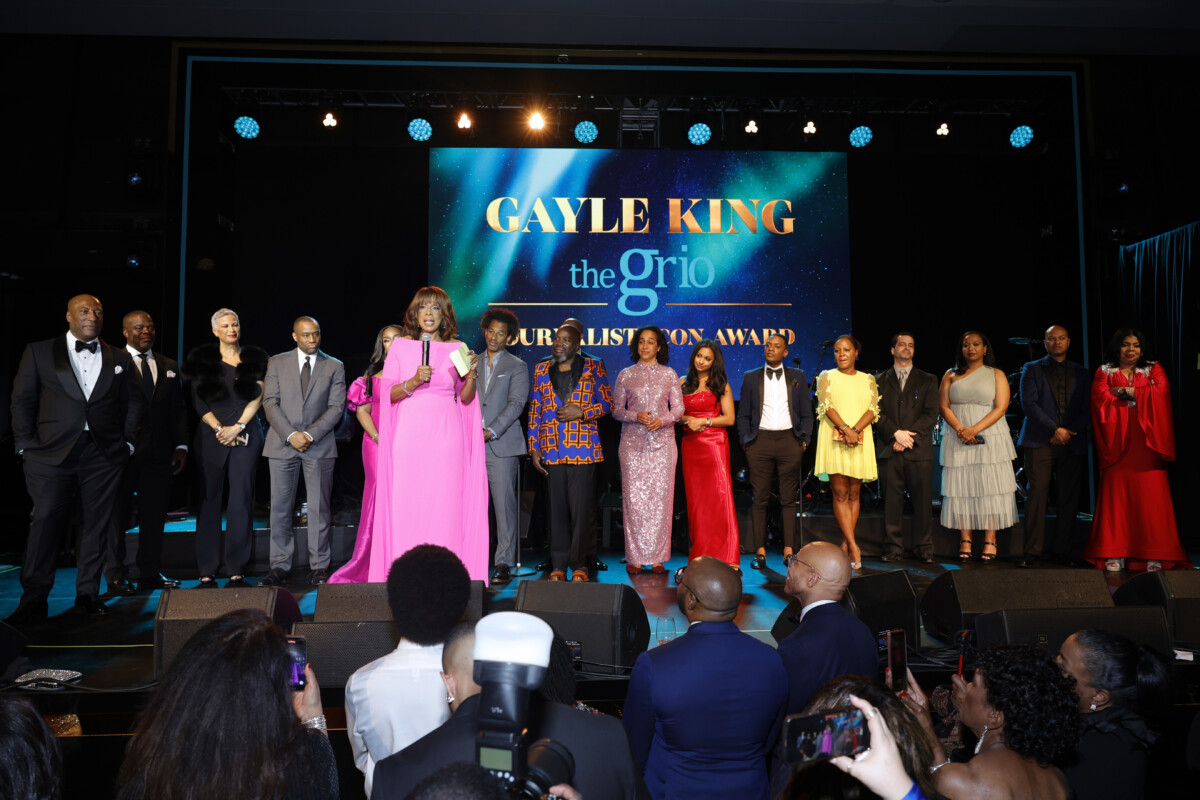
Gayle King speaks onstage with Byron Allen, left, and the staff of The Grio at Allen’s 2023 gala at the Smithsonian’s National Museum of African American History and Culture. King then 68, said then, “I’m not even thinking about retirement” and was “looking for more things to do.” From left: Allen, Princell Hair, Michele Ghee, Marc Lamont Hill, Natasha S. Alford. Toure’, Michael Harriot, Geraldine Moriba, Eboni K. Williams, Gerren Keith Gaynor, Dr. Christina Greer, Darren Galatt, Jocelyn Langevine, Panama Jackson, April Ryan. (Credit: Stefanie Keenan/Getty Images for Byron Allen, Allen Media Group)
2 Blacks on CBS’ New Contributors List
In a move to place CBS News more squarely in what she considers the political center, CBS News Editor-in-Chief Bari Weiss has hired a new slate of contributors, two of them Black. One is a Weiss colleague who has written a book titled, “The End of Race Politics: Arguments for a Colorblind America.”
 “In my book, I argue that colorblindness is the wisest principle by which to govern our fragile experiment in multi-ethnic democracy,” podcaster Coleman Hughes (pictured), a 29-year-old colleague of Weiss’ at her Free Press organization, wrote in 2024 for CNN. “My hope is that this book will help people think more clearly about the long-run consequences of race thinking and race-based policy, restore our faith in the guiding principle of colorblindness and pave a constructive path forward in our national conversation on race.”
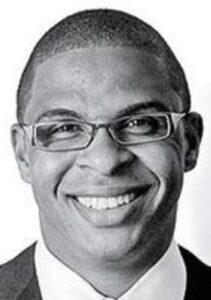 Also on the list is Roland Fryer, Jr. (pictured), a professor of economics at Harvard University, whose research combines economic theory, empirical evidence and randomized experiments to help design more effective government policies.
Fryer has been praised for his intellect – he was the youngest African American ever to be awarded tenure at Harvard — and for his escape from becoming “just another urban statistic.” But he has been criticized for some of his work.
In a 2018 study he authored on police shootings, Fryer found, “On non-lethal uses of force, blacks and Hispanics are more than fifty percent more likely to experience some form of force in interactions with police. Adding controls that account for important context and civilian behavior reduces, but cannot fully explain, these disparities.
“On the most extreme use of force – officer-involved shootings – we find no racial differences in either the raw data or when contextual factors are taken into account. We argue that the patterns in the data are consistent with a model in which police officers are utility maximizers, a fraction of which have a preference for discrimination, who incur relatively high expected costs of officer-involved shootings.”
In 2019, Fryer was suspended two years and saw the research lab he oversaw shut down permanently in response to multiple allegations of sexual harassment.
The 19 contributors “will appear across all of the Network’s broadcasts and digital platforms,” Weiss said at a CBS News staff meeting on Tuesday.
Weiss said there, “We’re for the center. We’re for the center-right, and we’re for the center-left,” according to Scott Nover and Laura Wagner, reporting for the Washington Post.
Also at the meeting, “CBS Mornings” co-host Gayle King, “who has been the subject of swirling rumors that she could soon be ousted at ‘CBS Mornings’ due to her hefty salary and age, spoke up towards the end of the question-and-answer session of the meeting to both praise Weiss’ vision and rage about the ‘leakers’ at the network,” Justin Baragona reported Wednesday for the Independent.
“While the first half of her remarks appeared to be an effort to rally the troops, King then segued to blasting those at CBS News who have leaked to the media – seemingly seeking to empathize with Weiss, who has been pilloried in the press over her tumultuous first few months on the job. The morning host and best friend of Oprah Winfrey also appeared to enforce Weiss’ ‘love it or leave it’ message to staff.
“ ‘I would like to think that we can have conversations, and then we could talk candidly with each other, and it’s not going to be friggin’ be in the paper. I am so sick of that. I’m so sick of it! I’ll be curious to see how long it takes for this to get out,’ she exclaimed.”
Meanwhile, some are writing that the Washington Post and CBS News are chasing an audience that will not respond to them.
“When you throw subscribers under the bus — even with the best intentions and without a good reason — you eat away at the trust that binds your audience,” Yoni Greenbaum wrote Wednesday for backstoryand strategy.com, referring to the Post’s rightward Opinion page turn.
“Weiss is poised to make the same mistake. The Gen Z audience she wants to reach does not watch linear television. The median age of a broadcast news viewer is over 60.”
The Gen Z ‘Barstool Conservative’ CBS might be seeking “is on YouTube, TikTok, and Joe Rogan. They will not turn on a television set at 6:30 PM on a Tuesday to watch a sanitized 22-minute broadcast, regardless of whether the anchor is Tony Dokoupil or Norah O’Donnell.”
- Eric Deggans, Substack: How misguided visionaries and negligent owners threaten journalism at CBS News and The Washington [Post]
- Richard Luscombe, the Guardian: A ‘wellness bro’, a cosmologist and an RFK Jr crony: meet Bari Weiss’s new CBS News contributors
Why Did Ye Choose Wall St. Journal for His Apology?
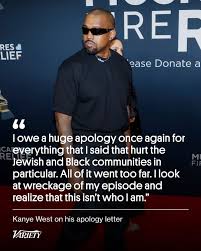 When Ye, the artist formerly known as Kanye West, apologized for his antisemitic behavior in a full-page ad Monday in The Wall Street Journal, at a cost estimated at $165,000 to $277,000, for some, the question was, why The Wall Street Journal?
“No Black publication for the Black apology?” asked the author of one post quoted by Blavity. “The fact that Ye took out an ad in the Wall Street Journal to apologize to the Black community tells me everything I need to know about his supposed return to reality,” wrote another, quoted by The Root.
Journal-isms put the question to the AI component of Yahoo:
The response:
“While he hasn’t explicitly stated why he chose the Wall Street Journal specifically, several key factors contributed to the move:
- “Corporate Accountability & Business Recovery: The ad coincided with his new mid-to-low seven-figure record deal with Gamma, a music company that reportedly required him to commit to positive messaging before signing. Choosing a prestigious business-focused publication like the Wall Street Journal signals a professional effort to mend fences with the corporate world after losing major partners like Adidas.
- “Targeting Global Influence: In the ad, titled ‘To Those I’ve Hurt,’ Ye acknowledged that his words as a leader have ‘global impact and influence.’ The WSJ’s high-profile, professional readership provided a serious venue to address his ‘reckless’ comments and deny being a Nazi or antisemite.
- “Album Promotion: Critics and fans noted that the apology preceded the upcoming release of his new album, Bully. This follows a historical pattern for Ye of issuing public apologies shortly before a major project drops to clear the air for commercial success.
- “Narrative Control: The advertisement allowed him to present a detailed explanation for his actions without being edited. He attributed his behavior to bipolar type-1 disorder and a 2002 brain injury that he claims went undiagnosed until 2023.
“The Anti-Defamation League called the apology ‘long overdue’ while noting that meaningful action must follow these paid words.”
Elias Leight reported Wednesday for The Wall Street Journal, “The rapper will put out his next album ‘Bully’ with Gamma on March 20, and the deal is in the mid-to-low seven figures, according to two people familiar with the matter.”
“A few years ago, a small, private school in an underprivileged Black community in Louisiana made national headlines for propelling student after student into elite universities like Harvard and Yale,” the “PBS News Hour” reported Jan. 20. “But according to the new book ‘Miracle Children,’ the school’s success was built on lies and threats. Amna Nawaz spoke with the writers, Katie Benner and Erica Green.” (Credit: YouTube)
Praise for Book Version of Stories on Race Scam
“The story seemed, and was, too good to be true,” Kevin Carey, who directs the education policy program at New America, a nonpartisan think tank in Washington, D.C., wrote Jan. 13, updated Jan. 14, for the New York Times.
“Year after year, T.M. Landry College Preparatory Academy, a tiny private school in Louisiana serving mostly Black, working-class children, was sending its graduates to top universities. It had become internet-famous for its viral videos of ecstatic students learning of their acceptance into the Ivy League.
“In November 2018, the New York Times reporters Erica L. Green and Katie Benner broke the news ‘that much of the academy’s success was a lie. Impressive transcripts were fabricated. Heart-tugging tales of overcoming deprivation and parental neglect were likewise made up by the school’s husband-and-wife leaders, Tracey and Michael Landry. The Ivies were embarrassed and the students branded as frauds.
“Seven years later, Benner and Green have published the definitive book-length account of the T.M. Landry scandal. If their original article was an indictment of the school’s deceitful proprietors, their book, ‘Miracle Children,’ makes the case against the punishing inequities and wide-ranging market for Black trauma that enabled the scam. . . . “
The book made Town & Country’s list of “The Best Books to Read This January.”
“Consider it essential reading,” wrote Emily Burack and Adam Rathe.
Roland Martin and Howard Bryant discuss “Kings and Pawns: Jackie Robinson and Paul Robeson in America” Saturday on Martin’s online network. (Credit: YouTube)
Cold War Tale of Robeson, Robinson Has Parallels Today
. . . Also warranting attention is sports journalist Howard Bryant’s “powerful history the intersecting paths of baseball star Jackie Robinson and singer and actor Paul Robeson against the backdrop of U.S. segregation and Cold War politics,” Publishers Weekly wrote.
“In 1943, Robeson was the first Black actor to play Othello in a major U.S. production, and a few years later Robinson broke the color line in Major League Baseball when he debuted with the Brooklyn Dodgers. Though the two never met, they were publicly pitted against each other.“
Bryant said Tuesday on the “PBS News Hour,” “I think the biggest lesson to me when I think about — especially when I think about Paul Robeson, is the power of the times that you live in.
“The complacency that we have today is very, very similar to the complacency that people felt back then, that the country wouldn’t go as far, that we still believed in our institutions, and the institutions would save us and that common sense would prevail. . . .
“There were all kinds of legal and extralegal things that took place there that really destroyed this man. And, on the other hand, when it came to Jackie Robinson, we talk about April 15, 1947, as the transformative moment that it was, but we also don’t talk about what it did to Jackie Robinson as a person. . . .”

In September 2024, Daphne Charles-Brown posted photos from Ulysses Byas Elementary School in Roosevelt, Long Island, participating in the Newsday in Education program for fifth graders.
Kids of Color Help Bid to Make Newsday ‘Cool Again’
Nearly two years ago, the Poynter Institute ran a feature about the Newsday in Education program for fifth graders, which combines field trips with free digital access to all school districts on New York’s Long Island But the photos illustrating program, which aims to “make Newsday cool again,” showed no visibly Black students. (scroll down)
That’s unlikely to happen again, according to Tara Rogers, Newsday’s communications director.
“In 2025, we reached more students than ever, with approximately 2,000 elementary school students participating,” Rogers messaged. . We are also preparing to launch a high school version of the program” in February.
“Program participants reflect the demographics of Long Island as a whole. The percentages of diverse student populations we serve meet or exceed those of Nassau and Suffolk counties.
“In 2025, the program attracted students from school districts across Long Island, including Hempstead Union Free School District — one of the largest and most diverse districts in Nassau County, with historically high Black and Hispanic enrollment; Uniondale Union Free School District — known for a higher percentage of Black students compared with many suburban Nassau districts; and Roosevelt Union Free School District— which, while smaller than Hempstead and Uniondale, often has a higher share of Black students.”
Anti-DEI Forces Win by Turning Laws on Their Heads
Barely a week after the National Urban League presented a survey to fellow diversity advocates, including journalist organizations, showing that the public is on their side, the New York Times headlined Sunday that “Conservatives Are Undercutting D.E.I. in Flood of Lawsuits.”
“Conservative groups have brought dozens of lawsuits since the Supreme Court’s decision in 2023 that ended affirmative action in college admissions,” Anemona Hartocollis wrote in a story on the Sunday print edition’s front page.
“Their ambitions are grand: To push that change beyond universities into other areas of American life, including corporations, law firms, health care, the arts and private nonprofits offering scholarships intended to help people of a certain race or ethnicity.
“And in some cases, they are using a novel strategy, employing Reconstruction-era laws that were intended to ensure the rights of Black people against D.E.I. programs.
“In many cases, they are claiming easy victories, lawyers on both sides say, with defendants buckling soon after the case is filed. . . .”
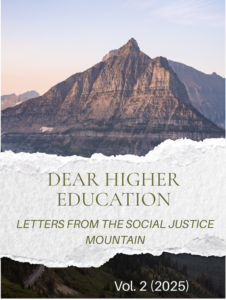 Meanwhile, “two former diversity professionals and an anthropology professor have founded a journal, called Dear Higher Ed: Letters from the Social Justice Mountain, to collect insights, experiences, research and best practices from faculty and higher ed staff currently or formerly engaged in DEI work on their campuses,” Sara Weissman reported Tuesday for Inside Higher Ed.
“The project started with two diversity professionals at Virginia Tech who wanted to document their coworkers’ experiences as potential fodder for a book as state DEI bans proliferated. Menah Pratt and Michele Deramo, who worked in Virginia Tech’s DEI office at the time, invited their colleagues to write letters to higher ed. But they quickly realized they wanted to include voices from other institutions as Pratt met coworkers invested in DEI nationally and internationally on a fellowship with the American Council on Education at the University of Minnesota. . . .”
Rhode Island College anthropology professor M. Gabriela Torres joined the pair later.
- Maryclaire Dale, Associated Press: Judge calls Justice Department’s statements on slavery exhibit display ‘dangerous’ and ‘horrifying’
- Scott MacFarlane, Jacob Rosen, Julia Kimani Burnham, CBS News: Trump administration’s claims of so-called “reverse discrimination” upend DOJ Civil Rights Division (Jan. 19)
- Tara Phamluong, Her magazine, UC Berkeley: The Need for Diversity, Equity , and Inclusion in American Journaism
As Conditions Sour, Cuba Targets Independent Journos
The Cuban government, the target of an executive order from President Trump declaring the nation “an unusual and extraordinary threat,” and undergoing worsening economic and social conditions, has responded with more repression against independent journalists, according to the Inter-American Press Association.
 The association “expresses its strongest condemnation of the recent escalation of arbitrary detentions, house arrests, and police harassment targeting independent journalists in Cuba, recorded over the past several weeks,” the collection of Western Hemisphere news publishers said Friday.
“The organization warns that there can be no press freedom under a system of permanent persecution and police control, and that the sustained repression of those who report the news constitutes an open and systematic denial of society’s right to be informed.
“This new offensive against independent journalism is taking place amid a profound economic and social crisis facing the island, further aggravated in recent weeks by an unprecedented energy crisis that intensified following the arrest of Nicolás Maduro in Venezuela, with power outages lasting 20 or more hours a day in large regions of the country and with no clear prospects for a solution.
“In this critical scenario, independent journalism plays an essential role in documenting the daily reality of the population, giving voice to social discontent, and exposing the consequences of the crisis. Precisely for this reason, the authorities have intensified mechanisms of repression to prevent journalists from freely reporting on these events. . . .”
IAPA went on to list eight cases it had documented involving journalists, in addition to those of opposition figures.
- Gretel Kahn, LatAm Journalism Review: Exposing the regime from afar: How Cuban journalists report on the island from exile
- Prisoners Defenders: Prisoners Defenders launches the First Comprehensive Report on Digital Surveillance in Cuba (Jan. 20)

