

Phillip Martin Denied Service Over ‘Mistaken Identity’
From Nov. 28: Journalists Plan to Join Pro-Diversity Coalition
IRE, NABJ to Confront Trump’s Effect on Newsrooms
Key Findings From Survey on Attitudes Toward DEI
‘Scary’ in Anti-DEI Climate, but Professor Perseveres
Journal-isms Roundtable photos by Jeanine L. Cummins
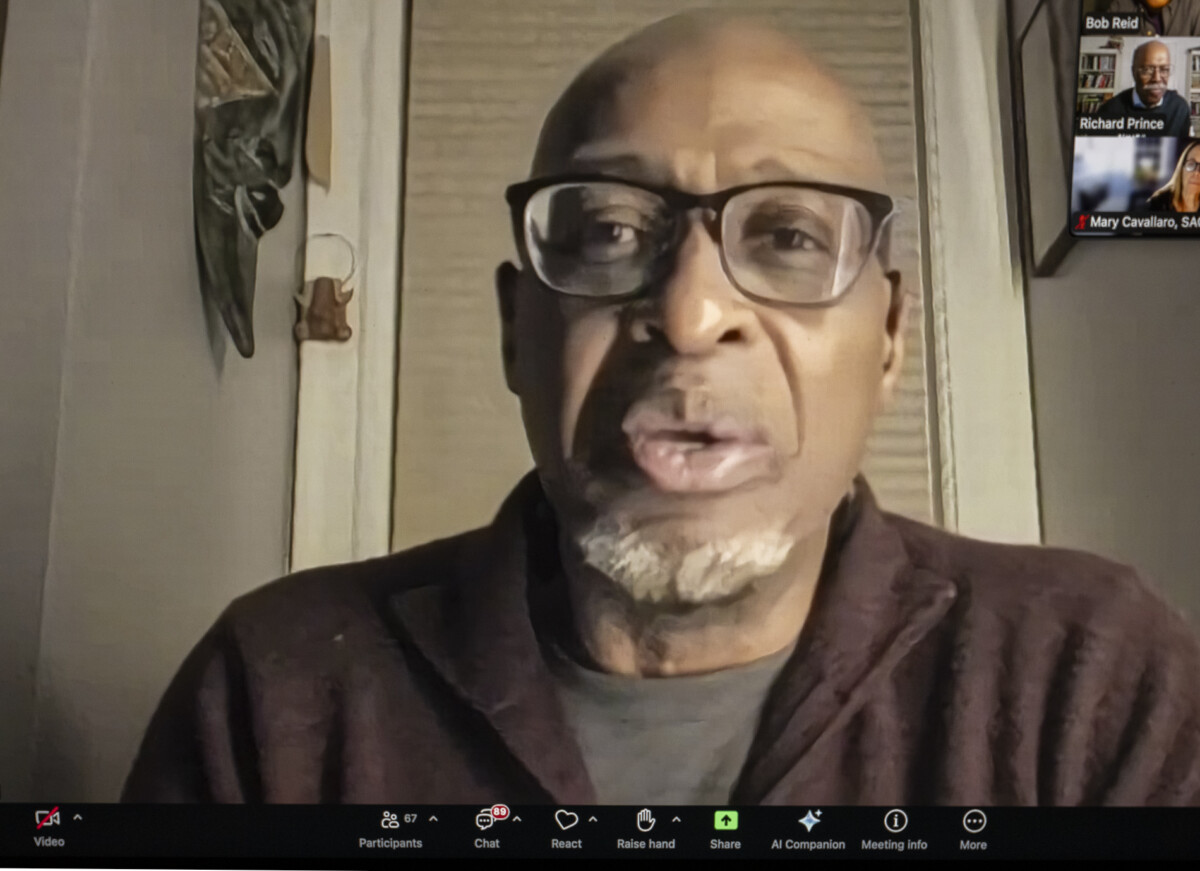
Phillip Martin, shown at the Journal-isms Roundtable three days after the cafe incident, noted that eyewitness misidentification and racial bias contribute to the disproportionate number of Black men in the criminal justice system. “It starts with something that’s innocent, as a misidentification at a counter in a restaurant or a café or a store. Once the police are involved, misidentification becomes a major, major issue,” Martin said. (Credit: Jeanine L. Cummins)
Phillip Martin Denied Service Over ‘Mistaken Identity’
Phillip Martin, newly retired senior investigative reporter for Boston’s WGBH public radio, has accepted an apology from the Americas COO of an international chain of coffee shops after being denied service because a barista mistook him for another Black man.
That person had been thrown out of the Cambridge, Mass, cafe for being “abusive to the staff” and had relieved himself inside, according to a cafe spokesperson.
“I’m trying to actually put a period to this issue, with Caffè Nero at least, and hope that organizations or people who are responding to this might look at the more broader questions of misidentification that are pervasive throughout our society, that happen in a lot of establishments,” Martin said, according to Boston.com.
“To that end, he flagged the Nov 21 incident to the Massachusetts Commission Against Discrimination and the Cambridge Human Rights Commission.
“ ‘The reason this is an issue for me is because I don’t want it to happen to anyone else,’ Martin said. ‘Though, of course, it will — not necessarily at Caffè Nero, but somewhere else.’ ”
Finding himself falsely accused, Martin, who has extensively covered race relations, used the knowledge gained from his reporting as he reacted to his situation as well as in his analysis of it.
The incident took place just days before the Journal-isms Roundtable, at which Martin took part, heard speakers note that Black journalists are part of the Black community at large.
“The same forces that are coming for our newsrooms are coming for our communities,” said Errin Haines, president of the National Association of Black Journalists, in the discussion of diversity, equity and inclusion in newsrooms.
 Martin G. Reynolds (pictured), co-executive director of the Maynard Institute for Journalism Education, spoke of the institute’s teachings about “the fault lines and how we all see the world through these lenses of race and class and gender, and generation, and geography and other elements of identity.”
Phillip Martin’s own remarks, which begin at 01:01:34 in this video, questioned whether the “DEI” term actually stood for something greater. He did not mention the café incident.
”I did not want to have this issue intrude upon our discussion Monday,” Martin told Journal-isms. “In retrospect it’s entirely relevant to that discussion.”
The Boston Globe story on the development, which drew 469 comments before they were cut off, underscored a racial and ideological divide that many DEI advocates say they are trying to ease.
“A simple case of mistaken identity . . . but he plays the race card because he’s black,” wrote a person identified as “Sugar Ray.”
“Your ignorance is astounding. He’s a black man, he doesn’t have to play a race card. It is his life,” replied “Sophie and Miles.”
“Those of us who are white have an obligation not to fall into the trap of confusing one person of color with another,” wrote media writer Dan Kennedy, a professor at Northeastern University’s School of Journalism. “If the barista had paused for a moment and thought about whether Martin truly resembled the person who’d gone off in her store earlier, she almost certainly would have realized that he didn’t.”
The barista was Latina, Martin said, though racism infects that culture as well, a subject discussed at a previous Roundtable.
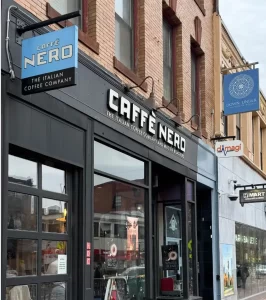 Nick Stoico and Alexa Coultoff reported for the Boston Globe, in a piece updated Nov, 24, “Phillip Martin, 71, an award-winning reporter for GBH who retired earlier this year after more than two decades with the station, said he was meeting with another journalist at Caffè Nero in Central Square (pictured) on Thursday when he tried to order a cup of tea.
“A woman working at the counter told Martin that her boss instructed her not to serve him if he came into the cafe again, according to Martin. He said he told her she must be mistaking him for someone else, but the woman insisted, ‘No, we have you on video.’
“Martin and the employee each called police, he said. After officers spoke with Martin and the cafe worker separately, they told Martin that he was allowed to stay.
“Sergeant Bob Reardon, a Cambridge police spokesperson, said officers determined the situation ‘to be a misunderstanding.’
“A Caffè Nero spokesperson said in an email that the interaction was ‘a genuine case of mistaken identity due to the close similarity of height, build, and style of beard and glasses with a customer who had been responsible for significant anti-social behaviour previously.’ ”
However, as Abby Patkin reported for Boston.com:
“Martin said he found the corporate representatives sincere, and he believed them when they said they regretted what happened and were working to correct the error. However, he also said he was left somewhat ‘befuddled’ after he was shown a photo of the person for whom Caffè Nero staff had mistaken him.
“ ‘I looked at the photo, and I told them, “He looks nothing like me,” Martin recalled. He said the picture showed a much younger light-skinned Black man with a scruffy beard.
“ ‘This was not a doppelgänger in the least,’ Martin added.”
In any case, Martin told the Globe, “They cannot make assumptions based on what the person appears to look like, because that is subject to the most vile stereotype when those things happen.”
Patkin continued, “Martin has reported extensively on the issue of eyewitness misidentification and the disproportionate consequences for Black men. He’s also got some firsthand experience, having been misidentified and forced into a police lineup as a young teenager.
“ ‘These things don’t leave your mind,’ he noted.“
 Martin said he met Wednesday with Paul Morgan (pictured), chief operating officer of Caffè Nero Americas, who also wrote the journalist:
“Our Area Manager, Margaux has passed on to me your email, which I was really pleased to receive as it gives me my opportunity to extend my professional and personal heartfelt apology to you. I extend this as an employee of Caffè Nero, and as a fellow human being.
“I was mortified to hear what had happened to you and how it made you feel. This was not acceptable, and we are taking this very seriously. Our goal is to ensure that this cannot happen again.
“Our Head of People, Sarah conducted face to face training in the store today to help achieve this. She has also recorded a podcast that will be issued across all of our stores within the next 24 hours.
“To ensure the training has landed, our Area Managers will be following up with all Store Managers to check that every single team member has received the training. I will also be asking as I visit stores.
“I did communicate to the Boston Globe that I would be happy to meet with you to extend my apology on a personal level, and that invitation still stands if you would like to. I have worked for Caffe Nero for 20 years, and one of the main reasons I have done this, and been proud to do so, are our unpinning values of inclusivity, diversity and family values. Everybody is welcome in our stores and we recruit team members who we believe will show kindness and welcome people of all ethnicities, religions, sexual preferences, gender etc.”
- Jensen Bird, Daily Mail: Coffee chain refuses to serve black customer before being forced to issue groveling apology
- Mark Herz and Lisa Wardle, WGBH News, Boston: Retired GBH reporter speaks out about ‘problematic’ case of mistaken identity at Cambridge café
- Dan Kennedy, Media Nation: Caffè Nero apologizes and vows to bolster training after a racially charged case of mistaken identity
Journalists Plan to Join Pro-Diversity Coalition
Nov 28, 2025
IRE, NABJ to Confront Trump’s Effect on Newsrooms
Key Findings From Survey on Attitudes Toward DEI
‘Scary’ in Anti-DEI Climate, but Professor Perseveres
Journal-isms Roundtable photos by Jeanine L. Cummins
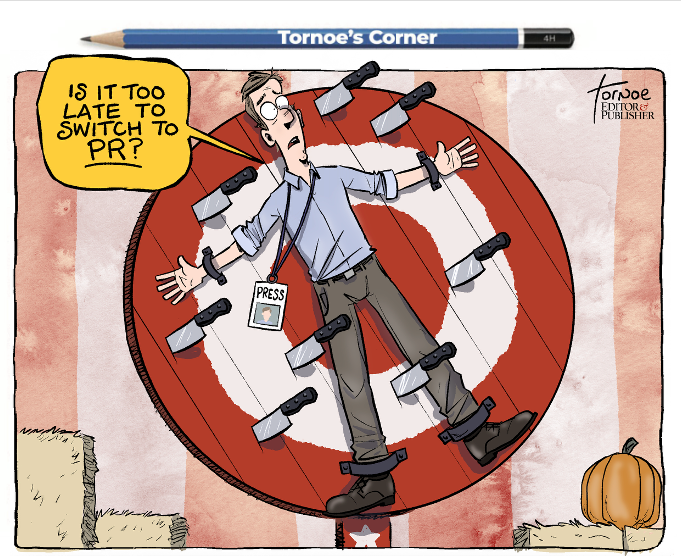
The Trump administration’s attacks on diversity, equity and inclusion come on top of those targeting the news media in general, and are compounded by assaults on the business model upon which media companies are built, as Rob Tornoe illustrates for Editor & Publisher.
IRE, NABJ to Confront Trump’s Effect on Newsrooms
Investigative Reporters & Editors and the National Association of Black Journalists — the nation’s two largest organizations primarily focused on journalists — plan to join the pro-diversity coalition organized by Marc Morial, president and CEO of the National Urban League, their leaders said this week.
Larry Goldbetter, president of the National Writers Union, which represents independent freelance media workers, says, “count us in,” too.
Three other groups – the News Guild-CWA, the Society of Professional Journalists and the Screen Actors Guild-American Society of Television and Radio Artists, known as SAG-AFTRA — also expressed strong support for newsroom diversity during a Journal-isms Roundtable Monday.
Click to view (Credit: YouTube)
The session, attended by more than 70 people via Zoom, was titled, “How Trump Has Affected Newsroom Diversity – and What We Can Do About It.”
Morial assembled a a powerful array of skilled civil rights advocates last January to undertake “massive resistance” in the courts and elsewhere to counter the Trump administration’s demonizing of the concept of diversity, equity and inclusion.
Journalism groups were not represented.
When the advocates meet next, they will be armed with a new survey that shows public support for DEI increasing in the face of the Trump administration’s assault, as well as from attacks by allied state and local governments.
 “The favorability amongst the American people for diversity, for diversity, equity and inclusion, for equal opportunity is higher than it was a year ago. And in the court of public opinion,” the attacks “are backfiring even as we listen to the loud noise,” Morial (pictured) told the Roundtable. He was joined by Tara Murray, executive director of the Washington bureau and senior vice president for policy and advocacy.
“We’ve got to leverage the court of public opinion to send a strong message to not walk away from their commitments,” Morial continued.
While the Urban League leader conceded that public opinion is no match for the federal government’s power to withhold approval for mergers and broadcast licenses, it is a tool, the civil rights leader said, noting that not all media companies have business before regulators.
“We have to have an inside and outside strategy,” Morial continued. “So groups like NABJ and other trade groups can and should, I think, meet with media organizations, should meet with broadcasters and newspapers and state what our position is and state how we feel and state how damaging these attacks are.”
In May, in response to a question, Morial spoke about the importance of those who know the craft of journalism.
“Journalists are storytellers,” Morial said. “And in this moment, also, our journalists in our community are truth-sayers. And it is so important in this moment that all of us find ways to lift our voices. Individuals can do it through social media. Those that have the pen in their hand, the proverbial pen in their hand, can write about this moment.
“See, I think the headlines have grabbed those companies that have retreated. There needs to be attention on those that have not.
“Because those that have not — now some of them don’t want a lot of attention. But we want to shine a light on it because it is a mixed result.”
At last January’s Demand Diversity Roundtable, 20 groups, including the NAACP, the Legal Defense Fund, the Southern Poverty Law Center, the Jewish Council for Public Affairs, Asian Americans Advancing Justice and the National Hispanic Media Coalition, met at the National Press Club in Washington. The session was streamed.
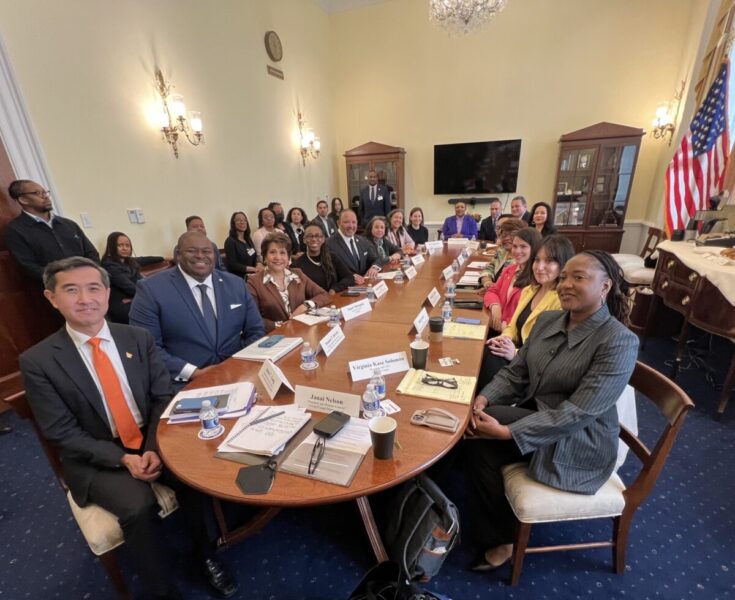
House Minority Leader Hakeem Jeffries, in rear at the head of the table, with Demand Diversity
Roundtable leaders in Washington on Feb. 25.
The next month, they discussed their concerns on Capitol Hill with House Minority Leader Hakeem Jeffries, D-N.Y.
In May, in response to a question from Journal-isms, Morial said the Urban League was “trying to figure out a way to include” NABJ and the trade group for Black-press publishers, the National Newspaper Publishers Association, in his coalition.
It was not until this week, when the question was put to NABJ President Errin Haines, elected in August, that either NABJ or NNPA responded definitively.
“We are in agreement,” said Haines (pictured) at the Journal-isms Roundtable Monday.
 “This is absolutely a moment that requires courage. And these are groups that know how to advocate, right? But so does NABJ. And we know that when NABJ leads, others in our industry follow. And the reality is, just like Marc said, if Black America is under attack, we are compelled to respond in this moment. And so, NABJ is absolutely in that fight.“
Haines continued, “I’m saving the date for Jan. 22 in Washington. Planning to be there in solidarity with you all because look, you know, the same forces that are coming for our newsrooms are coming for our communities. They’re attacking diversity. They’re suppressing the truth. They’re rolling back the freedoms that our profession frankly depends on.
“And so to me, it was pretty obvious it makes sense — it’s necessary for NABJ to really be standing shoulder-to-shoulder right with civil rights organizations right now. We know that we’re stronger in coalition. There’s strength in numbers and when we show up together you know we remind the country that press freedom and civil rights are not separate fights. They’re the same fight.
“And so I believe that that us being [in] coalition only amplifies our mission, and it ensures that we are not just telling the story as Black journalists, but we are shaping what happens.”
NABJ had 4,259 voting members, according to figures announced at its convention membership meeting in August.
That number is exceeded by Investigative Reporters & Editors, which has a membership that regularly hovers around 4,800 to 4,900, sometimes rising to 5,000 and sometimes dipping slightly below 4,800, according to Executive Director Diana R. Fuentes (pictured).
 “We actually have seen an increase in people who are asking for diversity training because they’re not getting it anywhere else,” Fuentes told the Roundtable. “And so we’re ready to serve and we do. Our membership, despite all these layoffs . . . decimating newsrooms right and left, has maintained at about 30 percent journalists of color.
“So they still want the training. People are still out there and are maintaining. So I look forward to the summit in January. We would like to participate.”
Speakers from other media organizations expressed strong backing for DEI, though not necessarily for attending the Demand Diversity Roundtable, with at least one explaining that the group wasn’t invited.
 Caroline Hendrie (pictured) is executive director of the Society of Professional Journalists, which had about 3,800 members as of Aug. 31.
Hendrie said, “What really resonates with me is this issue of how can we work together to fight the fear. . . . Press freedom, diversity, equity and inclusion, they are all one and the same in so many ways.
“We need to stick together and stick up for ourselves.” Journalists “need strong membership organizations that aren’t afraid to speak out.more than ever, to kind of listen authentically to the issues that really matter.
“And stand up for yteir rights, and the right to a diverse.and inclusive and equitable newsroom and news industry is part of that. . . . So, we want as many allies as we can in the fight for press freedom.” SPJ “looks forward to being part of the effort to fight back.and fight the fear.”
The News Guild says it represents more than 25,000 journalists and commercial workers in 200 media organizations in the United States and Canada.
 Jon Schleuss (pictured), the Guild president, told the Roundtable that collective bargaining is a powerful tool. “We actually have so much power to organize collectively and then bargain for diversity, equity and inclusion provisions at the bargaining table and put them into a contract that’s enforced,” he said.
“We have to be accountable and we have to look like the communities we cover. And so we can do things in contracts, in bargaining, like fight for pay equity, fight for a mandate that a certain percentage of people who are interviewed come from under-represented groups, fight for in our contracts the requirement that every single publication has to release a diversity study showing what the diversity is for the newsroom and making that public on our websites.
“So we can do a lot at the bargaining table to increase diversity to fight for equal pay and to provide for promotion so that there is management that is diverse, which is a big problem, as folks have said.
“So I think one of the best ways that we can fight for DEI is at the bargaining table. And . . . that’s why every single person on this call should be supporting journalists unionizing, whether you’re unionizing with SAG-AFTRA, whether you’re unionizing with the Writers Guild of America East, whether you’re a freelancer and you’re working with the National Writers Union, or you’re representing different folks. . . .”
 Nevertheless, said Mary Cavallaro (pictured), chief broadcast officer, news and broadcast, at SAG-AFTRA, anti-DEI decisions from the Supreme Court have generated pushback on DEI at some media companies.
Rulings against affirmative action at Harvard University and the University of North Carolina in 2023 sharply limited public colleges and universities from considering race in admissions.
The good news, Cavallaro said, is that “the people working as journalists in all areas, both in front of the camera, behind a microphone, behind the scenes, are really — they care. They want to make sure that their union contracts are enforced, but also that the principles of DEI and B [for “belonging”] are enforced and lived as a culture, as opposed to just performatively. . . . ”
There is no doubt that the Trump administration’s anti-DEI actions have taken their toll.
 “Between 2020 and 2022, we couldn’t keep up with the demand [for] newsroom diversity training,” said Martin G. Reynolds (pictured), co-executive director of the Robert C. Maynard Institute for Journalism Education. “There was obviously this huge swell, and for folks wanting to address these issues. And we saw the decline begin to happen in retrenchment in 2023.
“And it just accelerated into 2024. . . . We did probably more than $1.2 million in fee-for-service revenue related to this kind of training, focusing on the fault lines and how we all see the world through these lenses of race and class and gender, and generation, and geography and other elements of identity.
“And how you align across these fault line-shaped perceptions shapes coverage, business practice and the like. So we teach that framework.
“And in going into 2025, just to give you a sense of scale, we budgeted $0.
“I think this level of capitulation that we have seen on the part of many media companies, it’s obviously incredibly distressing and upsetting.”
The Pivot Fund says it “empowers independent, community-rooted news outlets serving under-resourced urban and rural areas. We provide funding and support that strengthen local news and build a more inclusive democracy.”
 Tracie Powell (pictured), who launched the Fund, also spoke of the toll the anti-DEI attacks have had on such work.
Powell also helped launch the Racial Equity and Journalism Fund in 2019.
“There was a boatload of money coming to the Racial Equity and Journalism Fund in 2020. I can say it’s almost dried up,” she told the Roundtable. “A lot of funders in the journalism space have kind of drawn down the dollars that they put toward diversity, equity and inclusion.
“It just isn’t there anymore. Those dollars are going elsewhere, even when they were putting dollars toward diversity and equity and inclusion . . . a lot of those dollars were going to largely white-led organizations that were, quite frankly, launching initiatives at the time when it was in vogue, launching initiatives that serve communities of color. Those initiatives are also going away. . . .
“We had a webinar just a month, a few months ago, where we had publishers come on and talk about how, you know, they had a $250,000 advertising campaign go away overnight because diversity, equity and inclusion initiatives were being eliminated. . . .
“These independent publishers are being hit hardest . . . We’re now saying independent journalism, hyper-local news, is the way forward for the industry. We need to also turn our attention to that sector, and make sure that owners and publishers are being supported in much the same way white-led organizations are. . . .”
At NABJ’s Nov. 1 board meeting, entrepreneurial journalist Roland Martin, elected this summer as vice president-digital, said, “We have to stop thinking as employees — they are CEOs of their careers. It’s a business conversation. We need members who can talk about the business of journalism. We have to prepare for more contraction.” Under Trump, “there will be more mergers,” he said.
Is freelancing thus a viable option? Attendees weighed in.
 “There isn’t an infrastructure currently that really supports freelance,” said Delano R. Massey (pictured), managing editor, Midwest, for Axios and vice president-print of the Atlanta Association of Black Journalists.
“An environment where you could make that kind of a living off of it; that would supplement the work that you could do in your regular newsrooms, or at least accustomed to the way that we’re doing it. But I do think that what I see with Axios and with Substack is that people are building ecosystems because, much like our streaming habits, it is evolving and it’s shifting and it’s changing.
“And you do not need a conglomerate to actually be a purveyor of news, much like you don’t have to be a part of a record company in order for you to be an independent artist. There are different ways that we can do this, but I do think the consistent theme that everybody has mentioned, it isn’t the front-facing publishing platform, but it is actually being able to create a consortium of people that can work together.”
He added later:
“The question was whether freelancing alone is the answer to what’s happening in the industry. My view is that we have to think with an entrepreneurial mindset now — multiple streams, not a single lane. The media landscape is shifting from legacy media to new media models, and we’ve seen the rise of outlets like Axios, The 19th, Capital B, Outlier, URL Media, etc. We’re finding new voice, but the advertising, sponsorship, and philanthropic funding models haven’t kept pace for us.
“There are people who make a living freelancing, but they’re usually the best, most in-demand talent with established brands. And even then, rates rarely compensate enough that they don’t have to hustle — pitching constantly, juggling multiple platforms, stacking opportunities. It’s really a ‘yes, and’ economy: freelance and paid speaking, and keynotes, and book deals, and teaching. That’s its own ecosystem, built on expertise and personal brand, not just assignments.
“Most people still need stable compensation and benefits to survive. That’s why freelance has largely been supplemental, not a standalone path — and with so many layoffs, the freelance market will become oversaturated. Then what? So the real question is how we build a model or infrastructure that supports people outside traditional newsrooms. That’s the gap we haven’t solved yet. But most innovation comes out of necessity. We need this now more than ever.”
The News Guild’s Schleuss, writing in the Zoom chatroom, added this element: “I worry that newsrooms can discriminate so much more against freelancers because they’re not employees — they’re independent contractors. And then on the flip side: keeping some people as freelancers (and paying them less) when they should just hire them outright.”
 Lynne Adrine (pictured), a veteran journalist who was director of the D.C. Graduate Program in Broadcast and Digital Journalism at Syracuse University, told the group, “I don’t know if we have a choice.
‘”Because the business model’s broken. And we see that all the time. There are just fewer of those jobs.”
She expanded on the point later: “My comment was a follow on a comment whether there was an option between working for a traditional media employer or pursuing freelancing. The number of traditional newsroom positions continues to shrink; the salaried positions are increasingly limited. For those who want to pursue journalism, they must recognize the need to be flexible, agile and creative.”
 Phillip Lewis (pictured), deputy editor at HuffPost and president of the Washington Association of Black Journalists, was less optimistic. “When I talk to these freelancers. They’ll, you know, they’ll tell me, like, it’s hard, but not for the reason you think. It’s hard because you know how terribly Black journalists are treated in the newsroom.
“Double that for freelancers. Like, it’s actually worse, you know, because these — there are editors, you know, largely white, largely, upper . . . class, right, Ivy League, whatever, and they don’t necessarily understand.some of these stories that [the Black journalists are] pitching. They’re not culturally — they just, they don’t understand, you know, why we are pitching certain stories. . . .
“So, when I think about freelancing, because Black journalists in particular, we tend to over-index as freelancers, and now we’re being pushed out of these newsrooms, the only thing I can think of is, OK, there needs to be some sort of just complete reckoning. Like, freelancing doesn’t seem to be the answer to me.”
 Madison J. Gray (pictured), recently named executive editor of the New York Amsterdam News, part of the Black press, said, “A significant number of the people who write for us are our freelancers, and that’s actually been true for quite some time.
“And as we tried to have a larger digital platform, that’s going to continue to be true. but I’m also, understanding that . . . a newspaper can’t live completely by . . . freelancers.”
Likewise, freelancers “can’t live solely by one news organization. A lot of our freelancers do other things. . . . there’s room to have a freelance ecosystem.
“But can we depend on just making everybody, making all our staff freelancers? No, that, I have to agree, is not the answer.”
 Angela P. Dodson (pictured), who works with writers with her Editors on Call business, said some magazine writers have already developed such an ecosystem.
When she was laid off as editor of Black Issues Book Review, “One of the reasons why I was able to find work so quickly is we all hire each other,” she said.
“I have a project, and I’ve worked with you before. Then I’m going to call you up and say, ‘I’ve got this writer who wants somebody to go write a book.
” ‘Are you available?’ And there’s this whole network of people, Black people in the magazine world, who hire each other like this.”
 Neil Foote (pictured), who has worked in newspapers, public relations and academia, saw the question “as a call to action as much as it’s an opportunity for us to kind of really bring conversations like this and bring the funders, the operators, and the owners together.”
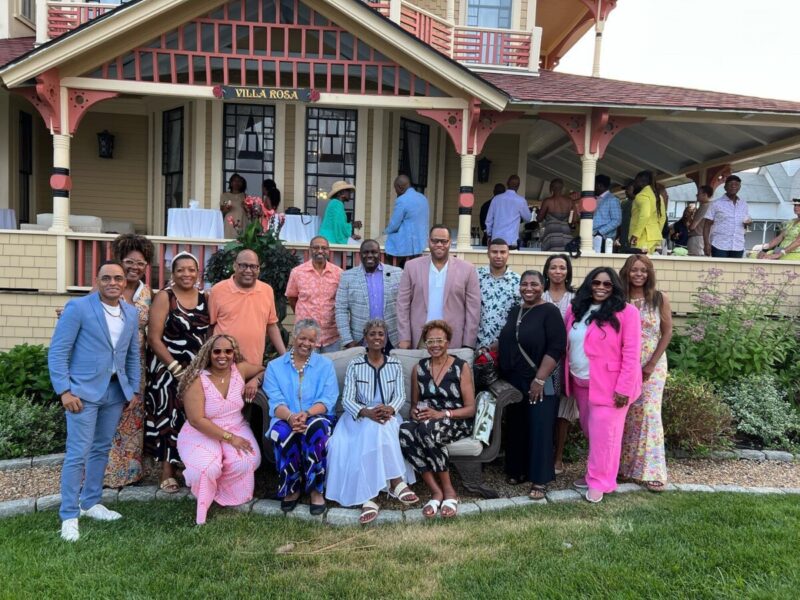
The National Association of Black Journalists began scheduling trips to Martha’s Vineyard in 2023, arriving right after its summer convention. Tracie Powell told the Journal-isms Rondtable that she admired the idea. “They go to Martha’s Vineyard every year, because they know when the Black wealthy folks are up on Martha’s Vineyard, and they’re talking to those folks about NABJ. We need to do the same and talk in terms of talking about civic news and information generally.” Photo above is from 2024. (Credit: Facebook)
Powell expanded on that point.
We need to “educate our community,” she said. “Let’s take the Black community first.
“There’s a lot of money in the Black community. We spend a lot of money. We need to educate them about what is Black-owned and what isn’t. I think sometimes we think stuff is Black-owned, and it’s not.”
She recalled being on the launch team for BlackAmericaWeb.com, started by the “Fly Jock,” Tom Joyner.
“So, if, you know, Tom Joyner was well off enough to fund his own news outlet, and so I think there are other Black people out there. You know, there’s the Donor, Donors of Color Network.
“That’s based right here in Atlanta. We need to talk to the Donors of Color Network, and talk to them about why civic news and information is just so critical to the work that they’re already doing.
“NABJ has started doing that. I really admire that a lot. I’m trying to figure out how to do the same thing. . . . They go to Martha’s Vineyard every year, because they know when the Black wealthy folks are up on Martha’s Vineyard, and they’re talking to those folks about NABJ. We need to do the same and talk in terms of talking about civic news and information generally. . . .”

Brendan Loper drew this cartoon for The New Yorker, captioned, “When They Go High, We Cave.”
Key Findings From Survey on Attitudes Toward DEI
The National Urban League touted this report Monday as two of its leaders appeared before the Journal-isms Roundtable. Bellwether Research conducted a representative national survey of 3,012 voters online from June 16 to 21. From the report:, “The DEI landscape: challenges and opportunities.” :
Voters are much more familiar with the acronym “DEI” than they were in 2024 and a majority have a positive view of it — driven by strong favorable movement among Democrats this year.
- The full phrase — diversity, equity and inclusion — remains very popular.
- When it comes to representing an organization’s goals, voters prefer the phrase “equal opportunity” over DEI.
- However, voters do not believe that equal opportunity and DEI are direct synonyms, with many proposing that there are instances of DEI that directly contradict equal opportunity.
- By a two-to-one margin, voters say that focusing on increasing diversity, equity and inclusion (DEI) in various settings is a good thing rather than a bad thing — consistent with 2024.
- Voters are supportive of DEI when companies give additional consideration to qualified candidates who may come from underrepresented backgrounds — but the key is “additional consideration” (not automatically checking a box) and “qualified.”
- A challenge is that many voters have a constrained view about DEI. It is seen nearly exclusively through the prism of race and its defining policy is perceived to be hiring or promoting based on race, not qualifications.
- One of the most noteworthy findings in this research is that voters across the political spectrum told us — through the survey and in discussions — that they believe groups facing significant bias and discrimination in hiring today are:
- People with physical disabilities
- Older adults over 50
- People with mental health challenges
- Democrats and younger people — more than Republicans and older adults — also rank LGBTQ and Black adults as experiencing high levels of discrimination.
- DEI is seen as helping Black and LGBTQ adults, but not those with physical disabilities, older adults, or those with mental health challenges.
- DEI is not given credit for positive changes in the workplace. Too often, voters say that enhancements are just a natural evolution — a changing of the times — or something that individual companies or leaders did that was based on common sense.
- In our discussions, the strongest supporters were white Democratic suburban women who supported DEI on behalf of others.
- Unlike issues such as Social Security or Medicare, we found that DEI has an advocate problem. Few of those who may have benefitted are willing to directly step up to say that. We heard them say “who knows,” if DEI may have helped them, or more commonly, emphasize their own agency in terms of hard work or qualifications.
- It is widespread knowledge that the Trump administration is against DEI.
- There is a sense that we are on a pendulum — with companies and government “over-emphasizing” DEI during the Biden administration and now, under Trump, moving fast in the other direction. There is a desire for middle ground.
- Voters are divided — certainly by party — about whether Trump’s anti-DEI actions have “gone too far” or are “about right.”
- Democrats and allies like heated messages that are strongly critical of the Trump administration’s motives and actions on DEI, but a more level tone proves more effective with everyone else. And there are arguments that can be made that have bi-partisan support. Among them are these themes:
- Government should not be telling private companies what to do on DEI. If a company thinks it’s good for their business, that’s their choice.
- We can’t erase history or only tell a version of American greatness. History is history — we can’t learn from our mistakes if we don’t acknowledge them.
- DEI cuts to medical research that focus on specific populations imperil people’s health
Consistent themes from 2024 to 2025
When voters think of DEI, they typically focus on hiring or promotions and not about what happens after. Talking about respecting and valuing team members as part of the organization’s culture consistently tests well.
- An effective message with Republicans has centered around government overreach in both our surveys. They think private companies should be able to decide about implementing DEI policies.
- Messages that highlight social justice or systemic barriers work well with Black voters and test poorly with white voters.
- There can be a danger with rhetorical overreach — like saying the Trump administration’s actions border on censorship or that critics of DEI programs want to take us back to the 1950s.
Recommendations
- Allies should lean in and push back on Trump’s DEI attacks. Right now, what voters are hearing isn’t balanced — it’s mostly anti-DEI. Many of these anti-DEI efforts are seen as overreach with the most egregious examples being:
- Cutting federal research on women’s health
- Erasing historical references to women, LGBTQ, and minority contributions from museums
- Pressuring private companies to drop DEI
- Defending DEI requires different strategies for different arenas. Against public sector attacks: messages about “history is history” work with center-right audiences, while base supporters respond to stronger language calling out whitewashing. Against private-sector attacks, companies can argue this is their decision — and not the government’s. They can credibly argue that a diverse team allows them to target diverse customers. A profit motive is seen as believable. And an “anti-government interference” argument is particularly strong with conservatives.
- Challenge DEI myths about who benefits and merit. Counter the idea that DEI is only about race or gender or that it lowers standards.
- Redefine who benefits. Personal stories from people with disabilities, older adults, and others outside the usual frame show DEI helps far more people than critics admit.
- Address merit and standards head on. Emphasize that DEI ensures equal opportunity to compete.
-
- Transparency isn’t the same as DEI, but pairing them may make DEI stronger. People want greater transparency and respect and want organizations to be clear about the criteria for hiring, promotion, and pay. Linking DEI to this kind of transparency has the potential to reinforce that high standards and merit remain central while advancing inclusion.
- Rely on everyday spokespeople who can expand the idea of who is helped by DEI . It can be effective to tie their stories to the bigger picture by using facts and statistics.
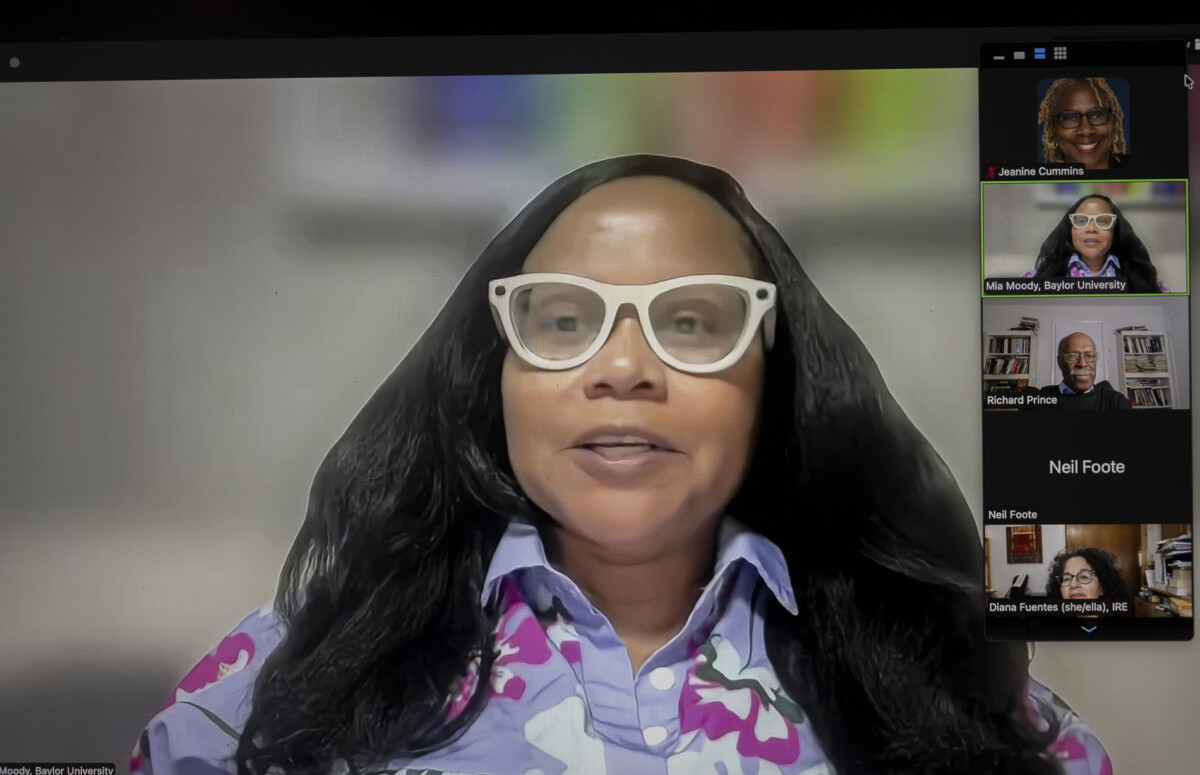
“Our stories shape society, and if those stories don’t reflect the richness of our communities of color, we fail our mission as truth-tellers,” Mia Moody told the Journal-isms Roundtable. (Credit: Jeanine L. Cummins) .
‘Scary’ in Anti-DEI Climate, but Professor Perseveres
Mia Moody, Ph.D., two-term chair of the Department of Journalism, Public Relations & New Media at Baylor University and a fearless diversity advocate, was toasted at the Journal-isms Roundtable Monday as the 2025 recipient of the Barry Bingham Sr. Fellowship, given “in recognition of an educator’s outstanding efforts to encourage minority students in the field of journalism.”
Asked what it was like to teach in one of the states that is Ground Zero for the anti-diversity movement, Moody said, “These are scary times, and we’re still kind of feeling our way around.
“But I am working with individuals who are continuing to fight a good fight for diversity.”
Moody is taking time off this fall to “work on a book about digital Blackface and media representations of race, topics that have long been central to my research. I have a contract with Bloomsbury, an imprint of Rowman & Littlefield Publishing.”
Her Roundtable remarks can be seen starting at 00:02:10 in this YouTube video.
To the question about the anti-DEI climate, Moody replied, “I have to say that it is –.it is scary, because I am blessed to work in a private university that has not been touched as much by some of these rulings, but I do have friends who work at state universities, University of Texas, Dorothy Bland at North Texas, and so just in talking with them, and having them tell… share their stories . . . how different departments have been eliminated, how positions have been eliminated. It deeply concerns me.
“And at Baylor, it’s not like we don’t have anything to worry about. We are cautioned, and we are told that we should not make ourselves a target.
“So we have colleagues there who are also concerned, particularly if they are not tenured.
“And they research diversity-related topics. So I was the chair of my department for six years, and I just finished up my tenure as chair, but that last year, I had colleagues come to me from various universities, and Baylor University, and ask me, ‘what does this mean for me? Should I continue to research this topic, or should I switch? Can I get tenure if I do research on DEI?’
“So that was a whole new area that I had to speak to as the chair of a department, and also as the incoming president of AEJMC [Association for Education in Journalism and Mass Communication].
“So, I just say that these are scary times, and we’re still kind of feeling our way around.
“But I am working with individuals who are continuing to fight a good fight for diversity.”
She later added:
“When I first started on the tenure track, I was told that, you know, I might reconsider.my research topic, because it would be very difficult to have articles published in journals.
“And it was, in the beginning, I received so many rejection letters for those journal articles, and it wasn’t until I added social media to my journal article submissions, or to my theories that I began to receive some acceptance letters.
[“This was about 20 years ago . . . I was one of the first scholars to look at social media, within the context of gender, race, and media.”]
“So yes, I was discouraged at first . . .I was told that I probably should look into doing research on other topics, rather than gender and race.”
- Dorothy Bland, Texas Metro News: Black Media Summit owners and creators tap into U.S. Black Chambers’ Innovation Campus vision (Nov. 14)
- Tandy Lau, Editor & Publisher Magazine: AMEJA marks 20 years expanding membership, mentorship and press freedom for Arab and Middle Eastern journalists (Nov. 14)
- Medill School of Journalism, Media & Integrated Marketing Communications, Northwestern University: News deserts hit new high and 50 million have limited access to local news, study finds (Oct. 20)
- National Urban League: Urban League Empowerment Center Grand Opening (Nov. 12) (YouTube video)
- Gretchen A. Peck, Editor & Publisher Magazine: What’s next for DEI in newsrooms? Legal risks, political pressure and resilience (Aug. 5)
- Timothy Richardson, Viktorya Vilk, PEN America: ‘Quiet, Piggy’ ‘Terrible Reporter’: President Trump Escalates Assault on Journalists (Nov. 21)
- Courtney Stein, B.A. Parker, Dalia Mortada, Jess Kung, “Code Switch,” NPR: How Trump’s cuts to public media threaten the first Native American station (Nov. 15)
- Hanaa’ Tameez, Nieman Lab: From reckoning to retreat: Journalism’s DEI efforts are in decline (Sept. 11)
- Ebonie Walker, Refinery 29: What Do We Lose When Black Women In Journalism Disappear? Everything. (Nov. 14)
- Robyn Williams, National Urban League: National Urban League Dedicates Empowerment Center in Harlem

