
Civil Rights Leader, Presidential Candidate Dies at 84
From Monday: Blacks at Post Complained of Leaders’ Disinterest: Trump’s Election, Meeting With Publisher Preceded Layoffs
Short Takes update: Richmond Free Press publisher cites Trump’s anti-DEI crusade in paper’s folding
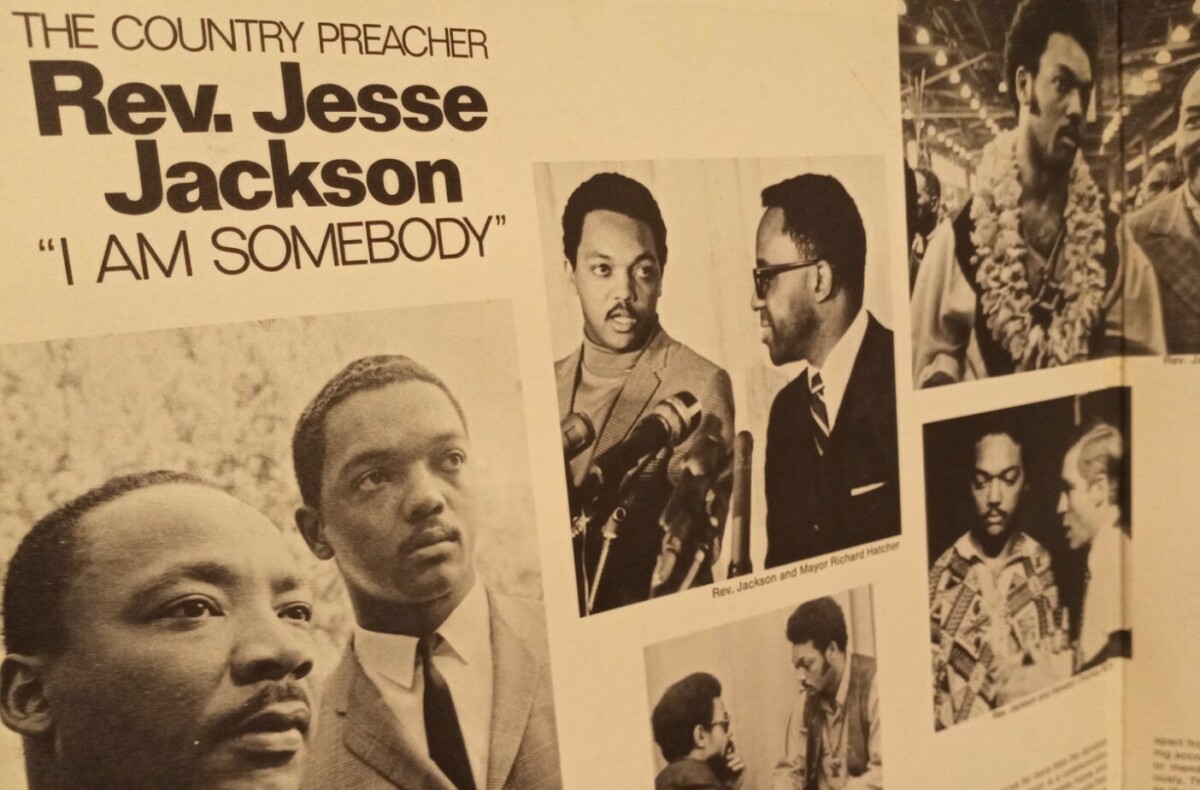
(Homepage photo: In 1971, Respect Records released “Country Preacher,” with Jesse Jackson’s exhortation, “I Am Somebody.”)
Journal-isms Roundtable photos by Jeanine L. Cummins
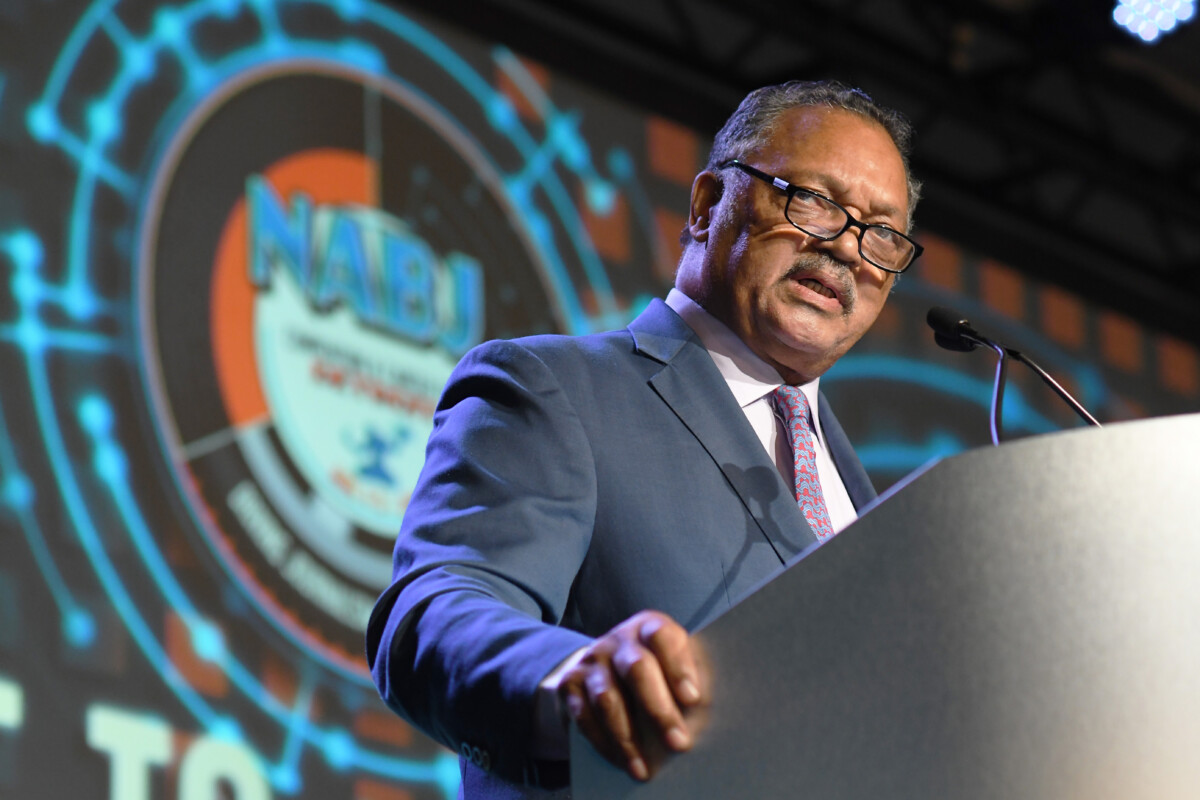
Jesse Jackson addresses the National Association of Black Journalists in Detroit on Aug. 4, 2018. He told the convention attendees the nation does not need “chocolate white men whose mind has bought into the system, whose vision is limited by what the master says. Don’t put your job over your mission.” (Credit: Jason Miccolo Johnson)
Civil Rights Leader, Presidential Candidate Dies at 84
Jesse Jackson, the onetime “country preacher” whose presidential campaigns opened doors for African American journalists and who said that those journalists must “become the authorities on the African American and African experience,” died Tuesday at 84, the family announced.
“Jackson battled Parkinson’s disease since 2017, and in April, he was diagnosed with progressive supranuclear palsy, a neurological disorder,” Bob Goldsborough wrote for the Chicago Tribune, which once barred Jackson from appearing on Page One. The paper then considered him too much of a publicity seeker.
“Our father was a servant leader — not only to our family, but to the oppressed, the voiceless, and the overlooked around the world,” the Jackson family said in a statement. “We shared him with the world, and in return, the world became part of our extended family. His unwavering belief in justice, equality, and love uplifted millions, and we ask you to honor his memory by continuing the fight for the values he lived by.”
The New York Times report, by Peter Applebome, called Jackson ”the nation’s most influential Black figure in the years between the civil rights crusades of the Rev. Dr. Martin Luther King Jr. and the election of Barack Obama.”
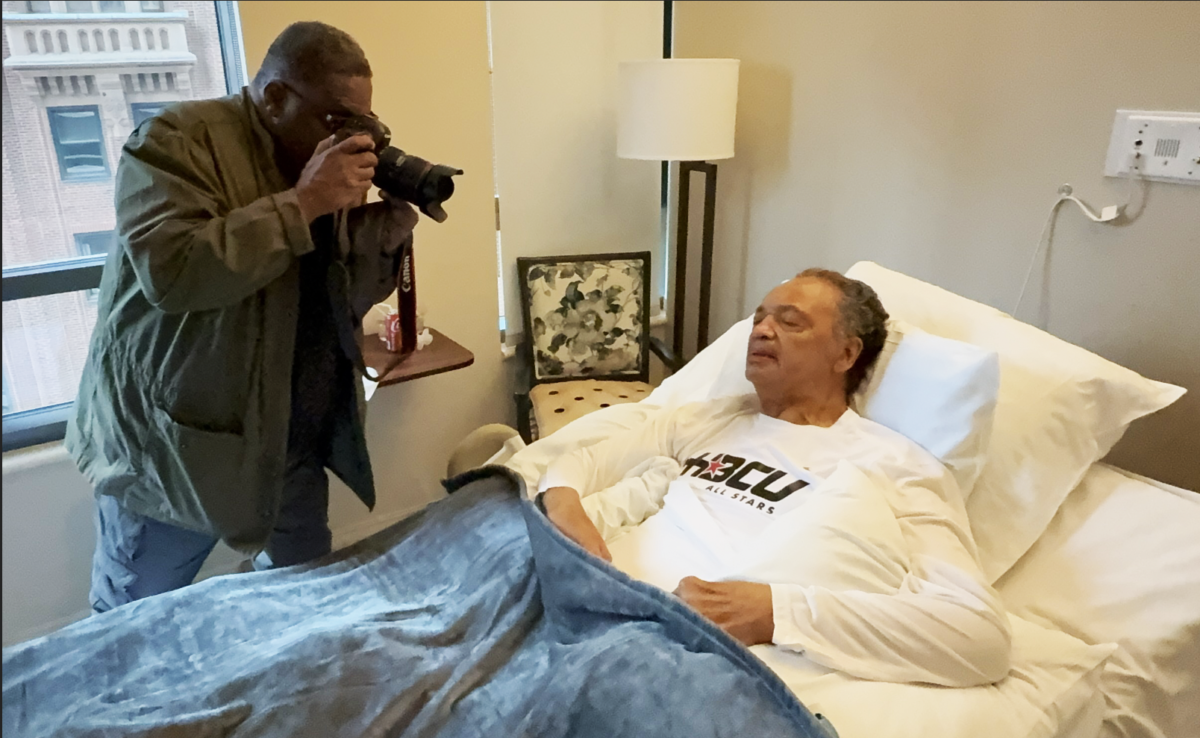
Photographer D. Michael Cheers, professor of photojournalism at San Jose State University, was invited to spend time with Jackson on Thanksgiving Eve at a Chicago rehab facility. He photographed the iconic civil rights leader there. Cheers covered both of Jackson’s presidential campaigns for Jet magazine and traveled with him for years. (Courtesy D. Michael Cheers)
In the New York Amsterdam News, part of the Black press, Karen Juanita Carrillo described Jackson as one “whose career took him from his early collaboration with Martin Luther King to creating the Rainbow/PUSH Coalition to two runs for the presidency and ultimately passing the torch to a new generation.”
Jackson had a special relationship with Black journalists, particularly evidenced during his 1984 and 1988 Democratic presidential campaigns.
 “I think of it as being Black people’s campaign,” Jack White (pictured, by Jeanine L. Cummins), who covered the 1984 crusade for Time magazine, told the Journal-isms Roundtable in December.
“Jesse was the vessel through which Black people’s aspirations, political aspirations, were expressed. It was bigger than him. . . . his was also for Black journalists an enormous opportunity, because a lot of our careers blossomed. We forget the extent to which Black journalists had been locked out of mainstream political coverage. There had been very few of us who had been ‘boys on the bus’ covering these presidential campaigns.”
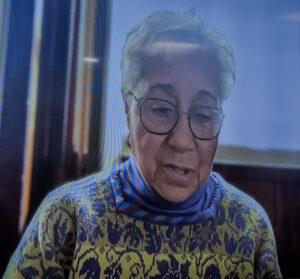 Marquita Pool-Eckert (pictured), then a producer for CBS News, added of Jackson and his supporters, “You wanted to see them succeed. And I think those of us on the Jackson campaign really did want to see him go as far as possible. . . . .
“At the same time, we’re journalists. So we had to balance that with, okay, we can’t be enablers, but at the same time, we had to make the case for our story, our candidate, what was happening today. Why should we be considered high up above the line in our budgets, in our news coverage, budgets for the day . . . You felt like a lawyer every day, kind of making your case for your candidate. . . .”
Others on that campaign included the late George Curry of the Chicago Tribune (whom Jackson would memorialize), Sylvester Monroe of Newsweek, A’Lelia Bundles of NBC News, Marilyn Milloy, who covered the campaigns in 1984 and 1988 for Newsday, the late Kenneth Walker of ABC News; Keith Moore of the Daily News in New York; Bruce Talamon, Los Angeles-based photographer who traveled with both Jackson campaigns, and Betty Anne Williams, who covered the 1984 effort for the Associated Press.
However, because Jackson traveled the country, and also ventured overseas, an untold number of journalists have their own Jackson stories, no matter the size of their media outlet.
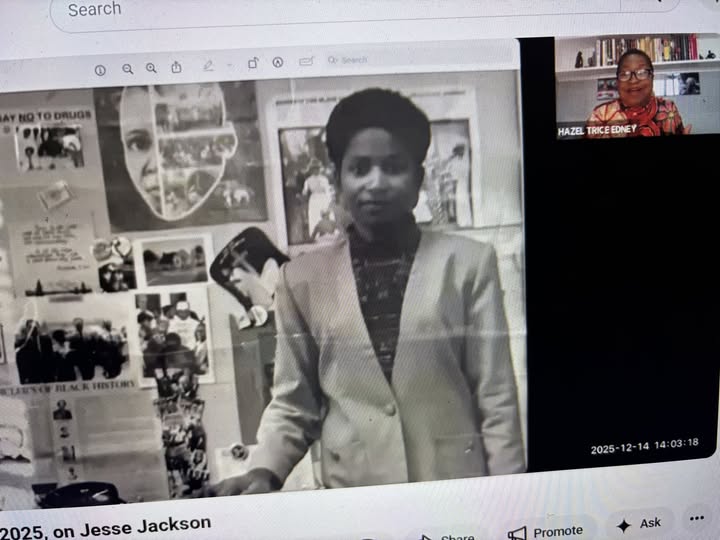 At that December Roundtable, titled “What We Should Remember About Jesse Jackson,” Hazel Trice Edney, who now runs her own news service, displayed a photo from her days as a cub reporter in Richmond, Va.
“It is actually my first time covering Reverend Jesse Jackson. It was in Jesse 88,” she said. “The reason that you all cannot see the photo in its actual form is because I’ve lost the photo. . . .
“I had it on my wall when I was at the Richmond Afro-American newspaper. . . .
“I wanted you to see that picture because you will see two people on either side of him, his security people, and they were pushing me back and pushing me back and telling me I could not interview Reverend Jackson.
“I was just a cub reporter and I was doggedly trying to get to him. He was in Richmond. You can see the Richmond Coliseum behind us. But anyway, he turned to me, and if you could see it close up, then you could see that I had pen and pad ready. And he turned to me and he said, ‘Come on, baby.’ Not in a flirtatious way, but in a way that was so respectful and so kind.
“And that is one of the things that I think we need to remember about Reverend Jackson and to know about him, because he ain’t going nowhere yet. . . . that his kindness is so genuine.
“And although they say that the most dangerous place in America in the world is between Jesse Jackson and the camera . . . the first thing I want us to remember is the kindness and just how he really pulled in Black reporters from the Black press, from . . . regardless of where you were, Chicago Tribune, et cetera. . . .”
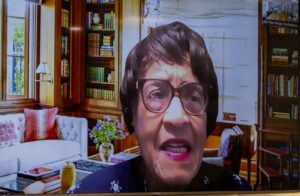 Barbara Reynolds, who wrote the first biography of Jackson in 1975, “Jesse Jackson, The Man, The Myth and The Movement,” which one writer called a “well-documented, extensive, audacious exposé,” said, “He’s been the big brother I never had, I’ve probably been the little sister that he never had.“
Reynolds told the Roundtable, “What we need is more inspiration. We need more charisma. We need this, ’I am somebody.’ . . . because we’re at a time when our children are being called garbage, when [it’s] being said that we come from shitholes.
“I’m not saying one man should do it, but I’m saying there [have] to be people that will move people from their heart and move people from their soul to know we’re not garbage, we’re not from shit, because we are somebody and we’re going to get respect and we’re going to fight.”
Reynolds also said, “Talk about the economics. That’s what King talked about. He said, ‘We can get on the bus, but we need to be able to buy the bus. So we talk about politics, let’s talk about economics because he was a transitional leader. King to Jesse and Jesse to Al Sharpton, who is carrying on the movement as well.”
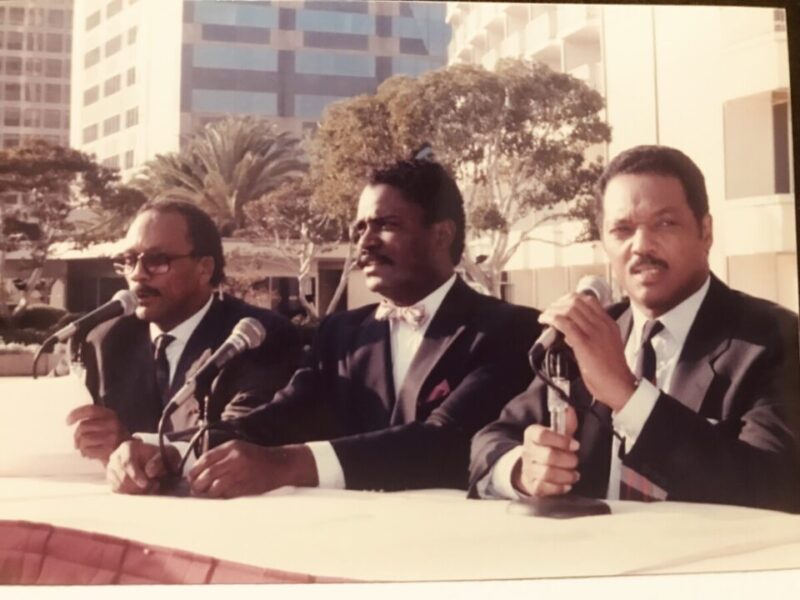
From left, Quincy Jones, Kenneth Walker and Jesse Jackson at the 1990 National Association of Black Journalists convention in Los Angeles. They held a news conference to promote the then-new hour-long “The Jesse Jackson Show.”(Credit: Jason Miccolo Johnson)
Jackson joined the media himself, with the television shows “Both Sides With Jesse Jackson” from 1992 to 2000 on CNN and “The Jesse Jackson Show,” a weekly syndicated talk show from Quincy Jones Entertainment and Warner Brothers that premiered in 1990.
Jackson told Harvard scholar Henry Louis Gates Jr. in a “Frontline” interview in 1998, “This generation by age 15 have watched 18,000 hours of television. They’ve listened to more than 22,000 hours of radio and video, as compared with 11,000 hours of school and less than 3,000 hours of church, temple, or synagogue.
“This means that the mass media quantitatively has more access to their minds and qualitatively penetrates more deeply than home, church, and school combined.”
Jackson prompted a discussion of journalistic ethics after he was reported in January 1984 to have labeled Jews as “Hymies” and referred to New York as “Hymietown.”
“At first he had denied the remarks; then, turning street fighter, he had tried to put Jews on the defensive, accusing them of making him the target of a Jewish conspiracy to ruin his campaign,” journalists Bob Faw and Nancy Skelton wrote in 1986.
“But the counterattack hadn’t worked, and day by day the furor had grown. Within two weeks his historic run for the presidency had nearly collapsed, and Jackson was trapped: There was no choice now but to swallow his pride and own up to his mistake.
“For the past several days Jackson had been ‘literally torn apart,’ as one aide put it, trying to find his way out of the ‘Hymie’ mine field. The controversy had done more than throw his campaign off stride — it had also changed Jackson. ‘It put him on the defensive, made him go almost into a shell. He was not the same, positive, outgoing person,’ said campaign manager Arnold Pinkney.”
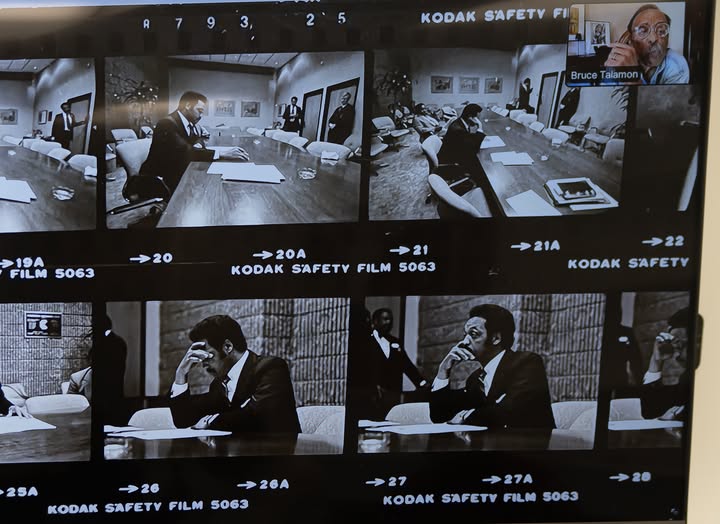
Bruce Talamon, at top right, who photographed the 1984 Jackson campaign for Time magazine, displays his contact sheets at the Dec. 14 Journal-isms Roundtable. “You’ve got the job nobody wanted, Jesse,” his editor told him. “. . . if you were working at that time, and actually even today, if you were working for AP, Time magazine, Newsweek, and your candidate went all the way, you were generally offered the job of White House photographer. And so folks looked up and down at Jesse and said, ”Oh, he’ll be gone by Super Tuesday.’ . . . They did not understand that this was not a traditional campaign. This was a crusade.” Photo taken Nov. 3, 1984, when Jackson announced his intention to run for the Democratic nomination at the Washington, D.C, Convention Center.
The issue became a hot topic at the 1984 convention of the National Association of Black Journalists. The Washington Post’s Milton Coleman, who broke the story, “has acknowledged that Mr. Jackson had prefaced his statement by saying, ‘Let’s talk black talk,’ ‘‘ E.R. Shipp reported for The New York Times in August from that Atlanta convention.
“Mr. Coleman said he understood that Mr. Jackson did not intend for the remark to be attributed to him. Many of the journalists here said Mr. Coleman had violated a basic rule of journalism.”
At the December Roundtable, White said that reports of the comment lacked context.
“Jesse had this problem . . . of characterizing different ethnic groups. For example, he would refer to southern Black people as Moze and Mozelle. Some of you all may remember that. So he had these terms. Now, obviously, Jesse was not anti-Black, so if he called somebody Mozelle, we knew what he was talking about and it was kind of a familiarity. I never thought that Jesse Jackson was an anti-Semite, I don’t believe that to this day.”
However, Coleman defended himself at the 1984 convention. “Mr. Coleman said he sought neither sympathy nor forgiveness,” Shipp wrote. “For many people, he said, the issue is ‘are you black first or a journalist first? Which side are you on?” Mr. Coleman said that he was black first and would be black last. ”But being black doesn’t mean that I automatically accept lower professional standards when I cover blacks or whites.’ ”
In the Post, he wrote, “This is about how a reporter covers a candidate for president of the United States.”
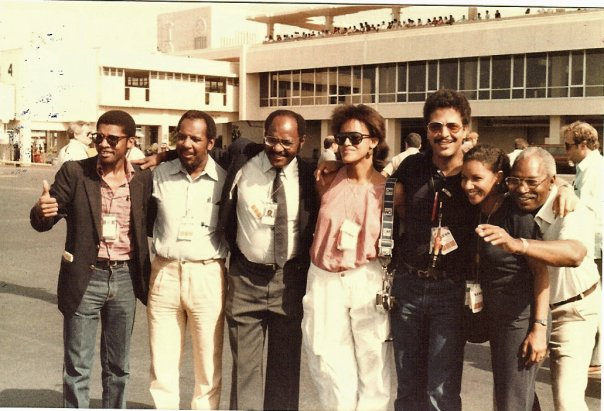
From left, reporters Sylvester Monroe of Newsweek; Bob Jordan, Boston Globe; Gerald Boyd, New York Times; Marilyn Milloy, Newsday; Jack White, Time and A’Lelia Bundles of NBC News; and Eugene Wheeler of the 1984 Jackson campaign. They are at the airport in El Salvador during Jackson’s campaign tour of Central America. (Credit: A’Lelia Bundles)
It was at that 1984 convention that Jackson addressed what he considered the role of Black journalists.
“No journalist is objective. Nor should you strive to be. You should strive to be fair,” he said..
“The African American journalist is trapped in this two-ness. On one hand you are covering a community that is enraged, and fighting for freedom and power. You were born into it, bred into it. You’re covering a community that is enraged, in anguish and pain. But you’re reporting to another community that is resisting and usurping and disallowing the sharing of power. And then you’re judged by the appraisers, the owners, the chief beneficiaries of the status quo, the editor and publisher. What a crossfire! . . .
“You must become the authorities on African American and African experience. Before you be a little of everything to everybody, be something special to where you live,” he said to applause.
“There should be nobody in your shop who knows more about our options in Southern Africa than you. Nobody that knows more about the denial of trade to African governments than you. Nobody should know more about how willing our government is to allow military coups to overthrow civilian rule in Africa, because they would rather deal with a general than a black democracy, than you.
“You must be the authorities on African life. You must be the authorities on Afro-American life.”
- Ben Jealous, New York Amsterdam News: OP-ED: Rev. Jackson Lifted All of Us Higher
- Joy-Ann Reid, Instagram: How I Will Always Remember Jesse Jackson — Sesame Street, 1971
Blacks at Post Complained of Leaders’ Disinterest
Feb. 16, 2026
Trump’s Election, Meeting With Publisher Preceded Layoffs
Short Takes update: Richmond Free Press publisher cites Trump’s anti-DEI crusade in paper’s folding
Homepage image credit: Washington Post Guild
View this post on Instagram
Amber Ferguson, a rapid-response culture reporter who had been at the Washington Post for nine years before being laid off this month, said she noticed a shift in how her pitches were received.
If no image is visible, please consider changing browsers.
Trump’s Election, Meeting With Publisher Preceded Layoffs
A dropoff in interest in newsroom diversity at the Washington Post followed Donald Trump’s second presidential election win and continued even after management was told of a survey of Black Post newsroom employes that rated interest in Black employees below 2 on a sale of 1 to 5, Riddhi Setty reported Monday for Columbia Journalism Review.
“The survey, aimed at gauging the experience of Black newsroom staffers in the wake of the firing of opinion columnist Karen Attiah “and the departures of other senior Black leaders, asked staffers to respond on a scale of one to five, with one being ‘strongly disagree’ and five being ‘strongly agree,’ to the prompt ‘I believe Newsroom and Opinions leadership values diversity and is committed to including Black employees in senior and decision-making roles,’ Setty wrote.
“The average response was 1.65. To the prompt ‘I am confident the organization is committed to retaining and supporting Black employees long term,’ the average response was 1.61. No one gave a number higher than three in response to either prompt.
“Employees also wrote that they had lost career mentorship and support systems in the newsroom, that their perspectives weren’t valued, and that stories ‘tied to race, culture or identity are often dismissed before they even get a chance.’ According to an email that was reviewed by CJR, the survey results were shared with then-Publisher Will Lewis and Wayne Connell, the head of human relations, on Dec. 1, 2025.
“ ‘The departures and buyouts of senior Black staff have left us without Black leaders in key roles, raising difficult questions about whether there are paths to advancement for Black talent and opportunities to shape coverage,’ “ according to an October letter to Murray, Lewis, Eleanor Breen, the chief of staff; and Adam O’Neal, the opinion editor, signed by forty-five Black Post journalists.
“These notable absences have created a perception that Black perspectives are being minimized at a time when they are most needed, both for our journalism and for the communities we serve.”
“The journalists requested a chance to speak with leadership about their concerns. On December 2, 2025, Ferguson and three Black colleagues met with Murray, Lewis, and Connell.
Amber Ferguson, a rapid-response culture reporter who had been at the Post for nine years before being laid off this month, “said that she and her colleagues laid out three asks: that the Post hire a managing editor of diversity and inclusion [Krissah Thompson was the first to hold such a post, but was later transferred]; that there be formal evaluations of managers on their efforts to recruit and retain employees of color on all levels; and that managers be trained in how better to assist journalists of color when they face harassment in response to their reporting.
“ ‘Will said, ‘How did it get this bad?’ ” Ferguson recalled. ‘And we were like, ‘What do you mean?’ That was just such a funny thing to say. I mean, you’re the cause of the majority of this. You didn’t appoint any people of color under your direct leadership.”
“Ferguson said Lewis told her and the other staffers that he found the survey revealing and was committed to addressing their concerns. When a staffer followed up to ask if he’d given thought to their discussion, Lewis wrote, in an email reviewed by CJR: ‘I have asked Wayne to consider your suggestions and thoughts as we consider what a broader company-wide strategy needs to be to address diversity. He recommended ‘speaking with Matt directly’ for suggestions specific to the newsroom.
“According to Ferguson and another Post journalist familiar with the meeting who asked not to be named because they still work at the paper, no action was taken.
Lewis stepped down on Feb 7 and was replaced in the interim by Jeff D’Onofrio, the chief financial officer.
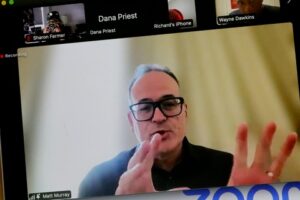 Murray took the top job believing ““there are not enough women and people of color in leadership positions,” he told the Journal-isms Roundtable in 2024 (pictured, by Sharon Farmer).
When the National Association of Black Journalists asked for a meeting in July 2025, a request that was granted, Murray wrote:
“It is certainly true that in the current voluntary separation program, we are losing several valuable Black colleagues, including senior editors. We all regret the departure of these smart and valued colleagues, and we wish them continued success.
“We also remain deeply committed to fostering diversity around The Post, where we are ardently engaged in the work of restructuring and reinvigorating the institution. We all agree that there is undoubtedly work to do on this front throughout the newsroom—and that has been true even before the current departures.
“Among other things, we are launching a two-year internship program for young journalists of color. And I, along with several of my colleagues, will be attending NABJ’s 2025 Convention & Career Fair next week in Cleveland where we’ll be actively recruiting for many open roles. Of course, ultimately, we know we will be accountable for what we do to build The Post’s next chapter, not just what we say.”
WaPo Layoffs Heavily Hurt Workers of Color
Feb. 15, 2026
WaPo Layoffs Heavily Hurt Workers of Color:
Guild Calls Numbers ‘Staggering and Devastating’
Ann Curry Resurfaces Amid Sudan Horror:
Ousted at ‘Today,’ She’d Pledged to Aid ‘the Voiceless’
Journal Links Hair Extensions to Cancer, Birth Defects
Black History: A Story of Grocers and Reconstruction
House Press Gallery Renamed for Frederick Douglass
Lemon Gains Thousands of New Followers Since Arrest
PBS Kids’ New ‘Phoebe & Jay’ Teaches Literacy Skills
Passings:
Rafael Pineda
Tommie ‘T.L.’ Lee Wyatt
Aaron Marckell Williams
Short Takes: Richmond Free Press; Kavitha Cardoza and Oliver Whang, Detroit Free Press and Detroit News; -alternative to Pittsburgh Post-Gazette; Black workers’ unemployment rates; Columbus Journalists in Training multi-week reporting program; NABJ donation from Onyx Impact; Morgan State University student newspaper; misidentifying Mariah Carey at the Olympics; N.Y. Times Local Investigations Fellowship winners; Amber Payne;
Michael I. Days and Angela P. Dodson; reporting on Hispanic-serving institutions; Deborah Barfield Berry; African Union’s Media Fellowship program;criminal penalties for press in Haiti – a first; exposing Cuban regime from afar; Mali charges an editor-in-chief; attempted assassination of Mozambique journalist and son.
Homepage cartoon credit: David Horsey/Seattle Times
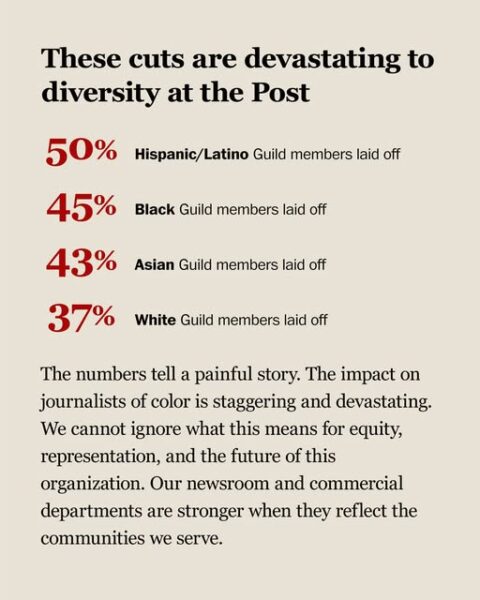
Guild Calls Numbers ‘Staggering and Devastating’
Data released Friday by The Washington Post Guild shows that the Feb. 4 Washington Post layoffs – affecting more than a third of its employees — fell heavily on union members of color, Hanaa’ Tameez reported Friday for Nieman Lab.
“I asked the Guild for the numbers behind these percentages. According to the Guild, 144 (37%) members who identify as white, 23 (50%) who identify as Hispanic or Latino, 44 (45%) who identify as Black, 33 (43%) who identify as Asian, and 14 (5%) who identify as multiracial were laid off. Twenty-two (8%) union members who were laid off didn’t disclose their races. (The Washington Post has a separate Tech Workers Guild, not included in these numbers.)
“The numbers tell a painful story. The impact on journalists of color is staggering and devastating,” the Post Guild said in its statement. “We cannot ignore what this means for equity, representation, and the future of this organization. Our newsroom and commercial departments are stronger when they reflect the communities we serve.”
The commercial piece is oven overlooked in the reporting of the Post layoffs. David DeJesus, -a former co- chair of the Guild unit who took the Post to court, messaged Journal-isms Saturday, “Much has been written about the scrapping of [DEI] in The Post’s newsroom. Although this is important and needs to be addressed, no one talks about the dismantling of diversity initiatives in the commercial/business units at The Post.
“When I joined The Post in 1993, it was because of the diversity in the ad sales, ad operations, HR, finance and accounting, and the press room, that I decided to leave the ad agency business in New York, and move to DC to join The Post.
“Over the past years (The Bezos era), I’ve watched diversity dwindle to a drip on the business side as well as the newsroom. And as you know, my 7 year legal battle with The Post specifically addressed its ‘race’ issue, settled in 2017. Yes it’s shameful about The Post’s lack of diversity in the newsroom, but it’s not just the newsroom that has been hit hard, although that’s all the public hears about these days.”
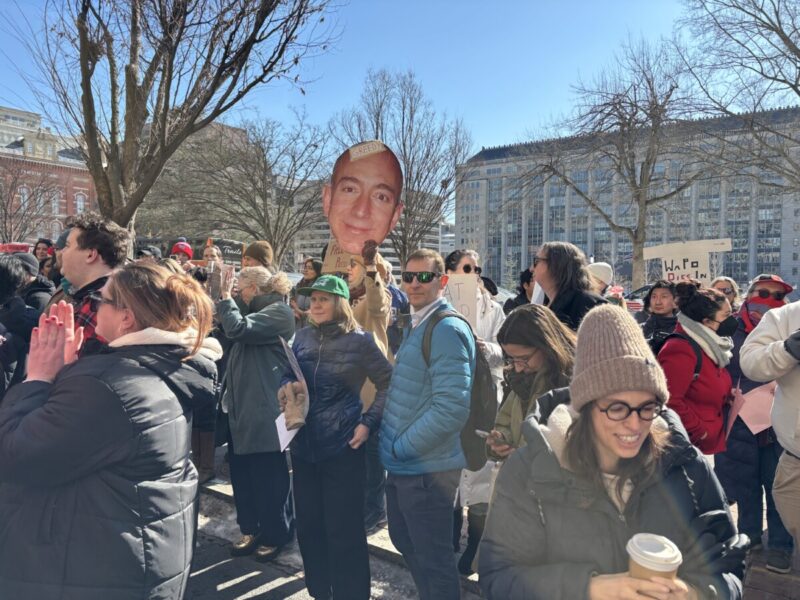
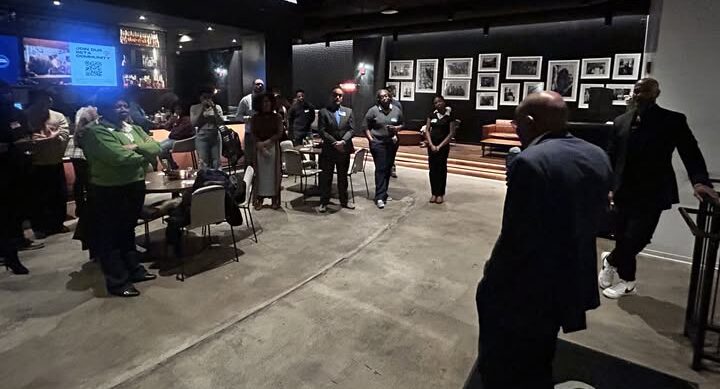
Top photo: A noontime Guild rally in front of the Washington Post building on Feb. 5 attracted relatively few community members of color (Credit: Richard Prince). But on Tuesday, members of the Washington Association of Black Journalists heard Terence Samuel, a former Post journalist and a veteran who told the group he had been fired as top editor at USA Today, tell a WABJ happy hour to keep their heads up and press on. (Bottom photo, credit: WABJ)
Tameez continued, “The Guild had more than 700 members prior to February 4. More than 250 were sent layoff notices, but that number could eventually decrease since the Guild is still negotiating layoffs and severance packages with Post leadership.
“The Washington Post did not respond to a request for comment.
“We still don’t have an official number of how many people were laid off in total. Former Washington Post media reporter Paul Farhi reported this week that the company laid off somewhere between 350 and 375 journalists, cutting the size of the newsroom by nearly half.
”On Wednesday, Post executive editor Matt Murray said in a town hall that the Post now has around 400 journalists and a total staff of 1,300. That’s down from a reported 1,000 journalists and 2,500 staffers in total in 2022.”
Tameez also wrote, “In June 2020, the Post’s then-publisher, Fred Ryan, told staff the company would ‘build a stronger culture of diversity and equity.’ That included hiring for a dozen new positions and establishing Krissah Thompson as manager of diversity and inclusion. Thompson stayed in the role for a year before becoming a general managing editor and eventually leaving the company last year. The original role no longer exists.
“Last June, the Post put its ‘About US‘ newsletter (‘Candid conversations about race and identity in 21st century America’) ‘on hiatus.’ The newsletter’s author Rachel Hatzipanagos was laid off on February 4.”
Separately, Alexandra Steigrad reported Friday for the New York Post, “The owner of the New York Daily News fired 16 people this week – a ‘Valentine’s Day massacre’ that leaves the paper with a skeleton staff as layoffs continue to wreak havoc across the news industry.
“Notorious vulture fund Alden Global Capital on Thursday axed six people from the paper’s national desk – leaving just four writers to cover US and international news – and fired seven print production staffers, two people in the photo department and one metro reporter, according to a source with knowledge of the matter.
“ ‘Alden Global Capital — the nation’s most predatory newspaper owner — has again lived up to its reputation as the parasitic ‘destroyer of newspapers,’” the Daily News Union said in a statement, with their X account dubbing the layoffs a ‘‘Valentine’s Day Massacre.’ “
Reporter and columnist Leonard Greene, likely the only Black Metro columnist in the city, told Journal-isms that he was not among those let go.
There has been better news elsewhere.
In Philadelphia, the Inquirer in 2025 had its first year-over-year increase in revenue since 2004, and an operating profit of several million. Publisher Elizabeth H. Hughes told readers Jan. 26.
“The majority of our revenue, 70%, comes from consumer marketing, which means people are paying for our journalism; 19% is from advertising, which signals that local businesses and institutions find merit in supporting us; and 5% from syndication and other partnerships, Hughes wrote . Philanthropy accounted for 6% of revenue in 2025, and we project donor contributions ranging from 6% to 10% going forward.”
In another development, The New York Times added 1.4 million digital-only subscribers in 2025, including about 450,000 in the last quarter of the year, the company said on Wednesday, Katie Robertson reported for the Times Saturday.
The Times ended the year with 12.78 million total subscribers, a jump that puts it on a pace to reach its stated goal of 15 million by the end of 2027. Total revenue for the fourth quarter reached $802.3 million, up 10.4 percent from a year earlier, Robertson wrote.
- Baltimore Banner: The Banner announces coverage of Washington sports
- Paul Barrett, Associated Press Sports Editors: George Solomon on Washington Post layoffs: A triumph for the bad guys
- Martin Baron, Facebook: This ranks among the darkest days in the history of one of the world’s greatest news organizations (Feb. 4)
- Tina Brown, Substack: Bafflement with Bezos (Feb. 9)
- Dylan Byers with Matt Murray, Puck: Matt Murray on the Washington Post’s Mass Layoffs (Feb. 6) (podcast)
- Eric Deggans on CTV, Canada: ‘There’s a sense it did not have to be this way’: analyst on Washington Post layoffs (Feb. 4)
- Editorial, Washington Informer: With Journalism Under Attack, It’s Important to Support the Black Press
- Neil Foote, LinkedIn: I’ve had the great fortune to spend part of my career as a reporter at The Washington Post
- Journal-isms: Journalists of Color in WaPo’s ‘Bloodbath’ (Feb. 4)
- Eugene L. Meyer, The Overlook, Saugerties, N.Y.: Democracy Dies in Darkness. Indeed!
-
Julianne Malveaux, syndicated: Black journalists get punished for doing their jobs
- William McKenzie and Elizabeth Kennedy Trudeau, George W. Bush Presidential Center: Losing foreign bureaus impedes the flow of reliable information (Feb. 6)
- Ivan L. Nagy, Columbia Journalism Review: ‘We Still Have a Sports Section for a Few Days, and Readers Need Me to Tell a Story’
- Laura Hazard Owen, Nieman Lab: 37+ things The Washington Post did wrong and 22+ things they could do to fix it (Feb. 4)
- January Payne, Facebook: Yesterday was a heartbreaking day for The Washington Post.
- I.J. Poole, Daily Kos: Breaking up is hard to do, but I’ve now broken up with The Washington Post (Feb. 5)
- Ed Pilkington and Jeremy Barr, the Guardian: As goes the Washington Post: US democracy takes another hit under Trump
- Richard Prince, Pradya Joshi, Sree Sreenivasan and Neil Parekh, ScrSree’s Sunday #NYTReadalong: A Tribute to The Washington Post (video) (Prince at 22:09)

