

Endured Bitter Strike, NABJ’s Thumbs Down
Homepage photo: TribuneLive

Pittsburgh Post-Gazette building. (Credit: TribuneLive)
Endured Bitter Strike, NABJ’s Thumbs Down
The Pittsburgh Post-Gazette, which endured a bitter three-year strike that ended in November, and in 2020 received the Thumbs Down Award from the National Association of Black Journalists for “unfairly prohibiting two Black journalists from covering protests in the city following the death of George Floyd,” will shut down May 3, the paper’s owners announced Wednesday.
The paper “has served the region in some form since 1786, winning Pulitzer Prizes along the way,” Axios Pittsburgh reported.
“Over the past 20 years, Block Communications has lost more than $350 million in cash operating the Post-Gazette. Despite those efforts, the realities facing local journalism make continued cash losses at this scale no longer sustainable,” the Post-Gazette said in a prepared statement.
As Axios reported, “Block Communications threatened to shut the paper down after they lost their appeal to a ruling that ordered the company to reinstate the terms of a prior union contract and resume negotiations, requiring the Pittsburgh Post-Gazette to restore wages, undo health care premium increases and compensate workers for increased costs resulting from the changes.
“Context: The U.S. Supreme Court earlier Wednesday rejected the Blocks’ attempt to block a lower court order requiring changes to health insurance coverage for union workers, per Bloomberg Law.
“Flashback: The move comes days after Block Communications Inc. shuttered its alt-weekly Pittsburgh City Paper.”
 The Newspaper Guild of Pittsburgh had a different take.
“In July of 2020, the Post-Gazette illegally tore up the previously collective bargained union contract governing working conditions at the paper and unilaterally imposed work rules that worsened health care coverage and other benefits. Workers went on strike for more than three years over the company’s illegal behavior. The strike followed more than 20 years in which workers did not receive any across-the-board wage increases as they bargained in the spirit of shared sacrifice to sustain the paper and continue providing news for Pittsburgh readers.
” ‘Instead of simply following the law, the owners chose to punish local journalists and the city of Pittsburgh,’ said Andrew Goldstein, president of the Newspaper Guild of Pittsburgh (TNG-CWA Local 38061). ‘Post-Gazette journalists have done award-winning work for decades and we’re going to pursue all options to make sure that Pittsburgh continues to have the caliber of journalism it deserves.’
“Closing the paper does not get the Blocks out from under the legal liabilities they incurred. . . . “
The rival Tribune-Review reported, “Allan Block, chairman and CEO of Block Communications, hung up on a TribLive reporter on Wednesday. A voicemail to a Block family residence requesting comment was unreturned immediately on Wednesday.”
The Pittsburgh Black Media Federation, an NABJ affiliate, did not respond to a request or comment. Nor did Rod Doss, editor and publisher of the New Pittsburgh Courier, part of the Black press.
But in 2020, Andrew Conte wrote for the alternative NextPittsburgh:
“Pittsburgh already has so few Black journalists, and many who are here say they feel mistreated, left out and stuck in dead-end careers.
“Look at the research from Columbia University’s Tow Center for Digital Journalism. In a still fresh report that came out in October, Black journalists in Pittsburgh described what it’s like to work here. It’s not easy. Listen to what they said:
- “ ‘I felt like the token at that paper. I felt like I was buried, and my work was buried in one section of the paper. I was rarely on the front page of the paper, and I felt like when I tried to do more, I was smacked back to that [less prestigious section].’
- “ ‘In Pittsburgh, I felt very much in a box. I felt like I was fighting my bosses and [fellow] staff at the same time, and I was exhausted.’
- “ ‘It’s almost like you had to be really exceptional [if you were black] … some people didn’t get the same kind of encouragement. It’s not [that] talent is not recognized, but there did seem to be a difference between the type of encouragement and mentoring you might get between white and black staffers.’
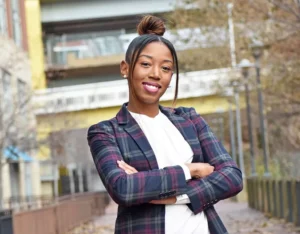 “Now, with those words fresh in your mind, think about what happened to Alexis Johnson, a Black reporter at the Post-Gazette who was told she could no longer cover the Black Lives Matter movement because she posted this funny tweet about white people making a mess at the annual Kenny Chesney concert . . . . ” (Photo of Alexis Johnson by Shantale Davis)
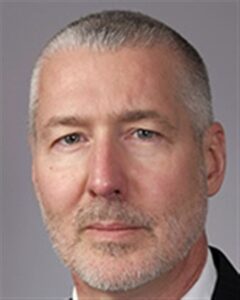 Defending the newspaper, then-Executive Editor Keith Burris (pictured) wrote that Post-Gazette readers had been “subjected to a great deal of disinformation.”
“It is time for the rest of the story,” Burris said.
“Let’s start with this: Editors at this newspaper did not single out a black reporter and a black photographer and ban them from covering Pittsburgh protests after the killing of George Floyd.
“And we certainly did not single out two people and keep them from covering local protests because they were black. That is an outrageous lie — a defamation, in fact. . . . ”
However, NABJ awarded the paper its Thumbs Down award anyway, “for unfairly prohibiting two Black journalists from covering protests in the city following the death of George Floyd. Pittsburgh’s largest newspaper barred a Black reporter, Alexis Johnson, from covering protests in the city following the killing of George Floyd by Minneapolis police,” the association said.
“The newspaper’s management declared that Johnson had shown bias by posting a joke on Twitter comparing the extensive litter after a Kenny Chesney concert to the destruction following looting. A White reporter who had posted a disparaging remark on Twitter about a man accused of looting was not barred from covering the protests until the newspaper’s union asked about disparate treatment.
“Editors also sidelined a Black photographer, Michael Santiago, from covering the protests. Of the 140 members of the Newspaper Guild of Pittsburgh, just 13 are African American. The guild has accused the newspaper of bias at a public press conference and even the White reporter, who was initially treated less severely, says the Black reporters should not have been barred from contributing to coverage. Reference link”
- Joshua Benton, Nieman Lab: Will Pittsburgh become America’s most important city without a newspaper?
Mul>
- Jennifer Bertetto, president and CEO, TribLive: Always local, always here: TribLive’s enduring commitment to Pittsburgh news (Jan. 8)
Maduro Gone, but Arrests of Journalists Continue
Jan. 5, 2026
Reclaiming Democracy Seen as Subject to Negotiation:
N.Y. Times, WaPo Learned of Raid but Kept Quiet
En Español: Maduro se ha ido, pero las detenciones de periodistas continúan.
Colleen Sullivan and Phillip Palmer of KABC-TV in Los Angeles introduce Irene Cruz’s report on deposed Venezuelan President Nicolas Maduro’s appearance in court Monday. (Credit: YouTube)
Reclaiming Democracy Seen as Subject to Negotiation
- Jan. 7 update: Statements have now been issued by the Inter American Press Association, the National Press Club and the Committee to Protect Journalists.
Venezuelan authorities arrested at least a dozen journalists Monday as a Venezuelan press workers’ union demanded that press freedom return, now that President Nicolas Maduro has been arrested and relocated to New York.
But some observers were pessimistic about the prospect of that freedom as remnants of the Maduro regime continue to hold power. They said the Trump administration must negotiate with the holdovers over how much democracy to allow in order to keep peace in the country, and that the U.S. authorities showed little interest in making press freedom a priority.
Meanwhile, in New York, Maduro pleaded not guilty to federal narcotics trafficking and other charges in a Manhattan courthouse on Monday and was insistent that he was not a common criminal defendant, but a “prisoner of war.”
Separately, “Some of the staunchest U.S. allies criticized the raid that captured Venezuela’s leader two days ago, using an emergency meeting of the United Nations Security Council to object to a military operation that landed the autocrat before a federal judge on Monday,” the New York Times reported.
The Venezuelan press union, the National Union of Press Workers of Venezuela, reported that “During the coverage of the installation of the legislative session [of the National Assembly], journalists were prohibited from broadcasting live and recording or taking photos.
“There, at least three were detained by DGCIM [Venezuela’s primary military counterintelligence agency] officials, transferred to the Guard command within the Legislative Palace and, as part of the procedure,” the DGCIM “reviewed their cell phones, demanded access codes and entered the photos, contacts, conversations, voice notes, Instagram accounts, emails and files stored in the cloud.
“In the case of journalist Daniel Álvarez, a Televen reporter, he lost custody of his phone for a time when the officials left the place where they held him before releasing him. This type of [action] not only violates privacy and source confidentiality, but also establishes a pattern of criminalization of journalistic practice.”
“Venezuela woke up to the news of María Corina Machado receiving the Alternative Nobel Prize, but within hours, the regime responded with silence and punishment,” says this October report. “Maryorin Méndez, a journalist from Venezuela and former director of NTN24 Venezuela, reported that several journalists —including Shirley Varnagy and Luis Olavarrieta — were taken off the air without explanation, replaced by substitutes after mentioning the award on their programs. (Credit: YouTube)
Shortly after 6 p.m. Eastern on Monday, the union said on X:
#NOW |”Up to this moment, 12 of the 14 detained press workers have been released during today’s events on #5Ene, one of them was deported. We are still awaiting the release of two comrades who were detained by the Dgcim.”
[Update: #January5 8:40 pm. Spanish journalists Jair Coll and Javier Quesada have been released after being detained today by authorities in San Antonio del Táchira. They crossed the border and are safe in Colombian territory.]
Earlier Monday, the union said it “demands the immediate release of the 23 journalists and press workers who are unjustly deprived of their liberty “ and that “It is not possible to move towards a democratic transition as long as the political persecution, censorship, arbitrary imprisonment and the systematic violation of fundamental rights”continues in the country.”
The Inter-American Press Association, representing newspaper publishers in the hemisphere, plans a lengthier statement on Tuesday, Executive Director Carlos Lauria told Journal-isms, but for now the organization said, “We demand the immediate release of journalists detained in #Venezuela and that the exercise of journalism be guaranteed without interference, intimidation, or reprisals.”
Human Rights Watch said Saturday that “After decades of brutal repression under Chavismo [the ideology named after dead socialist leader Hugo Chavez, Maduro’s predecessor], Venezuelans deserve a prompt transition to a rights-respecting democracy, led by Venezuelans, where their freedoms and right to participate in free and fair elections are respected, political prisoners are released, and those responsible for serious human rights violations are held to account. In 2024, independent election observers presented data showing Venezuelans voted to oust Maduro from power, and that the official results were riddled with fraud.”
Some viewed that as unlikely. In an analysis Sunday in the Miami Herald, Antonio María Delgado wrote, “Washington now appears open to a scenario that would have once been politically unthinkable: working with remnants of the Maduro regime — particularly his vice president, Delcy Rodriguez, and her brother, Jorge Rodríguez — to stabilize, administer and reorient Venezuela without first installing a democratic government.
“Analysts who have followed the Venezuelan crisis for years told the Miami Herald that the arrangement announced Saturday by President Donald Trump and Secretary of State Marco Rubio pairs deeply distrustful actors with opposing worldviews. But it is also an experiment that could succeed because it has the potential to satisfy the core interests of both sides — and, under certain conditions, may be one of the few scenarios capable of governing Venezuela without triggering large-scale violence, institutional collapse or mass migration.
” ‘I think this could probably work because of one reason, and that is the ultimate fear they’ll have is that Venezuela goes into chaos, and I think it’s on all sides,’ said Oren Kesler, CEO of the geostrategic and business consultancy Wikistrat.
“The arrangement could simultaneously serve the interests of the remaining Chavista leadership — which is, above all, staying in power — and those of the United States, which include reclaiming influence over Venezuela from Russia, Iran and China, and pressuring Venezuelan officials to curb drug trafficking, without plunging the South American nation into turmoil. The price, however, could be paid by ordinary Venezuelans eager to reclaim democracy after two decades of authoritarian socialist rule that coincided with economic collapse, mass emigration and institutional decay.
“Among the biggest losers is the long-suffering Venezuelan opposition led by Nobel Peace Prize holder María Corina Machado. Despite commanding broad popular support — polling and opposition estimates have placed it near 80% — Machado lacks what Washington increasingly views as decisive: the backing of the Venezuelan military.”
The Venezuelan regime is “a hydra with different heads,” says former acting US Ambassador to Venezuela Todd Robinson @Digby06. He explains the power players in Caracas, and reveals his personal impressions when he met Delcy Rodriguez. pic.twitter.com/5Pv1KBzagh
— Christiane Amanpour (@amanpour) January 5, 2026
If no image appears, please consider changing browsers.
Delgado also wrote, “ ‘Democracy would be a positive outcome,’ said Evan Ellis, a research professor of Latin American studies at the U.S. Army War College Strategic Studies Institute. ‘But it is not a necessity.’ That distinction marks a fundamental departure from the outlook of officials such as Rubio, who has long framed Venezuela as a moral and ideological struggle. . . .
“Maduro’s removal has created a rare transitional moment in which power holders are reassessing their options. In that vacuum, a controlled, elite-driven transition — even short of full democracy — may be acceptable to actors who would otherwise resist any change.”
- Teo Armus, Sabrina Rodriguez, Marianne LeVine and Maria Sacchetti, Washington Post: What Maduro’s ouster means for Trump’s mass deportation campaign
- Jennifer Bowers Bahney, Mediaite: CBS’ Matt Gutman Recalls His 5-Day Detention at a Venezuelan Black Site While Maduro Regime Accused Him of Being a CIA Spy
- Sibylla Brodzinsky, the Guardian: Venezuela detains journalists and seizes communication devices after Maduro’s removal
- Karen DeYoung and David Ovalle, Washington Post: Trump team puts a target on Cuba, with threats and oil blockade
- Emiliano Rodríguez Mega, New York Times: Venezuela Detained and Deported Members of the Foreign Press
- National Union of Press Workers: Imprisoned for telling the truth: the faces and stories of jailed journalists (July 13)
N.Y. TImes, WaPo Learned of Raid but Kept Quiet
“The New York Times and Washington Post learned of a secret US raid on Venezuela soon before it was scheduled to begin Friday night — but held off publishing what they knew to avoid endangering US troops, Semafor first reported on Saturday,” Max Tani reported Monday for Semafor.
 “The decision to maintain official secrecy aligns with longstanding American journalistic traditions — even amid unprecedented mutual hostility between the American president and a legacy media that continues to dominate national security reporting. It also offers a rare glimpse of contact and even cooperation over some of the highest-stakes American national security issues.
“Secretary of State Marco Rubio confirmed Semafor’s reporting in an ABC interview on Sunday, giving a rare hat-tip to the legacy media organizations with whom the administration has frequently clashed.”
- Jem Bartholomew, Columbia Journalism Review: When to Publish News of War
Previously:
- Rolando Cartaya, Marti Noticias (on Cuba) Maduro and Cuba: a relationship forged in ideology, dependence, and crime (Jan. 4)
- CiberCuba editorial staff: Cuban academic warns that Maduro’s fall due to foreign intervention does not guarantee freedom for Venezuela (Jan. 4)
- Luis Flores, CiberCuba: The Washington Paradox: Why Trump Rejects María Corina Machado and Bets on Delcy Rodríguez (Jan. 4)
- Silvia Higuera, LatAm Journalism Review: In 2025, Latin America again deadliest region for journalists outside war zones
- Ana León, CubaNet: Cuba is not Venezuela, unfortunately (Jan. 4)
- Regional Alliance for Free Expression and Information: Venezuela: Freedom for detained journalists (detained journalists listed)
Maduro Capture Could Be a Win for Press Freedom
Jan. 3, 2026
Venezuelan Used Terror to Try to Silence Journalists
Will 2026 Be Another ‘Abomination’?:
Veteran of Three Administrations Gives Trump ‘F-’
As New Era Begins, Telling the AJC’s Black Story
Deported, but Guevara Continues His Journalism
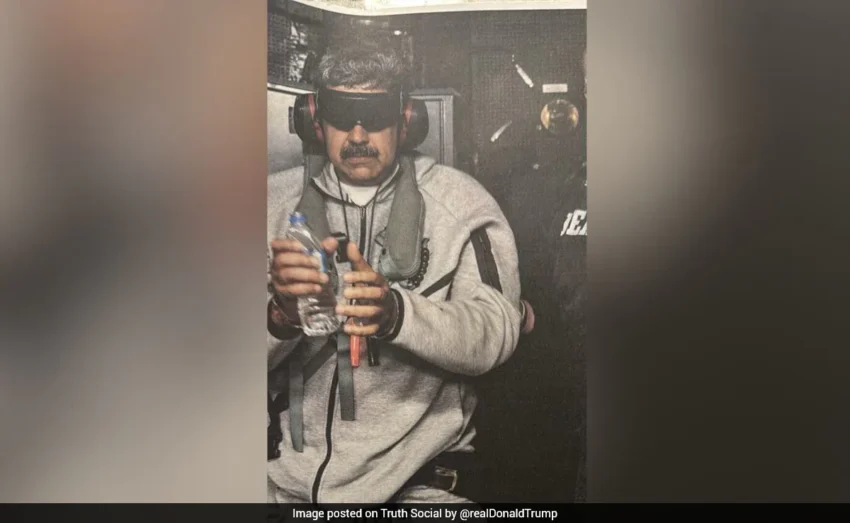
Posted on President Trump’s Truth Social account, this is said to be the first photo of Venezuelan President Nicolas Maduro in custody.
Venezuelan Used Terror to Try to Silence Journalists
Whatever one thinks of the United States’ capture of Venezuelan President Nicolas Maduro early Saturday – and there are objections that it violated international law — it is sure to be significant in the ongoing battle for press freedom and against authoritarianism in that country, and even more broadly, in Latin America.
“President Trump said on Saturday that the United States had captured the Venezuelan president, Nicolás Maduro, and was flying him out of Venezuela, in what would be a stunning culmination to a monthslong campaign by Mr. Trump’s administration to oust the authoritarian leader,” The New York Times reported.
“Mr. Trump made the announcement on Truth Social, his social media platform, and said that the United States had carried out ‘a large scale strike against Venezuela’ in an operation that was conducted in conjunction with U.S. law enforcement.’ He said that Mr. Maduro’s wife had also been captured.”
In October, Reporters Without Borders placed Maduro on its list of world leaders who “muzzle information in their country,” in this case in a nation that ranks 160th of 180 countries on the group’s Press Freedom Index.
The press freedom organization wrote, “After his disputed reelection in 2024, Nicolas Maduro again stepped up his persecution of the media and journalists, who became direct targets.
“The authorities regard the independent press as an enemy of the state and use a climate of terror to silence it. Their tools include an ‘anti-hate’ law and other legal provisions that serve to criminalise journalists and threaten them with drastic penalties.
“Journalists can be prosecuted on charges of terrorism, incitement to hatred or criminal association. Digital censorship has also been stepped up, with news site blocking and increased surveillance resulting in widespread self-censorship.
In Venezuela itself, the National Association of Journalists, its acronym CNP in Spanish, reported in December that “From January to November 2025, it had “documented at least 111 incidents against members of the press and media outlets in Venezuela, a situation that keeps alarm bells ringing amid an increasingly harsh wave of repression in the country.
“The report, shared on the CNP’s social media accounts, says 21 journalists have been detained by Nicolás Maduro’s government, most of them charged with offenses such as terrorism and treason.
“Blocking access also remains a censorship tool. There were at least 31 cases in which reporters were prevented from covering events in public spaces, as well as the shutdown of eight outlets: seven radio stations and one television channel.
“Secretary General Edgar Cárdenas has described the situation as a ‘Forced Silence Strategy’ that operates on three fronts: institutional, judicial and professional.”
There are broader implications. On Dec. 26, Pierre Manigault, president of the Inter-American Press association, an organization of publishers in the hemisphere, said that throughout the year, his group had “maintained an active and visible presence through international missions to Guatemala, Panama, Costa Rica, Peru, and the United States — countries where pressures against journalists and media outlets have intensified through legal harassment, disproportionate lawsuits, regulatory abuse, and stigmatization from the highest levels of power.
“This deterioration has been even more severe in Cuba, Nicaragua, and Venezuela, where governments openly deny their citizens the right to live under democratic norms and systematically suppress independent journalism.
Luz Mely Reyes, co-founder of Efecto Cocuyo of Venezuela, was part of a panel on exiled Latin American journalists held in November by the Knight Foundation for Journalism in the Americas. Her publication “is an independent media outlet in Venezuela . . . founded by four female journalists 11 years ago when we didn’t know what was going to happen in Venezuela,” she said. “We used to say that it was the . . . darkest moment in the press in Venezuela. Well, I have to say right now that we were wrong at that time. It was the worst time that we had lived, but it’s not the worst time we had to live in the years forthcoming.” (Credit: YouTube)
One of those defending Maduro and protesting the U.S. action was President Miguel Díaz-Canel Bermúdez of Cuba, a Maduro ally who holds a similar outlook.
The Cuban Institute for Freedom of Expression and the Press reported Dec. 18, “The wave of digital harassment against critical voices of the Cuban regime is intensifying. In recent weeks, journalists, activists and independent media have denounced various cyberattacks and social media blockades, aimed at silencing their platforms and restricting access to information. These facts evidence the growing digital repression faced by those who oppose or question power in Cuba, both inside and outside the island.”
At a November panel with exiled Latin American journalists organized by the Knight Center for Journalism in the Americas, Carlos Fernando Chamorro, founder of Confidencial of Nicaragua; turned to another panelist and said, “this oppression of press freedom, oppression of journalists is happening around the world and we can all learn from your experiences. And as I mentioned, it’s happening here in the U.S.
“And so, it’s important that people everywhere understand how you are continuing your work and why you’re doing it and what the warning signs are . . . so that we as journalists in other parts of the world can recognize, hey, we’re following down the path of Nicaragua. We’re following down the path of Venezuela or El Salvador or whatever other country that it might be.”
Will 2026 Be Another ‘Abomination’?
Referencing Martin Luther King Jr., Susan Rice said, “‘The arc of the moral universe bends towards justice. But it doesn’t bend on its own. We got to bend it.” (Credit: YouTube)
Veteran of Three Administrations Gives Trump ‘F-’
Despite the increase in misinformation and drain on the financial resources of more trustworthy venues, the proliferation of alternative media has given us such blunt and clear assessments as those given by Susan Rice, veteran of the Clinton, Obama and Biden administrations, in an interview conducted at year’s end by longtime White House reporter April Ryan.
On her Substack channel, Ryan asked Rice for her “general assessment of the year that’s passing us by.”
“An abomination,” Rice replied. “An abomination. I mean, in in less than 12 months, we have seen the burden on Americans go up in terms of their cost of living. Health care costs are skyrocketing, housing and energy costs remain very, very high. And there’s no relief in sight despite Trump promising on day one that he would end inflation.
“Meanwhile, if you look at what is happening throughout our country, the basic rights and freedoms that we’ve been accustomed to enjoying are evaporating. And Trump is marching us with extraordinary speed and efficiency toward a very serious authoritarianism. And he’s targeting his enemies.
“He’s destroying the the federal government and ruining the health care and public health system, you know, poisoning our kids. It’s just one thing after another. That’s just on the domestic front.
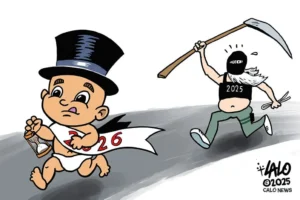 “So an abomination, an F-minus, if there’s such a grade to be given. (Cartoon credit: Lalo Alcaraz)
“And then on the international side, just to shorthand things, if you read the president’s National Security Strategy that was just released a couple weeks ago, and you watch what he’s been doing, he clearly is on a mission to shrink the United States from a global superpower to a regional great power like in the 19th century, where the great powers have their own spheres of influence. [Ours] are supposedly to be the Western Hemisphere, including Canada and Greenland.
“Russia can do what it wants on its flank and in Europe. China can do what it wants throughout Asia in the Indo-Pacific. And we’re committing superpower suicide.”
Ryan replied, “So also superpower suicide, an abomination, F-minus on foreign policy as well.
“An abomination domestically. F-minus and superpower suicide.
“Boy, you know how to start off an interview, don’t you?” Ryan said, smiling.
Like many in the news business. Rice also cited threats to press freedom and of unregulated artificial intelligence,. More discussion is needed, she said, about “what AI is doing to our kids and to mental health and their ability to to learn and read and think critically, write a paragraph.”
However, Rice also referenced “that famous saying attributed to Dr.[Martin Luther] King [Jr.]. ‘The arc of the moral universe bends towards justice. But it doesn’t bend on its own. We got to bend it. That’s right. We’ve got to do the work. “
Rice was director of the Domestic Policy Council in the Joe Biden administration; national security adviser and United Nations ambassador under Barack Obama and assistant secretary of state for African affairs under Bill Clinton.
- David Bauder, Associated Press: A rough year for journalists in 2025, with a little hope for things to turn around
- Nora Benavidez, New York Times: I Counted Trump’s Censorship Attempts. Here’s What I Found.
- Committee to Protect Journalists: CPJ calls on FCC commission to recommit to independence (Dec 22)
- Editors, Columbia Journalism Review: What We’re Watching: CJR staff on stories to look out for in 2026.
- Gerry Harrington, Editor & Publisher: Why journalism needs a marketplace model
- Adam Mahoney, Capital B: Deportations of African Migrants Triple Under Trump’s Second Term (Dec. 19)
- Theodore R. Johnson, Washington Post: America’s real source of patriotism has been clear for 250 years
- Ruben Navarrette, Creators Syndicate: After the Rollercoaster of 2025, Let’s Hope That 2026 Is a Smoother Ride
- Tracie Powell, NIeman Lab: Journalism’s influencer obsession will age poorly
- Reporters Committee for Freedom of the Press: Defending press freedom from unprecedented threat: RCFP’s 2025 year in review (Dec. 12)
- Ellis Simani, ProPublica: Deleting DEI: As the Trump administration ordered agencies to eradicate “illegal” diversity, equity and inclusion efforts, we identified more than 1,000 nonprofits that removed such language from the mission statements in their tax filings. (Dec. 17)
- Richard W. Stevenson, Mohammed Hadi, Nestor Ramos, Nikita Stewart, Michael Mason, Gilad Thaler, David Seekamp, Lauren Pruitt, Luke Piotrowski and Edward Vega, New York Times: The Biggest Questions We Have for 2026 (video)
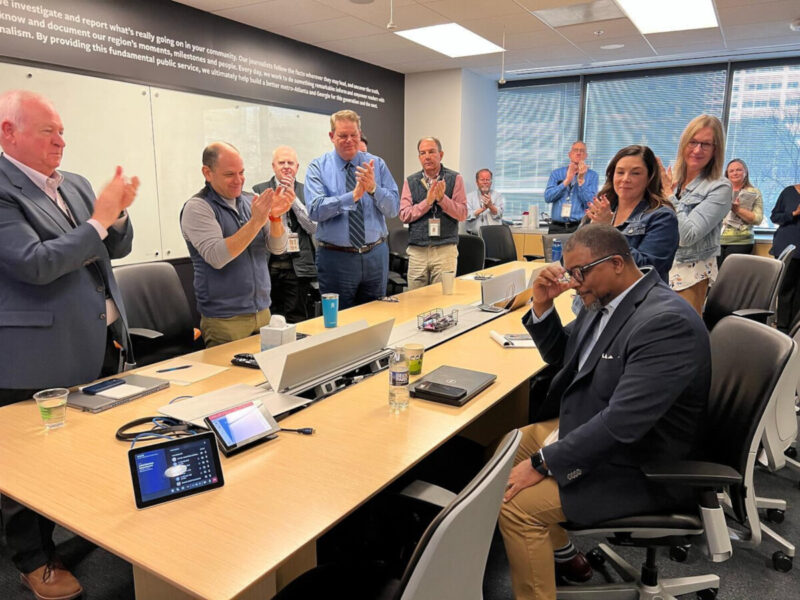
Leroy Chapman, sitting, receives a standing ovation after the March 23, 2023, announcement that he would be the AJC’s new editor-in-chief. (Courtesy of Ryon Horne)
As New Era Begins, Telling the AJC’s Black Story
On the morning of March 23, 2023, staff members at the Atlanta Journal-Constitution learned that Leroy Chapman, a managing editor who had been at the paper since 2011, would become the first Black top editor in the newspaper’s 155-year history.
“The celebration landed as both a milestone and a mirror reflecting how far the paper had come and how contested its relationship with Black Atlanta had long been,” Ernie Suggs wrote Dec. 22 for the paper in a retrospective keyed to the AJC’s year-end folding of its print edition to become an online-only product.
The AJC, said Andrew Morse, the AJC’s president and publisher, “is evolving into a modern media company and redefining local news. It is doing it in a national moment where diversity and inclusion are being attacked.
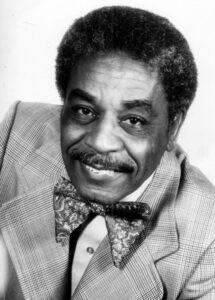 “The newspaper is reassessing what it has meant to Black readers, how it has covered race, and how the slow work of hiring Black journalists — from Harmon Perry (pictured) in 1968 to a new generation of storytellers — has shaped its credibility.
“For much of their existence, Atlanta’s daily newspapers reflected a social order enforced by Reconstruction and Jim Crow. The Atlanta Journal and The Atlanta Constitution of that era, long before they merged into the AJC, were white institutions built to serve white readers,” Suggs continued.
“In the late 19th and early 20th centuries, Henry Grady and other editors helped to shape a ‘New South’ narrative that promised economic modernization while openly defending the racial order.”
“That history includes Ralph McGill, in his first directive as executive editor of The Atlanta Constitution, declaring in 1938 that henceforth the word Negro would be capitalized whenever it was used.
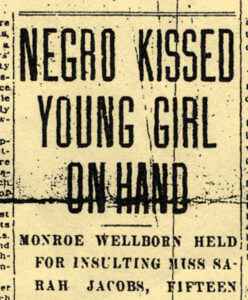 “It wasn’t until 1968 — in the wake of urban uprisings the presidentially appointed Kerner Commission concluded were the results of systemic racism — that the Atlanta Journal hired its first Black reporter, Harmon Perry, who had come from the Atlanta Daily World, part of the Black press .
“Pete Scott followed Perry to the Journal in 1971 as a general assignment reporter, In 1971, Tina McElroy Ansa joined the Constitution as an editorial assistant before becoming a reporter, becoming the first Black woman to enter the newsroom. She died last year.
“In 1972, the Journal hired Chet Fuller, who spent 26 years as one of the most influential voices in the newsroom, covering politics and neighborhoods before later becoming a columnist and eventually assistant managing editor.
“Alexis Scott spent 23 years at the AJC and Cox Enterprises before retiring in 1997 to take over her family’s business, the Atlanta Daily World.
“Others, like Ernie Reese, who covered Black college sports, Ernie Holsendolph, who covered Black business, and Shelia Poole, who covered religion and stayed at the paper for 35 years — the longest tenure ever for a Black staffer — followed.
“In 1992, Cynthia Tucker became the first African American editorial page editor of The Atlanta Constitution. . . .”
Soon after Chapman’s appointment to the top job, “he approved the AJC’s first full-length documentary, ‘The South Got Something to Say,’ an Emmy-nominated exploration of Atlanta’s hip-hop legacy.
“He also expanded Unapologetically ATL into a standalone franchise — now known as UATL — extending its reach beyond a weekly newsletter to community events, social media, video and podcasting.
“ ‘If the future of local news is deep engagement and direct relationships with readers, we know there’s a hunger for strong reporting on Black culture, HBCUs, and navigating Atlanta. UATL speaks to that ethic,’ Chapman said. ‘It’s reflective of who we are now and where we’re going.’ ”
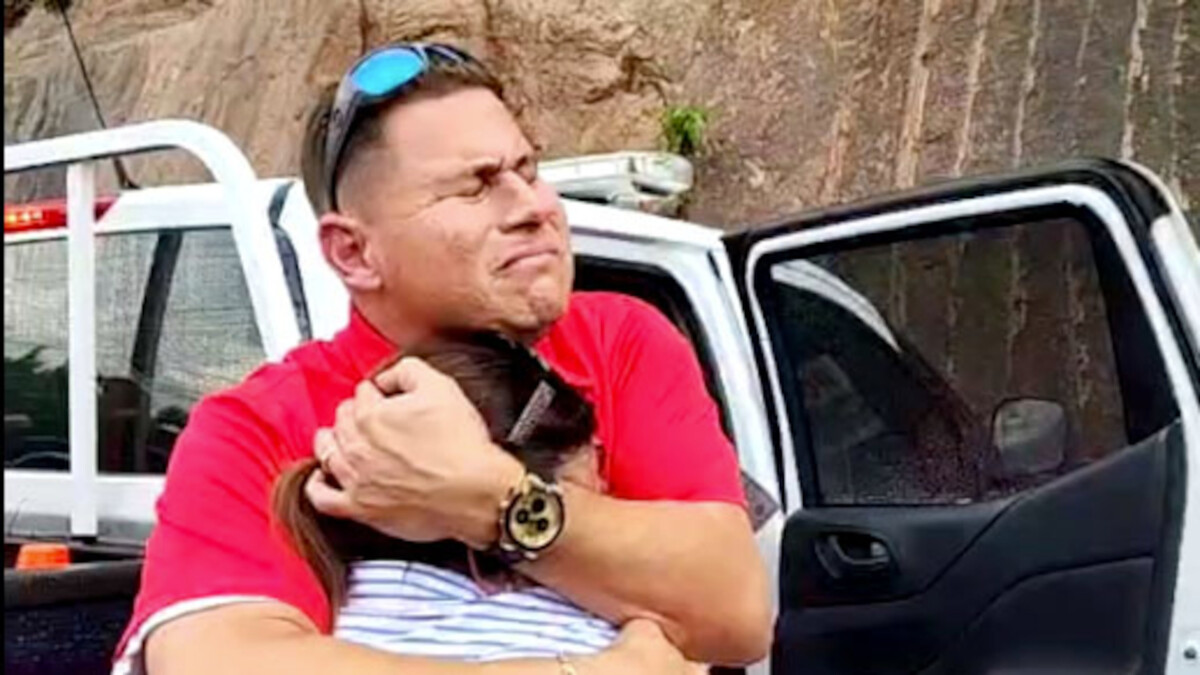
Spanish-language journalist Mario Guevara gets emotional as he arrives in Olocuilta, El Salvador, after U.S. immigration deported him in October after being in immigration jail for more than 100 days. (Courtesy)
Deported, but Guevara Continues His Journalism
“Even as he searches for emotional stability in his new life, Mario Guevara, the journalist deported to El Salvador — has gone back to work, once again covering immigration enforcement — now with the dubious benefit of firsthand experience with arrest, detention and deportation,” Lautaro Grinspan reported Monday (print edition) and Thursday (online) for the Atlanta Journal-Constitution.
“He has started work on a book and is conducting interviews with fellow deportees in El Salvador.
“But Guevara’s audience in metro Atlanta continues sending tips about ICE sightings in the area, so he is able to update his popular social media pages, which has helped him retain the support of most of his corporate sponsors.
“On Facebook, Guevara has picked up thousands of followers since his deportation and now reaches an audience of 812,000 people.
“Guevara is also traveling internationally for the first time in decades, reporting with trips to Colombia and Costa Rica and attending a journalism conference in Portugal.
“Still, he is quick to say he would trade all the new opportunities for his old life in Georgia.
“Since his release from ICE custody, Guevara says he has been approached by other immigrant journalists based in the U.S.
“ ‘They asked me, ‘Mario, what advice do you have for us?’ I told them not to mess with ICE. You may have a work permit, you may have a green card, but still, don’t mess with ICE. You’ll end up losing,’ he said. . . . .
“Guevara is holding on to hope that he may be able to legally reunite with his family in Georgia, but he says the earliest he thinks that may happen is three years from now, when the Trump administration vacates the White House. . . .”

