

Indigenous Journalists Honor Their Culture, but . . .
Homepage photo: After the formalities of the closing awards banquet at the Indigenous Media Conference in Albuquerque, N.M., some went outside the ballroom to the Enchanted Photo Booth to be photographed wearing crazy gear supplied for them to sample. (Credit: Richard Prince)

Marjorie Kaniehtonkie Skidders, Indian Time’s last managing editor, and Isaac White, staff reporter, look at the first edition of the newspaper. (Credit: Louis-Marie Philidor/CBC News)
Indigenous Journalists Honor Their Culture, but . . .
On the Akwesasne reserve straddling the New York-Canadian border, the Indian Time newspaper has gone out of business in part because too many local merchants, given the choice between having good relations with tribal leaders and supporting the newspaper, chose pleasing the tribal leaders.
In Oklahoma, meanwhile, Troy Littledeer finds himself unemployed after writing a piece for the Giduwa Cherokee News. Tribal officials didn’t like his criticism of government transparency and the piece’s allegations of financial mismanagement.

Automated license plate readers (Credit: Mike Katz-Lacabe)
As the use of surveillance technology spreads, raising questions about violations of the privacy of everyday citizens, tribal police are joining in: 18 tribal police departments have signed on to the use of automated license plate readers that lead police to stop citizens whom the technology deems “suspicious,” according to the Electronic Fronter Foundation.
Each of these subjects was raised at the Indigenous Journalists Association’s annual conference last week. It demonstrated that Native American journalists love their culture and hardly miss an opportunity to reference their tribal languages and traditions.
But also that such traditions most often do not include a free press.
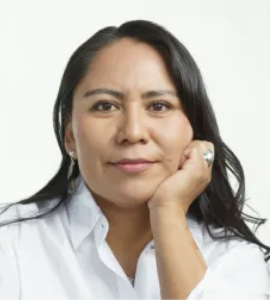
 “This year, we are focusing our theme on free press as an essential and fundamental component of sovereignty,” Christine Trudeau (pictured), president of the association and a member of the Prairie Band Potawatomi Nation, wrote in her welcoming message to conference attendees. Their Indigenous Media Conference meeting drew 400 people to the Isleta Resort and Casino on reservation land in Albuquerque, N.M.
 At its conclusion,
 “This theme is not just a topic for discussion, but a call to action,” Trudeau continued. “At a time of authoritarianism on the rise nationally and globally, it underscores even more so the importance of press freedom efforts everywhere, especially for Indigenous sovereign nations.”
 This is not a new issue. It was only in 2000 that the Cherokee Nation enacted the Free and Independent Press Act, landmark legislation passed on July 18 of that year to ensure that tribal publications have the independence to report objectively without political influence. The tribe celebrated the act’s 25th anniversary last month.
Still, IJA said in March, “A recent survey of Indigenous [Journalists] Association membership identified two of the biggest threats to tribal media were a lack of financial resources and editorial control. Tribal journalists reported that their nation’s economies impacted their tribal media’s ability to be financially independent and that government officials and political interests often determined media content.”

This May 2016 cartoon by Bruce Boot caused problems for Indian Time.
Jodi Rave Spotted Bear, executive director of the Indigenous Media Freedom Alliance and citizen of the Mandan, Hidatsa and Arikara Nation, has noted the absence of laws to ensure that government records and meetings are open to the public.
“There’s just no clear cut path to go into any of our tribal communities and accurately report on issues that could really raise the quality of life for our people,” she told Seth Stern of the Freedom of the Press Foundation.
That tribal citizens are also U.S. citizens protected by the First Amendment does not resolve the need for protections at the tribal level. First of all, tribal media outlets are usually dependent on tribal government for funding. “It’s very hard to compete with the established news ecosystem for independent money. It’s very hard to get,” added Angel Ellis, Muscogee, a board member of IJA.
Ellis went on, “I could go out and I could try to sell advertising to businesses, but they look at me and they say, hey, I’m trying to sell Ford pickups here. Why would I put an ad in your paper when I don’t think the people who read your newspaper have enough money to buy my pickup?”
Seeking traditional legal remedies to censorship also poses challenges. “Can I appeal to the federal government as an American citizen, say that this tribe has violated my rights? Yes, it can be done, but you will be a pariah in your own community. Culturally speaking, you’re going to be the person who has brought a federal suit against your family, basically,” Ellis said.
The Trump administration has added its own obstacles. Native public media were among those most hurt by last month’s clawback of funds for the Corporation for Public Broadcasting.
Two years ago, the Native American Journalists Association changed its name to the Indigenous Journalists Association to signal a more global approach to the issues of Indigenous people.
In that spirit, Trudeau, the IJA president, addressed the United Nations Permanent Forum on Indigenous Issues last year on “why supporting Indigenous journalism by and for Indigenous peoples is a key driver toward self-determination.”
This year, IJA snagged its biggest grant yet — $500,000 from the Press Forward organization, which aims to improve coverage of diverse communities. It was given to expand IJA’s “Indigenous Media Initiative, which addresses the vast underrepresentation of Indigenous people in U.S. media by improving coverage of these communities.”
The association also hired its first fund development director, Shirley LaCourse Jaramillo (Oglala Lakota / Oneida / Yakama / Umatilla).
Moreover, the group made progress toward having more Indigenous journalists in mainstream media.
At Friday’s closing awards banquet, IJA presented its Richard LaCourse Award for Investigative Journalism to a multicultural team from the nonprofit online magazine Grist, headed by Tristan Ahtone, a member of the Kiowa Tribe, former NAJA president and editor at large at the publication.
“The 2025 Special Awards Selection Committee selected Grist for its ‘Misplaced Trust’ investigation series, which revealed how land-grant universities continue to profit from more than 8.3 million acres of land taken from 123 Indigenous nations through the Morrill Act of 1862,” the announcement said. “This deeply reported series traced the legacy and ongoing impacts of these land transfers, exposing how universities have benefited financially while tribes were dispossessed and excluded from decision-making.”
 The association also honored Dana Hedgpeth (pictured) of the Washington Post, an enrolled member of the Haliwa-Saponi Tribe of North Carolina. She “recently completed a year-long investigative series with a team at The Washington Post that exposed the deaths of more than 3,100 Native students at U.S. boarding schools — more than triple the number previously acknowledged by the federal government,” the organization said. “The series also included a powerful report on the widespread sexual abuse of Native children within these institutions.”
 Watching it all was Graham Lee Brewer (pictured), Cherokee, a former NAJA president who now writes about Native issues for the Associated Press as part of its race and ethnicity team. He is also a recipient of IJA’s Indigenous Journalism Fellowship.
And in another milestone for Native journalists, the Herb Block Foundation awarded cartoonist Marty Two Bulls Sr., Lakota, its annual prize in April.
Still, there remains a need for Native news by Native journalists on Native land. Indian Time, which folded in December, was a successor to Akwesasne Notes, which chronicled disputes involving Natives on both sides of the U.S.-Canada border. It had no use for what Marjorie Kaniehtonkie Skidders, Indian Time’s last managing editor, said at the conference was the “cowboys and Indians-type stuff” written by nearby mainstream media.
“The AKWESASNE NOTES era was 55 years of Native American journalism, and yes, it was proud to be called advocacy journalism since there were not many advocates for Indigenous people anywhere,” Alex Jacobs (Karoniaktahke), who worked for both Akwesasne Notes and Indian Time, wrote in February. “The term may have negative connotations in some quarters but a look around at recent history and current events demonstrates what has happened to mainstream media. The results of ‘both sides’ and ‘objective journalism’ and corporate ownership of media are easily observable.”
Jacobs continued, “AKWESASNE NOTES did not care to represent detailed viewpoints from governments and corporations since those were the prevailing views splashed across all forms of media. To that media, Native people are dissenters and protestors, not sovereign peoples with well-formed ideas, deep historical and cultural philosophies, and potent political agendas. We cared what grassroots Native people said, what people of the land said, what Indigenous people from around the world said, and what our allies said with their support.”
Opposition from tribal leaders wasn’t the only reason for the downfall of Akwesasne Notes and its successor, Indian Time, but it helped. Competition from social media and lack of a strong business plan, factors that have led to the shrinkage of mainstream outlets as well, were partly to blame.
 “Indian Time editor Marjorie Skidders (pictured, by Indian Time) explained that tribal government entities no longer took out contracts to pay for community announcements, job notices, health and education news,” Jacobs added. “Politics may have been involved in some cases, but today the trend is to use free social media for announcements and news. A further disturbing trend is that in-house tribal publications can ask community members to submit material like photos and articles, again for free.”
It didn’t help, either, that the newspaper faced backlash over a political cartoon or that applying for 501 (c)(3) nonprofit status was frowned upon as counter to the traditions of the tribe, Skidders told a convention workshop session.

Even when the tribe has a bill of rights guaranteeing a free press, journalists can face trouble, Littledeer told Journal-isms. Littledeer was awarded the Tim Giago Free Press Award at IJE’s closing banquet.
“On Thursday March 20, 2025 during Sunshine Week, United Keetoowah Band Media Director Troy Littledeer was retaliated against by tribal officials who forced the censor of a clearly identified opinion editorial piece entitled, ‘The Federal Governments Trust Responsibility to Native American Tribes,’ ” IJA said in a March 24 news release.
“Officials at UKB demanded the opinion piece published on Feb. 25 be taken down on Feb. 27. Then in retaliation, officials demanded the logins to the social channels and websites utilized by UKB Media without opportunity for discussion or giving reason for their demands. Tribal officials also took over editorial review of the Giduwa Cherokee Newspaper.
“This demand of login allowing the government to control all the information published by Giduwa Cherokee News and UKB Media was carried out in secrecy without public discourse. Littledeer had been in good faith negotiations with the UKB government where he requested an editorial board composed of band members be formed to prevent government overreach of news coverage.
“This disciplinary action taken against Littledeer has produced a chilling effect that compromises the rights of United Keetoowah Bands members. It is a violation of the Keetoowah members’ own constitution, the Indian Civil Rights Acts, and the ethics supported by the Society of Professional Journalism and the Indigenous [Journalists] Association.”
Littledeer, a videographer and photographer in northeast Oklahoma, told Journal-isms he is living on unemployment insurance and that his case is now in the courts.
The screening of “Blood & Myth,” a film set to debut on Hulu on Sept. 4, provided perhaps the eeriest moment of IJA’s conference. It, too, bears on the need for Natives to tell their own stories.
The plot: When James Dommek Jr., a native of northern Alaska, “first learns about a string of bloody attacks in a remote Alaskan community, the details don’t add up. At the center of the rampage is an unlikely fugitive: Teddy Kyle Smith, a fellow Iñupiaq man and actor who was greatly admired within his tribe. The mystery only deepens when Teddy is finally apprehended and makes a shocking claim: while out in the wilderness, he had a frightening encounter with Iñukuns — sinister beings well-known and long-feared by the Iñupiaq people – and that they had guided his violent actions.
“To the Western courts, Teddy’s tale of Iñukuns fell on deaf years. But having grown up north of the Arctic Circle, Dommek knew all too well of the frightening stories of ‘the little people’ – whose existence is accepted as fact by northern Native communities and supported by first-person accounts and chilling sightings.
“Obsessed by the story, he embarked on a journey back to the village to uncover the truth behind what Smith allegedly saw in those mountains. Was it possible that those myths from his childhood were true? In search of answers, his years-long odyssey took him deep into the heart of uncharted Alaska, where myth and reality collide, and where he must confront his own demons to unravel the mystery behind the Iñukuns.”
Dimmek, who appeared virtually, was asked after the screening why it was important that this story be told.
“I’m not a journalist, I’m just a dude who became obsessed with this story,” Dimmek said. He was willing to wait eight years for Smith to be willing to tell his tale because most of the world sees northern Alaska through stereotypes about “Eskimos.”
“A lot of people of Northern Alaska have stories and seen weird things they can’t explain,” Dimmek said.
“As Alaska Native people, we’re always used to others telling our story. That’s why stories like this matter.
“That perspective doesn’t get seen very often. It matters that we tell this story.”
- Jorge Barrera, CBC News: Indigenous journalism legacy ends in Akwesasne with Indian Time closing (Dec.19, 2024)
- Graham Lee Brewer, Associated Press: Trump’s demand for Washington NFL team name change ignores years of psychological data, experts say (July 27)
- Angel Ellis, Shaun Griswold, Nancy Marie Spears, Hattie Kauffman, Native America Calling: Indigenous journalists’ unique role in reporting the truth
- Jacqueline Gelineau, CBC News: 120-year-old B.C. newspaper purchased by local Indigenous-owned corporation (Aug. 7)
- Chad Hunter, Cherokee Phoenix: Cherokee Phoenix staff offer insight at IJA conference (Aug. 23)
- ICT News: ‘A call to do more’: former ICT editor honored by Harvard [on Mark Trahant] (April 11)
- Indigenous Journalists Association: 2025 Indigenous Media Awards Winners (June 17)
- Inside Climate News: Indigenous human rights abuses? Trump administration cut them from annual report
- Denise-Marie Ordway, the Journalist’s Resource: 6 tips for covering tribal colleges and universities (Aug. 13)
- Jodi Rave Spotted Bear, Society of Professional Journalists: SPJ FOI Chair on press freedom in Indian Country and Sunshine Week plans (March 13, 2023)
- Tara Roanhorse, Indian Leader, Haskell Indian Nations University: Haskell Journalists Earn 12 Honors at Indigenous Media Awards
- Savannah Romero, ICT News: How we heal together: the potential of Black and Indigenous solidarity (Aug. 11)
- Patty Talahongva, “Frontline,” PBS: “Alaska’s Vanishing Native Villages” (April 22) (video)
- UNESCO: Strengthening media with indigenous voices (April 25)
