

Sierra Leone Journalists Unlikely to Attend
ESPN Cuts Ties With Sharpe After Rape Case
Lengthy Jailings Unwarranted, Reporters Find
Court: Descendants of Tribe’s Enslaved Are Citizens
Homepage photo: Sierra Leone Association of Journalists
Journal-isms Roundtable photos by Jeanine L. Cummins
The Sierra Leone Broadcasting Corp., government-owned national radio and television broadcaster, reports Friday on a cultural festival. (Credit: YouTube)
Sierra Leone Journalists Unlikely to Attend
By a Journal-isms correspondent
Less than two months ago, President Trump ordered restrictions on issuing visas to citizens of seven countries, nearly all Black and brown, and a complete ban on travel from 12 other nations where people of color dominate.
Now, journalists from Sierra Leone in West Africa are being blocked from coming to next week’s National Association of Black Journalists convention in Cleveland.
NABJ President Ken Lemon revealed the setback during a Journal-isms Roundtable discussion Sunday, reading from an email he received from the Sierra Leone Broadcasting Corp. About 53 people were in the Zoom meeting, and 92 had watched the video by midday Wednesday.
 “I got an email this week from people who went through that whole process with the State Department,” Lemon (pictured) told the Roundtable. “I’m going to read real quickly on behalf of Sierra Leone Broadcasting Corp.:
” ‘We are deeply disappointed and regret to inform you that despite our members’ diligent efforts, including filing completed visa applications and paying the required fees, the U.S. Embassy in Freetown has not yet scheduled interview dates.’ ”
NABJ worked to include the Sierra Leone journalists virtually in convention programming. The organization had anticipated potential visa challenges and prepared backup plans for remote participation, Lemon said.
The Journal-isms Roundtable Sunday, ” ‘Black Like Me?’ What Black People Worldwide Have in Common, and Don’t,” attracted about 53 people to the Zoom, and 92 had watched the video by midday Wednesday.
In his June 9 proclamation on the visa restrictions, Trump said, “I considered foreign policy, national security, and counterterrorism goals. And I further considered various factors, including each country’s screening and vetting capabilities, information sharing policies, and country-specific risk factors — including whether each country has a significant terrorist presence within its territory, its visa-overstay rate, and its cooperation with accepting back its removable nationals.”
The partial restrictions apply to Burundi, Cuba, Laos, Sierra Leone, Togo, Turkmenistan and Venezuela.
“According to the Overstay Report, Sierra Leone had a B-1/B-2 visa overstay rate of 15.43 percent and an F, M, and J visa overstay rate of 35.83 percent. Sierra Leone has historically failed to accept back its removable nationals,” Trump said.
The full ban applies to Afghanistan, Myanmar, Chad, Republic of Congo, Equatorial Guinea, Eritrea, Haiti, Iran, Libya, Somalia, Sudan and Yemen.
The same day as Trump’s proclamation, Abdul Rashid Thomas reported for the Sierra Leone Telegraph, “The African Union, which includes seven of the 12 nations on the full travel ban list, said the ban would harm ‘people-to-people ties, educational exchange, commercial engagement, and broader diplomatic relations’ that were built with the US over past decades.
“The African Union Commission respectfully calls upon the US administration to consider adopting a more consultative approach and to engage in constructive dialogue with the countries concerned,” the bloc said in a statement.
Chad responded by suspending visas for US citizens, but other African nations were more conciliatory, Thomas wrote.
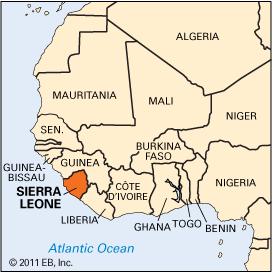 In February, Thomas wrote a piece headlined “Journalism in Sierra Leone is at its lowest ebb.” However, the country ranks 56 of 180 countries on the Reporters Without Borders World Press Freedom Index — one spot above the United States, which sits at 57th. Yet despite its comparatively higher ranking, Sierra Leonean journalists often face significantly more travel restrictions than peers from countries with lower press freedom scores, due largely to the complexities of global visa policies.
The visa setback illustrated the barriers to the global Black unity discussed during the Roundtable, “What Black People Worldwide Have in Common, and Don’t.”
 Lemon is up for re-election against two other presidential candidates, Errin Haines (pictured), editor at large for The 19th, and financial journalist Dion Rabouin, all present at the Roundtable as they ramp up their campaigns. Voting began electronically on July 14 and continues through Aug. 8. The three were present to respond to a question about NABJ’s place in the global Black world, and the candidates said they drew strength from both shared experiences and cultural differences.
Lemon said the involvement of the Sierra Leone journalists was part of an ambitious Pan-African cultural exchange initiative that he launched after his election in 2023.
Haines’ goals are similar. However, she stressed a vision of NABJ as a protective force for Black communities worldwide, drawing from her front-row experience while covering then-Vice President Kamala Harris’s first trip to Africa in 2023. “Our people are coming under attack,” Haines said.
Haines stressed the urgency of strengthening international connections, noting that “America does lead, for better or for worse, and the relationship between a free press and a healthy democracy is something that other countries are paying attention to.” Haines also called for the active participation of NABJ in more international conferences in a bid to help “shift the narrative” as African nations celebrate their liberation from colonizers.
“Black excellence is global, we know that,” she said. “We are the keepers of our culture as Black journalists, we are the ones that are telling that story.”
 While supportive of global engagement, Rabouin (pictured) argued for prioritizing domestic partnerships first. “We need to fix home first, because right now, NABJ just isn’t working with anyone,” he said, citing conversations with leaders from Hispanic, LGBTQ+, and other journalism organizations that he said described NABJ leadership as “closed, not collaborative.”
“If we want to see NABJ become something truly global, then we’ve got to first show up for that diaspora right here,” Rabouin explained. “That means our Afro-Latino brothers and sisters, that means our African brothers and sisters, that means all of the folks who are Black, representing the ‘B’ in NABJ.”
Rabouin emphasized the diversity within Black journalism: “We’re queer, we’re trans, we’re Afro-Latino, we’re immigrants, we speak Spanish, French, Portuguese, Haitian Creole, Yoruba, and all of those things.”
Representatives from the Sierra Leone Broadcasting Corporation could not be reached to discuss the specific timeline of their visa applications or whether they plan to reapply for future NABJ events.
Spokespeople for the U.S. State Department and the Sierra Leone Embassy did not respond to requests for comment.
ESPN Cuts Ties With Sharpe After Rape Case
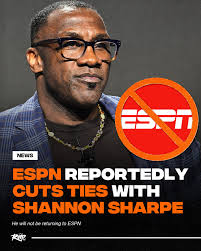 “ESPN has cut ties with NFL Hall of Famer and media analyst Shannon Sharpe less than two weeks after he settled a lawsuit in which his ex-girlfriend accused him of rape, sources briefed on the decision told The Athletic on Wednesday,” Andrew Marchand reported for The Athletic.
“Sharpe has not been on ESPN since late April, when the suit was first filed. He said at the time that he would return to ESPN at the beginning of NFL training camp. ESPN declined to comment.
“The woman, known as ‘Jane Doe’ in the suit, was seeking $50 million for ‘pain and suffering, psychological and emotional distress, mental anguish, embarrassment and humiliation.’ Sharpe publicly denied the allegations immediately after his accuser filed the suit in April, calling the case a ‘shakedown’ attempt. He has maintained that he and the Nevada woman were in a consensual sexual relationship.
“Since retiring from the NFL, Sharpe, 57, has had a long media career, first as an NFL studio analyst and then as a sports talk host at FS1, where he rose to greater prominence debating Skip Bayless on ‘Undisputed.’ After that run ended in 2023, Sharpe joined ‘First Take’ as a twice-weekly foil for Stephen A. Smith.
“Sharpe continues to have his podcasts ‘Club Shay Shay’ and ‘Nightcap,’ where he teams up with former wide receiver Chad Ochocinco, both of which are currently distributed by The Volume in an agreement that concludes at the end of August, according to sources briefed on the deal. . . .”
New: On March 15, President Donald Trump’s administration sent more than 230 Venezuelan immigrants to a maximum-security prison in El Salvador. Last week, the men were released as suddenly as they’d been taken away. These are their stories. https://t.co/PxNp3zzqAh
— ProPublica (@propublica) July 23, 2025
Lengthy Jailings Unwarranted, Reporters Find
“We’ve compiled a first-of-its-kind, case-by-case accounting of 238 Venezuelan men who were held in El Salvador,” ProPublica reported July 23.
“To do so, ProPublica, The Texas Tribune and a team of Venezuelan journalists from Alianza Rebelde Investiga (Rebel Alliance Investigates) and Cazadores de Fake News (Fake News Hunters) spent the past four months reporting on the men’s lives and their backgrounds.
“We obtained government data that included whether they had been convicted of crimes in the U.S. or had pending charges. We found most were listed solely as having immigration violations. We also conducted interviews with relatives of more than 100 of the men; reviewed thousands of pages of court records from the U.S. and South America; and analyzed federal immigration court data.”
ProPublica also said, “We obtained internal data showing the Trump administration knew that at least 197 of the men had not been convicted of crimes in the U.S. — and that only six had been convicted of violent offenses. We identified fewer than a dozen additional convictions, both for crimes committed in the U.S. and abroad, that were not reflected in the government data.
“Nearly half of the men, or 118, were whisked out of the country while in the middle of their immigration cases, which should have protected them from deportation. Some were only days away from a final hearing.
“At least 166 of the men have tattoos. Interviews with families, immigration documents and court records show the government relied heavily on tattoos to tie the men to the Venezuelan gang Tren de Aragua — even though law enforcement experts told us that tattoos are not an indicator of gang membership.
“The men who were imprisoned range in age from 18 to 46. The impact of their monthslong incarceration extended beyond them. Their wives struggled to pay the rent. Relatives went without medical treatment. Their children wondered if they would see them again. . . .”

Gary Lee, second from right, holds awards from the Oklahoma Press Association, flanked by principal M. David Goodwin, left, Oklahoma Eagle publisher James Goodwin and principal Ross Johnson, who is responsible for the newspaper’s creative direction. (Credit: Oklahoma Eagle)
Court: Descendants of Tribe’s Enslaved Are Citizens
“The Muscogee Nation Supreme Court ruled Wednesday that two descendants of people once enslaved by the tribe are entitled to tribal citizenship,” Graham Lee Brewer reported July 23 for the Associated Press, and at least one Black journalist is affected by the ruling.
“It directly affects me. As a Creek Freedman, it opens the door for me to apply for Creek citizenship,” veteran journalist Gary Lee messaged Journal-isms. “I have already started that process.”
Lee is executive editor of the Tulsa Local News Initiative and The Oklahoma Eagle and former foreign correspondent for Time and the Washington Post.
Brewer continued, “The court found that the tribal nation’s citizenship board violated an 1866 treaty when it denied the applications of Rhonda Grayson and Jeffrey Kennedy in 2019 because they could not identify a lineal descendant of the tribe.
“ ‘Are we, as a Nation, bound to treaty promises made so many years ago? Today, we answer in the affirmative, because this is what Mvskoke law demands,’ the court wrote in its opinion.
“The Muscogee Nation is one of five tribes in Oklahoma that once practiced slavery, and in that 1866 treaty with the U.S. government, the tribe both abolished it and granted citizenship to the formerly enslaved. But in 1979, the tribal nation adopted a constitution that restricted membership to the descendants of people listed as “Muscogee (Creek) Indians by blood” on the Dawes Rolls, a census of members of the five tribes created around 1900.
“When the Dawes Rolls were created, people were listed on two separate rolls: those who were Muscogee and those who were identified by the U.S. government as Freedmen. In its ruling Wednesday, the court remanded the matter back to the Muscogee Nation’s citizenship board and directed it to apply the Treaty of 1866 to Grayson and Kennedy’s applications, as well as any future applicants who can trace an ancestor to either roll.”
Added Deon Osborne for the Black Wall Street Times, “Ultimately, the Court struck down a system of deciding criticized as racial apartheid that was passed down from the U.S. government: a divided roll of human beings listed as the “By Blood” Dawes Roll and the Freedmen Roll.
“It was used to divide up land for European expansion, and it casted all Freedmen, Creeks of African descent, as well as children of intermarriages into one category. . . .
In 1999, Lee, a fifth generation Oklahoman of Creek Freedman descent, embarked on a personal journey to explore his Creek roots, and wrote about it for the Washington Post, where he was then a travel writer.
“More than 2 million Americans claim Indian ancestors, according to official census estimates. And yet many of us so-called mixed bloods have no sense of how our Native American heritage shaped us, what mark it left on our characters, what mannerisms it bequeathed us.
“And so I took to the road, with a partially completed family tree in hand, hoping to find some answers. . . .”
In 2021, the Cherokee Nation Supreme Court ruled that the tribal nation remove the phrase “by blood” from its constitution and other tribal laws. “That change formally acknowledges that the descendants of Black people once enslaved by the tribe — known as the Cherokee Freedmen — have the right to tribal citizenship, which means they are eligible to run for tribal office and access resources such as tribal health care,” Harmeet Kaur reported then for CNN. Boston journalist Kenneth Cooper and Washington reporter Sam Ford of WJLA-TV have been active in fighting for the rights of Cherokee Freedmen descendants like themselves.
