
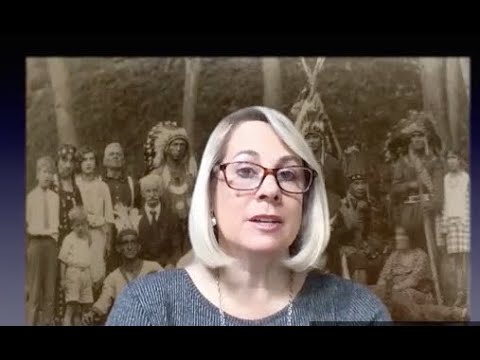
An Oct. 28 “Good Morning Indian Country” episode features a live look at a screening of the film “Remaining Native” at Haskell Indian Nations University, and an interview with director Paige Bethmann. (Credit: YouTube)
Award Honors Educators Nurturing J-Students of Color
FOR IMMEDIATE RELEASE
Nov. 18, 2026
Melissa Greene-Blye, Ph.D., Miami Tribe of Oklahoma, director of the Center for Indigenous Student Media at the University of Kansas, has been named the 2026 recipient of the Barry Bingham Sr. Fellowship.
The national award honors educators making exceptional efforts to encourage and support students of color pursuing careers in journalism.
 One of Greene-Blye’s signature achievements is “Good Morning Indian Country,“ a Native student-led weekly news and information program produced collaboratively by University of Kansas journalism students and students from Haskell Indian Nations University. She also worked as an anchor and reporter for 20 years, covering local news in television markets large and small. (Pictured: In 2021 YouTube video, Melissa Greene-Blye discusses Indigenous representation in the media.)
“Dr. Greene-Blye also understands growing the pipeline of future Indigenous college students and media professionals,” said Steve Bien-Amie, associate professor and interim chair, Sports Media & Society Concentration at KU’s William Allen White School of Journalism and Mass Communications, one of two who nominated Greene-Blye.
“To that end, she is the director of the annual KU Native Storytelling workshop, which brings Indigenous high school students to the university for a week of multimedia training and guidance.”
Added KU professor Teri Finneman, “Since ‘Good Morning Indian Country’ started four years ago, it is clear this production has already had a significant impact on students and the communities that they serve” in “a unique multi-university partnership.
“ ‘Good Morning Indian Country’ aims to increase the visibility and representation of Indigenous issues, individuals, and communities, while providing important political, cultural, and historical context. The show offers stories and interviews from across Indian Country covering topics related to business, health, education, and policy.
“Additionally, the newscast showcases the work of Native scholars, performers, athletes, and other culture-bearers. From the on-air talent to the production side, students come together under Dr. Greene-Blye’s guidance to not only serve a community that has always been marginalized by mainstream media but to also provide an invaluable education to the students themselves about issues important to this community and how to authentically frame them.”
The Bingham Fellowship includes a $1,000 grant and carries a legacy rooted in the values of the late Barry Bingham Sr. (1906–1988), patriarch of the famed Bingham publishing family of Louisville, Ky. The fellowship, established in 1990, continues to celebrate educators who expand access and opportunity for journalists of color.
Greene-Blye’s recognition arrives amid renewed national debate over diversity, equity, and inclusion in higher education. Journal-isms’ decision to honor her work underscores how vital educators remain in preparing the next generation of media professionals to foster fairness, representation, and trust in journalism. As Finneman noted, fewer than 0.5 percent of professional journalists are Native American.
Journal-isms assumed stewardship of the Barry Bingham Sr. Fellowship award in 2024, following the dissolution of the News Leaders Association, under whose leadership the award was previously managed. It was created by the National Conference of Editorial Writers, later the Association of Opinion Journalists.
The judges noted an exceptionally accomplished set of nominees this year, including:
- Deborah Barfield Berry, faculty member at the University of Maryland, College Park, and director of its Capital News Service Annapolis bureau.
- Dorothy Bland, Ph.D., professor and former dean of the Frank W. and Sue Mayborn School of Journalism at the University of North Texas, this year’s winner of the Educator of the Year award from the National Association of Black Journalists.
- Danielle K. Brown, Ph.D., 1855 Professor of Community and Urban Journalism and associate professor in the School of Journalism at Michigan State University.
- dominic mckenzie, assistant professor, Howard University, who also directs the Academy for Media Futures, a summer program for high school students that focuses on health disparities in Washington, D.C.
- Jason Samuels, journalism professor, New York University, Emmy Award-winning television news and documentary producer; creator, Ed Bradley Fellowship, formerly the Black Male Journalism Workshop.
- Sherri Williams, Ph.D., associate professor in Race, Media and Communication at the School of Communication at American University and author of “Black Social Television: How Black Twitter Changed Television.” She is also inclusion officer for the school.
The Bingham judges are William Celis, retired associate professor of journalism at USC Annenberg School of Journalism and 2018 Bingham winner; Mei-Ling Hopgood, journalist and William F. Thomas Professor of Journalism at Northwestern University, 2020 Bingham winner; Rick Horowitz, legal-writing coach, speaker, and workshop leader at Prime Prose, LLC, longtime Bingham judge; Linda P. Shockley, former deputy director and managing director, Dow Jones News Fund; and Richard Prince, CEO and columnist at Journal-isms, Inc., chair.
Past Bingham winners include James Hawkins, Florida A&M University (1990); Larry Kaggwa, Howard University (1992); Ben Holman, University of Maryland (1996); Linda Jones, Roosevelt University, Chicago (1998); Ramon Chavez, University of Colorado, Boulder (1999); Erna Smith, San Francisco State (2000); Joseph Selden, Penn State University (2001); Cheryl Smith, Paul Quinn College (2002); Rose Richard, Marquette University (2003).
Also, Leara D. Rhodes, University of Georgia (2004); Denny McAuliffe, University of Montana (2005); Pearl Stewart, Black College Wire (2006); Valerie White, Florida A&M University (2007); Phillip Dixon, Howard University (2008); Bruce DePyssler, North Carolina Central University (2009); Sree Sreenivasan, Columbia University (2010); Yvonne Latty, New York University (2011); Michelle Johnson, Boston University (2012); Vanessa Shelton, University of Iowa (2013); William Drummond, University of California at Berkeley (2014);
Julian Rodriguez of the University of Texas at Arlington (2015); David G. Armstrong, Georgia State University (2016); Gerald Jordan, University of Arkansas (2017), Bill Celis, University of Southern California (2018); Laura Castañeda, University of Southern California (2019); Mei-Ling Hopgood, Northwestern University (2020); Wayne Dawkins, Morgan State University (2021); Marquita Smith (video) of the University of Mississippi (2022), Rachel Swarns, New York University (2023), and Mia Moody, Baylor University (2025).
For more information, contact Neil Foote, Journal-isms board chair, at 214.448.3765 or via email at neil (at) neilfoote.com.
###
- Cristina L. Azocar and Meta G. Carstarphen, editors, “Storytelling Sovereignty: Indigenous Peoples and the Media” (University of Oklahoma Press)
