
Trump’s Election, Meeting With Publisher Preceded Layoffs
Short Takes update: Richmond Free Press publisher cites Trump’s anti-DEI crusade in paper’s folding
Homepage image credit: Washington Post Guild
View this post on Instagram
Amber Ferguson, a rapid-response culture reporter who had been at the Washington Post for nine years before being laid off this month, said she noticed a shift in how her pitches were received.
If no image is visible, please consider changing browsers.
Trump’s Election, Meeting With Publisher Preceded Layoffs
A dropoff in interest in newsroom diversity at the Washington Post followed Donald Trump’s second presidential election win and continued even after management was told of a survey of Black Post newsroom employes that rated interest in Black employees below 2 on a sale of 1 to 5, Riddhi Setty reported Monday for Columbia Journalism Review.
“The survey, aimed at gauging the experience of Black newsroom staffers in the wake of the firing of opinion columnist Karen Attiah “and the departures of other senior Black leaders, asked staffers to respond on a scale of one to five, with one being ‘strongly disagree’ and five being ‘strongly agree,’ to the prompt ‘I believe Newsroom and Opinions leadership values diversity and is committed to including Black employees in senior and decision-making roles,’ Setty wrote.
“The average response was 1.65. To the prompt ‘I am confident the organization is committed to retaining and supporting Black employees long term,’ the average response was 1.61. No one gave a number higher than three in response to either prompt.
“Employees also wrote that they had lost career mentorship and support systems in the newsroom, that their perspectives weren’t valued, and that stories ‘tied to race, culture or identity are often dismissed before they even get a chance.’ According to an email that was reviewed by CJR, the survey results were shared with then-Publisher Will Lewis and Wayne Connell, the head of human relations, on Dec. 1, 2025.
“ ‘The departures and buyouts of senior Black staff have left us without Black leaders in key roles, raising difficult questions about whether there are paths to advancement for Black talent and opportunities to shape coverage,’ “ according to an October letter to Murray, Lewis, Eleanor Breen, the chief of staff; and Adam O’Neal, the opinion editor, signed by forty-five Black Post journalists.
“These notable absences have created a perception that Black perspectives are being minimized at a time when they are most needed, both for our journalism and for the communities we serve.”
“The journalists requested a chance to speak with leadership about their concerns. On December 2, 2025, Ferguson and three Black colleagues met with Murray, Lewis, and Connell.
Amber Ferguson, a rapid-response culture reporter who had been at the Post for nine years before being laid off this month, “said that she and her colleagues laid out three asks: that the Post hire a managing editor of diversity and inclusion [Krissah Thompson was the first to hold such a post, but was later transferred]; that there be formal evaluations of managers on their efforts to recruit and retain employees of color on all levels; and that managers be trained in how better to assist journalists of color when they face harassment in response to their reporting.
“ ‘Will said, ‘How did it get this bad?’ ” Ferguson recalled. ‘And we were like, ‘What do you mean?’ That was just such a funny thing to say. I mean, you’re the cause of the majority of this. You didn’t appoint any people of color under your direct leadership.”
“Ferguson said Lewis told her and the other staffers that he found the survey revealing and was committed to addressing their concerns. When a staffer followed up to ask if he’d given thought to their discussion, Lewis wrote, in an email reviewed by CJR: ‘I have asked Wayne to consider your suggestions and thoughts as we consider what a broader company-wide strategy needs to be to address diversity. He recommended ‘speaking with Matt directly’ for suggestions specific to the newsroom.
“According to Ferguson and another Post journalist familiar with the meeting who asked not to be named because they still work at the paper, no action was taken.
Lewis stepped down on Feb 7 and was replaced in the interim by Jeff D’Onofrio, the chief financial officer.
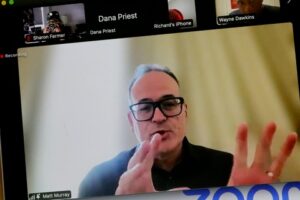 Murray took the top job believing ““there are not enough women and people of color in leadership positions,” he told the Journal-isms Roundtable in 2024 (pictured, by Sharon Farmer).
When the National Association of Black Journalists asked for a meeting in July 2025, a request that was granted, Murray wrote:
“It is certainly true that in the current voluntary separation program, we are losing several valuable Black colleagues, including senior editors. We all regret the departure of these smart and valued colleagues, and we wish them continued success.
“We also remain deeply committed to fostering diversity around The Post, where we are ardently engaged in the work of restructuring and reinvigorating the institution. We all agree that there is undoubtedly work to do on this front throughout the newsroom—and that has been true even before the current departures.
“Among other things, we are launching a two-year internship program for young journalists of color. And I, along with several of my colleagues, will be attending NABJ’s 2025 Convention & Career Fair next week in Cleveland where we’ll be actively recruiting for many open roles. Of course, ultimately, we know we will be accountable for what we do to build The Post’s next chapter, not just what we say.”
WaPo Layoffs Heavily Hurt Workers of Color
Feb. 15, 2026
WaPo Layoffs Heavily Hurt Workers of Color:
Guild Calls Numbers ‘Staggering and Devastating’
Ann Curry Resurfaces Amid Sudan Horror:
Ousted at ‘Today,’ She’d Pledged to Aid ‘the Voiceless’
Journal Links Hair Extensions to Cancer, Birth Defects
Black History: A Story of Grocers and Reconstruction
House Press Gallery Renamed for Frederick Douglass
Lemon Gains Thousands of New Followers Since Arrest
PBS Kids’ New ‘Phoebe & Jay’ Teaches Literacy Skills
Passings:
Rafael Pineda
Tommie ‘T.L.’ Lee Wyatt
Aaron Marckell Williams
Short Takes: Richmond Free Press; Kavitha Cardoza and Oliver Whang, Detroit Free Press and Detroit News; -alternative to Pittsburgh Post-Gazette; Black workers’ unemployment rates; Columbus Journalists in Training multi-week reporting program; NABJ donation from Onyx Impact; Morgan State University student newspaper; misidentifying Mariah Carey at the Olympics; N.Y. Times Local Investigations Fellowship winners; Amber Payne;
Michael I. Days and Angela P. Dodson; reporting on Hispanic-serving institutions; Deborah Barfield Berry; African Union’s Media Fellowship program;criminal penalties for press in Haiti – a first; exposing Cuban regime from afar; Mali charges an editor-in-chief; attempted assassination of Mozambique journalist and son.
Homepage cartoon credit: David Horsey/Seattle Times
Guild Calls Numbers ‘Staggering and Devastating’
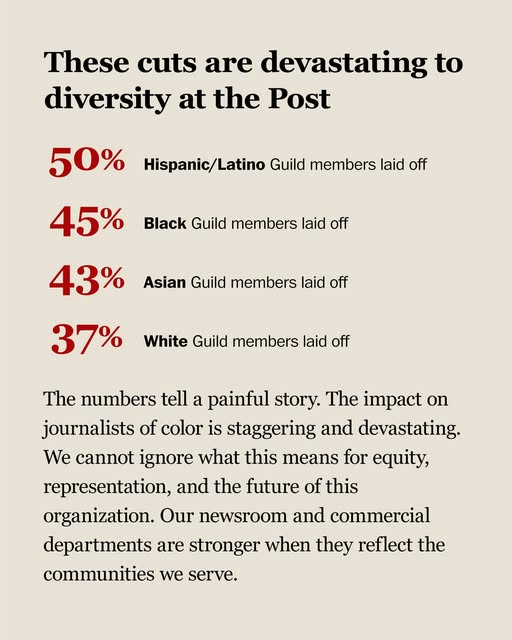
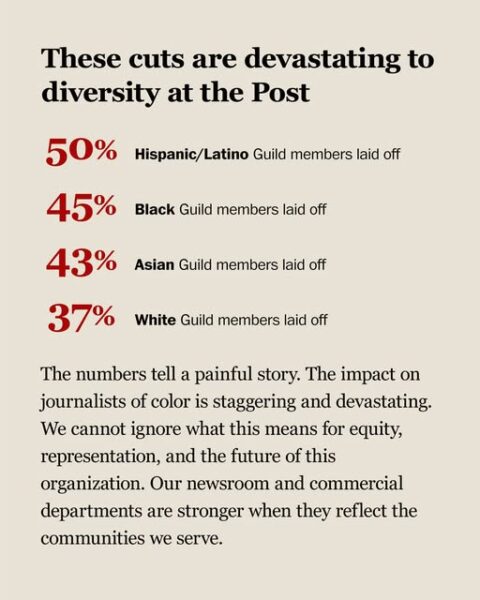
Data released Friday by The Washington Post Guild shows that the Feb. 4 Washington Post layoffs – affecting more than a third of its employees — fell heavily on union members of color, Hanaa’ Tameez reported Friday for Nieman Lab.
“I asked the Guild for the numbers behind these percentages. According to the Guild, 144 (37%) members who identify as white, 23 (50%) who identify as Hispanic or Latino, 44 (45%) who identify as Black, 33 (43%) who identify as Asian, and 14 (5%) who identify as multiracial were laid off. Twenty-two (8%) union members who were laid off didn’t disclose their races. (The Washington Post has a separate Tech Workers Guild, not included in these numbers.)
“The numbers tell a painful story. The impact on journalists of color is staggering and devastating,” the Post Guild said in its statement. “We cannot ignore what this means for equity, representation, and the future of this organization. Our newsroom and commercial departments are stronger when they reflect the communities we serve.”
The commercial piece is oven overlooked in the reporting of the Post layoffs. David DeJesus, -a former co- chair of the Guild unit who took the Post to court, messaged Journal-isms Saturday, “Much has been written about the scrapping of [DEI] in The Post’s newsroom. Although this is important and needs to be addressed, no one talks about the dismantling of diversity initiatives in the commercial/business units at The Post.
“When I joined The Post in 1993, it was because of the diversity in the ad sales, ad operations, HR, finance and accounting, and the press room, that I decided to leave the ad agency business in New York, and move to DC to join The Post.
“Over the past years (The Bezos era), I’ve watched diversity dwindle to a drip on the business side as well as the newsroom. And as you know, my 7 year legal battle with The Post specifically addressed its ‘race’ issue, settled in 2017. Yes it’s shameful about The Post’s lack of diversity in the newsroom, but it’s not just the newsroom that has been hit hard, although that’s all the public hears about these days.”
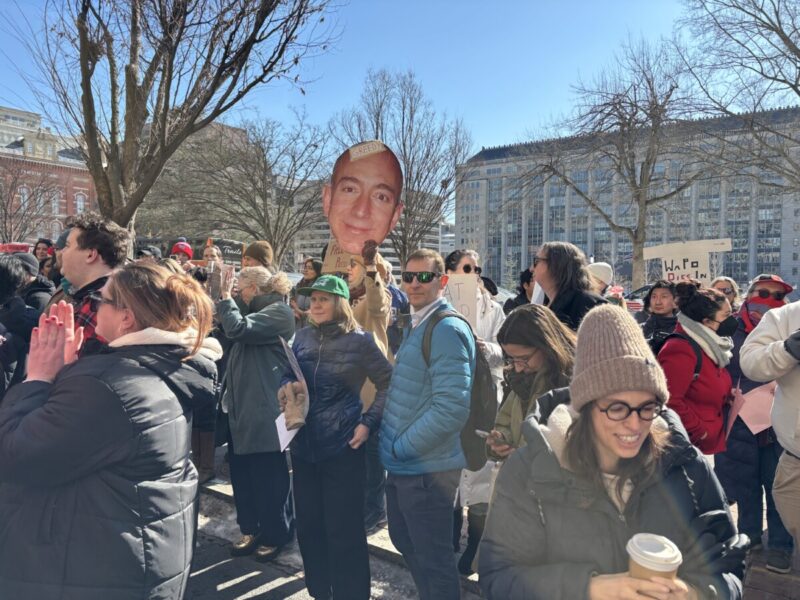
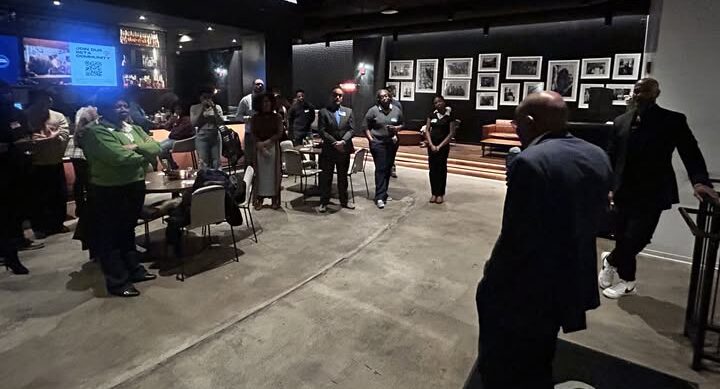
Top photo: A noontime Guild rally in front of the Washington Post building on Feb. 5 attracted relatively few community members of color (Credit: Richard Prince). But on Tuesday, members of the Washington Association of Black Journalists heard Terence Samuel, a former Post journalist and a veteran who told the group he had been fired as top editor at USA Today, tell a WABJ happy hour to keep their heads up and press on. (Bottom photo, credit: WABJ)
Tameez continued, “The Guild had more than 700 members prior to February 4. More than 250 were sent layoff notices, but that number could eventually decrease since the Guild is still negotiating layoffs and severance packages with Post leadership.
“The Washington Post did not respond to a request for comment.
“We still don’t have an official number of how many people were laid off in total. Former Washington Post media reporter Paul Farhi reported this week that the company laid off somewhere between 350 and 375 journalists, cutting the size of the newsroom by nearly half.
”On Wednesday, Post executive editor Matt Murray said in a town hall that the Post now has around 400 journalists and a total staff of 1,300. That’s down from a reported 1,000 journalists and 2,500 staffers in total in 2022.”
Tameez also wrote, “In June 2020, the Post’s then-publisher, Fred Ryan, told staff the company would ‘build a stronger culture of diversity and equity.’ That included hiring for a dozen new positions and establishing Krissah Thompson as manager of diversity and inclusion. Thompson stayed in the role for a year before becoming a general managing editor and eventually leaving the company last year. The original role no longer exists.
“Last June, the Post put its ‘About US‘ newsletter (‘Candid conversations about race and identity in 21st century America’) ‘on hiatus.’ The newsletter’s author Rachel Hatzipanagos was laid off on February 4.”
Separately, Alexandra Steigrad reported Friday for the New York Post, “The owner of the New York Daily News fired 16 people this week – a ‘Valentine’s Day massacre’ that leaves the paper with a skeleton staff as layoffs continue to wreak havoc across the news industry.
“Notorious vulture fund Alden Global Capital on Thursday axed six people from the paper’s national desk – leaving just four writers to cover US and international news – and fired seven print production staffers, two people in the photo department and one metro reporter, according to a source with knowledge of the matter.
“ ‘Alden Global Capital — the nation’s most predatory newspaper owner — has again lived up to its reputation as the parasitic ‘destroyer of newspapers,’” the Daily News Union said in a statement, with their X account dubbing the layoffs a ‘‘Valentine’s Day Massacre.’ “
Reporter and columnist Leonard Greene, likely the only Black Metro columnist in the city, told Journal-isms that he was not among those let go.
There has been better news elsewhere.
In Philadelphia, the Inquirer in 2025 had its first year-over-year increase in revenue since 2004, and an operating profit of several million. Publisher Elizabeth H. Hughes told readers Jan. 26.
“The majority of our revenue, 70%, comes from consumer marketing, which means people are paying for our journalism; 19% is from advertising, which signals that local businesses and institutions find merit in supporting us; and 5% from syndication and other partnerships, Hughes wrote . Philanthropy accounted for 6% of revenue in 2025, and we project donor contributions ranging from 6% to 10% going forward.”
In another development, The New York Times added 1.4 million digital-only subscribers in 2025, including about 450,000 in the last quarter of the year, the company said on Wednesday, Katie Robertson reported for the Times Saturday.
The Times ended the year with 12.78 million total subscribers, a jump that puts it on a pace to reach its stated goal of 15 million by the end of 2027. Total revenue for the fourth quarter reached $802.3 million, up 10.4 percent from a year earlier, Robertson wrote.
- Baltimore Banner: The Banner announces coverage of Washington sports
- Paul Barrett, Associated Press Sports Editors: George Solomon on Washington Post layoffs: A triumph for the bad guys
- Martin Baron, Facebook: This ranks among the darkest days in the history of one of the world’s greatest news organizations (Feb. 4)
- Tina Brown, Substack: Bafflement with Bezos (Feb. 9)
- Dylan Byers with Matt Murray, Puck: Matt Murray on the Washington Post’s Mass Layoffs (Feb. 6) (podcast)
- Eric Deggans on CTV, Canada: ‘There’s a sense it did not have to be this way’: analyst on Washington Post layoffs (Feb. 4)
- Editorial, Washington Informer: With Journalism Under Attack, It’s Important to Support the Black Press
- Neil Foote, LinkedIn: I’ve had the great fortune to spend part of my career as a reporter at The Washington Post
- Journal-isms: Journalists of Color in WaPo’s ‘Bloodbath’ (Feb. 4)
- Eugene L. Meyer, The Overlook, Saugerties, N.Y.: Democracy Dies in Darkness. Indeed!
Julianne Malveaux, syndicated: Black journalists get punished for doing their jobs
- William McKenzie and Elizabeth Kennedy Trudeau, George W. Bush Presidential Center: Losing foreign bureaus impedes the flow of reliable information (Feb. 6)
- Ivan L. Nagy, Columbia Journalism Review: ‘We Still Have a Sports Section for a Few Days, and Readers Need Me to Tell a Story’
- Laura Hazard Owen, Nieman Lab: 37+ things The Washington Post did wrong and 22+ things they could do to fix it (Feb. 4)
- January Payne, Facebook: Yesterday was a heartbreaking day for The Washington Post.
- I.J. Poole, Daily Kos: Breaking up is hard to do, but I’ve now broken up with The Washington Post (Feb. 5)
- Ed Pilkington and Jeremy Barr, the Guardian: As goes the Washington Post: US democracy takes another hit under Trump
- Richard Prince, Pradya Joshi, Sree Sreenivasan and Neil Parekh, ScrSree’s Sunday #NYTReadalong: A Tribute to The Washington Post (video) (Prince at 22:09)
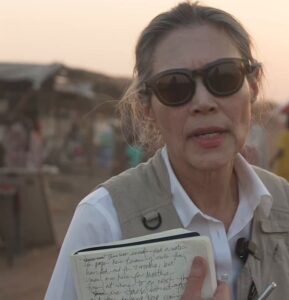
“There is a massive gap now . . . between the need, the desperation here and the humanitarian funding cuts, especially from the United States,” Ann Curry said from a refugee camp on the Sudan-South Sudan border. “The ultimate hope is in us, is in the people in the outside world.” (Credit: YouTube)
Ann Curry Resurfaces Amid Sudan Horror:
Ousted at ‘Today,’ She’d Pledged to Aid ‘the Voiceless’
A dozen years after she was dismissed from NBC’s “Today” show, earning the sympathy and admiration of millions of viewers, Ann Curry surfaced on the “PBS News Hour” Friday doing what she says she loves — turning the spotlight on an international tragedy that deserves more media attention. She was in Sudan, site of the world’s worst humanitarian crisis.
Curry said when she left NBC in 2015, “I want to expand my drive to give voice to the voiceless to emerging platforms and produce both scripted and non-scripted content, in addition to continuing to report on-air about stories that matter.”
And so Curry told co-anchor Amna Nawaz Friday, “I’m on the border of Renk in South Sudan, in the northernmost part of South Sudan.
“And this is where people, survivors, have been arriving by bus and by car, by donkey cart and by foot. And they’re arriving hungry and thirsty and they’re in need of desperate need of shelter. But there is a massive gap now, as you well know, as you’ve been reporting between the need, the desperation here and the humanitarian funding cuts, especially from the United States.
“And this has caused a lot of extra suffering here. I can tell you I’m walking into a transit center, which was set up by UNHCR, which is the United Nations refugee agency. And this center was built to house 3,000 people and they were supposed to be here just for a few days, and they’re given blankets and they’re given tents and they’re given basic necessities. But in fact, there are 9,000 people here.
“There was a woman we spoke to who carried her mother, her elderly mother on her back because she was aging and ran with four kids and keeping them all in line to leave as the bombs were falling. And she said that her mom eventually died. And so that’s the story we’re hearing.”
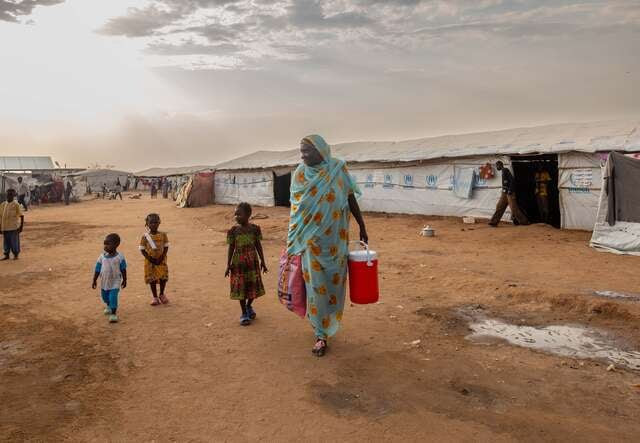
The conflict has driven families across borders to transit centers like this one in Renk, South Sudan. Fairuz Faiz Deng, 60, arrived here in May 2023 with her brother and his family, and her grandchildren.
(Credit: Fahmo Mohammed for the International Rescue Committee.)
Speaking at a donor conference two weeks ago in Washington, U.N Emergency Relief Coordinator Tom Fletcher warned that the brutal conflict, famine and mass displacement are pushing millions of civilians deeper into crisis, while aid access remains severely constrained,” the United Nations reported.
The United States is part of the “Quad” – with Egypt, Saudi Arabia and the United Arab Emirates – aimed at securing a humanitarian truce, including the demilitarization of key areas to allow life-saving aid to reach civilians.
Yet the Trump administration’s closing of the Agency for International Development shares part of the blame for the extent of the crisis, according to relief organizations.
“After the halt on U.S. foreign assistance, hundreds of American-funded soup kitchens in Sudan remain closed in a country where any aid cut can be deadly, the Better World Campaign reported last May.
“Further, as of January 2, 2026, all UN Humanitarian Air Service flights to northern Jonglei have been halted, leaving dozens of remote communities without access to lifesaving aid. With rates of acute child malnutrition 10 times above the emergency threshold, more than 637,000 Sudanese people are already experiencing famine conditions, with another 8 million at risk. The WHO [World Health Organization] estimates 5 million Sudanese people lost access to life-saving care due to the aid cuts in food and medical support.”
The victims in this conflict include journalists.
 “In Sudan’s vast western region of Darfur, journalists in El-Fasher are trapped under siege, enduring violence, hunger, and relentless bombardment alongside the people whose lives they report on,” the Committee to Protect Journalists reported Sept. 9.
“Seven journalists interviewed by CPJ by phone — all currently or recently based in the city — described being cut off from food and aid, amid relentless shelling.” Some were also targeted by RSF fighters with sexual violence and arbitrary detention because of their reporting.” The reference is to the paramilitary Rapid Support Forces, which is fighting the Sudanese Armed Forces (SAF)
“We are starved, we are hunted, but we still report. Our voices are the only thing left,” one journalist told CPJ, on condition of anonymity, citing fear of reprisals. . . .
“The journalists told CPJ that RSF fighters often storm neighborhoods, raid houses, and use informants inside the city to identify them.
“One said RSF fighters descended on her El-Fasher neighborhood in September, going door to door. When they entered her home and discovered she was a journalist, they ordered her family to leave, and three armed men beat and gang-raped her.
“ ‘This was not random violence. This was punishment because of my work,’ she told CPJ, on condition of anonymity, citing fear of reprisals.”
On “Today,” Curry was noted especially for her reporting on humanitarian crises in war-torn countries and on natural disasters, as the Asian American Journalists Association noted in 2012 at her departure. In fact, Nawaz wrote on Facebook, “I learned so much about empathetic, rigorous reporting in very tough conditions overseas by working on Ann Curry’s teams early in my career. No one does it better.”
Curry would speak in 2013 at the AAJA convention (scroll down).
 Ann Curry, in red, is flanked by, from left, fellow journalists Zinnia Bukhari, Leezel Tanglao, Juju Chang, Jessica Xiao, Sofia Koyama and Ti-Hua Chang at the China Institute in New York on July 29, 2021. (Credit: Asian American Journalists Association.)
Curry, 69, was born in Guam to a Japanese mother and a white American father.
Although she has led a mostly private life since she left the “Today” show in 2012, Curry has been to Antarctica, among other stops. In 2018, she hosted the PBS docuseries “We’ll Meet Again.” The show captured dramatic reunions of people whose lives crossed at pivotal moments.
She was also in Sudan in 2007, when Sudanese President Omar al-Bashir gave her an unprecedented two-hour, no-holds-barred interview.
Curry concluded her “NewsHour” piece, “Hope is hard to find, but the ultimate hope is in us, is in the people in the outside world. And whether we have the capacity, that compassion still within us to care for people who are suffering the most in the world, or at least one should say in the largest humanitarian disaster in the world.”
The Radio Television News Directors Association used one of her quotes as a tagline in 2023: “Journalism is an act of faith in the future.”
- Oussama Bouagila, Reporters Without Borders: After torture, flight, two Sudanese journalists describe El-Fasher hell (Nov. 13)
- International Rescue Committee: Crisis in Sudan: What is happening and how to help (April 17, 2023, updated Feb. 10)
- Martin Roux, Reporters Without Borders: Exiled from Sudan, the editorial staff of Al-Jarida defies borders and war (June 20, 2025)
- Martin Roux, Reporters Without Borders: Sudan’s exile media — fragile sources of news about a forgotten war (April 14, 2025)
@consumerreports We tested popular brands of synthetic braiding hair, and found that every product contained multiple carcinogens. The toxic chemicals we detected put Black women at risk of serious health issues, including cancer, reproductive harm, hormone disruption, and respiratory problems. Braids are commonly worn for weeks or months, which can increase the health risks due to long exposure time. Our investigation also found that there’s little to no oversight of the safety of synthetic braiding hair. “It’s appalling that toxic chemicals are in these products with so little scrutiny from those who are supposed to protect people, like the FDA,” says Oriene Shin, CR’s safety advocacy manager. Join us in calling on the FDA to set strong safety standards and protect consumers from dangerous chemicals in synthetic braiding hair. Tap the link in our bio to sign the petition! #braidinghair #blackhairtiktok #protectivehairstyles #protectivestyles ♬ original sound – Consumer Reports
In February 2025, Consumer Reports reported that “Dangerous Chemicals Were Detected in 100% of the Braiding Hair We Tested.’
If no image appears, please consider changing browsers.
Journal Links Hair Extensions to Cancer, Birth Defects
In what it called “To our knowledge, . . . the most comprehensive testing of hair extensions publicly reported,” a new study “finds a variety of hair extensions — from natural to synthetic — contain chemicals associated with cancer, birth defects and reproductive issues,” Aude Konan reported Wednesday for Scientific American.
“Dozens of hair extensions — including artificial and natural braids — may contain synthetic chemicals that are a health and environmental hazard, a new study shows. At least 12 of the 169 chemicals detected in the new analysis have been associated with cancer, birth defects and reproductive issues and are included in California’s Proposition 65 hazardous chemicals list.”
The global hair extension market is projected to surpass $14 billion by 2028, with the United States leading in global imports.
Konan wrote, “More than 70 percent of Black women in the U.S. use hair extensions at least once per year, including in hairstyles such as braiding — a staple of many Black cultures that’s been shaped by the slave trade, colonialism and Western beauty standards. Chemical relaxers— another product commonly used to style Black hair — that permanently straighten curly or kinky hair have previously been linked to higher risk of uterine cancer.”
Elissia T. Franklin, lead author of the study and a research scientist at Silent Spring Institute, told Scientific American, “On one hand, I’m excited to get the work out and share this new knowledge with the world. On the other hand, I’m learning this new information leans toward the idea that my community is deeply polluted with harmful chemicals, even down to practices that are so embedded in the culture, like getting braids.”
Konan also wrote, “Biobased hair products, such as those made from silk or banana-based fibers, are generally better options than other extensions. But the study found that some biobased extensions labeled as nontoxic contained unclassified complex chemicals. Although those chemicals might not be dangerous, Franklin advises caution: “Biobased doesn’t automatically mean safer.”
Black History: A Story of Grocers and Reconstruction
Credit the Atlanta Journal-Constitution with the most unexpected Black History Month story.
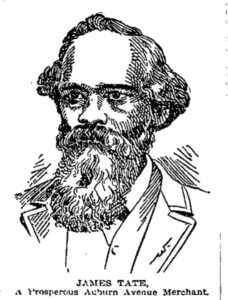 Henry Hollis, a reporter and restaurant critic who is white, wrote Friday about Black grocers during Reconstruction
“The weapons of oppression were occasionally blunted by the economic realities of daily life,” Hollis wrote. “Everybody has to eat, and nobody likes paying high grocery prices.
“In the late 1800s, many of Atlanta’s most prominent Black businesspeople got their start in the grocery business. These would become some of Atlanta’s most important historical figures, like James Tate (pictured, archival image from Feb. 2, 1896), the successful grocer who laid the foundation for Spelman College and the Atlanta University Center, or Floyd Crumbly, a grocer and former Buffalo Soldier who helped found South-View Cemetery.
“Success could be a dangerous pursuit for aspiring Black entrepreneurs in the 19th century. Those who became too wealthy or well-known were quickly curtailed by the white establishment of the day
“The stories of these Black, Reconstruction-era entrepreneurs often highlight humble beginnings. Tate famously came to Atlanta with $6 worth of grocery stock. Crumbly began his grocery business with $300 worth of goods bought on credit,” according to an 1894 book titled “The Black Side” by Rev. E.R. Carter of Friendship Baptist Church.
“John Schnell struck out on his own by purchasing a license to make patent soap until he earned enough to start his grocery business with his brother.
Akila McConnell, a local historian, “noted in her ‘Savory Stories’ podcast that Black-owned grocery stores were often the only places where Atlanta’s Black citizens could buy food at fair prices. Those decent prices also attracted white customers, she said, making these grocery stores one of the few places where color lines blurred.
“The businesspeople who found success selling the most basic goods were able to form the foundations for some of Atlanta’s most important institutions, from the Atlanta University Center to the Martin Luther King Jr. Historic District.
“In ‘The Black Side,’ Carter credited Crumbly with an observation that felt bold for the time. Crumbly was known to say Black men, “if given a white man’s chance and let alone, will accomplish what any other race has accomplished or can accomplish.’ ”
View this post on Instagram
If no image appears, please consider changing browsers.
House Press Gallery Renamed for Frederick Douglass
“The press gallery overlooking the U.S. House chamber has been renamed after the abolitionist, writer and presidential adviser Frederick Douglass in a bipartisan move brokered by Black lawmakers,” Matt Brown reported Thursday for the Associated Press,” Matt Brown reported Thursday for the Associated Press.
“The renaming of the press gallery, spearheaded by Rep. Byron Donalds, R-Fla., was conceived over the last year after the congressman said he brainstormed with his staff on ways to commemorate the history of prominent Americans, including Black Americans, across the Capitol.
“ ‘When we talk about Frederick Douglass, we are talking about a man who possessed a profound and unshakable faith in Americans, in America’s family,” Donalds said in remarks celebrating the dedication.
“Douglass wrote about congressional proceedings from the chamber during the Civil War. His public speeches and letters to President Abraham Lincoln and northern Republican congressmen helped galvanize support among lawmakers and the public for the abolition of slavery. . . .”
- Akilah Johnson, Washington Post: New evidence shows how discrimination shortens lives in Black communities (Jan. 26)
- Haitian Times: ‘The Forgotten Occupation’ opens in Los Angeles, explores Haiti’s US occupation (Jan. 14)
- Hank Klibanoff, Facebook: Today, February 5, Moses J. Newson is celebrating his 99th birthday in his Baltimore home with his daughters
- Tracie Powell, Pivot Fund: Black History Month Begins With a Familiar Repression of the Black Press (Feb. 4)
- Ben Solis, Michigan Advance: Michigan’s Black-owned legacy media giants are still teaching important lessons from the past
- WIS-TV, Columbia, S.C.: WATCH: WIS explores tradition, impact of Gullah-Geechee culture in ‘Before Bondage’ (Feb. 4)
- Jenelle Vannoy, KLAS-TV, Las Vegas: Pioneers on the air: early Black journalists and radio voices in Las Vegas
- Randall Yip, AsAmNews: Op-ed: Why Asian Americans should support Black reparations (Feb. 6)
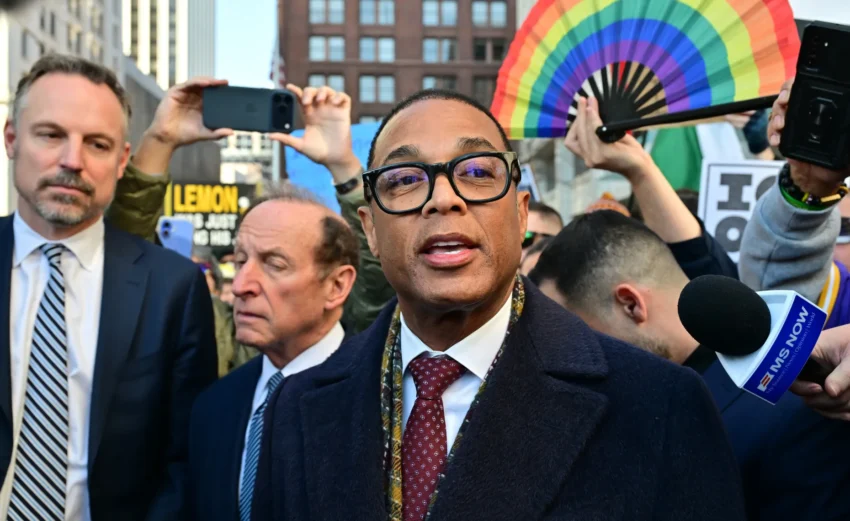
Don Lemon speaks to reporters outside the Warren E. Burger federal building in St. Paul, Minn., on Friday after pleading not guilty to federal civil rights charges. In the nearly two weeks since he was taken into custody, Lemon attracted more than 300,000 new followers on Instagram and 140,000 new subscribers on YouTube. (Credit: John Autey/Pioneer Press)
Lemon Gains Thousands of New Followers Since Arrest
“The White House took a victory lap late last month when federal authorities arrested journalist Don Lemon after he covered an immigration protest in a Minnesota church, tweeting his photo and the caption, ‘When life gives you lemons,’ along with the emoji for chains,” Drew Harwell reported Saturday for the Washington Post, in a piece appearing on the front page of the Sunday print edition.
“But in the nearly two weeks since he was taken into custody, Lemon has enjoyed a triumph of his own. A new audience galvanized by the arrest has flooded his online-media empire, earning him more than 300,000 new followers on Instagram and 140,000 new subscribers on YouTube.
“His Substack business has soared 73 percent to more than 140,000 subscribers, many of whom pay $8 a month to be a part of ‘Lemon Nation.’ His online store has even started offering a new line of merchandise: tees, stickers and $55 sweatshirts labeled ‘We Will Not Be Silenced.’
“ ‘I think they did not expect public sentiment to go the way it’s going,’ Lemon told The Washington Post in an interview. ‘They elevated me when they tried to demean me and demote me.’ ”
Separately, the Post’s Samuel Oakford reported Friday, “Video footage appears to contradict key aspects of a federal indictment’s descriptions of former CNN anchor Don Lemon’s actions at a protest last month inside a church in St. Paul, Minnesota, according to a review by The Washington Post.”
“ ‘Don Lemon participated in the disruption of a worship service on private property and was asked to leave,’ said Greg Scott, a representative of True North Legal, a law firm for the church, adding that Lemon remained in the sanctuary for some time and went on to ‘harass congregants.’ The videos and audio reviewed by The Post contain no indication Lemon threatened church congregants or chanted or yelled. . . .
“In the video and audio reviewed by The Post, at no point does Lemon appear to obstruct the pastor’s movement.
“Scott, the representative at the church’s legal firm, said: ”It is indisputable that Lemon invaded the pastor’s space while his church was being invaded. There is no world in which the aggressor and the accosted can be flipped here.’ ”
- Steve Karnowski, Associated Press: Journalist Don Lemon pleads not guilty to civil rights charges in Minnesota church protest

PBS Kids’ New ‘Phoebe & Jay’ Teaches Literacy Skills
” ‘Phoebe & Jay,’ an animated PBS Kids series premiering this month, aims to foster and improve early literacy skills in children ages three to five,” Gregory Wakeman reported Feb. 4 for Current.
 “Co-created and co–executive-produced by Genie Deez and Thy Than (pictured), the series and its accompanying digital games were developed and produced with funding from Ready To Learn, the Department of Education program supporting early childhood education. . . .
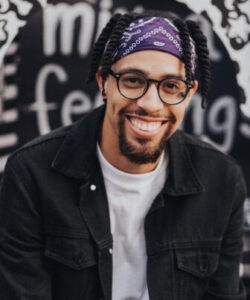 “For the pilot episode, the co-creators drew from Deez’s (pictured) childhood. ‘The seed of the show, about this family, is based on my own family,’ said Deez, a writer, TV producer and interdisciplinary scholar. Grandma Annie is named after and inspired by Deez’s own grandmother, who helped raise Deez and his brother. . . .”
Passings
Rafael Pineda
 “Rafael Pineda, a longtime news anchor who became a familiar face for Spanish-speaking viewers in the New York area, has died at age 88. Pineda passed away Sunday, Jan. 25, at his home in Florida, Univision said, “Chris Pugh reported for cleveland.com.
“Pineda was born in Pinar del Río, Cuba in 1937. He began his journalism career in 1968 and joined WXTV Univision 41, the Spanish‐language TV station in New York, four years later. He went on to become one of the main news anchors for the station . . .”
Tommie ‘T.L.’ Lee Wyatt
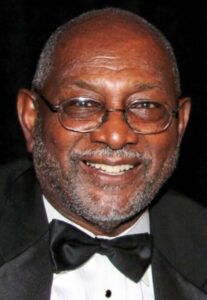 ”Tommie ‘T.L.’ Lee Wyatt, longtime publisher of East Austin’s The Villager newspaper, died in his sleep on Jan. 9 after a long illness. He was 88,” KUT Austin reported Jan. 19.
“Wyatt arrived in Austin in 1962, a life insurance salesman and former college football player who was inspired by the Civil Rights Movement. He was passionate about uplifting the achievements of Austin’s Black residents and promoting equality at a time when the city was still largely segregated. To that end, he co-founded The Villager in 1973,” the Texas station reported.
Aaron Marckell Williams
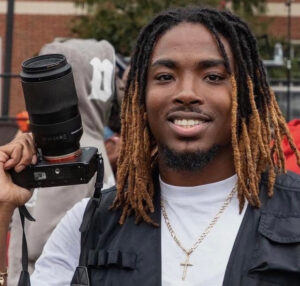 “People around the D.C. area and beyond are remembering Aaron Marckell Williams, a photographer who once worked with The Washington Informer, not for the tragic accident that ended his life last week near the White House, but for his incredible talent, strong faith and beautiful soul, Hamil R. Harris reported Jan. 12 for the Washington Informer.
“’ ‘Marckell was a go-getter,’ said Shevry Lassiter, Washington Informer photo editor, who also attended Greater Mount Calvary Holy Church in Northeast D.C. with Williams. “He had a creative eye … and we were just grateful for the time he spent with The Informer.”
“Williams, 26, was killed in a crash that occurred on Wednesday, Jan. 7, at the intersection of 16th and L Streets in Northwest D.C., shortly before 4 p.m., according to the Metropolitan Police Department (MPD). He was on his way to church when the incident occurred. . . .”
Short Takes
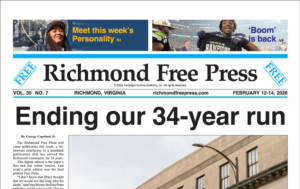 Jean Patterson Boone, publisher of the Richmond (Va.) Free Press, explicitly linked the decision to close the Black weekly to the Trump administration’s crusade against diversity, equity and inclusion Sunday in an appearance on MS NOW’s “Politics Nation” (video, go to 36:45). On Thursday, Boone had cited a loss of advertising revenue (scroll down), but became specific on Sunday’s program. She said, “The Trump administration had its way and has infiltrated the thinking and the decision-making by advertising agencies, by advertisers, by corporate leadership. It’s been a very difficult task to keep it going when you have the winds against you.” Host Al Sharpton replied, “This is part of the fallout of ending DEI and a lot of corporations cutting back on anything that looks like diversity, so the result is advertising dollars freeze up . . . .“ Benjamin F. Chavis Jr., president of the National Newspaper Publishers Association, disclosed Jan. 22 that the Black press has experienced an 80 percent decline in revenue since the backlash against diversity, equity and inclusion (DEI) ramped up a year ago.
 Kavitha Cardoza (pictured), a Washington-based broadcast and print journalist focusing on deep reporting about education, children, and poverty, and Oliver Whang, a Boston-based journalist and writer who has reported on addiction and recovery, economic issues and public health, often from Appalachia, have won the 2026 American Mosaic Journalism Prize, the Heising-Simons Foundation announced Feb. 9. The prize “was created to affirm journalism’s highest calling: foundational to an informed and inclusive society, with the power to illuminate lives, communities, and truths that might otherwise go unseen,” said Brian Eule, who founded the Prize in 2018 and is the foundation’s president and CEO.“
- USA Today Co., owner of the Detroit Free Press, will acquire The Detroit News and continue to publish it separately, the company announced Jan. 26.
- “A mere three weeks after the Post-Gazette (PG) announced its impending closure, members of the Newspaper Guild of Pittsburgh, community organizers, neighbors, and labor leaders unveiled their initiative to research and pursue a daily news alternative to the Block-owned Post-Gazette,” the Communications Workers of America announced Jan 29. The Guild unit said. It is to be called “PAPER.”
- The talking points are true: “In 2025, Black workers experienced an increase in unemployment rates,” reports the Joint Center for Political and Economic Studies. “Compared to the unemployment rate of all workers and amongst different racial demographic groups, Black workers continued to experience high unemployment. Employment data from 2025 highlights the inequities Black workers face when entering and re-entering the workforce. . . . The 8.2 percent unemployment rate for Black workers in November was the highest monthly unemployment rate of any racial group, and more than twice the highest unemployment rate of white workers of 3.9 percent in the same month.”
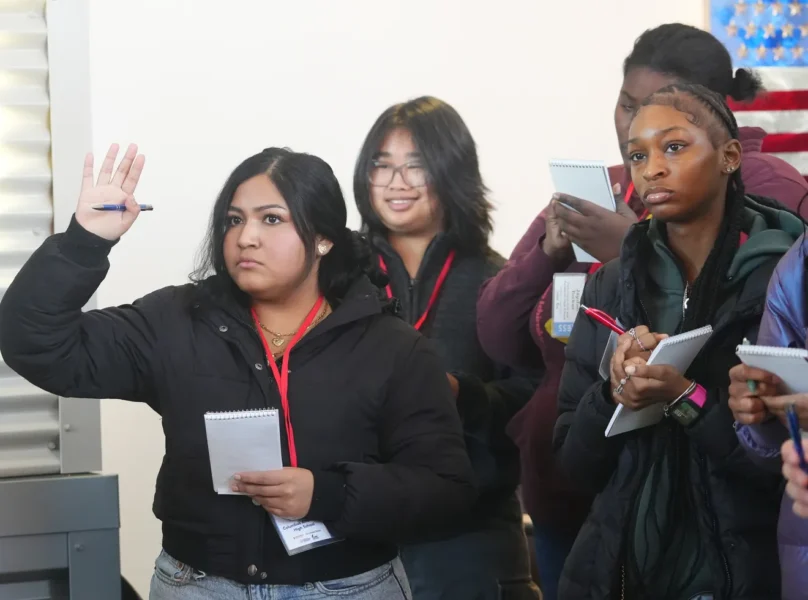
- The Columbus Journalists in Training multi-week reporting program started this month, sponsored by the Columbus Dispatch, Columbus City Schools, Central Ohio Society of Professional Journalists, Columbus Association of Black Journalists and Denison University. Above, attendees participate in a seminar on Feb 7.
- The National Association of Black Journalists has received a $500,000 commitment from Onyx Impact, which turns “data-driven research into innovative strategies that create resilient information ecosystems — where Black people are empowered, protected, and heard.’ “ “Onyx Impact launched Invest in Black Media, committing $100,000 to NABJ as part of Onyx Impact’s $500,000 overall commitment in 2026 to strengthen Black journalism, broadcasting, and digital storytelling,” NABJ said Feb. 5. “As part of this effort Onyx Impact is matching up to $100,000 raised for the NABJ Jubilee Endowment Campaign during Black History Month.”
 For years, current and former editors said, reporters at The Spokesman, the Morgan State University student newspaper, “have hit a wall getting the information they need to cover the news on the campus of 11,000 students,” Ellie Wolfe reported Jan. 19 for the Baltimore Banner. “The rocky relationship hit a breaking point this fall, when an email directed university employees to schedule media interviews through the public relations office — a move student journalists said effectively ends their tradition of interviewing their professors directly and hampers their ability to cover breaking news. Two national advocacy groups, the Society for Professional Journalists and the Foundation for Individual Rights and Expression, sent a letter to Morgan State President David Wilson, accusing the university of infringing on free-press rights.” Morgan says the policy is nothing new.
- “Misidentifying Mariah Carey. Mistaking the Olympics’ top boss for the Italian president’s daughter. Confusing the location of the opening ceremony. These gaffes at the Milan Cortina Winter Games by a top Italian broadcaster’s commentator so thoroughly embarrassed its staff that they’re going on strike,” Daniella Matar reported Feb. 9 for the Associated Press. “ ‘The show continues with Mariah Carey,’ RaiSport director Paolo Petrecca said as the camera locked onto Italian actress Matilda De Angelis, who is known throughout the country. Carey is more than 25 years older than her, and a global superstar. (De Angelis has since posted photos of the ceremony to Instagram with the caption: ‘Please, call me Mariah.’). . . “

- Mukta Joshi (pictured) an investigative reporter for Mississippi Today, and Rosemary Westwood, a reporter based in New Orleans with a focus on health policy, are joining the Local Investigations Fellowship and the newly established Deep South Today Investigative Reporting Center created in collaboration with The New York Times, the Times announced Feb. 5. “The Local Investigations Fellowship, led by Dean Baquet, the former executive editor of The Times, gives journalists the opportunity to produce signature investigative work focused on the state or region they’re reporting from.”
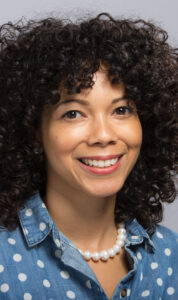
- Amber Payne (pictured) has been appointed Rocky Mountain Public Media’s first chief experience officer (CXO), the company announced Feb. 3. “Payne will spearhead the organization’s mission to transform public media by creating audience-centered journeys across its content brands — Rocky Mountain PBS, KUVO JAZZ, and THE DROP 104.7. . . . She most recently served as Publisher and Founding Co-Editor of The Emancipator, a multimedia digital magazine exploring solutions to racial inequity. A 2021 Nieman Fellow at Harvard, she previously served as Managing Editor of BET.com and Executive Producer of Teen Vogue and Them. In 2015, she created and launched NBCBLK, an NBC News digital initiative dedicated to elevating discourse on Black culture and identity. . . .”
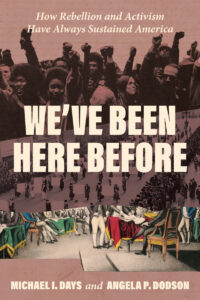 The final book collaboration between Michael I. Days and his wife, Angela P. Dodson, is scheduled for publication June 9. The publisher says there are “key revolutionary moments in which the promise of America has been fully realized. We’ve Been Here Before draws together the stories of these movements as a powerful reminder that America has always been sustained and challenged by rebellion and activism.” Days died Oct.18.The Michael I. Days Scholarship Fund created by NABJ – Philadelphia, which Days led, has raised $17,455, which is 34% of $50,000 goal, according to the fund’s website.
- “Experts in law, education and education journalism shared tips to help journalists report on U.S. colleges and universities that serve a disproportionately high percentage of Hispanic students,” Denise-Marie Ordway wrote Jan. 28 for Journalists Resource. The tip sheet is based on the group’s webinar on the topic.
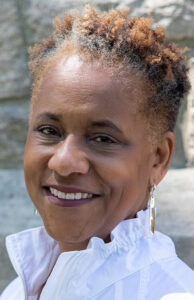 The University of Maryland’s Philip Merrill College of Journalism has hired award-winning journalist and alum Deborah Barfield Berry ’85 (pictured) as the new director of its Capital News Service Annapolis bureau, and named Christi Parsons the new director of the CNS D.C. bureau, Dean Rafael Lorente announced. Berry replaces Parsons, who takes over as D.C. bureau chief, after the retirement of director James Carroll. Berry is a former national correspondent for USA Today who has reported from Angola, as well as a 2023 Nieman Fellow at Harvard University and a member of the Merrill College Hall of Fame.
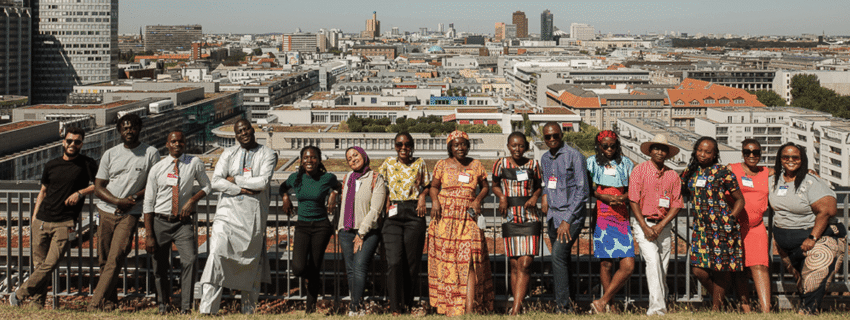
- After a call for applications last year, the African Union’s Media Fellowship program (pictured) received more than 100,000 submissions from across the continent and the diaspora, the African Union announced Jan. 29. “Over the 16-month programme, the cohort 3.0 Fellows will receive advanced training, personalised mentorship, and access to a continental and global network of peers and media leaders. Fellows will produce impactful, solutions-focused stories that challenge stereotypes, amplify African voices, and reflect the continent’s realities and ambitions,” the organization said.
- In Haiti, “a Transitional Presidential Council (CPT) decree establishing jail time and fines for Haitian journalists and digital media distributors has set off alarm bells across the country and abroad, the Haitian Times reported Jan. 22. “Advocates for an open press and freedom of expression warn the directive opens the door to expanded state control over speech — all without public debate and ahead [of] critical elections.The decree was quietly approved by the Council of Ministers on Dec. 18 and published in Le Moniteur on Dec. 30. Its adoption marks the first time in Haiti’s history of journalism that a decree introduces criminal penalties for press offenses, the National Association of Haitian Media (ANMH) said in a statement. At least one international advocacy group is calling for its repeal.”
 “According to Cuban outlet El Toque, at least 150 Cuban journalists went into exile between 2022 and 2024 due to harassment by state security agents,” Gretel Kahn reported Jan. 27 for the Reuters Institute. ”A study coordinated by the University of Costa Rica documented 98 Cuban journalists forced into exile between 2018 and 2024. However, the real number of those currently living in exile is likely much higher, due to under-reporting and earlier waves. Kahn’s piece was headlined, “Exposing the regime from afar: How Cuban journalists report on the island from exile.”
- Mali’s military authorities have detained a senior journalist after he published commentary scrutinizing statements made by Niger’s leader, according to Human Rights Watch, in what critics say signals mounting pressure on free speech amid worsening insecurity in the region. “The police took Youssouf Sissoko, who heads the weekly publication L’Alternance as editor-in-chief, before a cybercrime unit prosecutor, who charged him with spreading false information and insulting a foreign head of state, among other offenses, and ordered him held in pretrial custody,” the statement read.
- The Committee to Protect Journalists called on Mozambican authorities to investigate a shooting described by journalist Carlitos Cadangue as an attempted assassination of himself and his son, following threats over his reporting. “The attack on Carlitos Cadangue and his son is a horrifying reminder that Mozambique is increasingly unsafe for journalists,” CPJ Africa Program Coordinator Muthoki Mumo said Feb. 6. “While Cadangue and his son are lucky to have survived without physical injury, they require urgent state action to credibly investigate this shooting, including any possible police involvement, and to ensure justice.”
