One Less Black Male Top Editor:
Investigative Veteran Mark Rochester ‘Fired’
DEI, Immigration Moves Test Student Journos:
Vets Urge Knowing History, Pressing On
Notices
Homepage photo: Sarasota Herald-Tribune
Journal-isms Roundtable photos by Don Baker/Don Baker Photography
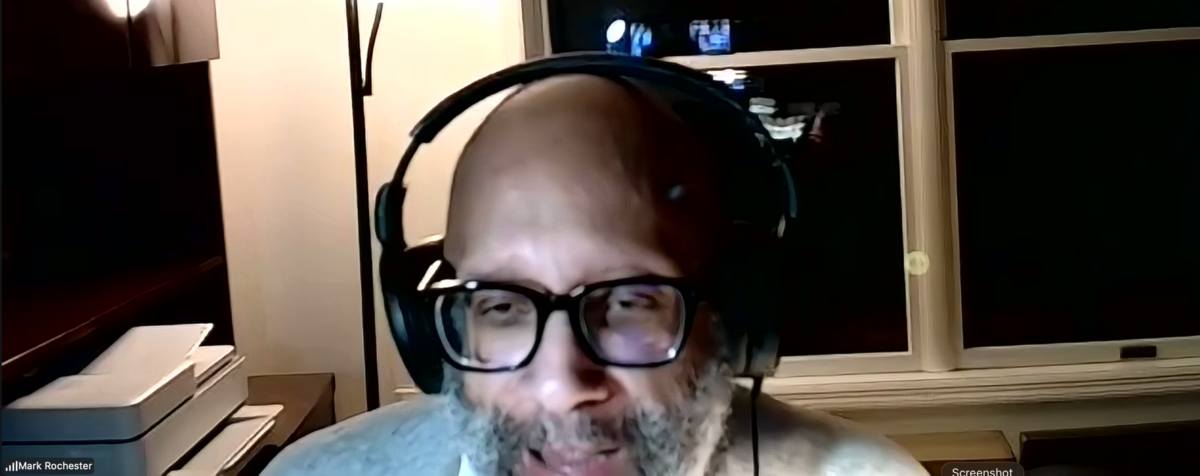
Mark Rochester discloses his firing from the Sarasota (Fla.) Herald-Tribune at Tuesday’s Journal-isms Roundtable. (Photo by Don Baker/Don Baker Photography; click here for video of his remarks, by YouTube)
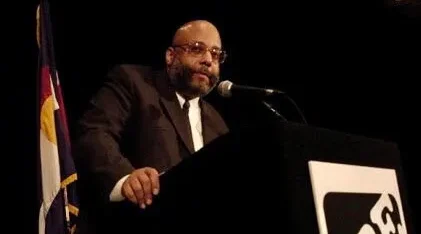
Investigative Veteran Mark Rochester ‘Fired’
Just a year ago, Mark J. Rochester, executive editor of the Sarasota (Fla.) Herald-Tribune, was decrying the departure of fellow Black top editor Katrice Hardy from the Dallas Morning News. Hardy left to join the Marshall Project, which reports on criminal justice issues.
“The impact of this loss reverberates beyond Dallas,” Rochester wrote. “Of the nation’s roughly 1,200 daily newspapers, fewer than 10 have African American leadership. As an African American male, my position as executive editor of the Sarasota Herald-Tribune, is rare in this industry.”
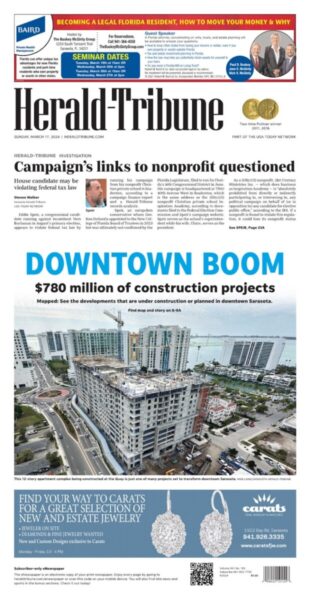
Now Rochester, too, is gone. He told the Journal-isms Roundtable this week, “I got fired a couple of weeks ago for reasons I still don’t understand, and the company hasn’t explained to me, but I was removed from my job, a few weeks ago. which — it’s unfortunate, not for me, but just because, you know, there are so few Black executive editors in the country.”
Rochester’s departure follows that of other Black men. Terence Samuel, ousted in 2024 at USA Today, like
the Herald-Tribune, part of the Gannett Co., as the company was then known. Kevin Merida resigned in 2024 from the Los Angeles Times. Others retired, such as Don Hudson at Newsday in 2024 and Dean Baquet at the New York Times in 2022.
Ronnie Agnew, former general manager of New Jersey Advance Media, stepped down in December. He had been executive director of Mississippi Public Broadcasting and executive editor of the Clarion-Ledger in Jackson, Miss. Rick Christie left the Palm Beach (Fla.) Post in January.
The remaining Black men in top newspaper newsroom jobs include Leroy Chapman Jr. at the Atlanta Journal Constitution, Romando Dixson at the Journal Star in Peoria, Ill., Ismael Turay Jr. at the South Bend (Ind.) Tribune and Andale Gross at the Kansas City Star. Deep South Today, a nonprofit network of local newsrooms, includes Terry Baquet, editor of Verite News in New Orleans.
 The issue of Black men in journalism is considered so consequential that the National Association of Black Journalists created a Black Male Media Project in 2022, and the Dow Jones News Fund paired with New York University in 2024 to launch the Black Male Journalism Workshop, now the Ed Bradley Journalism Fellowship.
The USA Today Co., as Gannett is now known, did not respond to a question about Rochester’s termination.
In January, Journal-isms asked the company how close it came to its stated 2020 goal for USA Today and more than 260 local news operations to make their workforce as diverse as the country by 2025.
The response from a company once considered the news industry’s foremost diversity leader: “While we no longer publish workforce diversity metrics or an inclusion report, USA TODAY Co. remains deeply committed to our ethical business model, which entails creating a thriving workplace where our workforce feels respected and valued.
“You can learn more about our company culture here.”
Last April, Gannett announced it would no longer publish demographic and diversity data about its workforce, and had revamped its corporate site to remove mentions of diversity.
Greg Moore, former editor of the Denver Post who regularly meets with a small group of veteran diversity advocates, made this observation in January for Journal-isms:
“I attribute this lack of progress to a lack of commitment to the principle of inclusion. I trace that back to the corporatization of the news media and the sheer magnitude of the consolidation that has taken place.
“The expense and personnel cuts devastated journalists of color, particularly Black journalists. I’m shocked that Alden [Global Capital hedge fund] controls so many of America’s newspapers. And diversity is not top of mind for that company. Same is true for Gannett.
“After promoting a striking number of Black editors across the country, damn near all of them disappeared just as quickly in the last couple years. Most US newspapers no longer report the racial makeup of their newsrooms. Put simply, they don’t give a damn anymore.”
Rochester expanded on his dismissal at Tuesday’s Roundtable:
 “I have to tell you, there is such a hunger among, especially among people of color to have our stories told. To have balance and truth in local journalism,” he said.
“I would go speak at public events, particularly with Black community organizations here. And most of them had no idea until I showed up that the editor of the paper was Black.
“And you know, when they saw me walk through the door to be, you know, the evening speaker, they were like, ‘how did you get that job? We didn’t know — we didn’t know there was anybody Black at the newspaper.’
“I was like, ‘well, there aren’t many, but there are some, and there are other folks who have important jobs besides myself. . . .’
“I think about some of the stories we did while I was here that definitely would not have happened if I hadn’t been sitting in the big chair deciding what got covered and what didn’t.
“We certainly would not have done stories about police misconduct.
“About Black residents who died at the hands of police.
“About political decisions here that would have an adverse effect on Black and Hispanic residents here.
“Just issues that really affect our quality of life. This would not have been covered if I hadn’t insisted on that coverage, or had I not given [chances to] reporters who were traditionally not given opportunities to tell ambitious, enterprise stories. . . .
“Newspapers in particular are still havens for — you know, only the stars in the newsroom get these good stories, and I always try to make sure that everyone got the opportunity to tell great, ambitious stories. And it made a big difference in the kinds of journalism that several reporters did.
“I know when I got here I kept hearing from the assigning editors, ‘well, so-and-so doesn’t deserve the opportunity to do that great story.’ Or, ‘you know, they haven’t earned the right to do that investigative story.’
“And I’m like, ‘but don’t ever say that again in this newsroom. Don’t talk about people having to earn the right to do what reporters are supposed to do.’
“And so, you know, representation is greatly important. more important than ever these days . . . with the current administration in Washington.”
- Monica Richardson, LinkedIn: Michael McCarter will be taking on the role of Vice President of Multimedia at USA TODAY, effective April 20.
- USC Annenberg Center on Communication Leadership & Policy: Kevin Merida, award-winning journalist and former LA Times executive editor, joins CCLP as a Senior Fellow (March 30)
DEI, Immigration Moves Test Student Journos
Vets Urge Knowing History, Pressing On
Sixty-five people were on the March 24 Journal-isms Roundtable Zoom call, which brought together students and professionals to discuss the concerns of student journalists of color and to pay tribute to Diana R. Fuentes, the executive director of Investigative Reporters and Editors who died at 67 after an accidental fall on March 20.
The University of Alabama suspended two student magazines last year — one aimed at the university’s Black community, the other at women on campus — and on Monday the magazines sued the university, alleging their First Amendment rights were violated. The university had cited the anti-DEI policies of the Trump administration.
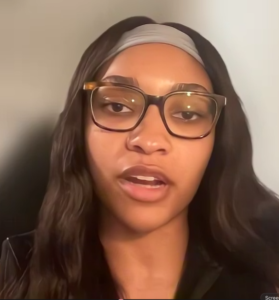 The next day, Kendal Wright (pictured), the editor of Nineteen Fifty-Six, aimed at UA’s Black community, joined the Journal-isms Roundtable on student journalists of color in this time of officially sanctioned anti-DEI and anti-immigration policies.
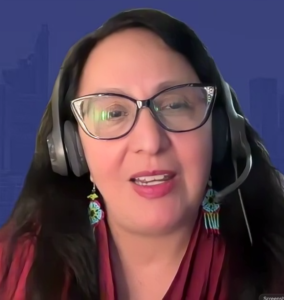 So, too, did Teresa Puente (pictured), who teaches at California State University, Long Beach. Puente gave a pop quiz. “What percentage of Latinos in the U.S. are U.S. citizens? . . . Even my own students get it wrong, It’s 80%,” Puente said. That high percentage notwithstanding, she said, there is trepidation on campus.
“I’ve actually had that fear. What if they come for our funding? . . . We’ve had a lot of different ‘Know Your Rights’ trainings on campus. So what to do if you get pulled over by ICE, or ICE comes to campus?”
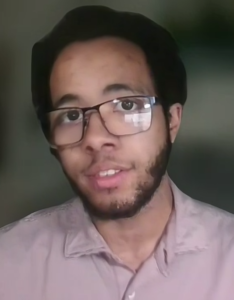 At historically Black Morehouse College, Elijah Qualls (pictured), a reporter with the Maroon Tiger, the student news site, told of a recent article of his. “It was very contentious, about our college deciding to commemorate and honor Joseph Smith, the founder of Mormonism.
“They hung up a portrait in the chapel, and many students were against this, and we distributed this paper on the day of our president’s inauguration. President [ F. DuBois] Bowman, he was getting inaugurated. It just so happened that those days lined up.
“We received a lot of pushback from the college. We even got approached by, you know, campus police about it. . . .
“It’s just kind of alarming sometimes to see your institution that you think . . . would stand with you and support the pursuit of higher education and the pursuit of your major in specifics.”
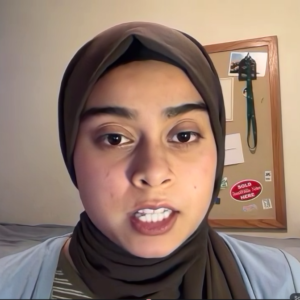 Nazeffa Ahmed (pictured), a student at Craig Newmark Graduate School of Journalism in New York, the city where she was born, referenced the fears of international students –– the case of Tufts University doctoral student Rümeysa Öztürk, who was detained by ICE for more than a month last year after she wrote an op-ed for the campus newspaper about Palestinians — comes to mind.
But Ahmed had another concern. “I was wondering . . . my internship was a Diverse Voices in Science Journalism internship, writing about diverse communities at a time when there were cuts,” she said. “So, I think the immediate risk that we’re facing is to our safety, our physical safety when reporting on topics, and our future as well, if we do report on topics, and there’s a risk on that. But I think that a greater risk that is kind of being overlooked at times is the beat itself. Are we able to report on our communities without feeling as though that it won’t exist anymore.”
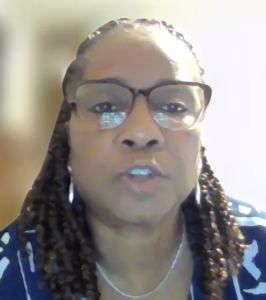 Shirley Carswell (pictured), director of the Dow Jones News Fund, spoke up about student training: “In addition to the issues with coverage that student newspapers are having, student news organizations are having, there are also issues around opportunities, for instance,” she said.
“You know that in partnership with NYU’s journalism school, the Dow Jones News Fund started, two years ago, this effort to try to increase the number of African American men studying journalism and going into journalism. So the first year we had great, you know, a lot of great encouragement. And then the world changed, and then last year, it was like a lot of news organizations were reluctant, afraid to support something that was called the Black Male Journalism Project.
“So it turned out that we had been planning to change the name anyway, so now it’s the Ed Bradley Journalism Fellowship, and that seems to go over a little better for some people. But it is a thing where, you know, this anti-DEI thing is affecting opportunity; it’s affecting donations; it’s affecting people who want to be affiliated with organizations and programs that are specifically aimed at people of color. So it’s not just the coverage, it’s also scholarships, training, internships and opportunities.”
Sixty-five people were on the Zoom call, which brought together students and professionals to discuss the concerns of student journalists of color and to pay tribute to Diana R. Fuentes, the executive director of Investigative Reporters and Editors who died at 67 after an accidental fall on March 20.
“It was refreshing to see young student journalists interacting with seasoned pros on somewhat equal footing,” Christopher Cathcart, an adjunct professor at California State Northridge, said afterward. “Now, I don’t mean in terms of experience, of course, but being able to express/discuss concerns and ideas. It appeared both sides learned a thing or two from the other.”
Chief among those things was the need to know one’s history and to continue the struggles of their predecessors.
Who better to bring that point home than Charlayne Hunter-Gault, the veteran journalist who with Hamilton Holmes desegregated the University of Georgia in 1961?
“Hamilton Holmes and Charlayne Hunter changed history when they became the first African American students to attend the University of Georgia, and this story commemorates their strength and courage,” said the University of Georgia. (Credit: University of Georgia/YouTube)
Hunter-Gault told Roundtable participants she was inspired by the younger generation, though at least one other contributing attendee, Leon Carter of the Sports Journalism Institute and The Athletic, said that generation didn’t seem “hungry enough.”
While many are aware that Hunter-Gault entered the previously all-white University of Georgia, fewer know that did not mean she could also work on the school newspaper.
Here is how the iconic journalist, now 84, told it:
“You know, when I was at the University of Georgia as again, we didn’t integrate, we desegregated. And when I went into work, I was so excited because I wanted to be a journalist from Day One. And when I went into the journalism area where they were working, and by the way, Tom Johnson, who later became head of CNN, was the student there, and he was very receptive to my participating . . . in the school newspaper, but nobody would work with me.
“And so after a while, I thought, well, you know, I really need this work. I need this experience. And I found out that Julian Bond, I don’t know if any of you will remember him, but if you don’t, look him up, because he’s a historic figure — Julian Bond and Carl Holman, another historic figure, had decided to start their own newspaper, because even the Black newspaper was not covering the student movement. And that was because . . . there were white people who owned that newspaper.
“And so they kept the so-called Black newspaper from writing too many things about Black people that [were] positive. And so Carl Holman and Julian Bond started this newspaper, and I would go home every weekend. I’d drop my clothes off 70 miles from Athens, Ga., where University of Georgia was, from Atlanta. I would go in, I’d drop my bag at my mother’s house, and I’d keep on going to Carl Holman’s basement.
“And that’s where the students who were demonstrating to open up the schools as well as restaurants and everything else that was segregated in Atlanta, they would demonstrate, get arrested, and then come to Carl Holman’s basement and tell their stories. And that’s where I would sit, and I would write. I would type out what they were telling us.
“That was very interesting and important to do.
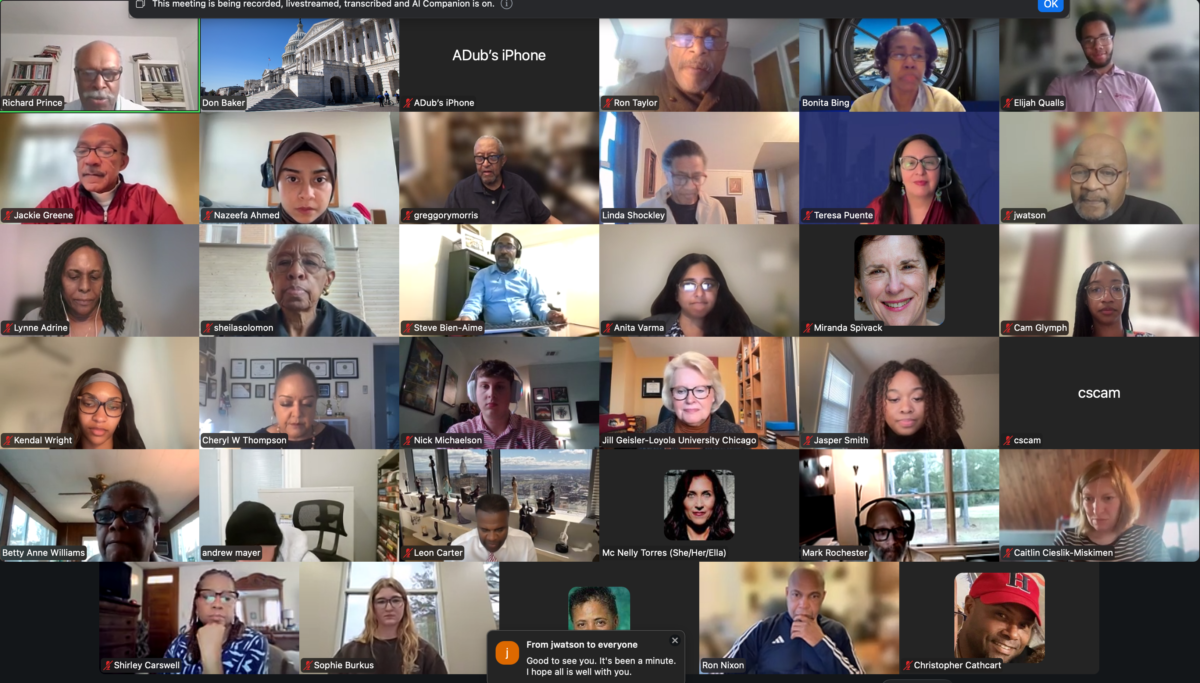
Student journalists shared stories about obstacles they faced, and professionals urged such ideas as increased mentoring and being their authentic selves.
“But I got tired of sitting in the basement. So at one point I said to Carl, ‘Could I go outside and write some of the things that are happening?’ Having seen them, and they agreed to that.
“And so I spent a lot of time. The first time I did a story I call the woman who was head of the whatever it was, I can’t remember at the moment, but she was a white woman who was in charge of all of this, and I called her to ask why were they segregating, continuing to segregate.
“And what was amazing to me, and a very inspirational moment, was that she actually took my call! And here I am, you know, just a kid from from University of Georgia trying to do the best I could, getting journalism in my blood and in my brain, and in my body.
“And she actually took my call. And I think that that was the thing that told me that this is something I need to do, because while the young people who were demonstrating against segregation were demonstrating, here was a white woman who was willing to listen to a Black — well, at that point, I don’t know if you could have called me a journalist, but I thought of myself as a journalist. And she actually talked to me, so that really was . . . part of what inspired me to keep on keeping on.
“And I have never . . . gone away from that notion that it is our job to cover the stories that we think are important, and if they’re about people who look like us or people who don’t look like us, because there are people who don’t look like us who’ve died for us, and I think that’s what we also have to remember.”
- ACLU Alabama: University of Alabama Students File Lawsuit Challenging Suspension of Campus Magazines
- Mollie Banstetter and Hannah Everett, North Texas Daily: Public records reveal over $20k spent procuring canceled exhibit (March 19)
- Alvin Buyinza, Word in Black: Only 8% of school counselors were Black in 2025.
- Janice Kai Chen, Ilena Peng, Jasen Lo, Trisha Ahmed, Simon J. Levien and Devan Karp, AAJA Voices, Asian American Journalists Association: “I didn’t feel wanted by student media”: Few Black and Latinx students are editors of top college newspapers (Sept. 7, 2021)
- Roy S. Johnson, al.com: By caving to Trump and muffling student voices, the University of Alabama gets an F
- Jacqueline LeKachman, New School Free Press: How international student journalists are contending with censorship (Dec. 8)
- Media Alumni Seeking to Highlight Equity and Diversity (MASTHEAD): Defend a Free and Fair Press at the University of Alabama
- Bob Miller, E&P Magazine: Training journalists for every platform
- Chatwan Mongkol, Poynter Institute: As newsroom jobs shrink, some journalism schools teach students to go solo (March 9)
- Elijah Qualls, Maroon Tiger, Morehouse College: Morehouse Chapel unveils portrait of Joseph Smith Jr., sparks student outrage (February)
- Aleisha Robinson, the Spokesman, Morgan State University: Morgan revises, tightens protocols on ability of students, faculty, staff to speak to press (Nov. 24)
- Student Press Law Center: Students show Resilience in Action in 2026
- Michaela Towfighi, New York Times: Texas University Closes Exhibition With Anti-ICE Artwork (Feb. 13)
- Caleb Turrentine, the Bama Buzz: 2 new student-centric magazines to focus on life at University of Alabama (March 12)
- Anita Varma, Columbia University Press: Solidarity in Journalism — How Ethical Reporting Fights for Social Justice (April 2026 publication date)
- Anita Varma, University of Texas at Austin: Dealing with Journalistic Repression (Oct. 1)Quintessa Williams, Word In Black: Black Students Are the Future of Journalism
- Zion Williams, NewsOne: Black Journalists Are Under Attack, And Howard Students Are Rethinking Their Future In The Industry (March 10)
Notices
March 31-April 1: HBCU Digital Media Conference in D.C.
April 2: From Howard University — Reporting While Black
April 3: Deadline to Apply for Rosalynn Carter https://wordinblack.com/2025/03/black-students-are-future-journalismFellowships
April 9: Webinar on ‘Big Beautiful Bill’ Impact on Black Households
From New York: Media Watch
From Zita Arocha: July 2026: Writing Your Life, Writing to Heal
JOBS
From these journalist organizations
National Association of Hispanic Journalists
National Association of Black Journalists
Asian American Journalists Association
Poynter Institute
Society of Professional Journalists
Public Media Jobs.
Online News Association
Rebecca Aguilar’s Journalism Job Openings: The March List” <em>(March 18)</em>
From Washington Association of Black Journalists
From the Uproot Project (March 17)
From Committee to Protect Journalists
March 31-April 1: HBCU Digital Media Conference in D.C.

Royal Sonesta Washington DC Dupont Circle
Washington, DC | March 31-April 1
Registration is now open for Elevate 2026: The HBCU Digital Media Conference. This two-day convening brings together HBCU student journalists, emerging media leaders, campus publishers, industry stakeholders, and leading professionals for hands-on training, critical conversations, and real-world exposure to emerging tools, career pathways, and professional development opportunities. . . .
April 2: From Howard University — Reporting While Black
Joy Reid, Michael Harriot, Jason Johnson, and Karen Attiah to Headline Howard University ‘Reporting While Black’ Panel
 The Journalism Sequence in the Cathy Hughes School of Communications will host a timely installment of the Reporting While Black series, convening leading journalists Joy Reid, Michael Harriot, Jason Johnson, and Karen Attiah for a conversation on the future of journalism, independence, and truth-telling in a rapidly shifting American media landscape.
At the center of this conversation is a question reshaping the industry: what happens when Black journalists step outside traditional newsrooms and build direct relationships with their audiences?
Using platforms like Substack and other direct-to-audience models, many are redefining what independent, immersive journalism looks like, and who controls it.
From there, the panel will examine broader issues of power, ownership, editorial freedom, audience trust, and the economic realities of sustaining impactful reporting.
Drawing from their work across television, digital media, academia, and global reporting, panelists will reflect on what it means to cover race, politics, and democracy amid political polarization, attacks on the press, and increasing restrictions on how history and identity are reported. The discussion will also explore how Black journalists navigate institutional pressures while maintaining accountability, cultural clarity, and a commitment to the communities they serve.
The panel will be joined by Howard University student journalists Zoe Cummings and Myla Roundy, grounding the conversation in the experiences and aspirations of the next generation.
Their participation underscores the event’s focus on mentorship, pipeline-building, and preparing emerging journalists to enter, and reshape, an evolving media ecosystem.
As part of Howard University’s broader commitment to journalistic excellence and public engagement, the Reporting While Black series creates a space where scholarship, professional practice, and lived experience intersect.
This event offers students, faculty, and the wider community an opportunity to engage the ethical, professional, and political stakes of journalism today, while exploring new models for telling stories with depth, independence, and impact.
The event will take place April 2, 2026, from 6–8 p.m. in Miner Hall and will be live-streamed on Howard University’s social media platforms. Seating will be limited.
Please RSVP using the eventbrite link: https://www.eventbrite.com/e/
April 3: Deadline to Apply for Rosalynn Carter Fellowships

April 9: Webinar on ‘Big Beautiful Bill’ Impact on Black Households
We invite you to join the Joint Center for Political and Economic Studies on Thurs. April 9, 2026, at 11:30 AM – 12:30 PM for the Taxing Consumption and Work: The Cost to Black Households webinar.
The One Big Beautiful Bill Act (H.R.1) makes major changes to the federal tax code with implications that extend well beyond Washington. As federal revenue shifts and intergovernmental fiscal pressures intensify, states are likely to face renewed budget constraints which often lead to greater reliance on consumption taxes, fees, and other regressive revenue tools.
This cost shift translates into higher everyday expenses, from sales taxes and transportation costs to utility fees and local property tax pressures. Black households are particularly exposed to these shifts due to longstanding disparities in income and wealth and because state and local tax structures rely heavily on taxing work and consumption rather than accumulated wealth. . . . (From Joint Center for Political and Economic Studies)
From New York: Media Watch
Air date: 16 March 2026 Hosts: Robert Anthony, Alan Singer, PhD, and Eric V Tait, Jr:
Subject: 1) Background re the illegal War with Iran
2) Fallout and Blow-back from the Iran War
3) Israeli censorship re Iran War coverage
4) US assault on a Free Press in general and particular individual journalists, now reflected in our dismally low ranking as a nation with a free, unfettered Press.
5) Govt use of “Classified Briefings” for the Congress so they can’t then brief their constituents on the status of the War.
Tag with Rev Jesse Jackson’s Homegoing Service coverage and tRUMPs disrespect for our returning Military slain in the Iran War.
From Zita Arocha: July 2026: Writing Your Life, Writing to Heal
Writing Your Life, Writing to Heal weeklong memoir writing and restorative yoga retreat at the beautiful Blue Spirit Retreat Center in Guanacaste, Costa Rica, July 25–August 1, 2026. Cost is $3,000 per person.
For those of you who are interested in memoir writing and writing as a healing practice, this is an amazing opportunity. You’ll have space and time to slow down, connect with your voice, and deepen your writing practice. Over the six retreat days, you can clarify your memoir’s themes and overall structure, explore restorative and therapeutic yoga and mindfulness practices to support your creative process, enjoy nature walks, ocean time, an infinity pool, and deep rest, and draft 20–25 new pages in your memoir.
You’ll be guided by award-winning author and journalist Zita Arocha in writing workshops throughout the week, and by yoga therapist Lorelei Alvarez in daily restorative, trauma-informed movement and mindfulness practices. , , ,
JOBS
From these journalist organizations
Rebecca Aguilar’s Journalism Job Openings: The March List” (March)
From Washington Association of Black Journalists (March 4)
- CityCast DC is hiring a reporter.
- Semafor is seeking a communications and media advisor.
- The Baltimore Banner is expanding into Prince George’s County.
- WETA has several jobs open.
- New Republic is hiring a staff writer.
Bloomberg Government is seeking a financial reporter from Capitol Hill.
- Applications are open for ProPublica’s Investigative Editor Training Program.
- NPR is hiring senior manager for communications.
- The Council on Foundations is looking for a storytelling consultant.
- American Express is looking for a director of social media.
- Kotaku is hiring a staff reporter.
Chesapeake Associated Press Broadcasters Association scholarship deadline is March 20th.
- TIME is hiring a weekend news desk editor.
- USA TODAY is hiring for several positions.
- WABJ’s Yolanda McCutchen is hiring a marketing consultant.
- The Hill is looking for an editorial intern for the summer.
- The 19th is recruiting for its 2026-2027 cohort – Frances Ellen Watkins Harper Fellowship.
- In These Times has opened applications for its internship.
- Forbes is hiring an education reporter.
- Reuters has several editorial jobs open. They’re also looking for a social media editor.
- Apply for the National Press Club Journalism Awards.
- The IRE Conference at the National Harbor is accepting calls for ideas.
- Cheddar is looking to hire a Freelance Multimedia Journalist based in Washington.
- Ars Technica is hiring an arts reporter.
- Washington City Paper is seeking a Loose Lips Reporter and a News Reporter.
From the Uproot Project (March 17)
Job Opportunities
- Mississippi River Basin Ag & Water Desk, Assistant Editorial Director
- Nature, Reporter
- The Guardian, Senior Reporter, Climate Justice
- ProPublica, Data Reporter
- NYT, Assistant Editor, Climate
- Mountain State Spotlight, Environment and Energy Reporter
- Sentient, Investigative Reporter, Iowa Reporting Project
- Scientific American, News Intern (deadline March 26)
- Springer Nature, Audience Engagement Intern (deadline March 27)
- Adirondack Explorer, Digital Editor
- VTDigger, Environmental Reporter & UVM Community News Service Mentor
- WIRED, Senior Editor, Science
- The Bulletin of the Atomic Scientists, Assistant Multimedia Editor
- Quanta Magazine, Senior Staff Editor
Fellowships & Grants
- Renews Project, DEI Beat Grant (deadline May 31)
- The 19th, News Fellowship (deadline March 20)
- Fire Newsroom, Greenlight Grants (deadline April 27th)
- Sloan Foundation, YouTube and TikTok program
Other resources
- Spirit Rock, Holding Ground: Inner Resilience for Environmental Changemakers (A Free 5-Month Resilience Intensive for Climate and Justice Leaders)
- NPR, Next Gen Radio
- Calendar for paid internships & fellowships (courtesy of Mandy Hofmockel’s substack for journalism jobs)
- National Press Photographers Foundation, Grants & Scholarships
- Pitching Science Friday
- ProPublica, Freelance Pitch Form
Webinars & events
- 10 Steps to Resilience & Empowerment in a Chaotic Climate – Good Grief Network
From Committee to Protect Journalists: