

Astronaut Takes Cue From ‘Whitey on the Moon’:
Victor Glover is Pilot for Crew Making Lunar Orbit
McCoy Cuts Staff at Newly Acquired Indy Station
Journalists Forced, Squeezed Into Metal Containers
Reversal: WaPo Editorial Board Opposes DEI Program
Journos Uncover Canadian Spying on Indigenous
. . . . Berkeley Law Links With Indigenous Journalists
Homepage photo: Victor Glover in white flight suit, by NASA (2020)
The National Aeronautics and Space Administration (NASA) prepared this video about astronaut Victor Glover, one of the four astronauts who blasted off from Kennedy Space Center in Florida Wednesday. (Credit: NASA/YouTube)
Victor Glover is Pilot for Crew Making Lunar Orbit
“Once at a space conference I attended in Colorado Springs, NASA astronaut Victor Glover — the pilot of NASA’s upcoming Artemis 2 mission to the moon — said something that caused a bit of a stir,” Tariq Malik wrote Tuesday for Space.com, a niche publication that has highlighted an angle missing from most other coverage of the first African American chosen to orbit the moon.
“It was April 17, 2023, just two weeks after NASA had named Glover to the Artemis 2 crew, a lunar flight that will make him the first person of color ever to visit the moon. Glover was there at the Space Symposium conference with other astronauts to talk about, well, space.
“But he also told a group of reporters about his weekly tradition: Every Monday, he listens to ‘Whitey on the Moon’ on the way to work at NASA’s Johnson Space Center in Houston.”
“Whitey on the Moon” is a spoken-word poem by the late Gil Scott-Heron, “published and set to music in 1970. It recounts the challenges of doctor bills, taxes and high rent for Black Americans at a time when the U.S. was spending billions to send astronauts to the moon and beat the Soviet Union during the Cold War space race. You can read the full poem here,” Malik’s story continued.
” ‘It’s funny, because that Space Symposium caused me a lot of grief in the next months because people tried to quote me out of context,’ Glover told me in an interview last September. ‘And it ain’t about racism. It’s about the human condition.’ ”
Glover also “makes it a habit” to listen to Marvin Gaye’s “Make Me Wanna Holler,” also “from the white-dominated Apollo era,” Marcia Dunn added Tuesday for the Associated Press.
Of “Whitey on the Moon” (above) and “Makes Me Wanna Holler,” Victor Glover told the Associated Press, “I listen to those for perspective. It captures what we did well, what we did poorly.” (Credit: YouTube)
Glover, a U.S. Navy captain and astronaut from Pomona, Calif, who turns 50 on April 30, was one of four astronauts who blasted off from Kennedy Space Center in Florida Wednesday on a monumental 10-day mission to circumnavigate the moon.
“That song is a reminder that everybody wasn’t having a good time in 1968 when we launched the first Apollo missions. People were struggling,” Glover said of the Scott-Heron composition. “Some people were like, ‘These bills and these potholes, like my condition hasn’t been improved by NASA.'”
“He started listening to Scott-Heron’s song and poem as a way to keep a perspective that many people out there aren’t space-loving cheerleaders, and as a way to share that perspective with his colleagues,” Glover told Malik.
” ‘That song reminds me that, at that time, that community, which is very similar to the community I grew up in, they didn’t feel heard,’ Glover told me. ‘And so it’s a reminder to me that there are more perspectives and more stories out there than you’ll hear from the people cheering for NASA on a regular basis.’
“But those people? We work for them too.”
Scott-Heron’s poem begins:
It begins:
A rat done bit my sister Nell.
(with Whitey on the moon)
Her face and arms began to swell.
(and Whitey’s on the moon)
“Space.com launched in New York City on July 20, 1999, the 30th anniversary of the Apollo 11 moon landing, with the goal of covering the latest discoveries and missions in space like never before,” the company explains.
“The company was originally founded by news anchor Lou Dobbs and Rich Zahradnick, with Zahradnik serving as our first President, a position later filled by Sally Ride — the first American woman in space. Apollo 11 commander Neil Armstrong, the first man to walk on the moon, was on the board of directors.”
- Brandon Caldwell, theGrio: As Victor Glover makes history with Artemis II moon mission, a look back at other notable Black astronauts
- Craig Fehrman, the Conversation: Astronaut Victor Glover is the latest in a long line of Black American explorers − including York, the enslaved man who played a key role in the Lewis and Clark expedition
- Noah Haggerty, Los Angeles Times: A SoCal native is set to pilot NASA’s lunar mission — and become the first Black person to reach the moon
- Katrina Miller, New York Times: Victor Glover, Artemis II’s Pilot, Will be the First Black Astronaut Around the Moon.
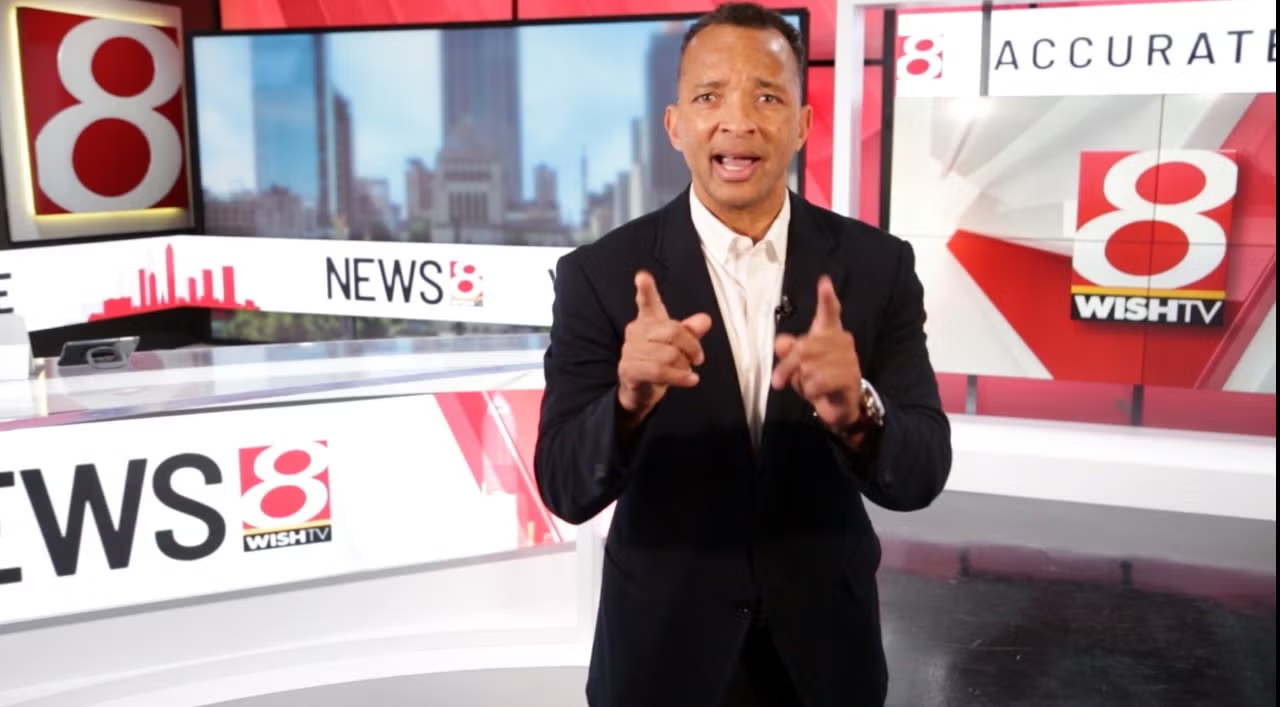
DuJuan McCoy’s acquisition of of WRTV in Indianapolis has been applauded as a boost for Black ownership of broadcast stations.
McCoy Cuts Staff at Newly Acquired Indy Station
Circle City Broadcasting, led by DuJuan McCoy, now one of the most prominent African American television station owners, “laid off a significant portion of WRTV staff after completing its acquisition of the Indianapolis ABC affiliate from E.W. Scripps Co.,” Newscast Studio reported Wednesday.
“The cuts came the same day the local media company finalized the purchase, expanding its holdings to three television stations in the Indianapolis market, the company said in a statement.
“The move comes weeks after the Federal Communications Commission greenlit the acquisition, bucking a longstanding regulation meant to prevent local monopolies,” Heather Bushman added for the Indianapolis Star.
Newscast Studio added, “Several on-air staffers, including meteorologists Kyle Mounce and Todd Klaassen, anchor Nicole Griffin and community reporter Nico Pennisi, confirmed on social media that March 31 was their final day. Some employees described widespread job losses, though the company has not released official staffing figures.
“ ‘Despite the quick ending for us all this place gave me so much,’ Klaassen said in a Facebook post.
“ ‘While I’m smiling — it’s what I always do (nickname: Smiley) — I’m also hurting,’ he said. ‘I gave everything to my job: long nights, early mornings, holidays, covering too many tornado warnings (sorry if I interrupted your programming), and time away from my family.’
“Circle City said it offered positions to some WRTV employees and provided severance packages to others based on contract terms or tenure. Employees not immediately retained may apply for open roles through a standard hiring process, the company said.”
When McCoy reached another milestone in 2017, the National Association of Black-Owned Broadcasters noted, ” Today, even though constituting 14% of the total population, African Americans own only 12 full power commercial television stations out of the 1300 full power commercial television stations in the United States.”
Journalists Forced, Squeezed Into Metal Containers
“A rebel group in eastern Congo has detained civilians, including two journalists, in metal shipping containers without light or ventilation, an advocacy group said,” Mark Banchereau of the Associated Press reports, in an egregious attack on journalists overshadowed by others elsewhere, including Tuesday’s abduction of American freelance reporter Shelly Kittleson in the center of Baghdad, and last Saturday’s killing of three Lebanese journalists in a targeted Israeli drone strike.
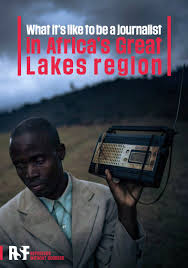 In the Great Lakes area of Africa, “Journalists’ enemies take many forms,” Reporters Without Borders said this week in a special report. “Reporters are squeezed between armed violence, political pressure, economic suffocation and disinformation, all of which undermine the public’s right to reliable information in the long term.”
On the journalists held in metal containers, the press freedom group, known by the French acronym RSF, said “the Rwanda-backed M23, which controls parts of eastern Congo, used the containers in the city of Goma as makeshift detention cells under ‘inhumane’ and ‘degrading’ conditions.
“Using witness accounts, satellite imagery and photos collected in 2025, RSF said at least two journalists were among those detained in the containers, which were installed at the compound of the province’s legislative assembly in Goma. Witnesses’ identities have been withheld for security reasons.
“As many as 80 detainees at a time were placed inside a container, without light or ventilation and allowed out only once a day. Witnesses said they received minimal food, while some reported routine beatings. According to the testimonies, conditions were extreme — suffocating heat by day and cold at night — with deaths reported. Survivors were often held for weeks before being transferred to other locations.”
There have been no updates since the March 24 report.
Separately, the Inter-American Press Association Tuesday named “Eight Latin American countries with severe restrictions on freedom of expression.”
“The group of countries in the ‘No Freedom of Expression’ category — comprising Cuba, Venezuela, and Nicaragua — is followed by eight countries in the ‘High Restriction’ category: Ecuador, Bolivia, Peru, Honduras, Mexico, El Salvador, Cuba, and Haiti.”
From the Committee to Protect Journalists:
Also:
- Mohamed Atim, Sudan Tribune: Three years of silence: A Sudanese journalist’s journey from a digital dead zone (March 22)
- International Press Institute: The information frontline — Press freedom and the security crisis in the Sahel
- Bashir Mbuthia, Eastleigh Voice, Kenya: Abducted Ugandan journalist charged over fake news on First Lady’s death
- The Monitor, Uganda: Journalist abducted in Kampala after radio show
- Maurice Oniang’o, Columbia Journalism Review: Inside an East African Investigative Newsroom That Has Defied a Decade of Pressure (March 24)
- Reporters Without Borders: Cuba: Surveillance and restrictions on journalists intensify in the context of demonstrations over the energy crisis
- Carlos Alejandro Rodríguez, CubaNet: Mike Hammer: “I am impressed by the courage of independent journalists in Cuba”
Reversal: WaPo Editorial Board Opposes DEI Program
In a reversal of longstanding policy, the Washington Post editorial board, under owner Jeff Bezos choice Adam O’Neal, has come out against a diversity, equity and inclusion program.
 As the Monday editorial, “The government’s DEI complex lives on,” explains, “The Native Hawaiian Health Scholarship Program pays tuition and other expenses for students studying to work in the medical field, including as doctors, dentists, nurses or social workers. After their studies, recipients of the scholarship agree to work in underserved parts of Hawaii. Some members of Do No Harm want to participate in the program, but are excluded because of their race.”
The Post’s AI summary of the more than 700 comments shows the editorial has become yet another way the Post, which has hemmorhaged circulation after a Bezos-ordered rightward editorial turn followed by staff resignations, is turning off readers:
“The conversation explores strong criticism of the Washington Post’s editorial board, particularly regarding their stance on a scholarship program for Native Hawaiians. Participants express frustration over what they perceive as a right-wing shift in the editorial board’s views, accusing it of ignoring broader issues like systemic racism and the Trump administration’s policies.
“Many comments highlight the importance of diversity, equity, and inclusion (DEI) initiatives, arguing that the editorial fails to acknowledge the historical and cultural context of the scholarship program.
“There is a recurring sentiment that the editorial board lacks depth in its analysis and is out of touch with the needs of marginalized communities.”
Many complained that the editorial was ahistorical. Part of that history, a paper by Noelani Nasser for the University of California’s Law Constitutional Quarterly explains, is that “historical events in Hawai’i from 1778 to the twenty-first century . . . demonstrate the atrocities and injustices of American imperialism that prevented the Native Hawaiians from profiting from the islands’ rich lands in a period of immense economic growth, stemming largely from agricultural developments.
“As a result of Americans seizing the Hawaiian lands for their own economic benefit and their subsequent disregard for the plight of an entire indigenous culture and people, Native Hawaiians are left by the wayside. American imperialism systematically disregarded the value of this native group’s culture and history and now only calls for remembering Native Hawaiians when it serves the interests of furthering their imperial agenda.”
A newsroom manager with a Hawaiian background could have explained the history, one Post alum told colleagues. Replied another, “there is nothing wrong with editorial writers seeking context on issues. The point is that they had an expert right there and apparently were too lazy to talk to her.
“And they wouldn’t have had to say anything about the position they intended to take (and one would hope they didn’t land on a position without doing thorough research). All they had to say was, Tell us about the reasoning behind this Native Hawaiian Health Scholarship Program. Then, they could have addressed all the issues behind the program, rather than focusing on the narrow issue of whether Native Hawaiians benefit from Native Hawaiian health care providers. If they want to knock down the other arguments for the program, that’s fine, as long as they understand that they exist.”
O’Neal did not respond to a request for comment.
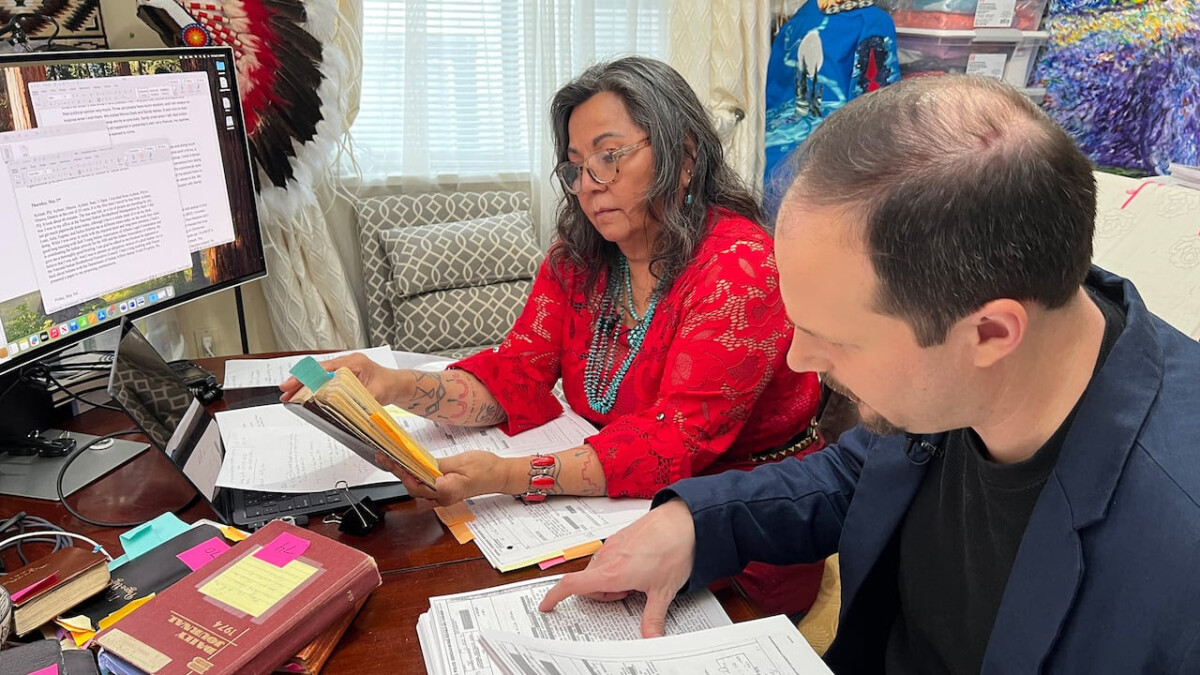
Doreen Manuel and Brett Forester, right, examine documents on the RCMP’s surveillance of Indigenous leaders during the 1970s. (Credit: Marnie Luke/CBC)
Journos Uncover Canadian Spying on Indigenous
“Today, we begin publishing a series of exclusive stories that expose a sweeping RCMP program of surveillance, disruption and infiltration of Indigenous organizations between 1968 and 1982,“ Brodie Fenlon reported March 24 for the Canadian Broadcasting Corp.
“Though long suspected by Indigenous leaders across Canada, the scope and scale of the spy program has remained hidden behind walls of government secrecy, until now.
“The dossier of these now-declassified documents is substantial, comprising 6,000 pages of surveillance reports conducted by what was then called the ‘Racial Intelligence Section’ of the RCMP’s Security Service.
“The scale of the operation is staggering: 150 police officers, with hundreds of Indigenous people and 30 Indigenous organizations under police watch, mostly during the 1970s. The RCMP used a range of methods, from paying informants, physical surveillance, covert filming and photography to tracking travel, monitoring media and assembling intelligence files.
“The documents corroborate for the first time that the RCMP used covert electronic surveillance and wiretaps to monitor the telephones of the offices of the National Indian Brotherhood (NIB) — now the Assembly of First Nations (AFN) — in Ottawa during the mid-’70s. . . .”
. . . . Berkeley Law Links With Indigenous Journalists
“Reporting on stories and issues impacting Native Nations and Indian Country often gets a critical piece wrong: the law. From tribal sovereignty and complex jurisdictional issues to water rights and child welfare, many of the issues affecting Native communities are rooted in legal frameworks that are frequently misunderstood or underreported because of those complexities,” UC Berkeley Law reported March 23.
“A new partnership between Berkeley Law’s Center for Indigenous Law & Justice and the Indigenous Journalists Association aims to change that. Formalized through a newly signed memorandum of understanding, the collaboration will equip journalists with the legal knowledge and culturally informed practices necessary to cover Native Nations with greater accuracy and context.
“Across Indian Country, issues such as Missing and Murdered Indigenous People, tribal jurisdiction, gaming, natural resource protection, and child welfare demand informed, accurate, and sustained national attention. Yet, coverage often lacks the legal grounding needed to explain how these complex frameworks operate in Indian Country — and why they matter. . . .”
More to come

