
Country Hosted J-School’s Session on U.S. Book Bans
Search of WaPo Reporter’s Home Sparks Outrage
Afro-Venezuelans Offer Nuance on U.S. Attack
19 Press Workers Released From Venezuelan Prisons
Dissing Martin Luther King Jr., From Reagan to Trump
12 Discuss Risks of Being a Trans Journalist
‘PBS News Hour’ Spotlights Black Maternal Inequities
It’s Here: Radio Group Introduces All-AI Host Lineup
Short Takes: “60 Minutes”; which cities have most Blacks, whites, Asian Americans, Hispanics? N.Y. Mayor Mamdani’s media office; immigrant media training program;
Black Sportswriters Hall of Fame; indigenous journalist Thaioronióhte Dan David; honoring East West, bilingual Chinese American weekly; new family bios by Eugene Robinson, Jeanne Saddler; Cheryl W. Thompson.
Homepage photo: Members of Morgan State University delegation in Cuba, December 2024, via Facebook.
Not available in Cuba: In 2022, the Committee to Protect Journalists produced this video about Abraham Jimenez Enoa, an Afro-Cuban journalist who received CPJ’s International Press Freedom Award for that year. Jimenez Enoa, who now lives in exile in Spain, said in his acceptance speech, “I was born in a country where all the television channels, all the radio stations, all the newspapers, all the magazines, are by law managed by the Communist Party, the only political organization allowed under the constitution of the republic.” A collection of his work, “The Hidden Island,” has just been published. [He told Journal-isms on Jan. 21, “In Cuba, the book is not available; it’s censored there!! “] (Credit: YouTube)
Country Hosted J-School’s Session on U.S. Book Bans
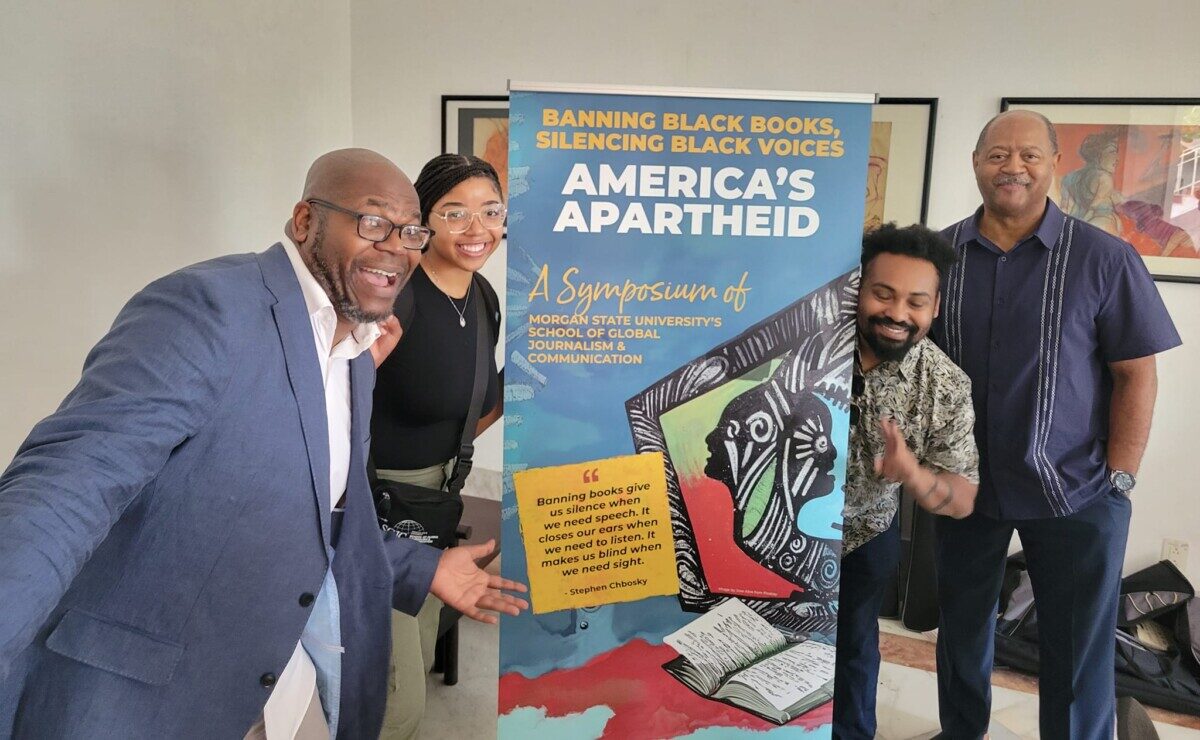
Cuba, the site of a Morgan State University journalism symposium on “Banning Black Books, Silencing Black Voices: America’s Apartheid,” is itself one of the “10 countries with the highest levels of censorship,” according to the Committee to Protect Journalists.
Cuba shares that distinction with:
Eritrea, North Korea, Turkmenistan, Saudi Arabia, China, Vietnam, Iran, Equatorial Guinea and Belarus.
“Despite some improvements in recent years – for example, the expansion of the mobile Internet and Wi-Fi access – Cuba continues to have the most restricted climate for the practice of journalism in the Americas,” the committee said.
“The print and audiovisual media are under the absolute control of the one-party communist state and, by law, must act ‘in accordance with the ends of socialist society.’ On a wasted occasion, a referendum on constitutional reforms, approved in February 2019, did not include any relaxation of media restrictions.
The CPJ report, last updated in 2019 but surfaced on the CPJ website last week, assumes more relevance as the Trump administration places the island nation in its crosshairs after the U.S. incursion of Venezuela.
In the early hours of Jan. 11, President Trump posted a screenshot of an X post, in which a user joked that Secretary of State Marco Rubio “will be the president of Cuba.” Trump wrote in the post, “Sounds good to me!”
Some 32 Cuban soldiers died during the U.S. military operation in Venezuela, an ally that supplied much of its oil. The invasion culminated in the capture of now-deposed president Nicolás Maduro and his wife, Cilia Flores on Jan. 3.
Many Americans, including 51 percent of Blacks, said they were not sure whether Cuba was a friend or an enemy in an Economist/YouGov poll [PDF] taken Jan. 9-12. But more Blacks and Hispanics joined whites in calling Cuba an unfriendly country rather than a friendly one.
Asked whether Cuba was an ally, 2 percent of whites said yes, as well as 2 percent of Blacks and 3 percent of Hispanics.
Is it a friend? 11 percent of whites said yes, as did 12 percent of Blacks and 17 percent of Hispanics.
Unfriendly? 39 percent of whites said yes, So did 24 percent of Blacks and 31 percent of Hispanics.
An enemy? 27 percent of whites agreed, 11 percent of Blacks did, as did 23 percent of Hispanics.
Those not sure included 26 percent of whites, 51 percent of Blacks and 26 percent of Hispanics.
“Filmed across borders, from the U.S. to Cuba and featuring powerful voices like Nikole Hannah-Jones, Morgan State University President, David Wilson, Mary Frances Berry, Molefi Kete Asante, Nancy Morejon, Jacqueline Jones and Miriam Nicado, Rector, University of Havana amongst others, this gripping documentary confronts the global implications of erasing Black history.” (Credit: YouTube)
Press freedom and human rights groups, however, seem to be unanimous.
Cuba ranks 165 among 180 countries around the world on Reporters Without Borders’ Press Freedom Index.
“The government continues to repress and punish virtually all forms of dissent and public criticism,” says Human Rights Watch.
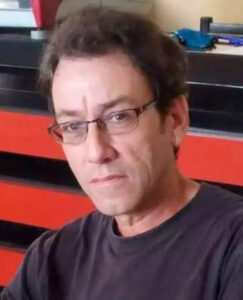 News organizations reported last week that the Villa Clara Provincial People’s Court sentenced journalist and writer José Gabriel Barrenechea Chávez (pictured) to six years in prison for the alleged crime of public disorder, along with five other citizens who participated in a peaceful demonstration in the municipality of Encrucijada on Nov. 7, 2024, against the prolonged blackouts.
The Spain-based Prisoners Defenders, meanwhile, posted its count of 1,198 political prisoners on the island.
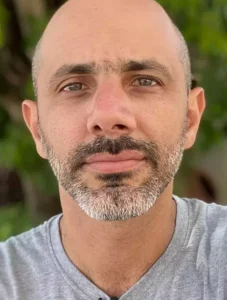 It was also reported that the director of the independent media outlet La Hora de Cuba, Henry Constantin (pictured), has been missing in Havana since Wednesday, amid a significant military presence in the capital.
Constantin is regional vice president of the Inter-American Press Association. A Saturday Facebook posting. reads, “Free Henry Constantin, director of La Hora de Cuba, after an absurd police kidnapping following the funeral of Cuban agents in Venezuela.”
[Jan. 21 update: Constantin was arrested again on Tuesday in the city of Camagüey, just a week after he was arrested in Havana, CiberCuba reported. As reported by his own media, Constantin was intercepted by a patrol of the National Revolutionary Police when he was outside his daughter’s home. The arrest occurred around 4:30 p.m., without the officers offering any explanation, and the journalist was released about an hour later.]
[Jan. 22 update: Constantin was released after his arbitrary arrest]
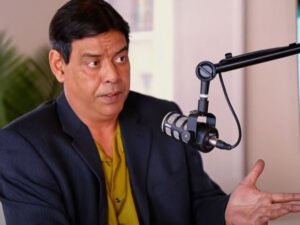 Last year, Cuban journalist and sports commentator Armando Campuzano (pictured), exiled in Canada since 2017, wrote a book critical of the Cuban government. He reported having received a telephone threat that directly referred to his four children (scroll down).
Jacqueline (Jackie) Jones, dean of Morgan State’s School of Global Journalism and Communication, did not respond when asked whether the school planned to address the censorship and press freedom issues when it discusses banning books and/or the practice of journalism in Cuba.
Nor did DeWayne Wickham, founding dean of the school, who has taken scores of students and others to Cuba, citing ties between African Americans and Afro-Cubans while denouncing the U.S. embargo.
Wickham was praised by Cuban leader Salvador Valdés Mesa, vice president of the Republic, and given the title of visiting professor at the University of Havana.
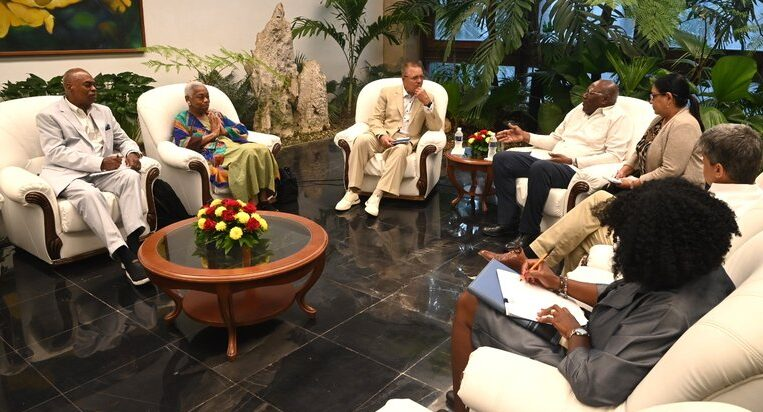 In July 2023, the Cuban government news agency, ACN, issued a press release celebrating the visit of DeWayne Wickham, center, founding dean of the School of Global Journalism and Communication at Morgan State University. Salvador Valdés Mesa, vice president of the republic, “praised the variety of social, civic, and racial issues that Mr. Wickham addresses and actively acts upon on an ongoing basis and thanked him for his work in favor of Cuba-U.S. relations and against the [U.S.] embargo, ‘the most serious obstacle to Cuban development today,’ he emphasized.” (Credit: ACN)
“Cuba also, ironically, doesn’t experience book bans, making it the perfect place to host a banned book symposium, according to Wickham,” Lex Weaver, who went on the December 2024 trip, wrote last year for Public Radio International’s “The World.” Weaver also noted that book bans don’t apply solely to Black authors, as the “apartheid” label might suggest, instead, “Most books being banned in the United States focus on LGBTQ, racial or gendered themes, according to Pen America.
“ ‘I think the banning of books robs our children of their history,’ said Michael Cottman, assistant to the SGJC dean and author of ‘‘The Wreck of the Henrietta Marie.’ ”
- CiberCuba: Repression continues against Cuban young woman who conducted a survey on Marco Rubio and Díaz-Canel
- Ciber Cuba: The repressive history of one of the Cuban military officers who died in Caracas has come to light (Jan. 6)
- Ciber Cuba:52% of Cubans believe the U.S. should sanction artists who travel to perform in Cuba (Oct. 2)
- Diario De Cuba: Without direct evidence, the regime sentences the dissident artist Nando OBDC to five years in prison (Jan. 19)
- Ivan Leon, Ciber Cuba: Journalism is not betrayal: Debunking the criminalization of the free press in Cuba (Dec. 1)
- Journal-isms: The Embargo Made Them Do It: Journalists Accuse Cuba’s Rulers of Scapegoating (Dec. 6, 2023)
- Prisoners Defenders: Cuba ends 2025 with 134 new political prisoners, bringing the total to 1,197 by the end of the year
- John J. Suárez, Executive Director of the Center for a Free Cuba, Marti Noticias: OPINION: Cuban “anti-imperialism” 60 years after the Tricontinental
- J.J.S. Tennant, Times Literary Supplement: Leaving Cuba: Reportage and fiction about a troubled island (new book by exiled Abraham Jimenez Enoa)
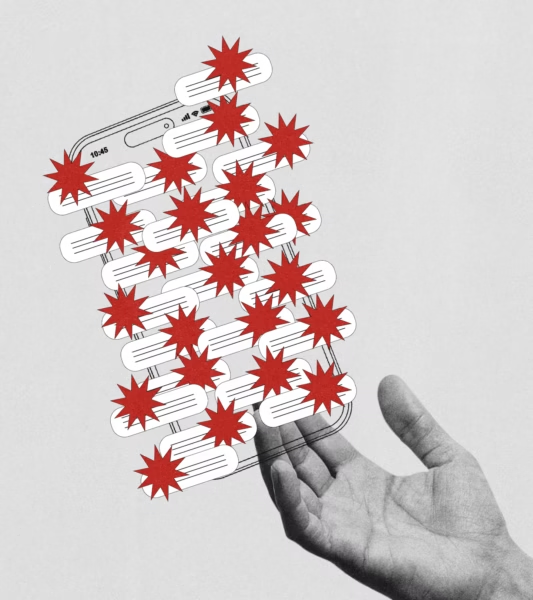
This illustration, credited to “Natalie Vineberg/The Washington Post; iStock” accompanied Hannah Natanson’s Dec. 24 project headlined, “I am The Post’s ‘federal government whisperer.’ It’s been brutal: One reporter’s effort to show how Trump was transforming government brought her 1,169 new sources — and nearly broke her.”
Search of WaPo Reporter’s Home Sparks Outrage
The National Association of Black Journalists, the Asian American Journalists Association, the Association of LGBTQ+ Journalists, Journalism and Women’s Symposium (JAWS) and the National Association of Hispanic Journalists are among 31 press-freedom and civil-liberties groups who signed a statement protesting government invasion of the home of Washington Post journalist Hannah Natanson.
“The joint statement by the news organizations urges lawmakers to call Attorney General [Pam] Bondi before Congress, reintroduce and pass the PRESS Act and reform the Espionage Act to explicitly protect journalists and whistleblowers from prosecution,” the group Free Press reported.
“The groups also call on Congress to introduce a resolution that confirms that the First Amendment protects everyone’s right to record the public activities of law enforcement.”
Maddy Crowell explained Friday for Columbia Journalism Review, “On Christmas Eve, the Washington Post published a story by Hannah Natanson, a reporter who works as part of a team covering the ways Donald Trump is upending the federal workforce. ‘I am The Post’s ‘federal government whisperer.’ It’s been brutal,” the headline went.
“She described having been an education reporter who wandered over to Reddit, where she put out a call for ‘anyone willing to chat’ She provided her contact information on Signal, an encrypted app that Post reporters are encouraged to use.”
“ ‘The next day, I woke at sunrise to dozens of messages — the ruling pattern of my mornings ever since,’ she wrote. Before long, ‘I would gain a new beat, a new editor and 1,169 contacts on Signal, all current or former federal employees who decided to trust me with their stories.’ On Wednesday morning, the FBI searched her home and seized her phone, a Garmin watch, and two laptops — one of them issued by the Post
Matt Murray, Post executive editor, said Wednesday, ”According to the government warrant, the raid was in connection with an investigation into a government contractor accused of illegally retaining classified government materials. We are told Hannah, and The Post, are not a target.” However, Murray said he found the action ‘deeply concerning.’ ”
The Reporters Committee for Freedom of the Press announced Thursday that hours after the FBI searched Natanson’s home and seized her electronic devices on Wednesday it asked a federal district court in Virginia to unseal records related to the search warrant.
Also on Thursday, Lauren Harper, the Freedom of the Press Foundation’s first Daniel Ellsberg Chair on Government Secrecy, wrote for The Intercept that “The raid can be seen as a direct result of Attorney General Pam Bondi’s decision last year to reverse media protections for journalists from having their records searched during leak investigations — a decision that was a sham from the start. . . .
“A Freedom of Information Act request filed by Freedom of the Press Foundation showed that Bondi’s pretext for reversing these protections was nonsense.“
- Committee to Protect Journalists: In highly unusual move, FBI searches Washington Post reporter Hannah Natanson’s home, seizes devices
- Sarah Ellison, Patrick Marley and Colby Itkowitz, Washington Post: Journalists confront new reality in reporting after FBI raid
- The Onion (satire): ‘Washington Post’ Publishes Editorial Defending FBI Raid On Its Reporter
- Reporters Committee for Freedom of the Press: RCFP statement on FBI search of Washington Post reporter’s home
- Reporters Without Borders: USA: Congress must rein in Trump’s war on press freedom after FBI raid on journalist
- Riddhi Setty, Columbia Journalism Review: ‘A Trauma That You Carry’
- Society of Professional Journalists: SPJ condemns FBI search of Washington Post reporter’s home as a grave threat to press freedom
- Diane Sylvester, Editor & Publisher: U.S. journalists face war-zone conditions at home
ACE, a YouTube content creator who visits Black communities worldwide, took viewers in 2022 to several historic sites in Venezuela to learn more about Black people in that country and the nation’s African history. (Credit: YouTube)
Afro-Venezuelans Offer Nuance on U.S. Attack
“Human Rights Watch and the United Nations have documented how [Nicolás] Maduro’s government carried out extrajudicial killings in poor, predominantly Afro‑descendant neighborhoods, manipulating crime scenes and planting weapons to justify the deaths,” Adam Mahoney wrote Monday for Capital B, referring to Venezuela.
“ ‘Blunt, lethal violence was enforced against the poorest areas, which are mostly inhabited by people of African descent,’ ” said Nadia Mosquera Muriel, an Afro‑Venezuelan anthropologist who grew up in Venezuela and now studies Black life from the United States.
On the other hand, Mosquera Muriel said that in Latin America, “none of the U.S. interventions have actually brought anything positive to any country where that has happened.”
Moreover, she added, “following the introduction of new census categories in 2011 and a strategic push by former President Hugo Chávez,” the Maduro mentor “who identified as a descendant of the African slave trade, things changed,” Mahoney wrote.
“Chávez was ‘overtly the first non‑white president’ to make explicit racial claims, Mosquera Muriel said, and he faced ‘quite a lot of racist attacks from the elites’ who saw a leader who looked like the working‑class majority.
“Afro‑Venezuelan organizers said they had to cultivate that racial consciousness in Chávez, but once he embraced his African ancestry publicly, it became ‘an awakening’ for many Black Venezuelans who had been taught to hide or downplay their Blackness,” according to Christian Pich Ortiz, described as “a proud Afro-Venezuelan.”
Mahoney wrote that his publication “interviewed Afro-Venezuelans here in the U.S. and in the coastal country bordering the Caribbean Sea and Atlantic Ocean.” Their views were “shaped by the country’s long history of denying racism and by who has actually borne the brunt of sanctions, poverty, and police violence.”
More than half of Venezuelans identify as having African ancestry, the highest rate of the world’s Spanish-speaking nations.
- Journal-isms: What Blacks Worldwide Have in Common – journal-isms.com (Aug. 14)
- Journal-isms: ‘We Are, as Latinos, Quite African’ – journal-isms.com (June 27)
19 Press Workers Released From Venezuelan Prisons
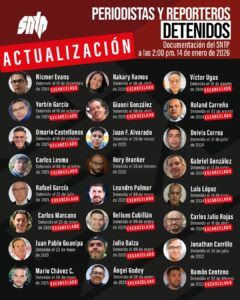 Venezuela released 19 press workers from prison between Jan. 8 and 14 after Jorge Rodríguez, president of the National Assembly, announced that a ‘significant number’ of political prisoners would be freed, the country’s National Union of Press Workers (SNTP) said Wednesday.
The union said that ”all of them are under precautionary measures and remain subject to a judicial process.”
“Some of those released, due to their time in prison and the precarious conditions, now have serious health problems . . .
“According to the number of arrests documented by the SNTP, as of today five press workers remain arbitrarily imprisoned,” the union continued. “For those who remain in prison, for those who have been released, and for all people deprived of their liberty for political reasons, we demand full freedom.”
The union went on to describe each press worker.
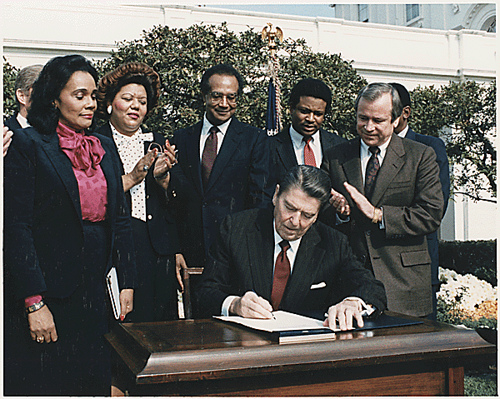
Just an act? President Ronald Reagan signs legislation creating a federal holiday honoring Martin Luther King Jr. in the White House Rose Garden on Nov. 2, 1983. King’s widow, Coretta Scott King, is at left. (Credit: National Archives)
Dissing Martin Luther King Jr., From Reagan to Trump
A new book by Heather Ann Thompson, a Pulitzer-prize winning historian, contends that the white nationalist impulses now controlling the federal government were propelled 40 years ago by the Ronald Reagan administration.
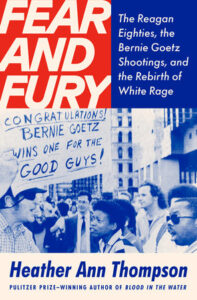 The book’s title, “Fear and Fury: The Reagan Eighties, the Bernie Goetz Shootings, and the Rebirth of White Rage,” refers to Bernhard Goetz, who is white, and who in 1984 shot four Black teenagers he said were trying to rob him on a New York subway. One, Darrell Cabey, was paralyzed and suffered brain damage.
“He was heralded by the local media as a hero,” Thompson writes of Goetz. “And the shootings would unveil simmering racial resentments that had been carefully fueled during the Reagan eighties. This moment would profoundly change America.”
Fast forward to the Donald Trump administration, in which diversity, equity and inclusion have become taboo and the civil rights movement — and the efforts of Martin Luther King Jr., whose birthday Americans commemorate this weekend — have led to white people being “very badly treated,”according to Trump, speaking in a Jan. 7 interview with The New York Times.
Under Trump, the National Park Service removed free admission to the parks on the King holiday and on Juneteenth, instead adding Flag Day, Trump’s own birthday, to the list of free-admission days.
Trump also removed King’s bust from the Oval Office, placing it in the private dining area.
As for Reagan, many who followed the news then will remember that Reagan was asked in 1983 whether King was a communist or had communist sympathies. He replied, ”We’ll know in about 35 years, won’t we?”
That’s when documents addressing that topic were to be made public.
Yet it was Reagan who signed the bill making the King Day a federal holiday. That expression of support was not as it appeared, Justin Gomer and Christopher Petrella wrote for the Boston Review on the 2017 King holiday.
“As the history of the federal MLK Day holiday demonstrates, the destruction of King’s legacy and the reframing of King’s words to serve the interests of civil rights opponents began over three decades ago,” they wrote.
“In fact, Trump’s election represents one logical endpoint of the tactic exemplified by MLK Day itself, legislated under the Reagan administration as part of a strategy to defang King of his most radical qualities while co-opting him into the ideology of colorblindness.”
If Reagan had his math right, the “35 years” are up.
The release last July of more than 240,000 pages of records of the FBI’s surveillance of King, despite opposition from his family and the civil rights group that he led, produced no news stories about any communist ties, only that the FBI was determined to portray King as one.
That, too, is part of Reagan’s legacy.
- Jimmie Briggs, New York Amsterdam News: Martin Luther King’s vision in this moment: A dream deferred or a test of our strength?
- Mary C. Curtis, Roll Call: Why the aggrieved need a scapegoat and an excuse — anything but the truth: But even Trump can’t erase the legacy of Martin Luther King Jr.
- Emmanuel Felton, Washington Post: Civil rights leaders discuss the lessons of the ’60s for the Trump era
- Journal-isms: What ‘The Movement’ Can Teach Journalists (May 5, 2025)
- Margo Moreno, San Antonio Express-News: History reminds us that figures like Martin Luther King Jr. were punished not for hatred but for refusing to remain invisible. (Jan. 10)
- Kevin Powell, Newsweek: What Would Dr. King Say Now?
- Brandon Tensley, Capital B: Stevie Wonder’s Battle for MLK Day and the New Challenges to King’s Legacy
- Sarah Pruitt, history.com: Why the FBI Saw Martin Luther King Jr. as a Communist Threat (June 24, 2021, updated June 30, 2025)
- Mark Allan Williams, Newsweek: Why Is Trump Trying To Compete With Martin Luther King? (Oct. 1, 2024)
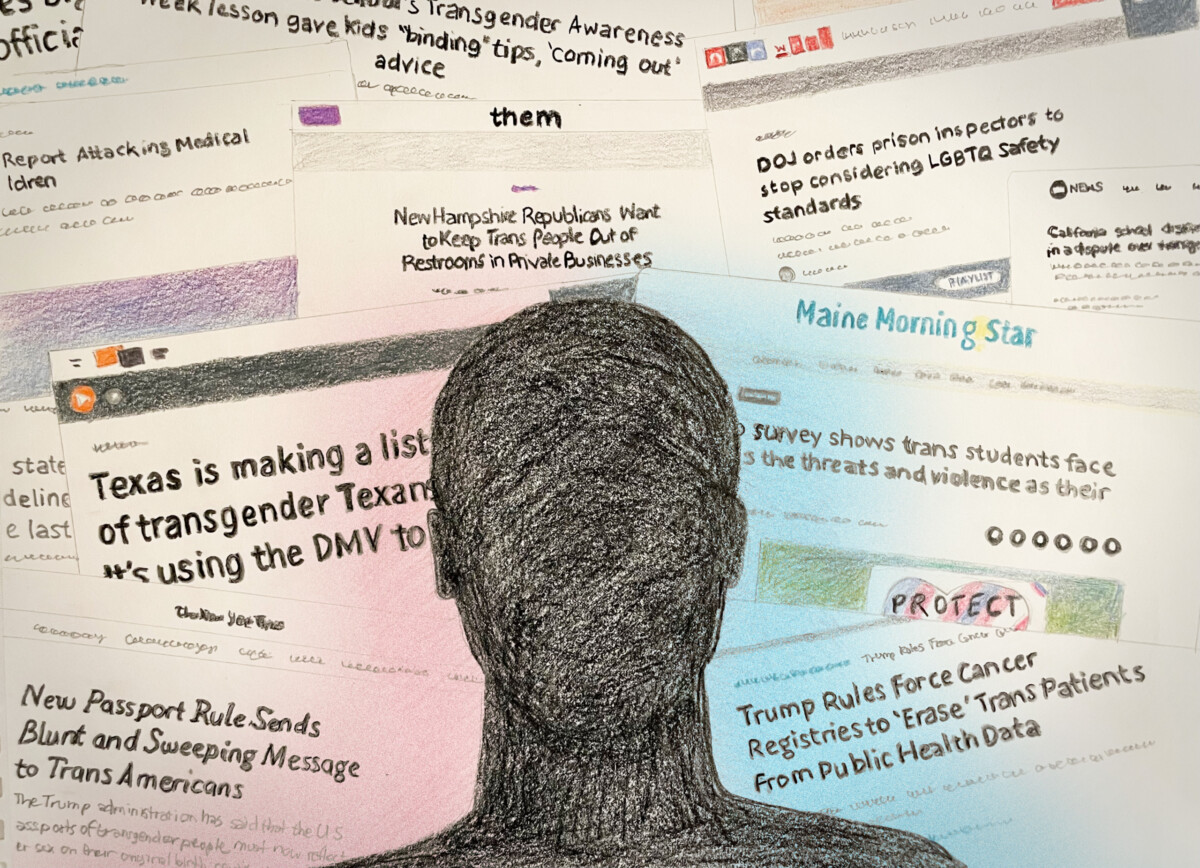
Illustration by H Conley
12 Discuss Risks of Being a Trans Journalist
“In recent years, trans people have become increasingly visible in the news,” H Conley wrote Monday for Columbia Journalism Review. “We are being banned from using bathrooms, participating in sports, serving in the military, accessing proper identification, and receiving medical care. It has always been risky to be trans, but recent political and cultural shifts against trans rights have exacerbated many of the dangers. . . .
“For trans journalists, risks tend to fall into two categories: those associated with being a trans employee and those associated with reporting as a trans person. . . .
“The risks trans journalists face while reporting are . . . important to keep in mind. Every trans journalist with whom I spoke attested to experiencing online harassment; many said they had received death threats; some have been stalked. . . .”
Included among the advice: “Being aware of the laws that affect your employees is also important for ensuring that journalists can do their jobs. In some states, using the ‘wrong’ bathroom could be punishable with prison time. . . . “
Interviewed were Erin Reed, Nour Abi-Nakhoul, Tre’vell Anderson, Orion Rummler, Finch Walker, Eden Lane, Ray Hobbs, Lewis Raven Wallace,Tat Bellamy-Walker, Gisselle Medina, Vivian McCall and Kae Petrin.
‘PBS News Hour’ Spotlights Black Maternal Inequities
“The death of a Black midwife following complications from giving birth has renewed difficult questions surrounding inequities in Black maternal health care. Stephanie Sy reported Thursday for the “PBS News Hour.” Black women are still three times more likely to die from a pregnancy-related cause than white women.”
It’s Here: Radio Group Introduces All-AI Host Lineup
 “Two and a half years after the furor of ‘AI Ashley’” introduced an artificial intelligence host to US radio, a Phoenix radio group is moving the concept beyond experimentation, opting for an entire on-air lineup of AI-generated talent on its new Alternative formatted signal,” Cameron Coats reported Thursday for Radio Ink.
“Zelus Media Group has launched 94.9 The Zone (KZON-HD2) in partnership with SonicTrek.ai. Unlike prior AI-assisted formats that blended automation with live or tracked air talent, The Zone’s on-air presence is fully driven by licensed voice models of format programmer Dennis Constantine along with Nicole Sandler, Kevin Malvey, and Sean Marten.”
SonicTrek.ai CEO Joel Denver told Journal-isms that all the voices are used with the human host’s consent, and that while there are no hosts or voices of color, that’s something the company would “definitely” like to incorporate.
You can listen online at: https://941thezone.com/listen-live/.
Short Takes
- The “60 Minutes” segment on Venezuelan detainees sent by the United States to a notorious El Salvador prison, pulled last month by CBS News editor-in-chief Bari Weiss, finally aired Sunday night.

- “Most big cities no longer have a single racial or ethnic majority,” Gene Balk reported Tuesday for the Seattle Times. “Only 20 of the 50 largest cities do. In addition to the 12 white-majority cities, five had Hispanic majorities — El Paso, Texas; Miami; San Antonio; Bakersfield, Calif.; and Fresno, Calif. — and three had Black majorities — Detroit; Memphis, Tenn.; and Baltimore. None of the nation’s 50 largest cities has an Asian majority, though San Jose comes closest. . . .”
 . . .
. . .
- . . . Portland, Ore., “recorded the highest share of white residents among large cities, at 65%, ahead of Colorado Springs. Detroit, at about 12% white, had the lowest share. Detroit also had the highest share of Black residents, at roughly 73%,” while Mesa, Ariz., “had the lowest, at under 3%. San Jose had the highest share of Asian residents, at nearly 42%, while El Paso had the smallest, at just over 1%. El Paso was also the most Hispanic large city, at more than 81%, while Atlanta had the lowest Hispanic share, at about 7%. . . . “
- New York Mayor Zorhan Mamdani “tapped former City Councilman Rafael Espinal to lead his media office on Monday — and made it one of Espinal’s first orders of business to revoke ex-Mayor Eric Adams’ 11th hour effort to place new restrictions on press access in the Big Apple,” Chris Sommerfeldt reported for the Daily News in New York. “The new rules, which Adams’ Office of Media and Entertainment rolled out on his final day in office, would’ve put tighter restrictions on who can obtain New York City press cards, including by requiring applicants be employed by a ‘media platform’ or a member of a journalism association.”
- “Documented, the nonprofit newsroom that covers New York’s immigrant communities, “announced the first cohort of its new immigrant media training program, which is slated to run through 2028,” Laura Hazard Owen reported Monday for Nieman Lab. “The six publishers — chosen from among 82 applicants across 22 states — will receive training over five months, and will each receive a $10,000 stipend to launch a project. . . .”
- Four journalists are to be inducted into the Black Sportswriters Hall of Fame on April 11: Clifton Brown, first Black golf writer at The New York Times; Garry D. Howard — former president of the Associated Press Sports Editors and longtime sports editor; Rob Parker, Fox Sports national radio host, founder of the Black Sportswriters Hall of Fame; and Ron Thomas, pioneering NBA reporter, first chair of the NABJ Sports Task Force, and founding director of the journalism program at Morehouse College.
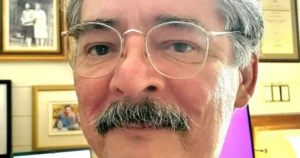
- “No one reshaped Indigenous journalism in Canada more than the Kanienke:haka (Mohawk) journalist, Thaioronióhte Dan David (pictured), who is remembered inside Aboriginal Peoples Television Network as the father — or these days, the grandfather—of APTN News,” Karyn Pugliese reported Friday for the network, created to serve the Indigenous people of North America. “On Jan.12, David, aged 73, passed into the spirit world, after years of living with cancer. . . . “
- The Chinese Historical Society of America plans to honor the staff of East West, a bilingual Chinese American weekly published for 22 years beginning in 1967, with the Bad Ass Asian Pioneer Journalism Award on Jan.24 in San Francisco, AsAmNews reported Thursday.
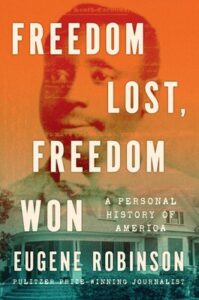 Two more Black journalists have books about their family histories: Eugene Robinson, former Washington Post columnist, has “Freedom Lost, Freedom Won,” And Jeanne Estelle Saddler, retired correspondent for Time magazine and The Wall Street Journal, has “The Great Triumph.” Others were discussed at the June 2025 Journal-isms Roundtable. Separately, Cheryl W. Thompson’s “Forgotten Souls: The Search for the Lost Tuskegee Airmen” is to be published next week. Thompson is an NPR investigative journalist and the daughter of a Tuskegee Airman.
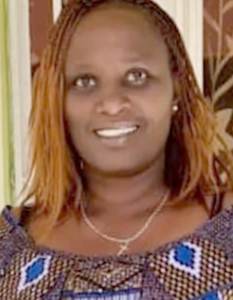 The Committee to Protect Journalists called Thursday for Burundian authorities “to end the persecution of jailed journalist Sandra Muhoza (pictured) who has been given a four-year sentence for comments she made on WhatsApp, after almost two years in detention.”

