

No Evidence Some Were Big-Time Drug Traffickers
Hundreds at Service for Pioneer Belva Davis (item includes Michael Days, Jim Avila and Richard Kipling)
Alarming Reports About Lack of Trust in Journalists
No Black Women Left at Gutted Teen Vogue
Former FCC Members Say Current Chair ‘Weaponizes’
New Archive Tells Story of Indigenous Slavery
Race Plays Out in Case of Boy, 6, Who Shot Teacher
‘How I Lost My Father to Deportation’
Cuba Blocks Imprisoned Journo from Receiving Books
Exiled Cuban Journalist Wins Human Rights Award
African Reporters Keep Digging Despite Obstacles
Homepage photo: Map traces reported U.S. military strikes on vessels in the Caribbean and Pacific waters, including but not limited to Venezuelan boats, revealing a widening maritime conflict whose targets and motives remain disputed. (Credit: Brittanica)
Update: A memorial service for journalist Rudolph Brewington, who died Oct. 21, is to be livestreamed Saturday, Nov. 15, at 1 p.m. Pacific time; 4 p.m. Eastern time, the family says. Funeral home information is here.
“More than 60 people have been killed since September when the U.S. military began attacking boats that the Trump administration alleges were smuggling drugs. The Associated Press interviewed dozens of residents in the Paria Peninsula, in Venezuela’s breathtaking northeastern coast from which some of the targeted boats departed.” (Credit: AP Video — Juan Arraez; Illustration by Peter Hamlino).
No Evidence Some Were Big-Time Drug Traffickers
“It’s not easy to get the answers. Many of these people come from poor Venezuelan villages, where the government’s repression has left citizens reluctant to speak to reporters, much less go on the record.
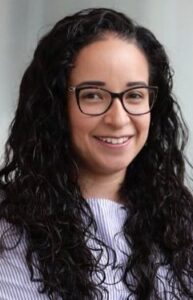 “Nonetheless, Regina Garcia Cano (pictured) and Juan Arraez from the Associated Press made their way to the Paria Peninsula, home of some of the men, including those who have disappeared and whose bodies may never be retrieved. In dozens of interviews with their relatives and friends, Garcia Cano learned that while some of the men were likely involved in the drug trade, there is no evidence that they were big-time traffickers.
 “ ‘They were laborers, a fisherman, a motorcycle taxi driver,’ Garcia Cano wrote. ‘Two were low-level career criminals. One was a well-known local crime boss who contracted out his smuggling services to traffickers.… Residents and relatives said the dead men had indeed been running drugs but were not narco-terrorists or leaders of a cartel or gang.’
“And the people left behind are angry about the lack of due process: ‘In the past, their boats would have been interdicted by the US authorities and the crewmen charged with federal crimes, affording them a day in court.’ The Venezuelan government is of no help, either: ‘I want an answer, but who can I ask?’ one relative told the AP. ‘I can’t say anything.’
“Garcia Cano’s intrepid reporting is worth your time, as is this Q&A with Del Quentin Wilber, her editor on the story, explaining how she got it.”
As Reuters explains, “With more than 5,000 military personnel and dozens of warplanes onboard, the U.S. Navy’s largest and most advanced aircraft carrier, the Gerald R. Ford, and its strike group moved into the Caribbean earlier this week, sharply escalating the military buildup. That added to the eight warships, a nuclear submarine and F-35 aircraft already sent to the region.”
- Melissa Sanchez, Jodi S. Cohen, T. Christian Miller, Sebastian Rotella and Mariam Elba, ProPublica: After Midnight Raid on Chicago Apartment Building, No One Was Charged With a Crime
The Bay Area celebrated the life of iconic journalist Belva Davis, the first Black female television news reporter on the West Coast, and how she fought for those following in her footsteps. Juliette Goodrich reports for KPIX in the Bay Area. (Credit: YouTube)
Hundreds at Service for Pioneer Belva Davis
“The service yesterday was beautiful and was attended by many dignitaries including Nancy Pelosi and her family as well as State Senator Scott Weiner,” retried journalist Carolyn Tyler of KGO-TV wrote on Facebook, one of many describing the Monday service in similar terms.
At least 500 were present, said Rebecca Nestle, a spokesperson for Grace Chapel in San Francisco, who said her estimates tend to be conservative.
“As you’ll see in the program, a number of other dignitaries spoke,” Tyler continued. “The speakers focused only on the incredible impact Belva Davis made to journalism, the arts, public welfare, the country and indeed the world. The musical tributes were stellar and divinely inspired.
“Belva was a woman of immense character and outstanding professional skills, as well as a woman deeply rooted in her faith and commitment to respecting all people equally. She went out of [her] way to ‘SEE AND LISTEN TO’ everyone in her reporting and interactions, and she didn’t make distinctions based on class or race or . . . gender orientation. She also was the first Black woman west of the Mississippi to become a television journalist, and she mentored hundreds over the years. She was widely admired and deeply loved.”
You can watch the service here, courtesy of KTVU.
Also:
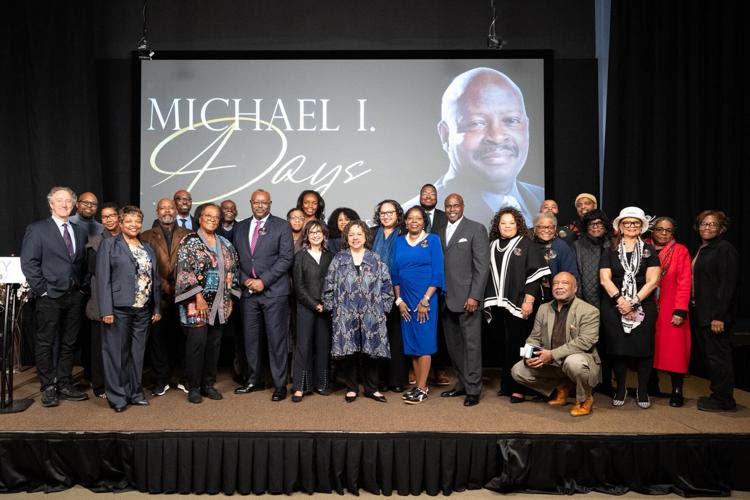 Angela Dodson, center, wife of Michael Days, and others joining the tribute at WHYY. (Credit: Erin Blewett)
- More than 100 people turned out at WHYY Studios in Philadelphia, also on Nov. 10, to celebrate the life of Michael Days, the Philadelphia-based journalist who died at 72 on Oct. 18, NABJ Philadelphia reported on LinkedIn. “He would have been humbled as speaker after speaker told of a heart as bright as gold and as open as an embrace. They each shared such powerful memories — honoring Mike not only as a giant in journalism, but in life. . . .” A funeral was held in Trenton, N.J., on Oct. 25. Facebook video and Philadelphia Tribune coverage
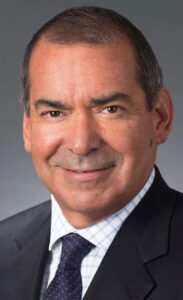
- Jim Avila, a former ABC News correspondent who covered several major trials in a career that spanned decades, died on Wednesday at his home in San Diego. He was 70, Sopan Deb reported Thursday for the New York Times. ‘”His death was announced in a statement by ABC News, which said he died after a long illness. . . . .’

- Richard Kipling, champion of newsroom diversity and mentorship, has died at 81, Hannah Fry reported Oct. 17, updated Oct. 31, for the Los Angeles Times. “Metpro trained generations of journalists of color whose careers took them to leadership positions at the Los Angeles Times, the New York Times, the New Yorker and beyond. As newspaper finances declined, Kipling fought to preserve a diversity program that had become a model across the industry. . . .”
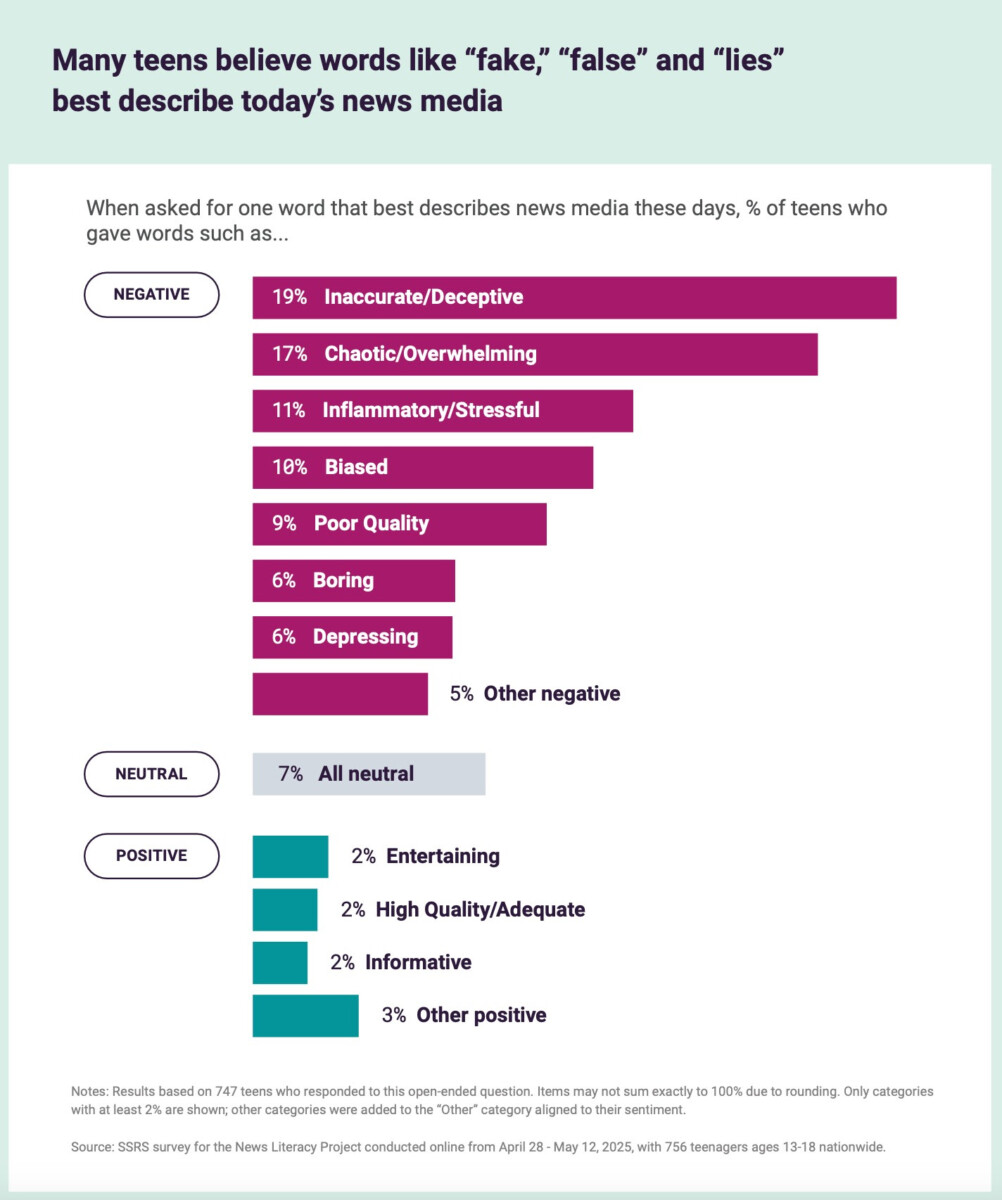
Credit: Nieman Lab
Alarming Reports About Lack of Trust in Journalists
A “global study of more than 2,600 consumers across 10 markets, including Australia, found that podcasts now reach two-thirds of listeners each month, with attention levels peaking locally at 71%. When video podcasts are included, that reach jumps by another 39%,” Natasha Lee reported Nov. 6 for Media Week.
“But the data point that’s both alarming and encouraging? Podcasters and journalists are now equally trusted for product recommendations – 33% each – outranking YouTubers, influencers and celebrities. . . .”
Meanwhile, a new report from the News Literacy Project that surveyed American teenagers about their attitudes toward journalists found, “About half of the teens surveyed believe that journalists frequently ‘make up details, such as quotes’ and ‘pay for sources.’
“When the researchers for News Literacy Project grouped responses together, the most mentioned perceived area of improvement for professional journalists was being honest and getting the facts right. More than a third of teens believe journalists could improve by simply ‘Telling the truth,’ ‘Fact checking,’ and ‘Not lying,’ ”Sarah Scire reported Nov, 6 for Nieman Lab.
As if those two studies weren’t enough, the Center for Integrity in News Reporting reminded us Friday that “Gallup’s recently released 2025 annual survey finds that just 28% of Americans now say they have a ‘great deal’ or ‘fair amount’ of trust in newspapers, television, and radio to report the news fully, accurately, and fairly — a record low since Gallup began measuring in the 1970s.”
 Writing in Editor & Publisher, the group said it offered “three interconnected programs to rebuild credibility where it begins — inside the newsroom and inside America’s journalism schools,” They are “Publishing Core Values,” “Rewarding Impartial Reporting” and “Teaching the Next Generation.”
“Trust can be rebuilt,” the center said. “And CFINR is helping lead the way.”
Former newspaper publisher Rufus Friday (pictured) is the group’s executive director.
No Black Women Left at Gutted Teen Vogue
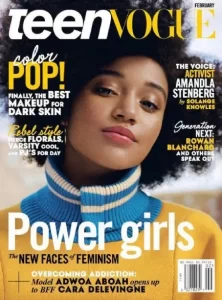 “If you just skimmed the press release, you wouldn’t really get the scale of it,” Allegra Kirkland wrote Nov. 4 for Talking Points Memo. “On Monday, Vogue.com announced that Teen Vogue would be folded into its parent publication — part of a ‘transition, in which Teen Vogue will keep its unique editorial identity and mission.’ ”
“That’s Condé Nast-ese for ‘we’re laying off nearly the entire team and stripping the publication for parts.’
“Nearly all of my former colleagues — including all but one woman of color and the only trans staffer — were let go. The identity and politics sections, which covered reproductive rights, LGBTQ issues, campus organizing, state and national politics, the labor movement, education, and more were folded. The art team was decimated. The editor in chief was pushed out.
“The Black women editors behind some of the most popular franchises developed for the style and culture sections were laid off. The only issues name-checked as ones that will continue to be covered when Teen Vogue is subsumed into Vogue’s flagship website are ‘career development’ and ‘cultural leadership.’ ”
Riddhi Setty added Monday for Columbia Journalism Review, “Last week, Teen Vogue laid off multiple people, including the only two Black women writers on staff, during its transition to Vogue.‘ ‘I can confirm that the majority of today’s layoffs were women of color. There are no longer any Black women working at Teen Vogue,’ Lex McMenamin, Teen Vogue’s politics editor, posted on Bluesky. McMenamin was also laid off.
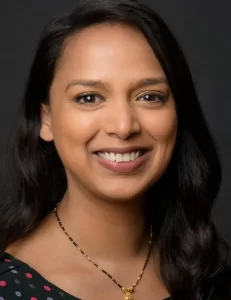 “Versha Sharma (pictured), the editor in chief of Teen Vogue, also stepped down. ‘We built a team of young Black, Asian, queer, and trans staffers, who are passionate, whip smart and consistently pushed impactful storytelling forward.… Many of them are now without jobs,’ she wrote in an Instagram post on Wednesday. That same day, a group of over a dozen Condé Nast employees confronted the company’s head of human resources about the shuttering of Teen Vogue and other recent cuts, and four were fired as a result, Semafor’s Max Tani reported.”
Dylan Byers wrote Nov. 7 for Puck, “This was a sober (and way-too-late) business decision that came amid a broader round of layoffs across the company — the umpteenth in recent history as [Conde Nast CEO Roger] Lynch & Co. continue to struggle toward profitability.”
Former FCC Members Say Current Chair ‘Weaponizes’
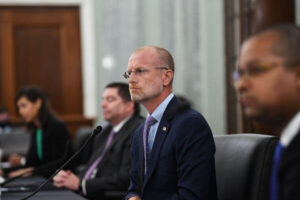 “A bipartisan group of former FCC chairs and commissioners is calling on the agency to rescind its ‘news distortion‘ policy, arguing that it is ‘constitutionally problematic’ and that it has been ‘weaponized’ by the current chairman, Brendan Carr (pictured), to go after unfavorable coverage of President Donald Trump,” Ted Johnson reported Thursday for Deadline.
“Carr has invoked the policy numerous times. A news distortion complaint over CBS 60 Minutes editing of an interview with Kamala Harris last year led to an FCC investigation, and Carr cited the policy when he warned ABC stations over late-night host Jimmy Kimmel and his comments about Charlie Kirk. The network pulled Kimmel’s show off the air for several days before reinstating him. . . .
“An FCC spokesperson did not immediately return a request for comment, but Carr posted on X, ‘How about no. On my watch, the FCC will continue to hold broadcasters accountable to their public interest obligations. And it is quite rich for the exact same people that pressured prior FCCs to censor conservatives *through the news distortion policy* to now object to the agency’s even-handed application of the law.’ ”
- Mariana Alfaro and Hannah Natanson, Washington Post: Trump administration prepares to fire worker for TV interview about SNAP
- Jeremy Barr, the Guardian: Joy Reid on her ouster from MSNBC: ‘In this moment, not being a part of corporate media is a gift’ (Nov. 8)
- Dawnelle Blake, The Post, Ohio University: Black journalism is in turmoil, demoralizing
- Helen Coster, John Shiffman, Christine Soares, Alexandra Ulmer and Linda So, Reuters: In Trump 2.0, MAGA-aligned influencers and media emerge as the new mainstream (Nov. 8)
Anna M. Gomez, Federal Communications Commission: Gomez on News Distortion Policy
- Sasha Ann Simons with Natalie Moore, Morgan Elise Johnson and Brandon Pope, WBEZ Chicago: Taking a closer look at mass firings, layoffs of Black journalists as media orgs dismantle DEI
- Julian Wyllie, Current: WETA to cut staff, cancel ‘PBS News Weekend’ and close News Hour West bureau
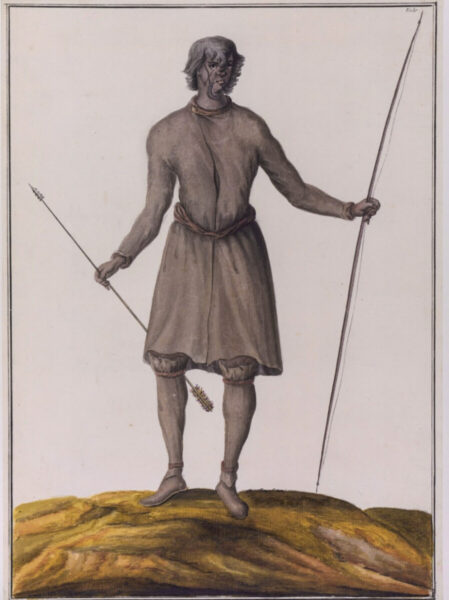
An illustration titled “Indian du Canada” depicts an enslaved Meskwaki person in colonial France in what is now the United States. (Credit: Bibliothèque Nationale de France)
New Archive Tells Story of Indigenous Slavery
A team of researchers is “actively sifting through archival documents, artifacts even artwork to expand the story of Indigenous slavery,” reports indianz.com, linking to a Nov. 5 discussion on “Native America Calling.”
“The Native Bound Unbound project includes interactive maps, digitized documents and recent interviews with descendants whose ancestors endured enslavement.
“The publicly-available digital archive aims to document every instance of Indigenous slavery in the Western Hemisphere to illuminate where and when slavery took place, and the lasting effects for Indigenous communities and their descendants.”
According to Andrés Reséndez, writing for the Smithsonian, “During the four centuries between the arrival of Columbus and the beginning of the twentieth century, some 2.5 to 5 million Native people were enslaved (PDF). All European empires took part in this human traffic: the English, the French, the Dutch, and the Portuguese.
“But because Spain came to control the richest and most densely populated regions of the Americas at the same time that it lacked African colonies (and thus access to African peoples), it emerged as the greatest enslaver of Indigenous Americans.”
- Ana Lucia Araujo, Aeon: The deepest South: Slavery in Latin America, on a huge scale, was different from that in the United States. Why don’t we know this history?
- Leonardo Coelho, LatAm Journalism Review: New manual by Indigenous journalists in Brazil aims to prevent errors and stereotypes about their communities
- Melanie Henshaw, InvestigateWest/Associated Press: Native American children more likely to be arrested, jailed in Washington state, data shows
- Carrie Johnson, NBCU Academy: How Journalists Can Avoid Indigenous Stereotypes (Nov. 4)
@cnn A jury awarded $10 million to Abby Zwerner, the former Virginia teacher who was shot by her 6-year-old student in 2023. Zwerner sued ex-assistant principal Ebony Parker, alleging Parker failed to act on concerns that the student brought a gun to school. #cnn #news ♬ original sound – CNN
If no image is visible, please consider changing browsers.
Race Plays Out in Case of Boy, 6, Who Shot Teacher
The rate of firearm-related deaths among Black youth was six times higher than with white youth “and substantially higher than any other racial and ethnic group,” the Kaiser Family Foundation had reported.
Now, the races of the people in the Newport News incident are public. The teacher, Abigail Zwerner, who survived the shooting, is white. She was awarded $10 million, saying she lost the use of her left hand after it was punctured by a bullet.
The child and his mother are Black, as is the former assistant principal, Ebony Parker, who has been found negligent. She had been warned by at least three teachers and a student that the child was a threat that day in January 2023, according to trial testimony.
Christina Carrega, writing for Capital B, has now written about the racial implications, but with a different approach.
“As prosecutors increasingly go after the parents of children involved in shootings, some legal advocates fear Black parents will be disproportionately prosecuted in the push for more accountability,” Carrega wrote Nov. 6.
The child’s mother, Deja Taylor, was sentenced to two years in state prison for felony child neglect and an additional 21 months in federal prison for using marijuana while owning a gun.
Carrega reported, “The central questions advocates are asking in Taylor’s case are whether the punishment fits the crime and is locking her up in the best interest of her son, whose birthday is in June. He turned 9 this year.”
She continued, “Advocates caution against tearing families apart because incarceration only causes additional harm — and there are alternatives. Sending Taylor to prison and away from her son is a ‘grave injustice,’ says Michael Mitchell, an assistant professor of African American studies and criminology at the College of New Jersey.
“ ‘There are other, healthier ways, and probably more prosocial ways, to repair harm that is done,’ said Mitchell, a former correction officer who co-authored a 2019 research study titled: ‘Formerly Incarcerated Black Mothers Matter Too: Resisting Social Constructions of Motherhood.’
“According to a 2010 Pew Research Center report, 1 in 9 Black children, 1 in 28 Hispanic children, and 1 in 57 white children in the U.S. have an incarcerated parent. Those statistics have not changed to date. . . . “
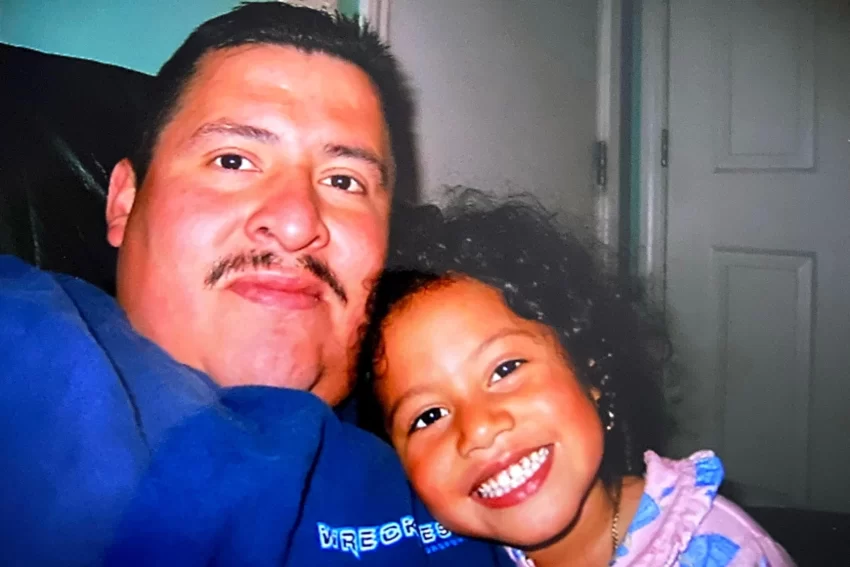
“My father started to feel like a ghost. The distance wasn’t just physical. It felt as if I was losing the man who raised me,” wrote Vanessa Lopez, who provided this photo.
‘How I Lost My Father to Deportation’
“He worked hard to give me a home. ICE took his: How I lost my father to deportation,” reads the headline over a first-person story Monday by Vanessa Lopez, an audience engagement specialist at the Chicago Sun-Times.
“Deportation has taken away the father I once knew and given me back a person I no longer recognize.”
The photo shows the author as a toddler and her father at their former home in Indiana.
If no image is visible, please consider changing browsers or go directly to Facebook.
“Despite police harassment, independent journalism gives voice to Cubans,” said Diario De Cuba, an opposition news outlet. “Jorge Enrique Rodríguez, reporter for #DiarioDeCuba in Havana, explains why independent journalism in #Cuba is a libertarian and civil resistance act, and sends a greeting to the participants of the ‘Foro DDC: For the Cuba of Tomorrow,’ held Nov. 6 in Buenos Aires.” (Credit: Facebook)
Cuba Blocks Imprisoned Journo from Receiving Books
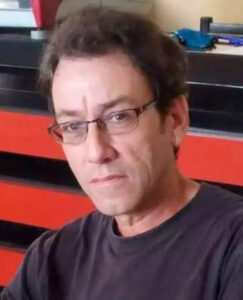 “The Cuban regime prevents political prisoner and writer José Gabriel Barrenechea (pictured) from receiving books at La Pendiente prison in Santa Clara, where he has been held for more than a year,” ADN Cuba reported Tuesday.
“According to a report by the Cuban Canadians Coalition, this new measure by his jailers constitutes ‘a form of psychological torture for a man who has dedicated his life to reading, critical thinking and the defense of freedom.
“In addition, his health condition has deteriorated, with weight loss and constant fevers.
“Barrenechea is in a cell shared with more than ten prisoners, mostly common prisoners.
“The coalition also recalled that the trial against the intellectual took place last September and the ruling has not yet been released.
“Finally, they called for the release of Barrenechea and the hundreds of Cuban political prisoners.”
The subject of book banning was to be raised Wednesday when Baltimore’ Enoch Pratt Free Library opened its DeWayne Wickham Collection. With others, Wickham, founding Morgan State University journalism school dean and former USA Today columnist, held a discussion in Cuba last fall on “America’s Apartheid – Banning Black Books, Silencing Black Voices,” and a preview of the resulting 34-minute film was to be shown.
The list of books that the U.S. military has recently banned includes authors of all races. What they have in common is the topic of diversity, including race, gender and sexuality. As the 19th wrote, “Following a public outcry, the [Naval] academy returned titles by Maya Angelou, Harper Lee and others — many by women — that were purged under Pentagon orders targeting race and gender discourse.”
“Cuba exposed: How the grandson of Castro’s bodyguard became Cuba’s number one enemy. Magnitsky Award winner and Cuban journalist Abraham Jiménez Enoa tells Times Radio how Cuba’s secret police interrogated and intimidated him and his family for exposing the realities of living in the country.” (Credit: Times Radio, Britain/YouTube)
Exiled Cuban Journalist Wins Human Rights Award
“Exiled Cuban journalist Abraham Jiménez Enoa was awarded the Magnitsky Prize 2025, which acknowledged his work denouncing human rights violations on the island and joined other international recognitions he has received throughout his career,” the opposition outlet Diario De Cuba reported Nov. 3.
“The Magnitsky was created in the United States in 2015 to recognize the work of journalists, politicians and courageous human rights activists. It is named after Serge Magnitsky, a lawyer who testified against Russian government officials whom he accused of stealing millions of US dollars in federal taxes, in 2008. He was arrested and imprisoned without trial. He died in prison in Russia in 2009.
“Jiménez Enoa founded in 2016, together with the journalist Carlos Manuel Álvarez, the narrative journalism magazine El Estornudo. He has collaborated with media outlets such as The Washington Post, The New York Times, BBC World, [Al Jazeera], Vice News, El País and Gatopardo Magazine.
Among his honors are an International Press Freedom Award in 2022 from the Committee to Protect Journalists.

From left: Journalists Seth Bokpe of Ghana, Dewald van Rensburg of South Africa, Edmund Boateng of Ghana, and Mustapha Darboe of the Gambia.
African Reporters Keep Digging Despite Obstacles
“Across Africa, journalists are being kidnapped, tortured and killed – often by people whose identities are known but who face no punishment,” Radio France Internationale said Nov. 6.
“Reports gathered by RFI and press freedom groups show these incidents spreading from Burkina Faso to Guinea and eastern Democratic Republic of Congo, where journalists who refuse to toe the line are silenced or forced to flee.”
Still, investigative journalism continues, and on Thursday at the African Investigative Journalism Conference in Johannesburg, attended by delegates from across the continent, the group named its African investigative journalist of the year, Andrew Kathindi reported Tuesday for the Namibian.
The award went to Dewald van Rensburg of South Africa “for an exposé into Johannesburg’s multibillion-rand illegal gold trade, which implicated a flamboyant pastor and a fugitive,” Kathindi continued.
“The Gambia’s Mustapha Darboe won second place for his investigation, titled ‘The Assets of Former Dictator Go for a Song,’
“The story investigated how the process of recovering the assets of The Gambia’s former exiled president, Yahya Jammeh, whose wealth was estimated at more than a billion dollars (equivalent to the country’s gross domestic product in the year he was deposed), was marred by alleged corruption.
“Ghanaian journalists Seth Bokpe and Edmund Boateng of The Fourth Estate won third place for their investigation, titled ‘Forest Invasion: The Scramble by PEPs to Acquire Mining Licences in Ghana’s Forest Reserve’.” Partnership for Economic Policy is a global organization dedicated to supporting development in the Global South.
“The investigation uncovered that the government enacted a law motivating politicians to apply for and receive mining leases in some of Ghana’s prized forests, including globally significant biodiversity areas.”
