
Heart Disease Claims News Industry Leader at 79
How Far Will Latino Journos Go for Press Freedom? (Oct. 30; updated)
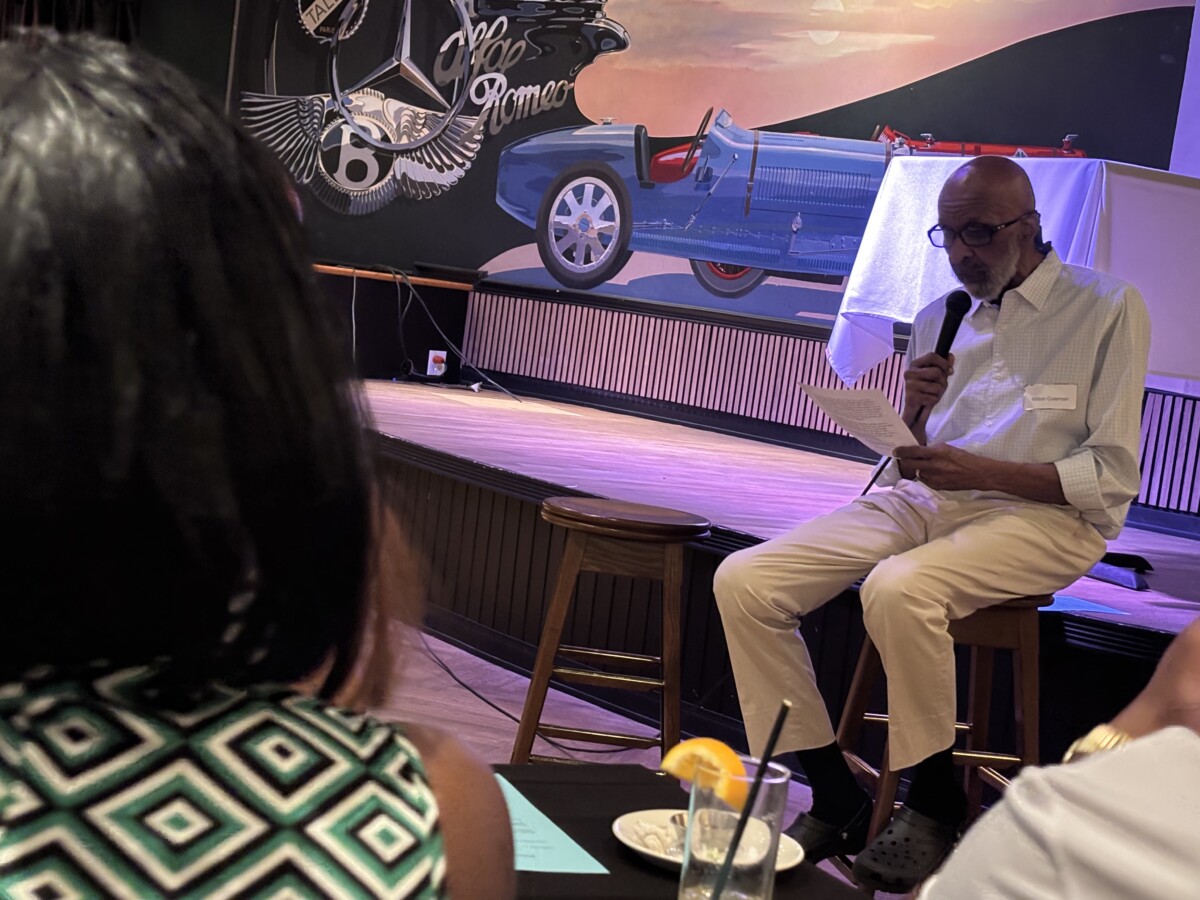
Milton Coleman reads introductions of speakers at the Herbert H. Denton Jr. Memorial Scholarship Dinner in suburban Maryland on June 7. (Credit: Richard Prince)
Heart Disease Claims News Industry Leader at 79
Milton Coleman, who said that as a journalist his goal was to lift up the kind of people he grew up with in his Black Milwaukee neighborhood, died at 79 Friday at the Washington Hospital Center “after navigating a growing series of health challenges in the last few years,” his son, Sekou Coleman, announced Sunday on Facebook.
“He had gone into the hospital on Monday after collapsing at home and was taken to the hospital. Milton had heart disease, which was the precipitating cause,” a former Washington Post colleague reported.
At the Post, where Coleman worked from 1976 to 2009, he became one of the highest-ranking Black newspaper editors in the mainstream media, as well as an industry leader, heading the American Society of News Editors as well as the Inter-American Press Association, which comprises publishers of newspapers in the Americas. He prided himself on having learned Spanish.
“Milton was so energetic and full of ideas,” said Post colleague Don Podesta. “I worked with him on a couple of projects, mostly involving outreach to the Latino community and he was all in… even to the point of recording his Post voicemail greeting in both English and Spanish.”
Coleman said that his obituary was sure to include high up the furor that erupted when he reported in 1984 that Jesse Jackson, as a Democratic presidential candidate, had uttered the words “Hymie” and “Hymietown” to refer to Jews and to New York. The publication led to death threats and a discussion of whether Jackson’s preceding the remarks by saying, “let’s talk Black talk” meant the comments should not have been used.
In his defense, which included a speech in Atlanta at the National Association of Black Journalists annual convention that year, Coleman wrote in the Post, “Professionally, as the journalist responsible for its publication, I never realized and certainly never hoped that reporting the remark would lead to all of this. As a person, I wish the process had not been so painful for all. But I am convinced that I did the right thing and that I acted on principles and stuck to them firmly. The cost has been exceedingly high.”
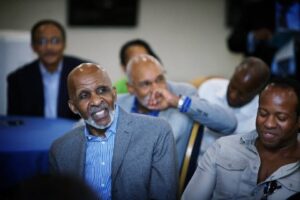 That uproar had been preceded by another flashpoint, when “Janet Cooke received journalism’s ultimate accolade, a Pulitzer for ‘Jimmy’s World,’ which had been a front-page feature in The Washington Post the previous September,” as Peter Osnos described it years later. “It was beautifully written at over 2000 words. It caused D.C. authorities to launch a search for Jimmy which ended when it was determined that he had “died’. (Photo: With fellow journalists Jackie Greene, left, and Fred Sweets, center, at Sept. 17, 2017, Journal-isms Roundtable, by Sharon Farmer/sfphotoworks)
It was a hoax, and Cooke had to return the prize before resigning. Coleman was city editor and had worked closely with Cooke on the story. Bob Woodward, the metro editor, now writes for the New Yorker that the episode cost Woodward the chance to ever become the Post’s top editor.
In reporting the story’s trajectory, ombudsman Bill Greene recounted at the time, “Coleman read it over, made suggestions on reworking it, suggested how to write the ‘lead,’ the opening, how to rearrange the material.
“ ‘I wanted it to read like John Coltrane’s music, strong. It was a great story, and it never occurred to me that she could make it up. There was too much distance between Janet and the streets,’ Coleman said.”
The HistoryMakers published this short bio of Coleman in 2013:
“Milton R. Coleman was born on November 29, 1946 in Milwaukee, Wisconsin. Coleman grew up in the Hillside Terrace public housing project in Milwaukee. He attended Fourth Street Elementary School and then graduated from Lincoln Junior and Senior High School. Coleman received his B.F.A. degree in music history and literature from the University of Wisconsin-Milwaukee.
“In 1971, he was named a Southern Education Foundation Fellow. In 1974, Coleman was awarded a fellowship to attend the Michele Clark Summer Program for Minority Journalists at Columbia University’s Graduate School of Journalism.
“Coleman began his career in journalism as a reporter for the Milwaukee Courier. He then worked as a reporter and editor for several minority-oriented news outlets, including the African World newspaper in Greensboro, North Carolina; the All-African News Service; WHUR-FM in Washington, D.C.; and the Community News Service of New York. Coleman also worked at a major metropolitan newspaper, the Minneapolis Star, before joining The Washington Post in 1976 as a reporter on the metropolitan desk where he covered politics and government in Montgomery County, Maryland and the District of Columbia.
“In 1980, he was promoted to the city editor. Coleman then moved to the national news staff in 1983 where he covered minorities and immigration, the 1984 Presidential campaign, state and local governments, and the U.S. Congress. In 1986, he was hired as the assistant managing editor for the metropolitan news where he directed the newspapers local coverage. In July of 1996, Coleman was promoted to deputy managing editor of The Washington Post.”
For a Journal-isms Roundtable in 2015, Coleman reached back to his Milwaukee past to introduce attendees to Howard Fuller, a ’60s activist once known as Owusu Sadauki. Fuller became superintendent of schools in Milwaukee and advocated for school vouchers, a cause he considered a continuation of his civil rights-era struggle. To help promote Fuller’s book, Coleman interviewed him for an hour on YouTube.
Coleman’s upbringing in Black Milwaukee was never far from his consciousness.
When he became president of the Inter-American Press Association in 2011, Coleman told IAPA members, meeting in Peru, that he was bringing that background with him.
“I am, I believe, the first African American from the United States to occupy this post,” he said. “I share African roots with many of the Afro-Latino people of Brazil, Colombia, Ecuador, Venezuela, the Dominican Republic, Puerto Rico and, yes, Peru, and with the Afro Caribbeans of Haiti, Barbados and Jamaica, among others in IAPA.
“As a young man, I fought for human rights in the civil rights struggles of the 1960s, was arrested and spent time in jail. As a young journalist, I challenged authority in the name of the people’s right to know. I was arrested and spent time in jail.
“As an experienced reporter, my life was threatened by those who disliked what I reported. So now, as an elder statesman in the rights struggle we all fight now, I feel very much at home. I’m no stranger to this cause.”
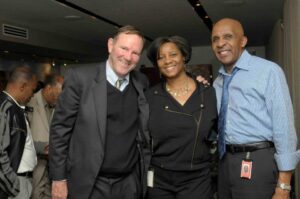 At the Post, Coleman would tell Journal-isms, neighbors in Washington’s Black communities would view him as a pipeline into the newspaper. (With Donald Graham, left, and Shirley Carswell in 2012 at a Journal-isms Roundtable; credit Jason Miccolo Johnson. Carswell succeeded Coleman as deputy managing editor.)
In 1990, Post publisher Donald Graham established the Herbert H. Denton Jr. Memorial Scholarship for a graduating senior from a select group of high schools in the D.C., metropolitan area. Denton was a Black reporter and editor. Graham chose Coleman to be the staff person administering the project. Few of the awardees are journalists, but nearly all, if not all, are Black.
In retirement, Coleman helped guide a project at the nearby University of Maryland, “Printing Hate,” headed by his onetime Post colleague, DeNeen Brown. It documented the racist pasts of newspapers.
For this year’s commemoration of the establishment of the United States, Coleman wrote lengthy, detailed pieces, as yet unpublished, about the role of African Americans at the nation’s founding.
“As the nation celebrates its 250th birthday, know that it is more than coincidence that much of what’s happening now regarding issues of race and immigration is a lot like what happened back in the day,” he wrote.
“That’s because at the time of the founding, Black folks were simultaneously the largest group of people in the new nation who weren’t White, and the largest group of non-citizens, too. The talk nowadays may be different, but the walk is much the same.”
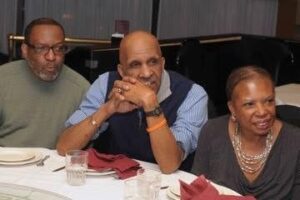 Son Sekou, who shares a name with Sekou Toure, the late president of Guinea, wrote of his dad, “He leaves behind a loving wife [Faye E. Coleman] with whom he shared 55 years of marriage, plus three grandchildren, numerous nieces and nephews, a sister-in-law and a countless amount of extended family and community members worldwide who will miss him dearly, just as I will.” (Photo: Flanked by broadcaster Kojo Nnamdi and Faye Coleman)
Referencing the Denton scholars, Graham messaged others Sunday, “I am so, so sad, as I know we all are. I know how much we all admired Milton. He cared about every scholar.”
Leonard Downie Jr., former Post executive editor, wrote, “Horrible, horrible news. City Hall reporter, City editor, Metro editor, Deputy Managing Editor, mentor to so many African-American journalists, Don Graham’s right hand for the very successful Herb Denton scholarship, and my friend. I could see that his health was failing, but I’m still in shock. Great loss of a great man.”
- Journal-isms: Jesse Jackson, by Those Who Covered Him (Dec. 16, 2025)
How Far Will Latino Journos Go for Press Freedom?
Oct. 30, 2026
In Low-Key NAHJ Election, Question Merits Attention
Don Harris of ABC News reports on Jorge Ramos being escorted out of Donald Trump news conference in 2015. (Credit: YouTube)
In Low-Key NAHJ Election, Question Merits Attention
Our next Journal-isms Roundtable — where journalists and others discuss issues of the day in relation to diversity and journalism — won’t take place Sunday after all. The moderator has lost his speaking voice to the flu, but as significantly, an important invited guest, Dunia Elvir, president of the National Association of Hispanic Journalists, up next week for reelection, declined to attend. Her opponent, Julio-Cesar Chavez, had accepted.
It comes at a significant time. On Wednesday, “the Knight Institute and the Media Freedom and Information Access Clinic at Yale Law School filed a lawsuit challenging President Trump’s policy of expelling journalists and news organizations from the White House for reporting what he characterizes as ‘fake news,’ ” the two groups announced.
“Filed on behalf of a human rights advocate, a media watchdog, a historian, a civics teacher, a legal journalist, and a student journalist, the lawsuit contends that the president’s effort to destroy the White House press corps’ independence is an unconstitutional attack on the public’s right to trustworthy and undistorted reporting about the president and his policies.”
There are no Latinos or other people of color among the six “ordinary citizens.”
Were any considered?
“That’s a fair question,” messaged David A. Schulz of the Media Freedom & Information Access Clinic at Yale Law School, counsel for the plaintiffs.
“I can’t say much about our conversations with prospective plaintiffs because they were privileged conversations that occurred in anticipation of possible litigation, but we did consider diversity as we built the case, and our outreach included multiple people of color. Not everyone we reached out to participated in the suit (that’s typical), and the group we ended up with is diverse in some important ways but not in others.”
It was a different story on Oct. 1. Then, journalist April Ryan, the National Association of Black Journalists and the National Newspaper Publishers Association, the Black-press trade organization, cited the need for African Americans’ access to credible media as the primary reason they filed a friend-of-the-court brief opposing President Trump’s ban on three media outlets. They did see color.
“By excluding CNN, MS NOW, and Politico from the White House press corps, the President’s media ban has disproportionate and harsher implications for Black audiences, who trust the very networks whose access has been revoked,” said the brief, filed by lawyers Olivia N. Sedwick of the NAACP and Kristen Clarke of the Howard University Law School Civil Rights Clinic. Clarke was assistant attorney general for civil rights in the Biden administration.
Separately, a new group coalesced: “Press4Democracy is a nonpartisan coalition of veteran print, television, radio and digital journalists,” this group says. “We have covered the White House and city halls, foreign wars and local school boards. We have reported under deadline, under pressure, and sometimes under threat. And while many of us are no longer working journalists, our commitment to a free and independent press has never wavered.
“We came together because we cannot stand silent on the sidelines.” These journalists are led by two former ABC reporters, Ian Cameron and Lisa Stark. “After about a year of spontaneous action to mobilize former journalists, we decided to formalize our group this fall and just launched our website,” Cameron told Journal-isms Friday. “We’ve asked those who had signed our past petitions and messages if they would like to join our coalition. So far, more than 200 have signed on.”
The same argument that Ryan, NABJ, NNPA and the NAACP made about Black audiences is true for Latinos. During the first Trump administration, at an Aug. 25, 2015, press conference in Dubuque, Iowa, Jorge Ramos, “one of the most prominent personalities on the Spanish-speaking network and a Mexican-American, began asking Trump a question, to which Trump told him to sit down: ‘You weren’t called,’ he said.
” ‘You cannot deport 11 million people,’ Ramos was heard saying as Trump told him to sit down,”
” ‘No, I will not sit down,’ Ramos said. ‘I have a right to ask a question.’
“Ramos continued asking questions when Trump told him to ‘go back to Univision.’
“Trump then looked to his left and said ‘go ahead’ before a security guard walked toward the anchor and physically escorted him out.”
Trump was similarly dismissive of Jose Diaz-Balart, then a chief anchor at the Telemundo network and also on MSNBC. “He’s not appealing to the Latino vote through these major Latino outlets,” David Folkenfllik said at the time on NPR.
Then, two years later, the White House revoked the press pass of Jim Acosta, CNN White House reporter. As would anyone in that role, then-NAHJ President Hugo Balta spoke up. “By harassing the journalist for simply doing his job and deeming Acosta as the ‘enemy of the people,’ President Trump is engaging in a calculated effort of putting a target on this journalist’s back,” Balta said.
Judge Timothy J. Kelly of U.S. District Court in Washington ultimately ordered the Trump administration to restore Acosta’s press credentials.
“Best way we can work together.” Members of the journalists of color associations seem to be in favor of more talk among them, not less. Some are wistful about the Unity: Journalists of Color coalition and wonder whether it can ever get back together.
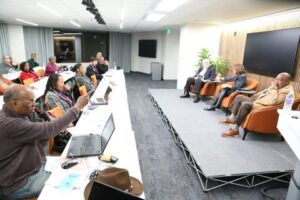
Others heard about the Demand Diversity Coalition Roundtable organized by the National Urban League to strategize about combatting the anti-diversity movement. While NABJ and the Asian American Journalists Association were among the attendees from all ethnicities, races and persuasions, organizer Tara Murray said, “We did extend invitations to NAHJ; unfortunately, they were unable to join this convening.”
Some of the Facebook comments when NABJ went ahead with its planned new dates for its 2027 convention in conflict with NAHJ’s:
“Says a lot about the lack of communication between these two important organizations — it would take 10 minutes for the presidents to call one another every so often and check in. Can’t we just get along?”
“NAHJ and NABJ squabbling makes zero sense in a time when both groups are in competition for an ever smaller piece of the journalism pie.”
“Why is it so hard for these groups to work together to avoid these conflicts? Not a good look at all.”
Online-only voting for the NAHJ election begins Monday and continues until Nov. 13, away from the excitement of a convention.
Members voted in 2024 to separate the association’s elections from the annual NAHJ conference in July, (“account has been suspended”) Sofia Esparza wrote in July for the convention’s Latino Reporter.
“ ‘It was a lot of work and too confusing for members to have to deal with an election at the same time when you have to focus on the sessions that you want to go to,’ Elvir said.” Her presidential challenger, Chavez, also supported the change.
In her message declining the invitation to the Journal-isms Roundtable, Elvir said, “Unfortunately, my schedule doesn’t allow me to participate this Sunday.
“I believe NAHJ will organize its own candidate forum, giving our members the opportunity to hear directly from us. I would like to take care of that before I go to another forum.”
The NAHJ elections webpage makes no mention of such a candidate forum, but perhaps if there is one, NAHJ members might ask about some of these issues involving interactions with the outside world. What NAHJ does also affects journalists who aren’t members.
Before last year’s elections for NABJ officers, all three presidential candidates accepted invitations to join a Journal-isms Roundtable discussion of ” ‘Black Like Me?’ What Blacks Worldwide Have in Common, and Don’t.” The NABJ candidates might have gleaned productive ideas.
The eventual winner, Errin Haines, editor-at-large for the 19th, said at one point, “This was such a robust conversation and I look forward to continuing it — with NABJ as a partner if I’m our next president.”
Update: In absence of candidate meetings, NAHJ Friday urges watching their videos:
|

|
|
Sunday update:
Elivir messaged Journal-isms with these endorsements:
- Committee to Protect Journalists: How journalists can stay safe – and how we can protect America’s press – on midterm Election Day and beyond
- Marcia Davis, Journal-isms: ‘We Are, as Latinos, Quite African’ (Oct. 18, 2025)
- Freedom of the Press Foundation: Brendan Carr: Reporting on polls may violate broadcast license terms (Oct. 21)
- Journal-isms: NAHJ VP Challenges Incumbent for Top Job (Oct. 11)
