
Tells NAHJ, ‘I Still Don’t Know’ Reason for Ouster
Updating: NABJ Keeping ’27 Date, Despite NAHJ Objection
New Owner Byron Allen Slashing Jobs at HuffPost
Illinois Honors Emmett Till; Death Became Journalism History
Black Kids’ Presence on TV Affects Views on Diversity
Sylvia Bugg, PBS Chief Programming Exec, Dies at 55
Washington Post Metro Seven Mark 54 Years Since Complaint
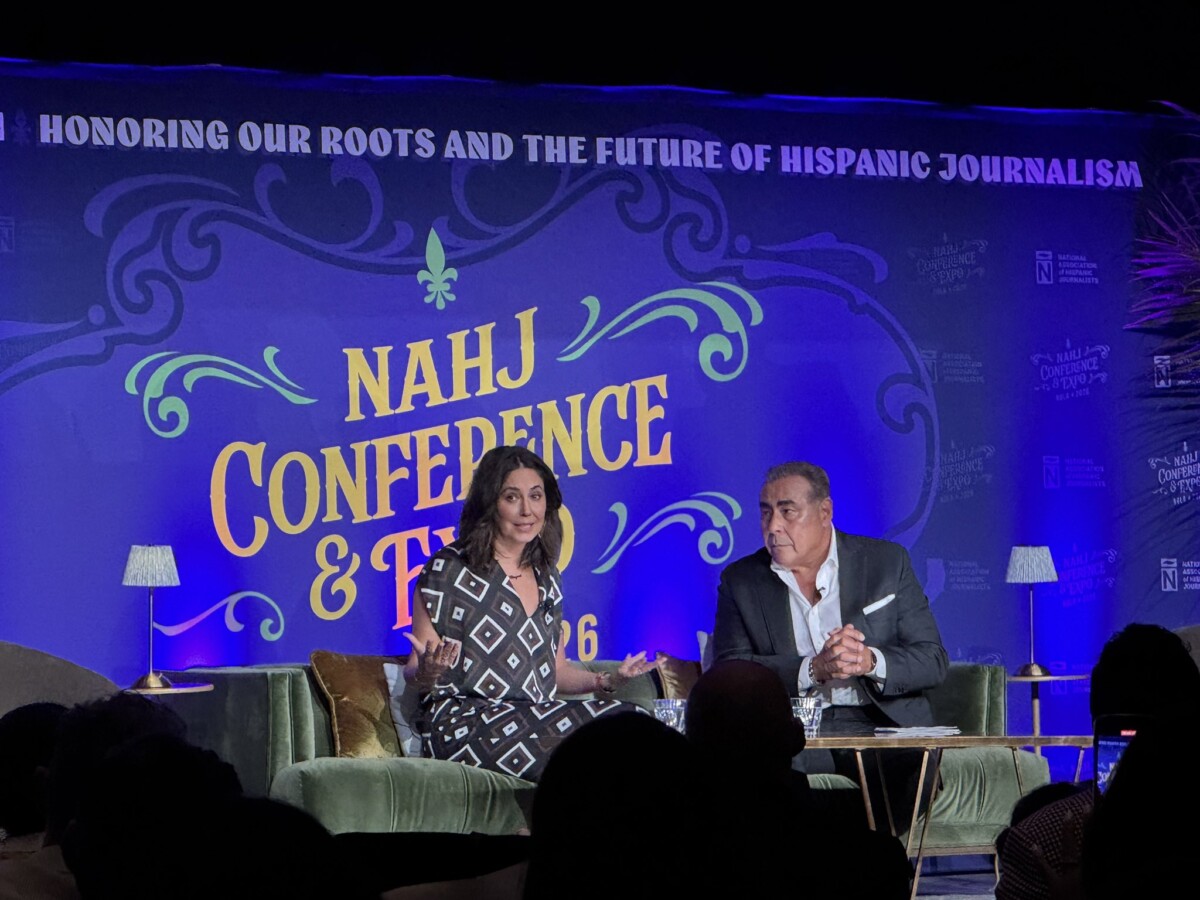
“I don’t know why I was fired,” Cecilia Vega said. ‘It’s been about three months now … and I don’t know. I was not given a reason. I still have not been given a reason.” (Credit: Dillon M. Thomas/X)
Tells NAHJ, ‘I Still Don’t Know’ Reason for Ouster
Cecilia Vega, fired in May from CBS’ “60 MInutes,” Thursday gave details of cases where she said CBS leadership, which includes CBS Editor-in-Chief Bari Weiss, tried to “insert political bias” into her pieces.
“Never in my career until now have I felt that those edits, those suggestions, came from a place of misinformation or politics,” Vega said at the National Association of HIspanic Journalists convention in New Orleans. “That’s the difference,” Oliver Darcy reported for his subscription-only Status newsletter.
Speaking on stage with ABC News correspondent John Quiñones, “Vega said that while reporting a piece in the wake of the fatal shootings of Renee Good and Alex Pretti in Minnesota, she was encouraged to include footage of protesters violently attacking people in the streets whom the demonstrators believed to be ICE officers in plain clothes. But Vega said her team could find ‘no credible examples’ of such behavior at the time,” Darcy wrote.
“Moreover, Vega said her team was asked to include a supposed moment from a press conference in which the city’s Democratic mayor, Jacob Frey, said he wanted local police to fight federal ICE agents in the streets to stop immigration activity, and that the city’s police chief rolled his eyes at the suggestion. Vega said her team scrubbed every frame of video from the press conference, but never found such a moment, deeming it ‘misinformation.’
” ‘That never happened,’ she said. ‘We could not find any instance of the mayor saying something like that.’
“On a separate piece about Donald Trump’s Iran War, just three weeks into the conflict, Vega said she was told to introduce the story by saying, ‘Who is winning the war? Iran is totally outgunned by the United States and Israel.’ Vega called it an ‘administration talking point’ used by the White House as it contended it was winning the war, which continues to rage months later without an end in sight.
“Finally, on a third piece about SNAP benefit cuts and poverty shot in the state of West Virginia, Vega and her team opted to tell the story ‘through the voices of strictly residents.’ Vega said she deliberately avoided interviewing experts and politicians for the piece. But Vega said she was asked why she had not either interviewed J.D. Vance or spoken to an expert about his ‘Hillbilly Elegy’ book. The book, Vega noted, had been published a decade before her story and was about his upbringing in Ohio, not West Virginia.
“Vega was asked if the attempted meddling ultimately impacted her pieces. ‘If you watch my pieces, you’d see those examples did not make them in,” Vega said, prompting loud and sustained applause from the audience.
“When asked who specifically was directing the meddling that she faced, Vega did not directly name Weiss, simply referring to the ‘new administration at CBS News.’ But she said that things ‘started to change when new people started showing up in the screenings and giving their feedback on pieces,’ strongly suggesting she believed Weiss was driving the requests. Vega described ’60 Minutes’ as previously having been an ‘island’ with a ‘moat of protection around it.’
“Vega said she could tell that the Weiss-led management team was not a fan of hers early on, describing a ‘real tension’ in screenings ‘that made me nervous.’ Vega said she could ‘get a sense’ that ‘they were not liking this back and forth’ over her stories. But she said she was never told specifically why she was fired and that she ‘never had an opportunity to sit down with Bari Weiss one on one.’
” ‘I don’t know why I was fired,’ Vega said. ‘It’s been about three months now … and I don’t know. I was not given a reason. I still have not been given a reason.’
“A CBS News spokesperson declined to comment on Vega’s latest accusations. The network has defended Weiss and previously said Vega’s claims are ‘not based in reality.”
‘CBS News has also rejected allegations that it has inserted political bias into stories, despite repeatedly facing such accusations from its prominent now-former journalists. In a story published by The Wall Street Journal in June, Weiss acknowledged providing editorial guidance on stories, but contended that it was simply part of her job.
“ ‘What’s being called “editorial interference” is in reality the job description of an editor in chief,’ she said.”
- Ivan Saravia, Latino Reporter: How Cecilia Vega’s life flipped in one minute and 48 seconds

The two organizations held joint conventions in 2020, above, and in 2022 (logo below).
NABJ Keeping ’27 Date, Despite NAHJ Objection
NABJ President Errin Haines (pictured) told members Friday that the organization will stick with its revised dates for its 2027 convention, even though they conflict with those of the already-scheduled conference of the National Association of Hispanic Journalists.
 “We recently learned that NABJ’s revised dates coincide with the dates of NAHJ’s 2027 convention,” Haines said in her message.
“This overlap was neither intentional nor intended as a slight to NAHJ or any other partner organization. Our decision was based solely on the needs of NABJ, the accessibility of the convention for our members and our responsibility to make sound decisions that support the sustainability of the organization.
“I have spoken directly with NAHJ leadership and clearly communicated NABJ’s position and the circumstances surrounding our decision. We respect the important role NAHJ plays in advocating for its members and strengthening journalism, just as NABJ remains firmly committed to serving Black journalists, media professionals and students.
“Our hope is that NABJ and NAHJ will continue collaborating on the issues that affect our members and the broader journalism community. We also hope that the sponsors, partners and friends who have historically supported both organizations will continue to recognize the distinct value of each convention and find meaningful ways to support and participate in both gatherings next summer.”
NAHJ did not immediately comment.
Then-NABJ executive director Drew Berry communicated the original NABJ 2027 dates to NAHJ in 2024, before NAHJ made its plans, according to Julio-César Chávez, NAHJ vice president of broadcast.
 But Haines explained her rationale Friday by saying, “The original dates fell significantly outside NABJ’s traditional early-August convention window. Scheduling the convention later in the month could have created attendance challenges for many members, particularly college students, educators, parents and professionals whose academic, family and work obligations intensify as the fall season approaches.
“Returning to an early-August timeframe gives more members the opportunity to attend, participate fully and benefit from the professional development, networking, recruitment and community that our convention provides.
“The date change also allowed NABJ to honor our long-standing commitment to convene in Houston. We were originally scheduled to gather there in 2021 but were unable to do so because of the COVID-19 pandemic. Returning to Houston has remained an important organizational priority, and the August 4–8 dates provided the most viable opportunity to fulfill that commitment while meeting NABJ’s operational and financial needs.”
New Owner Byron Allen Slashing Jobs at HuffPost
 “Comedian-turned-broadcaster Byron Allen (pictured, from Byron Allen Media) is slashing jobs at the Huffington Post less than a few weeks after acquiring its parent company BuzzFeed, according to an internal memo circulated to employees on Friday,” Matthew Keys reported for TheDesk.net,
“The layoffs will impact more than a dozen sk.workers at the outlet, its editor-in-chief Whitney Snyder wrote in the all-staff note. It wasn’t immediately clear which positions will be impacted.
“In addition to the job cuts, Huffington Post Executive Editor Kate Palmer is leaving the publication. Palmer joined the outlet as a national editor in 2012 before rising up the ladder to one of the top positions within the organization.
“Huffington Post, which now operates as HuffPost, has traded hands a number of times over the past few years. In 2011, publisher Ariana Huffington sold the outlet to AOL for $315 million. AOL was later acquired by Verizon, which spun Huffington Post into a separate company that was purchased by BuzzFeed in 2020. . . . ”
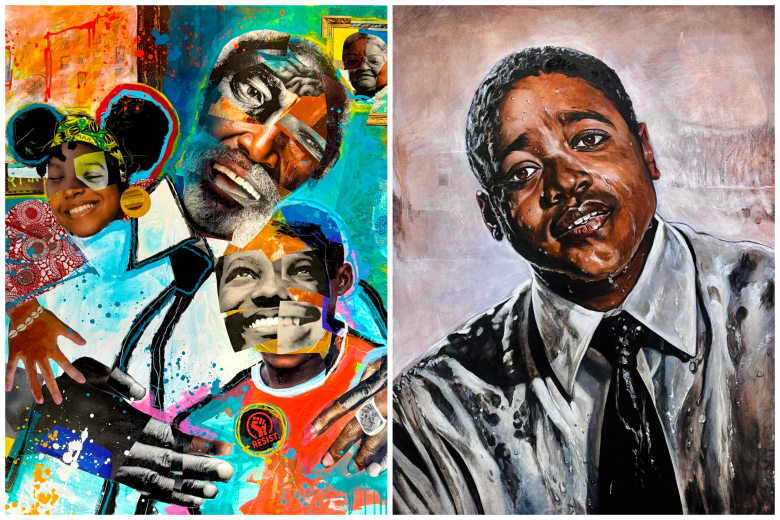
From an exhibit honoring Emmett Till at Blanc Gallery in Chicago. Left: Raymond A. Thomas’ “We Love You Paw Paw,” a piece that considers Till’s survival into old age with his grandchildren. Right: Gerald Griffin’s piece “Rising From the Depths, Unbroken.” (Credit: the artists, via Block Club Chicago)
Illinois Honors Emmett Till; Death Became Journalism History
“Illinois will annually honor Emmett Till, the Black teenager from Chicago whose 1955 murder galvanized the Civil Rights Movement and became a glaring example of failures in the justice system, under a new law Gov. JB Pritzker signed Thursday,” Olivia Olander reported for the Chicago Tribune.
“Every policy that advances justice passed, every bill signed, every monument built, is in the spirit of the legacy of accountability and progress, every inch of which was fought for, often with blood,” Pritzker said. “Today, we are building on that legacy.”
The Tribune accompanied its story with a 2025 look back at how the Tribune covered the story. Separately, a group exhibition, “From Memory to Movement: Emmett at 85,” has been on display since June at Blanc Gallery in Bronzeville. It closes this weekend with a “Radical Joy Celebration” on what would have been Till’s 85th birthday.
“The exhibit brings together 11 Black Chicago-based contemporary artists to produce works that speak to the humanity of Emmett Till and the social construct of the times we’re living in,” Darcel Rockett wrote July 2 for the Tribune.
The murder of Till was a significant moment in journalism history.
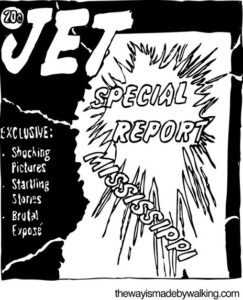 “Pictures of Till’s bloated and mutilated face, published across the country in JET Magazine and newspapers worldwide galvanized the despair and anger of Blacks throughout the nation,” Malcolm R. West reported for Jet on Jan. 27, 2003. “The political and social reaction to the gruesome murder is widely considered the spark which ignited America’s Civil Rights Movement.
“Comedian/human rights activist Dick Gregory said, ‘It was not Emmett Till’s death, but [Till’s mother Mamie] Till-Mobley’s ability to say to JET Magazine, ‘I will share this tragedy with you in order to share it with the world.’ And it was that picture in the magazine that brought lynchings to a standstill.
“Before Emmett Till’s death, ‘Black folks had heard of lynchings, but we had never seen the results. We’d heard of it. Or you would see some old pictures from the Twenties of bodies hanging down from trees, but
you never got a close up of what it really is,’ he explained.
“After news of Till’s murder spread across the country, more than 200,000 people lined up for blocks outside the A.A. Rayner Funeral Home in Chicago to view the teenager’s disfigured body over the four days it lay in state. It was considered one of the largest Black demonstrations in American history at that time.”

A scene from PBS’ “Daniel Tiger’s Neighborhood,” one of the programs studied by the University of Illinois’ Michael T. Rizzo and his research team. (Credit: Fred Rogers Co.)
Black Kids’ Presence on TV Affects Views on Diversity
“Television creatives and executives have pledged to increase racial diversity on and off screen for years. But whether it makes a difference in viewers’ actual feelings and reactions toward race and class has long been a question,” Whitney Friedlander reported July 13 for the Los Angeles Times.
“A new report, published Monday in the journal American Psychologist by the American Psychological Assn., indicates that it does. Titled ‘The Role of Children’s Media in White, U.S. Children’s Developing Racial Bias,’ the yearlong longitudinal study that looked at white children between the ages of 4 and 8 found that those whose favorite TV shows and movies portrayed fewer Black characters were less likely to choose to play with a Black child, held less positive attitudes toward Black children and were less likely to choose to attribute Black-white racial inequalities to intrinsic racial differences. These results were more overt when the analysts factored in class and status dynamics.
“Michael T. Rizzo, an assistant professor of psychology at University of Illinois, Urbana-Champaign, and the corresponding author of this study, says that his work looked at white children’s reactions because ‘they are the dominant and majority group in the United States’ and research has shown that ‘they’re the most likely to develop biases.’ Similarly, he says that while ‘anti-Black racism is not the only form of racism in our country,’ historically speaking, ‘this is where the literature really focuses on.’ The age range was chosen because accurate readings on these topics are harder with older kids. As kids age, he says, they usually ‘pick up the idea that they shouldn’t be responding with prejudice.’ ”
“PBS News Hour” co-anchor Amna Nawaz announces Sylvia Bugg’s passing. “She was a dedicated and passionate leader, and a staunch supporter of our team at the News Hour,” Nawaz said. (Credit: YouTube)
Sylvia Bugg, PBS Chief Programming Exec, Dies at 55
“Sylvia Bugg, PBS‘ chief programming executive and general manager for general audience programming, died ‘unexpectedly this weekend,’ PBS CEO Paula Kerger announced,” Tony Maglio reported July 20 for the Hollywood Reporter. “She was 55.”
“ ‘Over decades in public media, including her leadership at the Corporation for Public Broadcasting and three chapters of service here at PBS, Sylvia shaped the programming that defines our service to the American people,’ Kerger said Sunday. ‘She brought forward landmark films across history, science and the arts and guided our America @250 slate through a defining year.’
” ‘Bugg will be ‘gratefully remembered for her commitment to ensuring public media’s programming reflects a broad range of voices and perspectives,’ Kerger added. ‘She was a strong advocate for education, both in the programs she supported and in her own life, as shown by her multiple advanced degrees, including a recent doctorate.”’
“No cause of death was provided. This month, PBS received five Primetime Emmy nominations. . . . ”
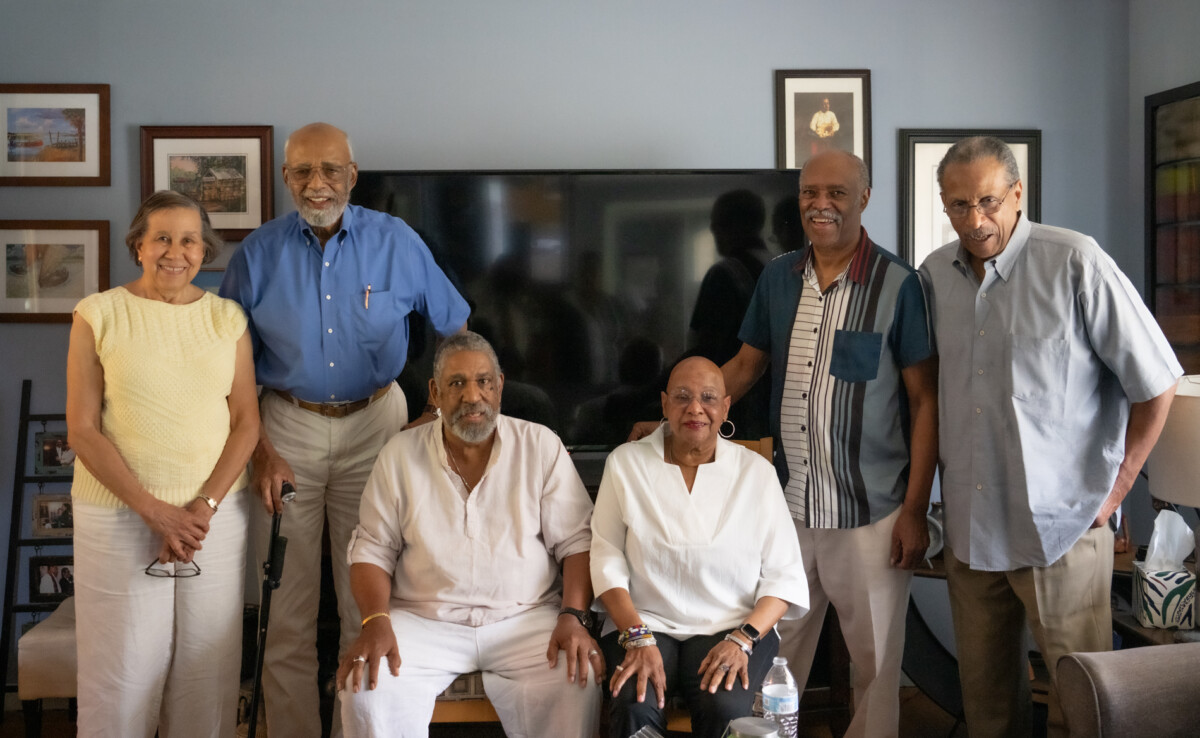
From left: Bobbi Bowman, Leon Dash, Ivan Brandon, Penny Mickelbury, Richard Prince, Ronald A.Taylor. (Photos by Jeanine L. Cummins)
Washington Post Metro Seven Mark 54 Years Since Complaint
The six surviving members of the Washington Post Metro Seven, who filed a landmark discrimination complaint against the Post with the Equal Employment Opportunity Commission in 1972, reunited on June 14 at the suburban Washington home of Ivan C. Brandon, one of the Seven, and his wife, Judy Brandon.
“The ‘Metro Seven’ fundamentally reshaped the American media landscape by pioneering the fight against systemic racial discrimination in major national newsrooms,” according to Gemini AI. “In 1972, seven Black journalists working on The Washington Post’s Metropolitan desk — Leon Dash, Richard Prince, Bobbi Bowman, Ronald Taylor, Ivan C. Brandon, Michael Hodge, Penny Mickelbury — . . . filed a landmark complaint . . . Their bold actions forced widespread changes in media representation and hiring practices. . . . ” The group is in the Hall of Fame of the National Association of Black Journalists.
NABJ Changes Plans, Putting NAHJ on Edge
July 23, 2026
Black Journalists’ Move Seen as Financial Threat
Disney Cuts Hit ESPN, National Geo, Film Studio
Ryan Clark Learns Fate During Commercial Break
EEOC Votes to End Collection of Race, Gender Data
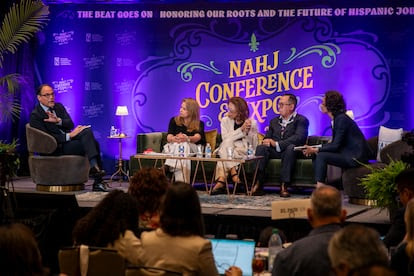
Jan Martínez Ahrens, editor of Spain’s El Pais, at the National Association of Hispanic Journalists convention in New Orleans Wednesday with Mari Torres, Ginger Thompson, Alfredo Corchado and journalist Paola Ramo. (Credit: Aggi Garduño, Patricia Clarembaux)
Black Journalists’ Move Seen as Financial Threat
A decision by the National Association of Black Journalists to move up the dates of its 2027 convention puts it in competition with the already-scheduled gathering of the National Association of Hispanic Journalists, threatening its ability to raise money, and prompted NAHJ’s vice president of broadcast to declare bluntly: “We expect NABJ to change their dates.”
But doing so could mean penalties for NABJ, which has financial issues of its own.
“Organization leaders said that NAHJ already booked its hotel and signed venue contracts for its Minneapolis event, and pulling out of those deals could cost the organization,” Angela Osorio reported Wednesday for the Latino Reporter, the NAHJ convention’s student newspaper.
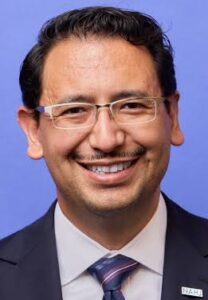 “It puts undue pressure and undue financial burden on NAHJ for us to be changing our dates at the last minute when we have had our dates finalized and signed and publicized,” said Julio-César Chávez (pictured), vice president of broadcast.
NABJ President Errin Haines (pictured, below) did not respond to a request for comment, but the student publication said Haines told them she was not aware of the scheduling conflict until the Latino Reporter contacted her this week.
“NABJ had originally planned its conference to begin Aug. 18, according to the organization’s president, Errin Haines. But the group’s leadership decided about four months ago to shift the event’s dates “in the best interest of our membership and in the best fiscal interest of our organization,” Haines said.
“The previous conference dates were ‘badly misaligned with our traditional conference window of early August,’ she said. The earlier dates would allow college students, parents and other members to have greater flexibility to attend, she said.
“NABJ, NAHJ and the Asian American Journalists Association typically notify each other of their conference dates years in advance to avoid scheduling conflicts, NAHJ leaders said.”
Drew Berry, former executive director of NABJ, “informed leaders of NAHJ two years ago that the group would be hosting its 2027 Houston conference from Aug.18 to 22, according to emails obtained by the Latino Reporter.” That decision “informed NAHJ’s subsequent date selection,” Chávez told Journal-isms.
Haines, “who was elected to her role last summer, said her group signed amended contracts changing its Houston dates in March,” the Latino Reporter continued.
“Chávez said NAHJ leadership found out about the scheduling conflict in mid-June. NAHJ executive director Yaneth Guillén-Diaz reached out to NABJ’s interim director at the end of June but had been unable to reach a resolution by the start of this year’s annual conference. . . .”
In a statement, NAHJ said, “The scheduling change creates financial, contractual and operational challenges that ultimately impact our members.
“Our priority remains serving our members while protecting the long-term health of our association. NAHJ has asked NABJ to adjust its 2027 conference dates to avoid the overlap and remains willing to engage in a productive dialogue to explore a mutually beneficial solution.”
The Latino Reporter added, “The two organizations, which have historically hosted joint conferences, have stopped collaborating in recent years, spurred, in part, by a decision by NAHJ in 2023 to pull out of a planned 2024 joint conference,” in order to have its own convention to commemorate its 40th anniversary, a circumstance that still generates resentment by some in NABJ, in part because of the financial issues it created.
As it turned out, the appearance by then-candidate Donald Trump at that NABJ convention generated unprecedented attention to that Chicago event.
Journal-isms is not attending the NAHJ conference, now underway in New Orleans. The association last year imposed a policy breaking from traditional and prevailing practice by requiring members of the press to pay registration costs of up to $625 to report on its four- or five-day conferences.
Meanwhile, NAHJ found itself in a scheduling conflict this week with the Indigenous Journalists Association, which is meeting at the same time in Portland, Ore. NAHJ announced its 2026 dates in January 2025, while IJA declared its choice of dates in December.
IJA Executive Director Rebecca Landsberry-Baker attributed the conflict to a “total oversight on our part.”
NAHJ did not respond to a request for attendance figures, but IJA opened its conference with 444 registrants, a record, Landsberry-Baker said at a Tuesday board meeting. That did not include any on-site registrants.
IJA’s biggest sponsor was the Confederated Tribes of the Umatiilla Indian Reservation. Comcast NBCUniversal, Oregon Public Broadcasting, the Confederated Tribes of Siletz Indians, the Inatai Foundation, The New York Times, AARP, ABC News and the MacArthur Foundation were major donors, and the Craig Newmark School of Journalism at CCNY, NPR, the Medill School of Journalism, Media and Integrated Marketing Communications at Northwestern University had tables, as did exhibitors promoting books, jewelry and other products aimed at Indigenous people.
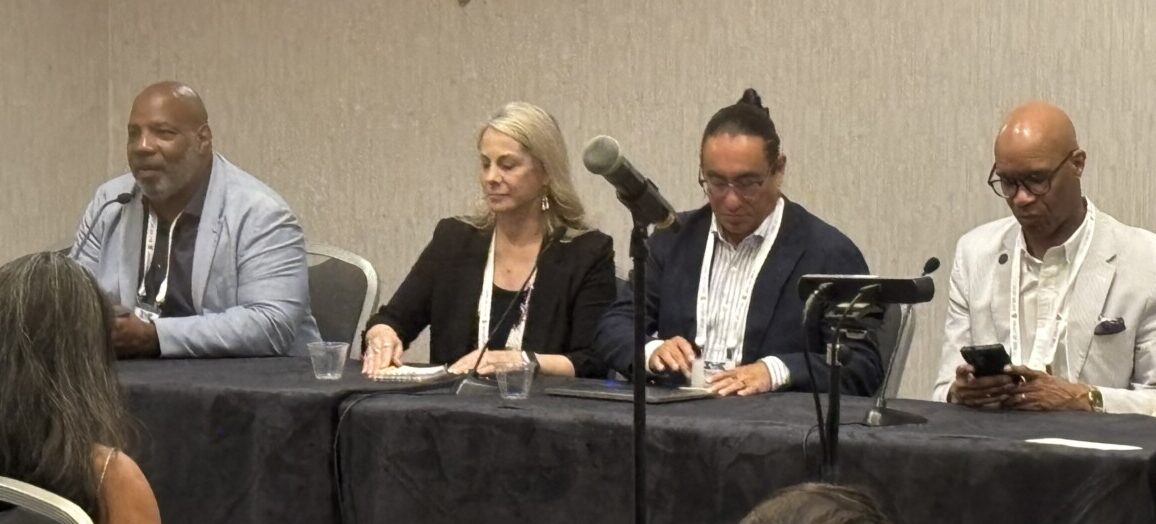
From left, Columbia Journalism School Dean Jelani Cobb; Melissa Greene-Blye, IJE Education Committee chair; Tristan Ahtone of Grist and Medill Dean Charles Whitaker discuss “What Journalism Schools Need to Learn from Indigenous Newsrooms.” (Credit: Richard Prince)
IJA’s difference in focus from traditional journalism groups was illustrated at a Wednesday panel on “What Journalism Schools Need to Learn from Indigenous Newsrooms,” which featured Medill Dean Charles Whitaker, Columbia Journalism School Dean Jelani Cobb, Melissa Greehe-Blye, IJE Education Committee chair; and Tristan Ahtone, editor at large at the environmental publication Grist.
Amid this summer’s 250th anniversary commemorations of the Declaration of Independence, Ahtone declared that the United States had seen “250 years of journalism” that echoed the government’s determination to exterminate Indigenous people and promote imperial expansion.
On the same panel, Whitaker discussed efforts to have Indigenous languages added to the list of those accepted for study by the university, only to have the administration plead that it did not have academics with sufficient credentials to do so. The university should have found a way to accomplish the goal, Whitaker said.

Members of Ke Kai O Kahiki, a men’s hula dance company from Oahu, perform at the opening night reception at the Indigenous Journalists Association conference in Portland, Ore. They are the subject of a film, “Hula,” previewed at the convention. (Credit: Richard Prince)
At a session on “The Psychedelic Story and Indigenous Communities,” speakers complained that too many outsiders approach the issue without an appreciation for the time-tested role the substances have played in Native communities, including the adoption of precautionary safety measures.
Other sessions promoted the association’s goals of increasing the number of Indigenous journalists in mainstream media, and covered fact-checking, data collection, climate change and best practices for covering Indigenous communities.
- Indigenous Journalists Association: Work from Indigenous Student Fellowship
Disney Cuts Hit ESPN, National Geo, Film Studio
“The Walt Disney Co. is cutting hundreds of jobs across the company as it continues a corporate streamlining that began in earnest earlier this year,” Alex Weprin reported Monday for the Hollywood Reporter.
 “Some corporate functions, ESPN, Disney Entertainment Television and film studios are expected to be impacted, with Pixar said to be the film studio seeing the most cuts, and Nat Geo most heavily impacted at DET, The Hollywood Reporter has learned.
“Pixar has released two films this year: the original film Hoppers and Toy Story 5, which is among the biggest movies of the year so far. The cuts also include some notable on-air talent at ESPN, including longtime SportsCenter anchor and Baseball Tonight host Karl Ravech, who has been with the channel since 1993, and Ryan Clark, a former NFL player who has been an analyst for the channel’s football coverage for over a decade.
“That being said, most of the layoffs at ESPN are behind-the-scenes staff, connected to its acquisition of the NFL Network earlier this year. . . .”
“About a dozen ABC News staffers have been impacted, with isolated layoffs in other DET divisions,” Dade Hayes reported for Deadline.
Samantha Masunaga added Monday for the Los Angeles Times, “At National Geographic, dozens of people have received layoff notices, though many will have an opportunity to move to a different role, according to another person familiar with the matter. Affected positions are across National Geographic’s television section, as well as editorial and digital.”
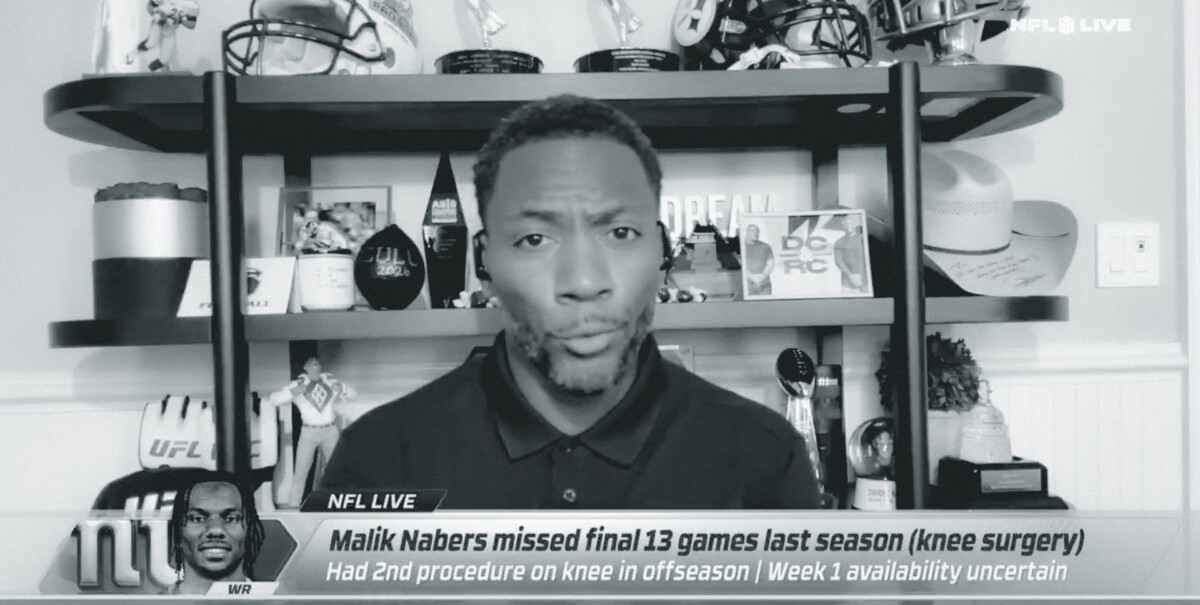
Ryan Clark was on air shortly before he learned of his dismissal from ESPN. (Screenshot via ESPN)
Ryan Clark Learns Fate During Commercial Break
“The cuts at the Disney-owned network exposed mounting tensions inside its Bristol headquarters, Status has learned, with network management scrambling to notify talent and staffers of their fate as news leaked,” Natalie Korach reported Wednesday for Status.
“On Monday afternoon, shortly after Ryan Clark went on air for ESPN’s ‘NFL Live,’ journalists were firing off emails to the network on reports that the analyst was about to be laid off.
“ESPN had planned to inform Clark the following day as part of a broader round of cuts.
“Instead, executives were suddenly faced with a choice: move quickly to tell Clark personally during a commercial break, or risk him learning he’d lost his job from someone else.
“Leadership at the Disney-owned network ultimately decided Clark should hear it from them first. So during a commercial break, a manager called to explain both the decision and why it was happening in the middle of a live broadcast.
“Clark and ESPN then mutually agreed he would not return to finish the on-air segment. Shortly after, around 5 p.m. ET, The Athletic’s Andrew Marchand broke the news that Clark had been cut, a day before ESPN had planned to notify employees as part of broader layoffs.
“The leaked reports dramatically accelerated ESPN’s urgency, Status has learned, with executives fearing that if they didn’t move quickly, employees slated to lose their jobs might learn their fate from outside reporting before hearing it directly from the company.
 “That led to an unusually frantic Tuesday morning inside ESPN. Some staffers received calls from an unfamiliar phone number, I’m told, only to answer and hear editor in chief Roxanna Scott (pictured) informing them they were among the cuts.
“One laid-off staffer told Status they had just returned from a reporting trip and had another scheduled later this month, forcing them to immediately scrap travel plans and cancel interviews. Hours later, several employees were still waiting for basic information about next steps, and even collecting their personal belongings from their desks at ESPN headquarters in Bristol.
” ‘It felt really haphazard and random,’ the staffer told Status. While the on-air departures dominated headlines on Tuesday, the front-facing layoffs represented only a small slice of the cuts, according to a person familiar with the matter.
“The overwhelming majority of those affected were behind-the-scenes employees tied to the integration of NFL Network, following ESPN’s acquisition of the league-owned media asset earlier this year. In a memo to employees Tuesday morning, ESPN chairman Jimmy Pitaro acknowledged that integrating the NFL assets had required the company to evaluate its ‘collective teams, resources and organizational structure to best position us for the future,’ adding that ‘most of the job cuts are tied to the acquisition,’ though employees elsewhere across the company were also notified.
“Indeed, the Disney-wide layoffs were not isolated to ESPN. Across the Josh D’Amaro-led conglomerate, several hundred positions saw the axe, including hard hits at National Geographic and Pixar.
“ABC News also saw about a dozen positions eliminated, Status reported. The broader cuts reflect the continued reshaping of Disney’s media business as the company navigates the decline of the traditional television bundle, invests in streaming, and searches for efficiencies across its sprawling entertainment empire. . . .”
- Andrew Marchand, the Athletic: Once the ‘Worldwide Leader in Sports,’ ESPN’s latest layoffs cement its new identity
- Charlotte Tobitt, Press-Gazette: Journalism job cuts in 2026 tracked: Latest from National Geographic, ESPN and Sherwood News
- Kristen Wong, si.com: Ryan Clark Clarifies How ESPN Let Him Go During ‘NFL Live’ Episode: ‘I Wasn’t Forced?’
EEOC Votes to End Collection of Race, Gender Data
“How many women hold executive-level positions at top U.S. companies? What is the racial and ethnic breakdown of those roles? What is the gender and racial breakdown of the lowest-paid roles at those companies?,” Alexandra Olson and Claire Savage asked Tuesday for the Associated Press.
“The Trump administration is making it harder for the public to know, moving to toss aside a 60-year-old requirement for tens of thousands of private sector employers to submit workforce demographic reports each year to the Equal Employment Opportunity Commission, the agency responsible for enforcing anti-discrimination laws in the workplace.
“The EEOC’s Republican majority voted 2-1 Tuesday to rescind the data collection requirement, submitting the proposal to a 30-day public commentary period before final approval. The proposal is a quiet but profound salvo in President Donald Trump’s shake up of civil rights enforcement, ending a practice that has endured through 10 Republican and Democratic administrations.
“EEOC Chair Andrea Lucas, an outspoken critic of diversity and inclusion practices who has urged white men to come forward with discrimination complaints, argued that requiring companies to submit the annual demographic reports risks encouraging companies to justify discriminatory practices to diversify their workforce.
“ ‘It may promote racial stereotyping at work, and it may encourage employers to engage in discrimination,’ Lucas said during a hearing ahead of the vote. . . . “
