
Threats to Freedoms Demand More, Better Reporting
‘A Quiet Force Shaping Conversations on Race and Media’
Journal-isms Roundtable photos by Jeanine L. Cummins
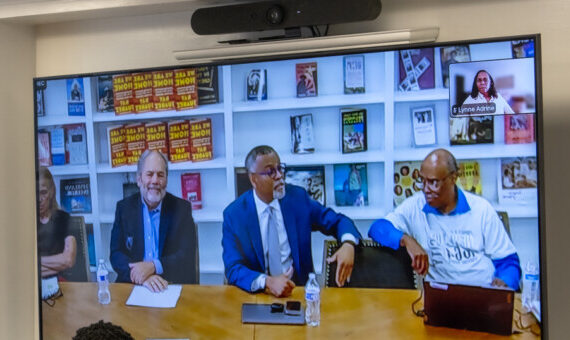
Homepage photo: From left, Ray Suarez, Eddie S. Glaude Jr. and Richard Prince
The Journal-isms Roundtable “What We Should Know for ‘America’s 250th’ “ took place at the Washington, D.C., headquarters of the National Conference of Negro Women. It drew about 47 people; 19 in person and about 28 via Zoom. (Credit: YouTube)
Threats to Freedoms Demand More, Better Reporting
As the 250th anniversary of the United States finds most Americans feeling that the country is heading in the wrong direction and our freedoms under threat, journalists must reimagine their roles, especially as business models crumble and news consumers seek information outside mainstream news outlets, attendees of our Journal-isms Roundtable concluded on Thursday.
“What We Should Know for ‘America’s 250th’ “ took place at the Washington, D.C., headquarters of the National Conference of Negro Women. It drew about 47 people — 19 in person and another 28 via Zoom — amid competition from a myriad of events, including preparations for Juneteenth, the annual convention of Investigative Reporters & Editors and the ticker-tape parade honoring the NBA champion New York Knicks.
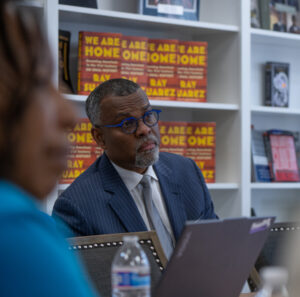 Lead panelist Eddie Glaude Jr. (pictured), Princeton University professor and author of the new “AMERICA, U.S.A.: How Race Shadows the Nation’s Anniversaries,” stressed that journalists must understand both economic pressures —such as oligarchic ownership — and their democratic responsibilities.
Glaude asked what it means to practice journalism across fragmented media ecosystems so that people can “do the work that democracy requires,” as seen at [1:22:55] [1:23:50] [1:23:56] [1:24:10] and [1:24:21] on the video.
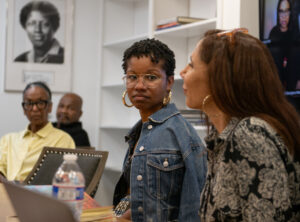 Former Washington Post managing editor Krissah Thompson (pictured, flanked by former colleagues Robin Givhan, at left, and Lonnae O’Neal) argued that journalism is “crucial” but “wounded,” with institutions captured by billionaires and social media algorithms dictating what young people see; she lamented the lack of media literacy education and the difficulty of adapting to attention‑grabbing formats without sacrificing core journalistic principles. [1:24:32] [1:24:46] [1:25:13] [1:25:35] [1:26:13]
Thompson, now a consultant advising The Root, noted the collapse of local newspapers, saying that 80% have shuttered since 2010, creating “news deserts” filled by platforms such as X, Facebook and TikTok, though she also pointed to such nonprofit outletsas ProPublica, Mississippi Today and others as hopeful models that still depend on public financial support. [1:26:29] [1:26:50] [1:26:55] [1:27:04] [1:27:10]
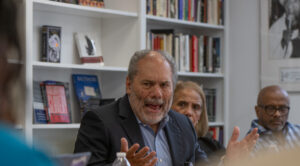 Ray Suarez (pictured), journalist and author, most recently of “We Are Home: Becoming American in the 21st Century: an Oral History,” compared the current media landscape with the 1830s.
Then, expensive, partisan newspapers proliferated. Suarez warned that today’s 900,000 podcasts range from excellent to “crappy” with little oversight, editing or fact‑checking, making it hard for audiences to distinguish truth from misinformation. [1:31:02] [1:31:27] [1:31:42] [1:32:00] [1:32:13] [1:32:49].
Suarez argued that new forms of factual oversight and production are needed because technology has “thrown everything open” and blurred the line between professional journalism and amateur content; if “everybody’s a journalist,” he said, “nobody’s a journalist.” [1:31:02] [1:31:27] [1:31:42] [1:32:00] [1:32:13] [1:32:49]
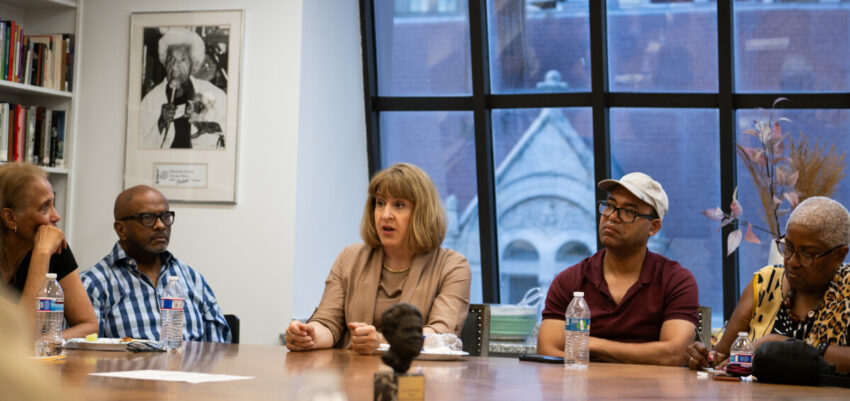
Rebecca Baker, center, with Dorothy Davis and Mark Williams at left, under photo, and Kamau High and Junette Pinkney, at right.
Rebecca Baker, an editor at Bloomberg Industry Group and former president of the Society of Professional Journalists, emphasized that young people have grown up knowing only “Trump‑style” politics and that journalists must use multiple platforms — including the Black press and “minority press” — to reach them, to show that alternative political norms exist, and to give them hope and a sense of agency in an “attention economy” dominated by social media and AI‑generated “slop.” [1:18:35] [1:18:49]
 Meanwhile, Marc Morial, president and CEO of the National Urban League (pictured), suggested that journalists are not adequately:
- Connecting dots: Journalists may be covering voting rights, tax policy, and anti-poverty programs separately rather than showing how they are part of a coordinated attack.
- Dramatizing stakes: Journalists may be treating these as routine political developments rather than communicating the urgency and magnitude of what is at stake.
- Mobilizing audiences: Journalists may be informing audiences without helping them understand what they should do in response.
- Amplifying marginalized voices: Journalists may not be adequately covering the work of civil rights organizations and community coalitions.
The Urban League has released a new civic education resource, “America 250: A Guide for Defending Democracy,” to help Americans navigate an era of profound democratic challenges.
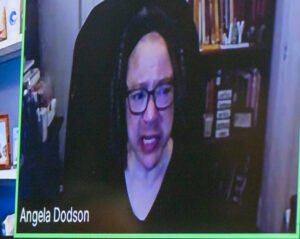 Journalist Angela Dodson emphasized that her new book “We’ve Been Here Before: How Rebellion and Activism Have Always Sustained America,” written with her late husband, Michael Days, was designed to “remind people that one, we’ve been here before, but we have learned to rebel and survive.” [29:09] She explained: “We are a country that was created by rebellion and at various points along the way, different people have risen up to fight some injustice or to move us forward.” [29:41]
Dodson highlighted a critical challenge that journalists should address: Communities actively erase histories of rebellion and activism. She described discovering that many of the movements she wrote about were never taught locally, even when they occurred in those communities.
Example: The West Virginia coal miners’ march of 1920 — a pivotal moment in labor history — occurred near her childhood home but was never taught there: “I grew up in West Virginia and the West Virginia miners’ march happened near where I grew up and I never learned about it in school.” [34:02]
Those remarks were part of a wider discussion.
Here is Rev.com’s summary of the Roundtable, produced via artificial intelligence, with numbers representing the remarks’ location on the video:
“Roundtable host Richard Prince framed the session as a ‘Journal-isms’ discussion on what Americans should know and do as the U.S. approaches its 250th anniversary. [0:01] [1:54] [2:19]
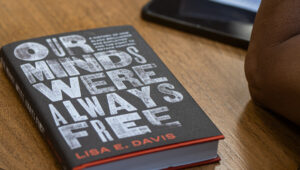 “Entertainment lawyer Lisa Davis argued that America was built as much on ‘Black brilliance’ as on stolen Black labor, highlighting how intellectual property law both exploited and sometimes empowered Black creators from the colonial era to today. [3:19] [3:40] [4:01] [4:31] [5:23] [5:38]
“Eddie Glaude described U.S. history as a ‘madness’ born of trying to be both a beacon of freedom and a white republic, using past centennial anniversaries (1876, 1926, 1976) to show how celebrations masked racial violence and exclusion, and calling for ‘love in country’ and honest confrontation with the past. [6:43] [8:01] [8:15] [8:36] [9:06] [9:23] [10:00] [10:19] [11:14] [12:06] [12:32] [12:56] [13:11] [13:27] [37:33] [38:02] [38:23] [39:02] [39:16]
[Glaude, 57, also bemoaned the failure of the Baby Boom generation to make way for succeeding ones. He spoke as former president Barack Obama unveiled the Obama Presidential Center in Chicago.
[“I’ll say this, I’m delighted to have the platform that I have, but I know I can’t stay in it,” Glaude said. “I can’t keep it for long. I don’t want to do to young people what was done to me. And what was done for me is that nope, the Baby Boomers wouldn’t leave. They wouldn’t leave. They still here. And so our period has been like this (closes his hands). And so if we’re going to allow that innovation to make its way into the public domain, people my age are going to have to do what we need to do to clear the underbrush and then get out of the way. Otherwise we’re going to duplicate the very thing that has kind of gummed up transition.
[“When I look at Juneteenth celebration and I looked at the presidencies and Obama and Michelle Obama, then I saw them framed by [George W.] Bush and [Bill] Clinton, and I was thinking about all the people in the House of Representatives and leadership positions who look like that. It’s like, damn. In terms of what’s actually gumming up imagination and innovation and creativity.”]
“National Urban League president Marc Morial warned that post‑1954 civil rights gains are under ‘vociferous hostile amoral attack,’ likening current trends to a path toward apartheid rule by minority interests, and urged a ‘summer of action’ to fight voter suppression and apathy. [15:34] [16:07] [16:24] [17:14] [18:11] [18:41] [19:03] [19:29] [19:47] [20:15] [20:25] [20:46] [21:18] [22:03] [22:32]
“Ray Suarez highlighted a backlash against ‘usable history,’ debunked myths like ‘Irish slavery,’ criticized exclusionary labels such as ‘heritage American,’ and warned that ignorance and comforting myths about race and nationhood are redefining the political battlefield. [23:06] [23:48] [24:35] [24:52] [25:09] [25:30] [25:45] [26:27] [26:45] [27:32] [27:59]
“Angela Dodson outlined her book on how rebellions and movements — from Indigenous resistance and slave revolts to women’s suffrage, labor struggles, civil rights, peace activism, and environmentalism — have repeatedly sustained and reshaped the nation, offering tactical lessons for today.” [29:09] [29:41] [30:14] [30:33] [30:48] [31:06] [31:31] [32:04] [33:26] [33:43] [34:02] [34:24] [34:38] [35:07] [35:19] [36:15]
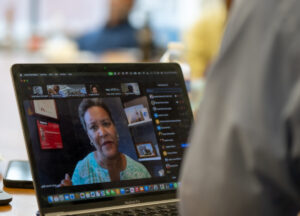 Leslie Harris (pictured), history professor at Northwestern University, “stressed that backlash has followed every era of progress, criticized Democrats’ cautious centrism and failure to deliver material gains, and argued that apathy — not just Trump’s base — is the biggest threat, while insisting that ‘freedom’ is still being defined and requires Black political ideas and engagement. [55:11] [55:25] [55:48] [56:17] [56:34] [57:14] [57:31] [57:56] [58:10] [58:23] [59:01] [59:20] [59:45] [59:57] [1:00:09] [1:00:22]
“Multiple speakers emphasized journalism’s central role in democracy but described it as “wounded” by billionaire ownership, collapsing local news, fragmented audiences, social media algorithms, and AI “slop,” calling for new forms of media literacy, nonprofit news, and platform-savvy storytelling to reach especially young audiences. [1:22:12] [1:22:55] [1:23:33] [1:23:36] [1:23:50] [1:24:10] [1:24:21] [1:24:32] [1:24:46] [1:25:13] [1:25:35] [1:26:13] [1:26:29] [1:26:50] [1:26:55] [1:27:04] [1:27:10] [1:27:34] [1:27:58] [1:28:14] [1:28:41] [1:28:57] [1:29:16] [1:29:36] [1:29:57]68avg, Ajq1ZA, AbuTnA, Ac9x0w, ALHQCw, AMQuQg, AEYMeg, CEqlpA, D7pD2w, B1LiEw, D0EASg, Blgegg, BeT8uQ, BWFa8Q, BPS5KA, BGuXYA]
“Participants underscored Black women as the ‘load‑bearing beam’ of U.S. democracy, noting their historic and ongoing leadership in movements and elections, even as prominent Black women like Ketanji Brown Jackson and Michelle Obama (video) face relentless public attacks. [1:43:36] [1:43:57] [1:44:26] [1:44:49] [1:45:03] [1:45:09] [1:45:20] [1:45:48] [1:46:00] [1:46:12] [1:46:14] [1:46:46]
“International voices argued that U.S. credibility abroad has collapsed, that other regions are forming new alliances without the U.S., and that Trump’s presidency has exposed the ‘belly of the beast,’ forcing Americans and the world to confront the depth of U.S. racism and power decline.” [1:52:05] [1:52:46] [1:52:52] [1:53:16] [1:53:40] [1:54:15] [1:54:39] [1:55:09] [1:55:30] [1:55:52] [1:56:10] [1:56:36] [1:57:06] [1:57:09] [1:57:23] [1:57:36]
Artificial intelligence contributed to this report.
‘A Quiet Force Shaping Conversations on Race and Media’
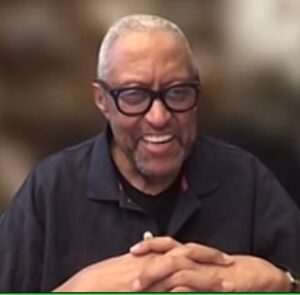 “In an era when the media industry is under constant scrutiny for how it represents race, equity, and truth, few spaces have proven as enduring — or as discreetly influential — as the Journal-isms Roundtable,” Gregg Morris (pictured, by Don Baker/Don Baker photography), posted on his thewordreview.com site, on Medium and on LinkedIn this week.
Morris is a Roundtable regular, professor, writer, journalist and author.
“Operated by veteran journalist Richard Prince (pictured below, by Bonita Bing), the Roundtable has, for more than two decades, served as a unique forum where journalists gather not simply to network, but to wrestle with the most pressing and uncomfortable questions facing their profession.
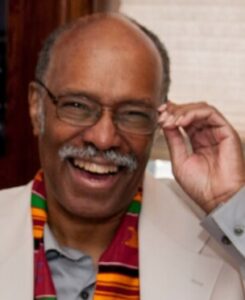 “What distinguishes Prince’s Journal-isms Roundtable is not its intentional informality paired with intellectual rigor, but it’s being a unique meeting place/platform of collegiality for scholars, journalists, man-woman-in-the-street, numerous other niches. Usually saying diversity implies or identifies or narrows down as ‘ethnic’ which is good but …
“Initially held as monthly gatherings in Washington, D.C. the Roundables are all now on ZOOM, giving a national and sometimes international conversation, and conducted as hybrids ‘HYBRIDS,” MEETING ON ZOOM AS WELL AS IN PERSON).
“Yet beneath their convivial atmosphere lies a serious purpose. Participants — who most often include reporters, editors, academics, media executives, and students— come prepared to discuss topics that are as urgent as they are complex: Racial bias in reporting, the lack of diversity in newsroom leadership, inequities in coverage, and the ethical dilemmas that arise when telling stories about marginalized communities. . . .”
Asked what prompted him to write the piece, Morris replied, “It has to do [with] what I felt and what other participants felt, that it was unique. And it was like this amazing discovery that needed to be shared. Roundtable is unique in the way it addresses diversity with an approach and methodology existential in breadth, dynamics, universality and, especially, collegiality. Participants are from around the globe. It felt to me that in these times with all the menacing and sinister isms that seemed at play, I and others had known something. I shared it. I’m dealing with a gut feeling that is a bit difficult to express.”
- Perry Bacon Jr., New Republic: What Today’s Media Can Learn From the Civil Rights–Era Black Press
- Susie Banikarim, Columbia Journalism Review: ‘America Knows Less About Itself at the Very Moment It Needs to Know the Truth’: While communities of color are under attack, Black journalists lose ground. Still, Black media-makers are expanding our thinking. And there’s a Black Crossword.
- Nathalie Baptiste, HuffPost: Trump Is Completely Rewriting Black History — With Devastating Consequences
- Meredith Berger and Rachel Moran, Brennan Center for Justice: News Deserts Leave Voters Vulnerable to Election Misinformation
- Hayes Brown, MS NOW: The White House UFC fight is a grand pageant for an 80-year-old boy king
- LaTosha Brown, The Root: Where the Truth Lives for Black America When the Mainstream Media Stays Silent (June 4)
- Susan Montoya Bryan, Associated Press: Native Americans mark the US 250th with pride, pain and patriotism
- Cary Clack, San Antonio Express-News: Democracy needs another ‘Greatest Generation’ to save it
- Ta-Nehisi Coates, Vanity Fair: Did Kamala Harris’s Silence on Gaza Cost Her the White House?
- Jonathan Edwards, Smithsonian: With Smithsonian under scrutiny, its leader curates a complex history show (May 29)
- Eddie Glaude Jr, A Native Son: Weekly Wrap Up – June 19, 2026
- Cindy Krischer Goodman, South Florida SunSentinel: ‘Bad policy costs lives.’ Medical professionals urged to improve Black patient outcomes — by voting
- Greg Johnson, Philadelphia Inquirer: Juneteenth wasn’t the end of slavery in America. Here’s what history left out.
- Roy S. Johnson, al.com: Shhh. Don’t tell Trump it’s Juneteenth
- Katie Johnston, Boston Globe: A white mob chased Black Bostonians celebrating the abolition of slavery in the early 1800s
- Ja’han Jones, MS NOW: New documentary spotlights boxing match that stunned Nazi Germany
- Colbert King: The presence of disgusting and vulgar mixed-martial artist Hokit on White House grounds only added to the national disgrace that Trump inflicted on America Sunday night. (June 15) Facebook X.com
- Jill Lepore, Liveright Books, “We the People”
- Angelo Lopez: A Cartoon on Loving America on its 250th Anniversary (June 12)
- Morgan Global Journalism Review: America at 250: A Black Retrospective
- Tonya Mosley with Eddie Glaude, “Fresh Air,” NPR: As the U.S. turns 250, this historian has blunt
advice: ‘America has to grow up’
- Abby Patkin, Boston.com: New Suffolk poll: Mass. is still on the right track. The U.S.? Not so much.
- Daniel Pearson, Philadelphia Inquirer: Shining the spotlight on America’s Black Revolutionary Era icons | Shackamaxon
- Robin Pogrebin, New York Times: Curating in the Cross Hairs: Is This the Smithsonian Chief’s Last Show? Lonnie G. Bunch III, the Smithsonian secretary under pressure from the White House, organized an exhibit exploring America’s founding ideals. (May 28)
- Publishers Weekly: .A Second Sight: How the Wonder and Vision of Black Mediamakers Push America Toward Freedom by Sarah J. Jackson (review)
- Reveal: We Get It. You Don’t Trust Us. A majority of Americans say they don’t trust the news media. But what if people are wrong about what’s really wrong with journalism? (June 6) (podcast)
- Heather Richards, E&E News by Politico: Judge blocks Trump national park history purge
- Howard Smead, Oxford University Press: Blood Justice: The Lynching of Mack Charles Parker (1988)
- Claire Thornton, Boston Globe: Only 13 percent of young people say US on right track: Harvard poll (April 24)
- Xintian Tina Wang, objectivejournalism.org: Journalism is increasingly pushing reporters of color out of the industry (June 4)
- Judy Woodruff and Frank Carlson, “PBS News Hour”: America’s 250th anniversary revives questions about religion and the founders
