

‘Certain White Males . . . Had to Do Less Work’
Indigenous Journalists Come and Get Their Love
Byron Allen’s New Properties to Lay Off 180 Staffers
Fewer Young Cubans Want to Be Journalists
Short Takes: Israeli drone strikes and journalists; freedom of expression in Central America; threats to journalists in Democratic Republic of Congo.
Homepage photo credit: Ojinika Obiekwe/ Instagram
‘Certain White Males . . . Had to Do Less Work’
“A federal jury has awarded former PIX11 reporter Ojinika Obiekwe $2.4 million after finding that the New York television station and its parent company, Nexstar Media Group, unlawfully retaliated against her after she complained about racial discrimination in the workplace,” Toria Sheffield reported Saturday for People.
 “The verdict, reached following a federal trial, includes approximately $1.14 million in compensatory damages and $1.28 million in punitive damages, according to a news release issued by the legal firm that represented Obiekwe in the case.
According to the complaint, filed in the United States District Court for the Southern District of New York in January 2025, “Prior to her unlawful termination, Ms. Obiekwe had spent her entire professional
career at PIX11, starting as an intern and working there for 22 years. Ms. Obiekwe considered
PIX11 her professional home.
“Over time, however, PIX11 began taking advantage of her. As the years progressed, Ms. Obiekwe had to do the work of two or even three people. Ms. Obiekwe, a Black woman, became acutely aware that certain white male peers with her same position had to do less work and were receiving more and better staffing support in the workplace.”
After a trial, a federal jury found that PIX11, formally WPIX, and Nexstar unlawfully retaliated against Ms. Obiekwe after she complained about race discrimination and awarded her $2.4 million in damages, including $1.137 million in compensatory damages and $1.28 million in punitive damages.
“I feel great! I’m grateful to God … I thank God for leading me to my lawyers because there’s no way I could’ve done this without them,” Obiekwe told Carlos Greer, writing Wednesday for Page Six.
“ ‘They believed in me. They believed my story. They knew I wasn’t lying. They just trusted me and then guided me and here we are: victory,’ she added, followed by a cacophonous chuckle that screamed ‘Vindication!’ ”
Dancer Kellen Trenal (Nez Perce and Black) performs to “Come and Get Your Love,” the 1974 hit for the Indigenous and Mexican American group Redbone, at the Indigenous Media Awards Banquet on Friday. The banquet closed the Indigenous Media Conference in Portland, Ore. (Credit: Brian Bull) Longer version of the dance here (Credit: Rachel Jones)
If no image is visible, please consider changing browsers.
Indigenous Journalists Come and Get Their Love
The Indigenous Journalists Association established a Pacific Islander component at its annual convention on Friday, expanding the international ties envisioned when it voted in 2023 to change its name from the Native American Journalists Association. But it was a fast-moving dance performance at the closing banquet, set to a chart-topper from the 1970s, that captured the imaginations of many.
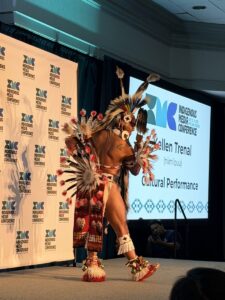 Kellen Trenal (pronounced like “Chanel”) a visual artist, performer, small business owner, alumnus of the University of Notre Dame and holistic wellness enthusiast, born and raised in the Pacific Northwest, included a dance to “Come and Get Your Love,” the 1974 hit for the Indigenous and Mexican American group Redbone, as a crowd-pleasing part of his repertoire. (Photo credit: IJA)
“Being both Black American and niimíipuu, Nez Perce, Trenal embraces his multiple identities to empower his work in all its manifestations. He shares his (he)artwork through Trenal Original, a traditional-arts based, QBIPOC [Queer, Black, Indigenous and People of Color]-owned, small business. Each piece is a custom creation aimed at increasing visibility for historically excluded communities,” says his promotional material.
“People of the West,” a 10-part docudrama that presents California’s history from an Indigenous perspective, spanning from creation stories to the present day, was featured in a screening and Q&A session at the Indigenous Journalists Association conference. (Credit: YouTube)
Cultural and historical representations are always a part of this particular gathering, and the vehicles for those include film. This year’s conference, which at one point had drawn 470 people, a record, to Portland, Ore., featured a preview of “People of the West Docudrama: California’s True History, Told Through Indigenous Voices, “Hula” (video), about keeping alive the tradition of male hula dancers, and “Murder in Big Horn” (video), about murdered and missing Indigenous people, a topic that earned Chelsea Curtis (Diné), the organization’s Richard Lacourse Award for Inestigative Journalism.
The bread-and-butter of the conference, however, was skills building, information sharing, amplifying the Indigenous voice and self-affirmation. A forthcoming book, “Storytelling Sovereignty: Indigenous Peoples and the Media,” by Cristina Azocar, Ph.D., and Meta G. Carstarphen, Ph.D., was the subject of a panel discussion featuring such veterans as Mark Trahant, Brian Bull and Meta G. Carstarphen, Ph.D., and Melissa Gene-Blye.
The partnership with journalists from Oceania is part of the effort to expand the Indigenous voice.
“The Pacific has never lacked powerful storytellers,” said Thomas Mangloña II, editor-in-chief of Marianas Press and a co-founder of the Pacific Islander Journalism Network, which uses the acronymn PIJN. “For a long time, Pacific journalists in the US have sought a professional network that recognizes the unique communities we come from and we serve. This is our approach to making this happen. . . .
“PIJN’s founding members represent Polynesia, Micronesia, and Melanesia and work across journalism, news media, and academia. [The] acronym is inspired by the pidgin languages of Oceania, including Tok Pisin, Bislama, Pijin, and Hawaiʻi Pidgin, which have long connected diverse Pacific peoples across cultures and islands.”
In April, three Indigenous Journalists Association represented IJA at the 25th session of the United Nations Permanent Forum on Indigenous Issues (UNPFII) in New York, with two IJA members — Dionne Phillips (video) (Xats̓úll First Nation) and Cheyenne McNeill (Coharie Tribe) — delivering “interventions.”
In November, several board members attended the Global Investigative Journalism Conference in Kuala Lumpur, Malaysia. More than 1,500 people from in excess of 135 countries and territories were present.
There is more on the horizon: Angel Ellis (Muscogee Nation), IJA vice president, says she is pressing forward wth press freedom issues and that the number of tribes adopting such protections is paltry, as reported in this space last year. She also is working on a code of ethics for Indigenous journalists, specifically tailored to their circumstances.
Northwestern University’s Medill School of Journalism, Media, Integrated Marketing Communications, already a conference sponsor, is expanding its relationship with the organization.
And an oral history project is underway, according to board member Greene-Blye, of the Miami Tribe of Oklahoma. It is to launch this year, with an inaugural interview with Shannon Shaw Duty, Osage Nation, winner of this year’s Minnie Two Shoes Award for Excellence in Tribal Media, as well as the IJA-Medille Milestone Achivemeent Award.
Shaw Duty captured the spirit of the conference in her acceptance speech. “I am still excited to wake up and tell the stories of my people,” she said.
- Elizabeth Blair, NPR: 50 years ago, ‘Come and Get Your Love’ put Native culture on the bandstand (April 16, 2024)
- Native America Calling: Tribal leaders condemn Trump’s downsizing of Utah national monuments
- Corey Williams, Associated Press: Black members of Oklahoma Native American tribe file federal lawsuit to gain citizenship rights
Byron Allen, founder, chair and CEO of Allen Media Group, discusses his plans to turn BuzzFeed into a free-TV super app. Speaking in May with Romaine Bostick on “Bloomberg The Close,” Allen also comments on taking over Stephen Colbert’s “Late Show” time slot.
Byron Allen’s New Properties to Lay Off 180 Staffers
“In the first major restructuring move of Byron Allen‘s ownership tenure, BuzzFeed, HuffPost and Tasty are set to undergo a significant round of layoffs, with some 180 staffers to be given pink slips, The Hollywood Reporter has learned,” Erik Hayden reported Monday for the Hollywood Reporter. “BuzzFeed, across all its units, had approximately 510 employees prior to the cuts.
“ ‘Today we are making important changes to BuzzFeed that are required to put our business on a path to profitable and sustainable growth,’ read a memo from the company’s leadership to employees on Monday. ‘Four months ago, in our March earnings call we stated a substantial doubt about the company’s ability to continue as a going concern. Fortunately after that public announcement, Byron Allen quickly stepped in and made an investment of approximately 26 million dollars into BuzzFeed to stabilize, protect, and grow the company.’
“In a $120 million agreement unveiled in May, Allen took a 52 percent majority stake in the company as well as the CEO role from founder Jonah Peretti, funded by $20 million in cash and $100 million in the form of a promissory note due five years after deal close.
“The move was alternately characterized as either a lifeline to the Millennial media company or a decision of last resort given BuzzFeed’s cash crunch as a publicly traded firm. In its latest quarter, BuzzFeed reported a nearly 20 percent decline in advertising revenue year-over-year. The company’s net loss for the quarter was $15.1 million, up from $12.5 million last year. BuzzFeed is set to report its next earnings disclosure on August 4. . . . ”

Cubadebate is the Cuban regime’s main news portal. (Credit: Cubadebate)
Fewer Young Cubans Want to Be Journalists
‘The 6th plenary session of the National Committee of the Union of Journalists of Cuba (UPEC), held on Tuesday by videoconference, openly acknowledged that fewer and fewer Cuban youth want to study Journalism, while the regime insists on ‘falling in love’ with the few graduates to defend ‘the truth of the Revolution,’ CiberCuba reported.
“In 2025, only two eleventh-grade students took the aptitude exam at the Manuel Ascunce Domenech headquarters of the University of Ciego de Ávila. In addition, only 49% of those enrolled manage to graduate; most abandon for economic reasons,” the story continued.
“Why are there so few young people interested in studying journalism in Cuba?” the publication asked.
“Low tuition in journalism is due to several factors, including low salary in state media, which offers less than 10 dollars a month, and the imposition of compulsory military service for women, a requirement that does not apply to other careers. In addition, the work environment is seen as unattractive due to censorship and lack of freedom of the press.”
- Rick Jervis, USA Today: He smuggled secret audio out of a Cuban jail. Now he’s free and talking
Short Takes
🔵 Israeli Drone Strike Wounds 10 Outside Al-Aqsa Martyrs Hospital
An Israeli drone struck a group of Palestinians near the gate of Al-Aqsa Martyrs Hospital in Deir al-Balah, central Gaza, wounding 10 people. The strike occurred next to a public workspace where journalists were… https://t.co/1jxzQcnNAd pic.twitter.com/DebqNzusjb
— Drop Site (@DropSiteNews) July 25, 2026
If no image appears, please consider changing browsers.
- “Threats against freedom of expression in Central America became a regional pattern in the past year,” Massiell Long Sword reported Tuesday for the Universal de Costa Rica’s (UCR) Program for Freedom of Expression and the Right to Information.” The report “documents “an increase in persecution against journalists, smear campaigns, restrictions on reporting and the exile of communicators. Unlike the first editions of the study, these pressures are no longer concentrated only in the countries with the highest levels of authoritarianism such as Nicaragua, but reach, with different intensity, El Salvador, Guatemala, Honduras and Costa Rica. . . .”
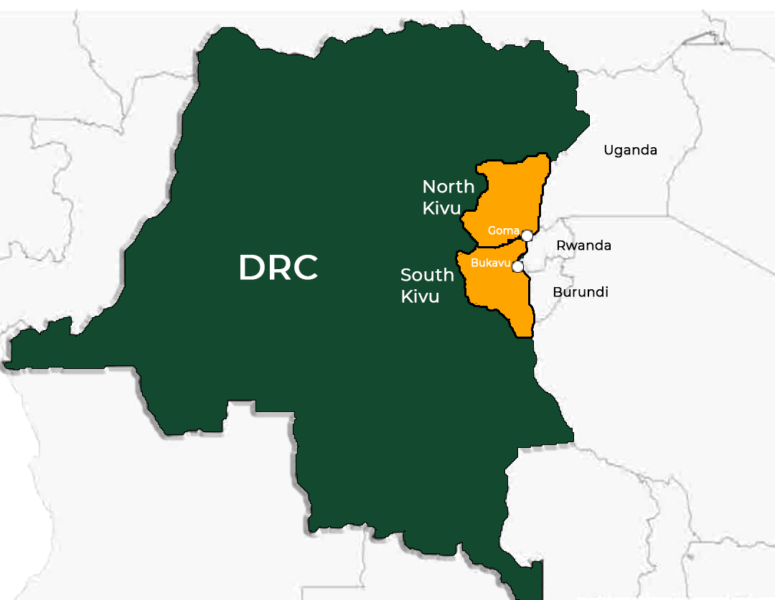
In the Democratic Republic of Congo, the Mouvement du 23 Mars (M23) rebel group has expanded its control over territory in North Kivu and South Kivu provinces, capturing strategic cities including Goma and Bukavu, and the respective provincial capitals. (Credit: amaniafrica-et.org)
- “Government-allied Wazalendo militiamen have threatened to kill or capture one reporter and to burn down another’s radio station because of unfavorable coverage, as frontlines shift under diplomatic pressure for peace in eastern Democratic Republic of the Congo,” the Committee to Protect Journalists reported July 17. “The Rwanda-backed M23 and Congo River Alliance (AFC) rebels — who made unprecedented territorial gains in early 2025 — withdrew from several parts of South Kivu province in May, after the United States sanctioned DRC’s former President Joseph Kabila and the Rwandan army. The U.S. alleged that Kabila and neighboring Rwanda were supporting the rebel alliance in violation of December’s faltering peace agreement to end the decades-old conflict — a move Rwanda condemned as one-sided. For journalists on the ground, the shifting frontlines have increased the risks they face reporting on intense clashes and drone strikes in civilian areas. None of the myriad warring parties are comfortable with the press reporting freely on their activities. Many journalists have fled eastern DRC, while those who remain face threats from both sides. . . .”

