

Questions Over Vibe, Rolling Stone Partnership:
Some Worry About ‘Erasure’ of Black Identity
Inadequate Support for Journos Covering Tragedy
Short Takes: Reporting slows stops of Black drivers; Bay Area end of access to police radios; no Blacks identified in Washington Post Intelligence”; Hollis Towns and Deep South investigative network; Manny Garcia; “Mapping Black California,”; NABJ urges members to send videos; NBC coworkers’ farewell to Omnika Thompson;
Quintard Taylor of BlackPast.org; California’s ethnic studies requirement; NewsOne partnership with Howard U. j-students; Candace Owens; Albert Rodriguez of MediaCo; Fresno anchor Monty Torres; Sara Sidner; CJR’s Betsy Morais; Minnesota’s Harry Colbert Jr. book on Britain’s Black journalists; drone killing of Sudanese journalist; South African’s call for jailing journalists
Homepage images: Penske Media Group.

“VIBE and Rolling Stone are actively looking to fill positions, including a new head of the VIBE brand, a video/podcast host and an events producer,” Billboard reported.
Some Worry About ‘Erasure’ of Black Identity
Vibe, the magazine that helped document the rise of the hip-hop era in the ‘90s, and Rolling Stone, which did the same for rock in the ‘60s, are joining forces, the parent company of both announced Thursday.
Not everyone is happy about that.
“VIBE ‘will bolster Rolling Stone‘s hip-hop coverage and allow the brand to go deeper in the genre,” Heran Mamo reported Thursday for Billboard, the music industry magazine which, like Rolling Stone and Vibe, is owned by the globally based Penske Media Group.
“VIBE will also print special collector’s editions of the magazine and launch a new interview series that spotlights in-depth conversations with the most important figures, ranging from musicians to superstar athletes and fashion icons.”
Julian Holguin, CEO of Rolling Stone, said in the story, “We are thrilled to announce that VIBE is joining forces with Rolling Stone. This historic team-up will enable Rolling Stone to level up the publication’s hip-hop and R&B coverage, allowing RS to dive deeper into the culture.
“As part of this move, Rolling Stone will invest in VIBE across video, podcasts, long-form journalism, social media and experiential opportunities – all areas where Rolling Stone is a market leader. VIBE will continue to power cultural conversations and reestablish itself as a driving force for commentary and reporting. Our goal is to continue the mission VIBE was founded on while leveraging Rolling Stone to amplify its presence across all platforms.”
 Some observers, such as longtime magazine industry analyst Samir Husni (pictured), known as Mr. Magazine, approved of the move. “I think it is [a] good thing, unifying the audiences of music magazines,” he messaged Journal-isms. “By merging with RS , music [will] have one large unified audience who enjoys all kinds of music.”
Rolling Stone’s circulation for the six months ending June 30 stood at 426,114, according to the Association of Audited Media. Vibe’s was not recorded, as it is not a member of the association, but it is no doubt smaller.
To other observers, the partnership represents erasure. “Is this media gentrification? Do Black voices really need this audience that Rolling Stone is offering?” asked Loren LoRosa, Friday on the influential “The Breakfast Club” podcast. She was co-hosting as senior news producer.
“Why can’t we gatekeep what’s ours, and it still be just as big, and as effective and as golden?” she asked.
Likewise, the website Feminegra wrote, “By the time headlines circulated, staffers at VIBE had already begun posting their layoff announcements. Most were Black. Some had spent years documenting the culture the merger claims to elevate. Mya Abraham, formerly R&B Reporter at VIBE, wrote, ‘It’s been the joy and honor of my life to document R&B in this capacity.’ Her message joined a growing number of personal statements that spread rapidly across social media.
“The industry didn’t just watch the merger unfold. It witnessed the quiet erasure of voices that built the foundation.”
Due to VIBE/Rolling Stone merger my position was eliminated and I was laid off. Thankful for the past 4 years of writing+ reporting. lf you have leads for roles in media, journalism, or anything editorial please send my way. Thanks in advance for any kind words.
— micia (@DeMiciaValon) October 16, 2025
If no image shows, please consider changing browsers.
 Billboard added that Datwon Thomas (pictured), a former longtime Vibe editor-in-chief, is being brought in as strategic adviser “to help with the transition.“
Thomas wrote on social media, “Looking forward to helping usher VIBE through the transition period of merging with Rolling Stone. While so many look at this as an odd pairing, I’m looking at it as a way to fuel VIBE’s legacy status and assist in bringing it to its rightful position as a leader in urban culture content.”
Vibe was founded in 1992 by the legendary impresario Quincy Jones and Time Warner, with a focus on hip-hop and R&B music and the culture surrounding it. It became one of the most influential publications of its kind, as the New York Times would report when the title was sold in 2013.
“Presenting a glossy and urbane view of urban culture, Vibe Magazine became a preeminent site for journalists and scholars chronicling contemporary black popular culture,” author, professor and cultural critic Mark Anthony Neal wrote in 2009, when the magazine folded, later to return as an online-only product.
It no longer holds the pre-eminent position it had in the ‘90s.
On Oct. 1, the website feedspot.com ranked the “15 Best Hip Hop Music Magazines you should follow in 2025.” The list was topped by the newer publications Clash, Hype off Life and Global Money World, with Vibe lagging at No 13.
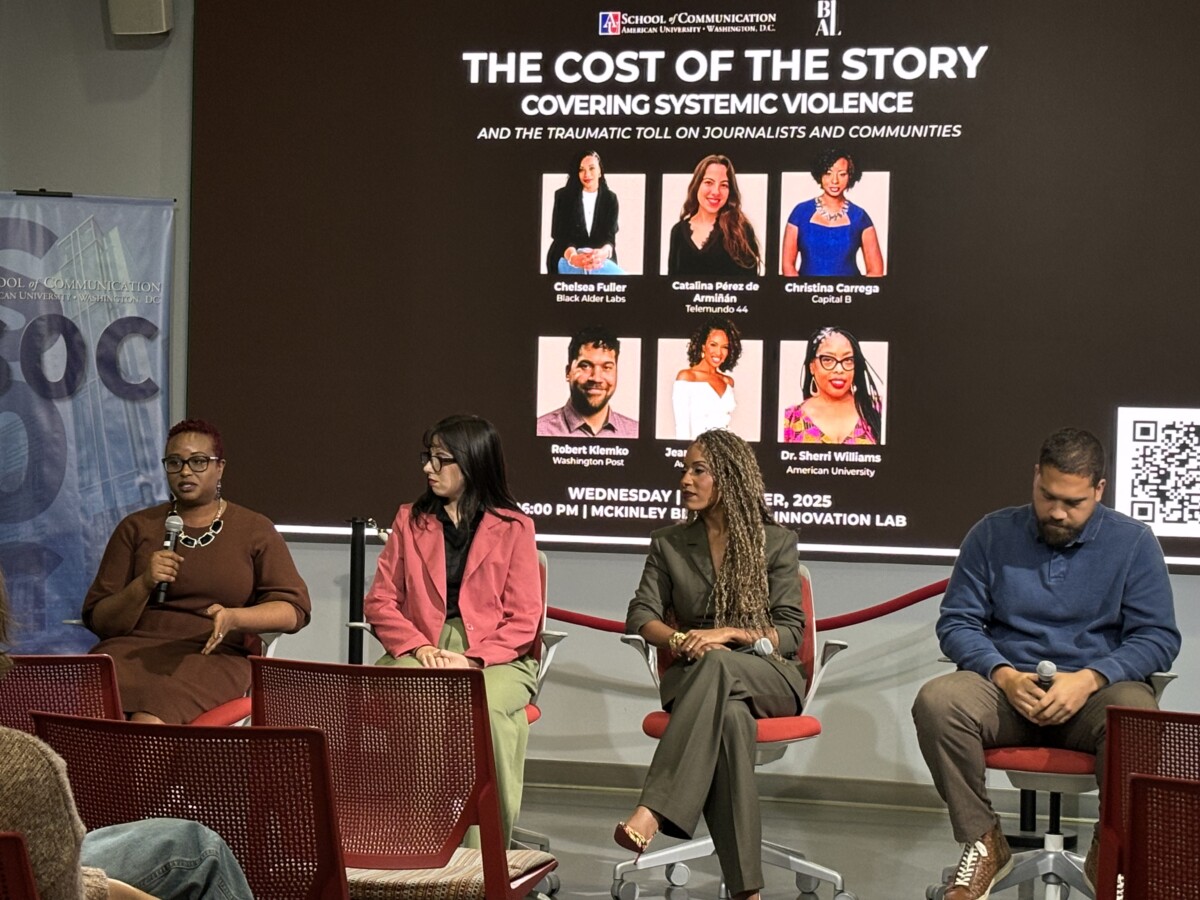
Christina Carrega, national criminal justice reporter at Capital B, left, says it took years before an editor inquired about her mental health after covering traumatic stories. Jeannette Reyes of Awf the Record, a former television reporter, third from left, told of the emotion that viewers saw after she covered two babies being shot. She was counseled to see a therapist. They joined fellow panelists Robert Klemko of the Washington Post, at right, and Catalina Pérez de Armiñán of Noticias Telemundo 44/NBC 4 in Washington, second from left, in discussing “The Cost of the Story: Covering Systemic Violence and the Traumatic Toll on Journalists and Communities” Wednesday at American University. (Credit: Richard Prince)
Inadequate Support for Journos Covering Tragedy
Journalists, particularly those of color, have long discussed the emotional cost of covering tragedy, especially involving people who look like them.
The journalists-of -color organizations have created such programs as “NABJ C.A.R.E.S.” at the National Association of Black Journalists and one on mental wellness at the Asian American Journalists Association.
For years, the Dart Center for Journalism and Trauma offered journalists advice, first at the University of Washington, then, until last summer, at Columbia Journalism School. It is now the independent Global Center for Journalism and Trauma.
Still, none of that is sufficient, according to “The Cost Of The Story: Covering Systemic Violence and the Traumatic Toll on Journalists and Communities,” a new, 52-page report discussed Wednesday at American University in Washington.
“Findings show that journalists, especially Black and Brown journalists, are frequently exposed to traumatic events with little to no institutional support, the report says. “At the same time, communities are often retraumatized by extractive or inaccurate coverage. While journalists report high levels of stress and anxiety, most have never accessed professional mental health care. Communities, in turn, are left to manage the ripple effects of how their stories are told and circulated.
“The report urges a shift toward trauma-informed journalism that centers care, consent, and accountability. It outlines concrete recommendations for newsrooms, journalism schools, and funders, calling for a future where both journalists and communities are protected, resourced, and treated with dignity.”
The study is said to be the first comprehensive examination of how the reporting of traumatic events affects journalists of color. It was developed by the organization Black Alder Labs with support from the Racial Equity in Journalism Fund at Borealis Philanthropy, and in collaboration with American University’s School of Communication and West Virginia University’s College of Creative Arts and Media.
Short Takes
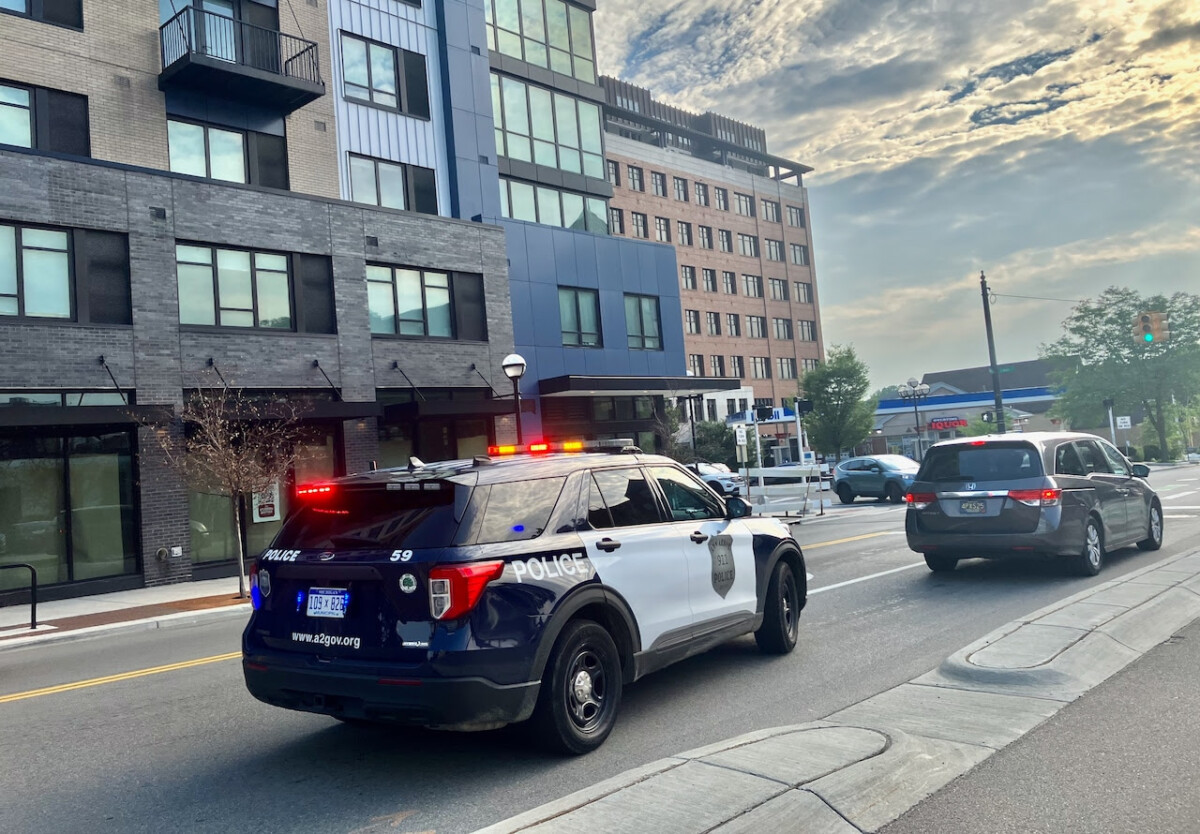
An Ann Arbor, Mich., police officer stops a driver downtown on July 13. The traffic stop was for disregarding a traffic control device. The driver was given a warning, police said. (Credit: Ryan Stanton/Ann Arbor News)
- “Ann Arbor passed rules to reduce traffic stops of minority drivers, a step toward equity,” John Hiner, president of MLive Media Group, told readers of his MLive email blast on Thursday. “But when reporters Jordyn Pair and Ryan Stanton checked the data, what they found was startling: stops of Black drivers actually increased. Police exploited a loophole allowing multiple equipment violations per stop. The policy changed, but policing hadn’t. After MLive’s reporting, the loophole was closed. Early data shows just 10 equipment stops since, and only three involving Black drivers.”
- “After weeks of technical hiccups, nearly every law enforcement agency across the East Bay has now silenced their police radios,” to the public, Jakob Rodgers reported Friday for California’s Bay Area News Group. “Before sunrise Wednesday, all but one Alameda County agency pulled public access to communications between officers and dispatchers, completing a region-wide shift toward secrecy that has prompted alarm among police accountability and First Amendment advocates. And in a surprise move, the lone holdout — the Berkeley Police Department — may soon join them. . . .”
 Less than three weeks after the National Association of Black Journalists met with leadership at the Washington Post to raise “urgent concerns about the environment” for Black journalists there, the Post Monday published an announcement touting the Washington Post Intelligence Councils, filling five pages in the print edition and featuring 45 people. It appeared to include not one Black person. Members of the invitation-only councils are described as “senior executives who want to engage in industry-shaping discussion and high-level networking.” The fields covered are energy and climate, global security and AI and tech. Post spokespeople did not respond to a request for comment.
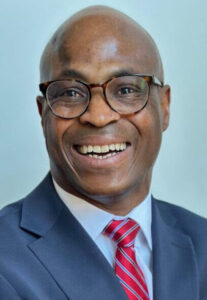 Deep South Today, a nonprofit network of local newsrooms that includes Mississippi Today, Verite News in New Orleans and The Current in Lafayette, La., announced Tuesday that it will create a new regional investigative reporting center in collaboration with The New York Times’s Local Investigations Fellowship. On Monday, Hollis R. Towns (pictured), who most recently held senior leadership positions at Gannett, AL.com and Alabama Media Group, was named its first chief operating officer.
 Veteran editor Manny Garcia (pictured) will lead the Lee Caplin School of Journalism & Media at Florida International University, the John S. and James L. Knight Foundation announced Tuesday. Garcia is to be the inaugural Knight Foundation executive director “This new leadership role is designed to shape the school’s long-term vision, academic strategy, and external partnerships – bringing bold, innovative direction to journalism education at FIU,” the announcement said. Garcia most recently was editor in chief of the Houston Landing, executive editor of the Austin (Texas) American-Statesman and senior editor at ProPublica.
 Candice Mays (at left, with Project Manager Alex Reed), a 2025-26 member of the latest John S. Knight Journalism Fellowship class at Stanford University, is part of the trio behind “Mapping Black California,” Tandy Lau reported Oct.10 for Editor & Publisher. “The data visualization project recently turned a decade old. It has “explored how cities spend their money on policing, where money goes in racial equity funding and what historically led to certain California beaches to become segregated. Their projects can be found online at MappingBlackCA.com.”
 “Although we’ve had to postpone our in-person gala,” Rod Carter, chair of the National Association of Black Journalists’ 50th Anniversary Committee, wrote members Monday, “we’re keeping the celebration alive with a virtual Founders’ Day event on December 12.” That’s “so that everyone can take part in honoring this historic milestone — no matter where you are. We’re inviting members to submit a short 50-second video sharing what NABJ means to you and offering your congratulations to the organization on this incredible 50-year journey. . . .Your video will be featured during our virtual celebration and/or shared across NABJ’s social media platforms as part of our 50th Anniversary tribute.” NABJ members should look for official email from the association to find out how to submit.
- “I recently had the honor of serving as interim Executive Producer of Top Story with Tom Llamas,” NBC’s Omnika Thompson wrote on LinkedIn. “It was amazing to lean into my Executive Producer roots with such a wonderful team. . . . And yes — being the creative, stealthy producers they are — the team managed to surprise me on my last day on the show with a sweet on-air moment!” (click LinkedIn post to view)
 Quintard Taylor (pictured) died Sept. 21 “after devoting his life to teaching history and educating people across the globe about Black history, particularly the history of the American West,” Angela King reported Oct. 3 for KUOW radio in Seattle. He was 76. No cause of death was reported. Taylor’s work included books such as “In Search of the Racial Frontier: African Americans in the American West 1528-1990,” which was nominated for a Pulitzer Prize. In 2004, Taylor informally began BlackPast.org as an extension of his faculty website at the University of Washington in Seattle. In 2023, the site had 6.5 million visitors and more than 1,000 contributors that include historians and academics from six continents who have written 7,200 entries. The Seattle Times editorialized Wednesday, “National scholar Quintard Taylor transformed study of Black history.”
- ”California’s plan to roll out ethnic studies at every high school this fall hit a snag when lawmakers left implementation money out of the state budget — but districts across Orange County are largely pushing ahead on their own,” Hannah King reported Thursday for the Orange County Register. “State law says high school students need to complete an ethnic studies course to graduate, starting with the class of 2030.”
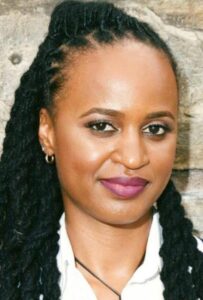 “I am proud to announce the launch of the Bison ONE Newsroom, NewsOne’s exclusive partnership with student journalists under the tutelage of renowned, award-winning journalist, author, and professor Dr. Stacey Patton (pictured) at Howard University’s Cathy Hughes School of Communications, named for the Founder & Chairperson of Urban One, NewsOne’s parent company and the largest Black-owned media company in the United States,” Kirsten West Savali wrote Monday for NewsOne. “Expanding on our iONE Digital NewsOne x Bison 2024 Election coverage, the Bison ONE Newsroom is a groundbreaking, first-of-its-kind partnership between a national media corporation and an HBCU journalism program — a partnership that honors the power of HBCUs as incubators of cultural and political transformation. . . . “
- “Australia’s highest court on Wednesday rejected U.S. conservative commentator rejected U.S. conservative commentator Candace Owens’ bid to overturn an Australian government decision barring her from visiting the country,” Rod McGuirk reported Wednesday for the Associated Press. “Three High Court judges unanimously rejected Owens’ challenge to Home Affairs Minister Tony Burke’s decision in 2024 to refuse her a visa on character grounds. . . . “
 MediaCo President/CEO Albert Rodriguez (pictured) has been selected by the National Association of Hispanic Journalists for its 2025 Visionary Award, NAHJ announced Monday. ”The award recognizes individuals whose bold ideas, leadership, and lasting impact have helped shape the media industry and inspired generations of professionals to follow in their footsteps,” NAHJ said. Media Co. is a holding company that, it says, “serves multicultural audiences across the U.S. through a network of iconic brands — including Hot 97, WBLS, EstrellaTV, Estrella News, Que Buena Los Angeles, the Don Cheto Radio Network, and iconic Spanish-language radio brands in Dallas, Houston, Los Angeles, and New York.”
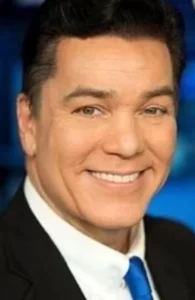 In Fresno, Calif., longtime FOX26 news anchor Monty Torres (pictured) has announced he is battling lung cancer, the station, officially KMPH, reported Tuesday. The lifelong nonsmoker “says he has been off-air for the past several weeks, seeing doctors and taking more tests to help determine the best. He expects to start his treatment plan in the next few weeks.Torres joined FOX26 News as the weeknight anchor for the ten o’clock news in 2006. . . . “
View this post on Instagram
If no image appears, please consider changing to a different browser.
- “If you’re a woman feeling alone on her journey with breast cancer, Sara Sidner wants you to know that you’re not alone,” Kay Wicker wrote Tuesday for TheGrio. “On Friday, World Mental Health Day, in a video posted to her Instagram, the 53-year-old ‘CNN News Central’ co-anchor opened up about the ‘profound’ sense of loneliness she’s been experiencing amid her breast cancer journey. . . .”
 “Columbia Journalism Review has promoted Betsy Morais CC ’11 (pictured) to Editor in Chief, effective November 1. Morais, who has been with CJR for more than seven years, most recently served as Acting Editor, guiding the publication through a period of ambitious reporting and in-depth analysis,” Columbia Journalism School announced Wednesday. She succeeds Sewell Chan, who left in April.
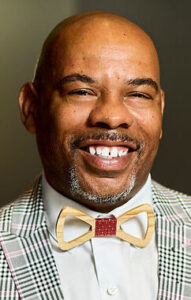 Harry Colbert Jr. (pictured), a former managing editor at MinnPost and editor-in-chief at North News, a grassroots publication in North Minneapolis, has been named vice president of the St Paul, Minn.-based Center for Broadcast Journalism. “Answering the urgent call to elevate, develop, and preserve independent Black media and its makers is among the top priorities for the organization,” the center’s Oct. 6 announcement said.
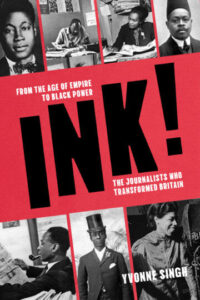 “Before social media, much less #BLM, journalists of colour were putting hot metal to paper to declare that Black lives matter,” begins a blurb for the new book “INK!: From the Age of Empire to Black Power, the Journalists who Transformed Britain,” by Yvonne Singh. It was published Thursday by Britain’s History Press. “Central to these newspapers were driven, often heroic, individuals passionate about the need to address global racial injustice and whose publications acted as a catalyst, raising the consciousness of Black and minority ethnic communities in the UK,” the blurb continued. The Guardian Thursday published an excerpt about “radical Jamaican journalist”… Claude McKay, “one of the few Black journalists” covering the turbulent 1920s, “a period that sounds all too familiar to us today.”
 “Al Nour Suleiman (pictured), the editor and presenter of El Fasher Radio in North Darfur, died of his injuries on 4 October, following a drone strike on his home one day earlier by the paramilitary group Rapid Support Forces (RSF),” the International Federation of Journalists said Tuesday. It joined its affiliate, the Sudanese Journalists’ Union (SJU), ”in condemning in the strongest possible terms this killing. They also call for a swift investigation to ensure the perpetrators of this heinous crime are brought to justice.” Regional Director Sara Qudah of the Committee to Protect Journalists said Oct. 7, “Sudanese authorities must swiftly investigate whether Alnor was targeted for his reporting and hold those responsible to account. Both warring parties must immediately stop attacking journalists and other civilians, and ensure reporters can work safely to cover the war.”
- ”After two months marked by six releases, the brief respite for journalists in Burkina Faso appears to have ended,” Reporters Without Borders said Monday. “According to RSF information, three men identifying themselves as members of the National Intelligence Agency (ANR) arrived at Le Pays headquarters, located in the 1,200 Logements district of Ouagadougou, around 9 a.m. They asked to see Michel Wendpouiré Nana, who was in an editorial meeting, and took him to an unknown destination. The ANR then repeated this scene at L’Observateur Paalga’s office. According to a statement issued by the newspaper, Ousséni Ilboudo ‘complied with the order and was immediately taken away in a van’ by ANR agents as he was about to lead a newsroom meeting. . . .”
- The Committee to Protect Journalists said Oct 10 it was “alarmed by KwaZulu-Natal provincial police commissioner Nhlanhla Mkhwanazi’s doubling down on his call for lawmakers to endorse the surveilling of journalists by South Africa’s State Security Agency and for reporters to be jailed for misinformation.”
